Relying on carrier liability isn't a logistics strategy; it's a gamble where the house always wins. When your high-value cargo hits a snag, those "per-kilo" liability rules often leave you with pennies on the dollar. It's a bureaucratic wall that stops your momentum cold. You need a shield that actually works. That's why all-risk cargo insurance has become the non-negotiable standard for the majority of global shippers in 2026. It's the only way to ensure your financial recovery matches your actual loss, not just a fraction of it.
We agree that insurance shouldn't feel like a chore or a mystery. You deserve a frictionless digital experience that provides total peace of mind for every shipment. This guide promises to help you master the gold standard of freight protection with our definitive checklist. We'll preview the critical ICC (A) clauses you need, identify the hidden exclusions that cause claim delays, and show you how to secure 110% valuation for your cargo. Let's turn your shipping protection from a complex headache into a high-speed competitive advantage.
Key Takeaways
- Stop settling for pennies on the dollar. Discover why carrier liability is a legal trap and how all-risk cargo insurance provides the full-value recovery you actually need.
- Move beyond the basics of standard coverage. Learn the critical differences between ICC (A), (B), and (C) clauses to ensure you aren't left paying for someone else’s maritime disasters.
- Master the "CIF + 10%" valuation rule. Use our checklist to protect not just your goods, but your shipping costs and anticipated profits as well.
- Ditch the bureaucratic paperwork. See how digital-first tools provide instant quotes and specialized protection for high-value tech and reefer products in seconds.
Why Carrier Liability is a Trap (And All-Risk is Your Escape)
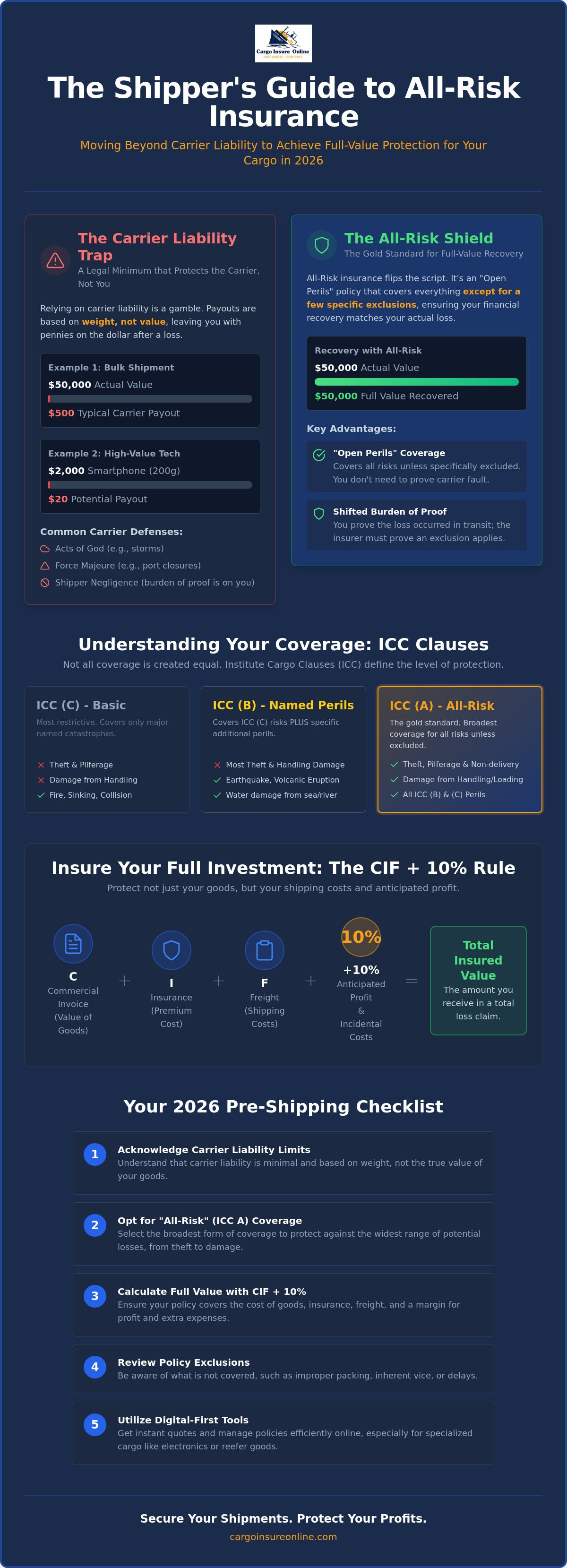
Carrier liability is not a safety net. It is a legal minimum designed to protect the carrier, not your bottom line. Many shippers learn this the hard way when a $50,000 shipment is damaged and the carrier offers a check for $500. This is the "Per-Kilo" trap. Under standard international conventions, carriers often pay based on the weight of the cargo rather than its actual value. Imagine shipping a high-end smartphone worth $2,000. If it weighs 200 grams, a carrier’s liability might max out at just $20. That is not recovery; it is a rounding error. It is a financial disaster waiting to happen.
Carriers also have a list of "get out of jail free" cards. They call them Acts of God or Force Majeure. If a storm hits or a port shuts down, the carrier can often walk away from the damage without paying a cent. You are left holding the bag. In the traditional world of freight, the burden of proof is on you. You have to prove they were negligent, which is a massive legal hurdle. Stop chasing carriers for crumbs. Secure all-risk cargo insurance to flip the script. It moves your business from a state of vulnerability to a position of absolute power.
The Hidden Limits of Carrier Liability
Freight contracts use Special Drawing Rights (SDRs) to cap what carriers owe. For sea freight, this is often as low as 2 SDRs per kilo. For air, it is typically 22 SDRs. These numbers haven't kept pace with the value of modern goods. When you look at the actual market value of your inventory, especially for something like electronics shipping insurance, the gap is terrifying. Proving negligence in a complex global supply chain is slow, expensive, and often impossible. You shouldn't have to be a detective to get paid for your lost goods.
The All-Risk Advantage in 2026
The history of Marine insurance shows a clear shift toward better protection. Today, all-risk cargo insurance is the ultimate "Open Perils" solution. Instead of a policy that only covers a few "Named Perils" like fire or sinking, all-risk covers everything except what is specifically excluded. It is a "negation-to-affirmation" shift. You don't have to prove the carrier messed up. You only have to prove the loss happened during transit. This is how you achieve frictionless global trade. It removes the friction of legal battles and replaces it with the speed of digital claims and full financial recovery.
The Anatomy of All-Risk: What is Actually Covered?
All-risk isn't a vague promise. It's a precise digital shield. While carrier liability looks for reasons to say "no," all-risk cargo insurance is built to say "yes." It operates on the logic of open perils. This means everything is covered unless the policy specifically names it as an exclusion. It transforms your risk profile from a list of "maybes" into a list of "absolutes." You aren't just buying a piece of paper; you're buying a frictionless path to recovery.
Theft and pilferage are the big players here, especially for high-value mobile phone shipping. Thieves don't wait for "negligence" to happen. They strike when you're most vulnerable. All-risk coverage steps in the moment your goods go missing. It also handles the #1 cause of supply chain friction: damage during loading and unloading. Forklift accidents and rough handling shouldn't end your profit margins. With a modern policy, these common headaches become simple, automated claims rather than long-term losses.
Then there is the strange reality of General Average. Imagine a ship caught in a massive storm. The captain decides to jettison containers to save the vessel. Under maritime law, every shipper on that boat shares the cost of those lost goods. It sounds like a nightmare because it is. If you don't have all-risk cargo insurance, you are legally obligated to pay for someone else’s loss before you can even claim your own cargo. The International Chamber of Commerce helps define these global standards, making all-risk the only logical choice for ocean freight. You can secure this protection in seconds with an instant cargo insurance quote that covers these catastrophic scenarios.
Specialized Coverage: Electronics and Reefer Goods
Modern trade requires more than just "basic" protection. If you're moving temperature-sensitive inventory, you need specialized reefer cargo insurance. A single power failure can ruin an entire shipment. All-risk policies for 2026 include "Concealed Damage" clauses. This is vital for electronics and drones. Sometimes the box looks perfect, but the tech inside is fried. All-risk ensures you're covered even when the damage isn't visible until the unboxing.
Standard Exclusions: What All-Risk Does NOT Cover
Insurance isn't magic; it's math. It won't cover "inherent vice," which is just a fancy way of saying your cargo destroyed itself. Think of rust on untreated steel or fruit that was already rotting. Improper packing is another deal-breaker. If you ship fragile glass in a thin cardboard box, the insurer will point the finger back at you. Finally, remember that "delay" is rarely covered. If a late ship costs you a sale, all-risk pays for the goods, but it won't pay for your lost time.
The "All-Risk" Comparison Framework
Choosing insurance shouldn't feel like a guessing game. It’s about precision. In 2026, the global supply chain moves too fast for "maybe." You need to understand the hierarchy of protection. All-risk cargo insurance now accounts for approximately 57% of the total demand in the global maritime cargo insurance market, and for good reason. It is the only way to move from a defensive posture to a proactive one. Don't settle for limited liability. Choose total coverage instead.
The Institute Cargo Clauses (ICC) provide the roadmap. They are the industry standard developed to bring order to global trade. Understanding them is the difference between a successful claim and a financial nightmare:
- ICC (A): This is your all-risk cargo insurance. It’s the "yes" policy. It covers all physical loss or damage unless specifically excluded.
- ICC (B): A middle ground. It covers a specific list of perils like earthquakes, volcanic eruptions, or water entry. It’s better than basic coverage, but it’s still a gamble.
- ICC (C): The bare minimum. It only pays out for major catastrophic events like sinking, stranding, or fire.
Don't let a 10% premium discount blind you to the reality of risk. If your loss isn't on a "Named Perils" list, you get zero. That’s not a saving; it’s a total loss. This realization is a core part of modern international cargo insurance strategies. You aren't just buying a policy. You are buying the certainty that your business keeps moving.
Choosing the Right Clause for Your Freight
For most shippers, ICC (A) is the non-negotiable gold standard for sea freight insurance. It covers the unexpected accidents that happen in busy ports. ICC (C) is typically reserved for low-value, non-fragile commodities like scrap metal or bulk minerals. When moving goods over land, trucking cargo insurance follows the same logic. Protect the full value or risk losing your entire investment to a single road accident.
Total Recovery vs. Partial Payouts
Total recovery is the only outcome that matters. Total Loss Only (TLO) policies are a relic of a slower era. They only pay if the entire ship goes down. In reality, most damage is partial. A dropped pallet. A wet container. A stolen box. All-risk ensures these "small" losses don't sink your quarterly profits. This is especially vital for cargo insurance Asia routes where high volumes and rapid handling increase the risk of partial damage. General Average is a shared liability risk where all ocean shippers contribute to cover losses incurred to save a vessel in distress.
Your 2026 Pre-Shipping Checklist: 7 Steps to Total Protection
Knowledge is power, but action is profit. You've already identified why carrier liability is a dead end. Now, it's time to build your fortress. In 2026, shipping moves at the speed of light. Your protection must keep pace. This checklist isn't just a set of suggestions. It is your blueprint for frictionless global trade. Use it to ensure your all-risk cargo insurance performs exactly when you need it most. Don't leave your recovery to chance. Automate your safety instead.
- Step 1: Verify the "All-Risk" status. Don't just take a broker's word for it. Ensure your policy wording explicitly maps to ICC (A) clauses. This is the only way to confirm you have the broadest possible coverage for your investment.
- Step 2: Check the valuation. Is it CIF + 10%? This standard covers the Cost, Insurance, and Freight, plus an extra 10% to account for unforeseen administrative costs and lost profits. If you aren't at 110%, you're underinsured.
- Step 3: Document the condition. High-resolution photos are the best friend of a digital claim. Capture the cargo, the packing materials, and the container seals before the doors close. Evidence is the enemy of claim denials.
- Step 4: Audit your packing. Does it meet international ISPM standards? Insurers look for any excuse to deny a claim. Improper packing is their favorite. Ensure your pallets are heat-treated and your goods are secured for the rigors of the high seas.
The Claims-Ready Checklist
The moment of delivery is the moment of truth. Maintain a clean Bill of Lading (BOL) at all costs. If you see a dented box or a broken seal, note the exceptions immediately. Never sign "Received in Good Condition" blindly. That signature can end your claim before it starts. Keep every email, text, and digital update from your freight forwarder in a centralized digital trail. In the world of all-risk cargo insurance, clarity is your greatest ally. For complex claims involving vehicle damage or value disputes, professional expertise from kfz-gutachter-berlin-spandau.de provides the objective documentation needed to turn a potential legal battle into a simple administrative update.
Digital Integration for High-Speed Logistics
Stop wasting days waiting for a PDF from a legacy broker. Use an instant cargo insurance quote tool to lock in your rates in seconds. Modern logistics demands modern tools. Ensure your provider offers a dedicated digital claim portal. This allows you to upload photos and documents directly from the warehouse floor. Finally, verify your "Warehouse-to-Warehouse" clause. This ensures your protection doesn't stop at the port. It covers the entire journey, from your door to theirs. Ready to secure your next shipment? Get your instant cargo insurance quote now and experience true peace of mind.
Frictionless Protection with Cargo Insure Online
The old way of securing freight protection is broken. It involves endless email chains, opaque spreadsheets, and legacy brokers who don't understand the speed of modern trade. We've replaced that friction with a high-speed digital engine. At Cargo Insure Online, we believe all-risk cargo insurance should be as easy to procure as the goods you ship. No more waiting. No more guesswork. Just instant, comprehensive protection for your global supply chain. We operate at the same high speed as the industries we serve.
Our platform isn't just a website; it is a sophisticated ally for the modern shipper. We provide specialized expertise in the sectors that matter most. Whether you are moving temperature-sensitive pharmaceuticals or high-value electronics, we have the niche protection you need. We understand the specific risks of drones, mobile devices, and reefer products. This isn't a generic policy. It is a precision tool designed to shield your specific bottom line from the volatility of international logistics. Our global reach ensures you have a partner for sea freight insurance and beyond.
Why 2026 Logistics Demands CIO
Speed is the new currency of global trade. In 2026, a delay of a few hours can ripple through your entire supply chain. That is why we offer instant quotes and immediate certificates. You can lock in your all-risk cargo insurance before your cargo even leaves the warehouse floor. We prioritize transparency above all else. You won't find dense legalistic jargon here. We provide bold, tech-savvy protection that makes sense for your business. Our digital-first claim process means that if something goes wrong, you aren't stuck in a bureaucratic loop. You are on the fast track to recovery.
- Instant quotes: Get pricing in seconds, not days.
- Digital-first claims: Upload evidence and track progress through our streamlined portal.
- Specialized protection: Custom coverage for electronics, reefer goods, and high-value tech.
- Global connectivity: Protection that follows your cargo across every border.
Ready to Ship Without the Scare?
All-risk protection is the ultimate safety net for e-commerce and global trade. It turns the "what-ifs" of shipping into "it's covered." You've seen the checklist. You know the steps. Now, you just need the right partner to execute. Don't let your shipments remain vulnerable to carrier liability traps or named-peril gaps. Secure your supply chain with a partner that values your time as much as you do. CIO transforms insurance from an administrative chore into a strategic win. It is time to ship with confidence and move your business forward at full speed.
Secure Your Competitive Edge in 2026
Global logistics in 2026 isn't a place for the unprepared. It's a high-speed environment where only the most agile shippers thrive. You've moved past the carrier liability trap. You've embraced the ICC (A) gold standard. Now, it's time to lock in your peace of mind for every single route. Every shipment is an opportunity, not a liability. Our specialized tech and reefer protection ensures your most sensitive cargo arrives with its value fully intact. Stop wrestling with outdated brokers and manual paperwork. Switch to a partner that respects your time and your bottom line.
Ready to experience the relief of automated safety? Secure your supply chain with 100% all-risk cargo insurance today. It's fast. It's transparent. It's exactly what your global strategy needs to scale without friction. You deserve a sophisticated ally that turns complex insurance into a strategic win and empowers your growth across every border. If your operations involve vessel transit through the Panama Canal, you can visit Adimar Shipping, Inc. for specialized ship agency support.
Get Your Instant All-Risk Cargo Insurance Quote Now and benefit from instant digital quotes and 100% all-risk ICC (A) options that keep your business moving. Your next shipment deserves the best shield available. Let's make global trade effortless together.
Frequently Asked Questions
What is the difference between all-risk and named perils cargo insurance?
All-risk coverage protects against all causes of physical loss or damage except for those specifically excluded in the policy. Named perils policies only cover the specific risks listed, such as fire or sinking. Choosing all-risk cargo insurance simplifies your recovery because the burden of proof shifts from you to the insurer.
Does all-risk cargo insurance cover "Acts of God" or natural disasters?
Yes, all-risk policies include coverage for natural disasters like earthquakes, floods, and lightning. Carriers often use "Acts of God" as a legal defense to avoid paying claims under standard liability rules. Insurance removes this obstacle, ensuring you receive full financial recovery regardless of the weather.
What are the most common exclusions in an all-risk cargo policy?
The most common exclusions are improper packing, inherent vice, and losses caused by delay. If your cargo is damaged because it was poorly secured or if it spoils due to its own nature, the insurer will likely deny the claim. Standard policies also exclude damage from war or strikes unless you add specific riders.
How is the value of a claim calculated in all-risk insurance?
Claims are usually calculated based on the CIF + 10% valuation. This covers the Cost of the goods, the Insurance premium, and the Freight charges, plus an additional 10% to account for your administrative time and anticipated profit. This formula ensures you aren't just breaking even; you're staying ahead.
Is all-risk insurance required for international shipping in 2026?
All-risk insurance isn't a legal mandate, but it's a commercial necessity for modern trade. While the FMCSA mandates public liability for carriers, most brokers and shippers require a minimum of $100,000 in cargo coverage before tendering a load. It's the industry standard for securing high-value contracts.
Does all-risk coverage include "General Average" on sea freight?
Yes, all-risk policies mapping to ICC (A) clauses cover your General Average contributions. If a captain sacrifices cargo to save the vessel, all shippers on board share the cost. Without this coverage, you could be legally forced to pay thousands of dollars to cover someone else's loss before your own goods are released.
How long does the all-risk claim process usually take with a digital provider?
Digital providers can resolve claims in a fraction of the time compared to traditional brokers. By using a digital portal to upload high-res photos and shipping documents instantly, you remove the weeks of back-and-forth paperwork. It's a frictionless experience designed to get your capital back into your business as fast as possible.
Can I get all-risk coverage for high-value electronics and reefer goods?
You can absolutely secure specialized all-risk protection for sensitive tech and temperature-controlled cargo. These policies include vital clauses for concealed damage and reefer breakdown. It's the only way to safely ship high-value items like drones, smartphones, or pharmaceuticals in a volatile global market.


