
Masked identities do not make a cargo claim a mystery, but they make accurate paperwork essential. For blind shipment cargo claims when the shipper and consignee are masked, a shipment typically uses two bills of lading (BOLs); a double-blind shipment uses three. The documents must preserve the details the carrier needs while showing the right parties on the paperwork used at pickup and delivery.
Hiding a supplier or customer does not mean removing their details from every record. Confidentiality depends on coordinating the paperwork while keeping track of who shipped the cargo, where it is going, and who received it. Mismatched details can lead to billing disputes or delivery delays, and complicate the record if cargo is damaged or missing.
This guide explains what a blind-shipping BOL does, why businesses mask identities, and how carrier procedures affect documentation and cargo claims. It also covers what changes in a double-blind shipment, which records help establish delivery or transfer, and where legal and regulatory requirements may matter for the goods and regions involved.
Key Takeaways
- Label pickup and delivery BOLs clearly so the carrier presents the correct document at each handoff.
- Keep shipment weights, dimensions, and freight classes consistent across paperwork to help prevent billing disputes and delivery problems.
- Give the carrier complete routing details and clear instructions, even when the documents shown to trading partners mask identities.
- Carrier procedures differ, so advance notification and documentation can shape how a blind shipment is handled.
- For a cargo claim, keep records that connect the shipment documents with its handling and receipt, while following the rules that apply to the goods and route.
Bills of lading for blind shipments
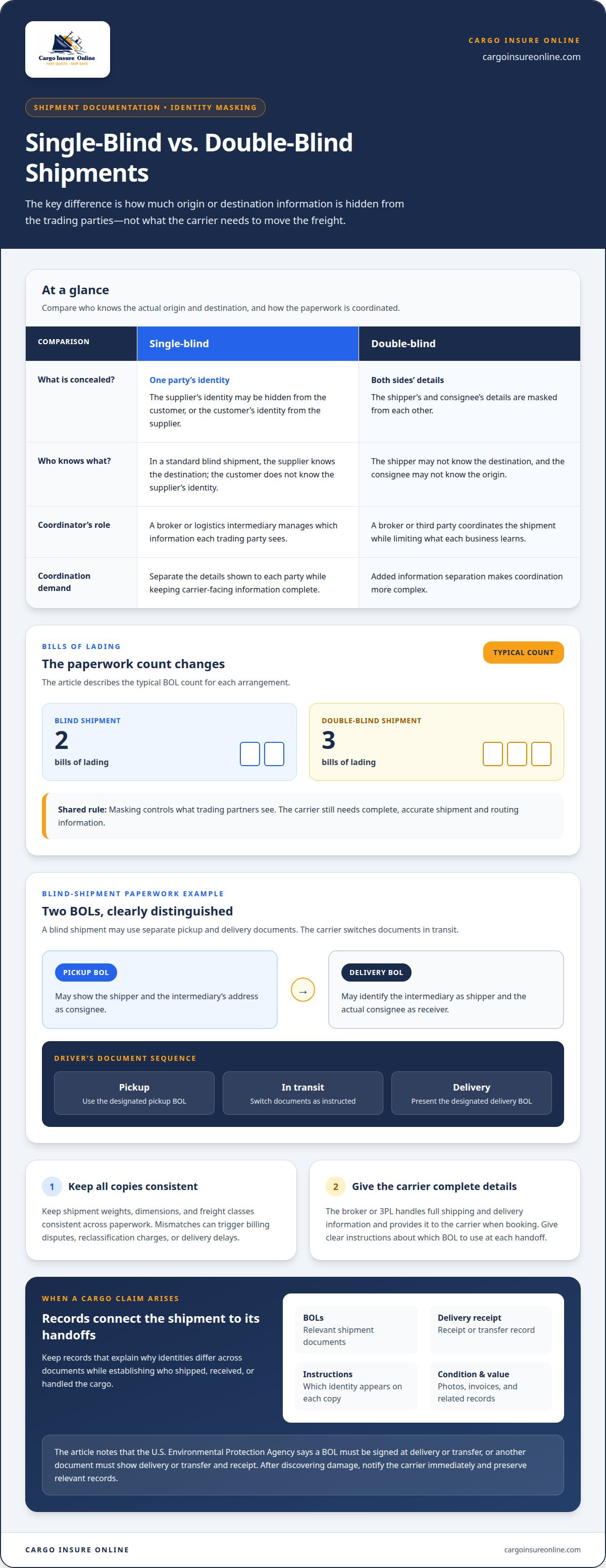
A blind shipment typically uses two bills of lading, or BOLs, while a double-blind shipment uses three. One BOL is issued at pickup, and another shows the parties and details for delivery. These records let a carrier move freight with the correct information without showing every trading partner the same identities.
For a blind shipment, one BOL may show the shipper and the intermediary’s address as consignee. A second may identify the intermediary as shipper and the actual consignee as receiver. The carrier switches documents in transit, so the driver needs clear instructions about which BOL to use at pickup, during transit, and at delivery. Labels such as “Pickup BOL” and “Delivery BOL” help distinguish their roles.
The freight broker or 3PL handles the complete shipping and delivery information, then gives it to the carrier when booking. That carrier-facing record supports routing, while the blind BOLs control what the shipper or consignee sees. Keep weights, dimensions, and freight classes consistent across all copies. A mismatch can trigger billing disputes, reclassification charges, or delivery delays.
To support a blind-shipment cargo claim, gather the relevant BOLs, delivery receipt, blind-shipping instructions, and records showing the cargo’s condition and value. These records connect the shipment, parties, handoffs, and reported loss; the carrier’s or insurer’s process determines what else is required. The shipper, consignee, or freight broker can notify the carrier and submit supporting information, while the contract and insurance documents establish who may seek recovery.
A BOL shows the shipment details used for a handoff; a delivery receipt records receipt or transfer. According to the U.S. Environmental Protection Agency, the BOL must be signed at delivery or transfer, or another document must show delivery or transfer and receipt. Blind-shipping instructions state which identity appears on each copy, helping explain why pickup and delivery records differ.
- Photograph damaged cargo, packaging, and labels before moving or disposing of them.
- Keep invoices, purchase records, packing details, and repair or replacement estimates together to support cargo value.
- Record when and where damage was found, then preserve the BOL and signed delivery receipt.
After discovering damage, notify the carrier immediately, as the United States Environmental Protection Agency advises. The carrier should document the reported damage and retain the relevant shipment records; the shipper, consignee, and broker should preserve their copies and share consistent details. For blind shipment cargo claims when the shipper and consignee are masked, matching records make the chain of custody easier to follow without exposing identities on every document.
Blind and double-blind shipment definitions
A blind shipment masks one trading party’s identity from another through the shipment’s paperwork or labels. The key distinction is which party knows the actual origin or destination during the freight transaction.
Blind Shipment Meaning
A blind shipment conceals the supplier’s identity from the customer, or the customer’s identity from the supplier. For example, a wholesaler can arrange for a manufacturer to send freight directly to a retailer without identifying the manufacturer on customer-facing paperwork. The carrier still needs accurate information to move the load; masking controls what each trading party sees.
In a standard blind shipment, the supplier knows the destination, while the customer does not know the supplier’s identity. A freight broker or logistics intermediary coordinates the shipment between them, managing the information shown to each party. For example, the intermediary’s details may appear on documents presented to the customer. This arrangement can protect supplier relationships and prevent a customer from bypassing the wholesaler.
Blind shipping describes confidentiality between parties, not a lack of information for the carrier. The intermediary coordinates the actual origin, destination, and identities needed for transport, while arranging which details appear on labels and other records. For example, a retailer may see the wholesaler as the sender, even though the freight was collected from the manufacturer’s location.
This distinction matters when a shipment is delayed, misrouted, or damaged. A consignee might recognize the wholesaler’s name on a document but not the manufacturer’s, while the carrier’s routing information identifies the actual pickup location. Keeping these roles clear helps explain why records may show different identities without confusing the commercial relationship with the physical movement of freight.
Single-Blind and Double-Blind Shipments
A single-blind shipment hides one party’s identity, while a double-blind shipment hides the shipper’s and consignee’s details from each other. In a double-blind transaction, a broker or third party may coordinate the freight so the shipper does not know its destination and the consignee does not know its origin. The difference determines how carefully information must be separated.
Consider a supplier shipping goods through a broker to a customer. In a single-blind arrangement, the customer may see the broker as sender but not know the supplier. In a double-blind arrangement, the supplier also does not see the customer’s identity or destination. The broker coordinates the shipment, giving the carrier the details needed for transport while limiting what each business learns.
That extra separation adds coordination complexity. The broker must ensure each party receives the appropriate information while the carrier receives the actual routing details. If a shipment changes course, instructions must still reach the carrier without revealing identities to the wrong party. These distinctions also explain why records from a single-blind shipment may identify one masked party, while a double-blind transaction keeps both ends confidential.
Carrier rules and documentation requirements
Blind-shipment procedures vary by carrier, especially for addresses, commodities, and double-blind freight. The carrier still needs complete routing details to coordinate the shipment, even when customer-facing paperwork masks identities.
A masked shipper or consignee name does not, by itself, establish whether cargo insurance applies. Policy terms and accurate shipment information matter when a claim is assessed, so carrier paperwork should not conceal the actual parties from those handling the shipment or claim.
Carrier Notification and Documentation
Carrier notification means requesting blind handling before pickup and giving the carrier full operational details. Early notice gives logistics staff time to prepare documents and brief the driver. Carrier rules may require accurate city and ZIP information, delivery instructions, or advance paperwork. Address practices differ: one carrier may require a city and ZIP matching the actual business, while another may use a different format.
Keep the carrier’s routing record aligned with the pickup and delivery instructions. A supplier’s location, for example, may differ from the name shown to the consignee, but the carrier must know where the inventory is actually collected. Missing or mismatched details can disrupt delivery or create billing errors. The broker should give the driver the right instructions for each handoff.
Carrier Liability and Insurance Coverage
Carrier liability concerns the carrier’s responsibility under its transportation terms; cargo insurance is a separate matter governed by its policy. Masking a party’s identity does not, by itself, settle coverage. Accurate disclosure to the carrier and insurer helps establish the actual shipment, route, and parties, while policy terms determine how those facts affect a claim.
Carrier rules also set practical limits. Some carriers prohibit double-blind shipments or restrict certain commodities, and ignoring their policies can lead to rejection or delay. Carriers cannot always guarantee confidentiality and may have limited liability for misrouted freight. A broker should communicate the actual route and identities privately to the carrier rather than rely on masked paperwork as a substitute.
Claim Investigation with Concealed Identities
For a claim involving concealed parties, the carrier investigates using complete routing information and transport records. The broker can connect the masked documents to the actual shipper and consignee, while pickup and delivery records help trace the freight’s movement. This lets an investigator follow the transaction without relying on customer-facing names alone.
After a loss, the carrier, broker, shipper, or consignee should preserve the relevant bills of lading, blind-shipping instructions, delivery records, and damage evidence. The broker can explain why document names differ and identify the actual parties through the carrier-facing file. A consistent sequence of pickup, transit, and delivery records helps show where an issue arose and supports claim review.
Concealing shipper and consignee identities
A blind shipment hides selected business identities from the other trading party, while the carrier retains the actual details needed to move freight. A wholesaler may hide a manufacturer’s identity from a retailer to protect the supplier relationship and reduce the risk of direct future orders. In another arrangement, a company may conceal a destination to protect customer or supply-chain information.
The typical goal is commercial confidentiality, not removing shipment details from every record. A freight intermediary can coordinate the transaction and control which names appear on customer-facing labels, documents, and tracking information. For example, a retailer may see the wholesaler as the sender even though the manufacturer supplies the inventory. The carrier still needs the actual pickup point and destination to transport it.
Identity leaks can happen during routine handling, not just because a form was completed incorrectly. A driver who mentions the origin during delivery can reveal a hidden supplier. A label, tracking update, or document shown to the wrong party can also expose a name or address. In a double-blind arrangement, a misplaced detail could disclose both the source and destination, defeating the intended separation.
To limit accidental disclosure, the broker should coordinate information flow before pickup. The carrier needs complete operational details, while each trading party should receive only the documents intended for them. For example, delivery paperwork can show the intermediary as sender, while the carrier’s routing record retains the actual manufacturer and consignee. Clear driver instructions reduce the risk of an offhand comment revealing the origin.
Masking also has limits. If the carrier receives incomplete or misleading routing details, freight may be misdirected or delivery instructions misunderstood. Inconsistent shipment information can lead to billing disputes. Confidentiality should change which identity a party sees, not the underlying description of the cargo or its route. If a delivery issue arises, the broker can explain differences between customer-facing paperwork and carrier records.
Separate supply chains create another reason to keep identities hidden. A business with distinct divisions or customer groups may not want a shipment to reveal shared suppliers or overlapping operations. E-commerce dropshipping follows a related pattern: a retailer arranges for a supplier to ship directly to the customer while keeping the supplier’s identity off customer-facing information. In both cases, labels and tracking updates need careful handling.
For a cargo claim, concealed identities should not erase the shipment’s history. The broker can connect masked paperwork to the actual parties and explain the commercial arrangement, while carrier records establish the route and handling. Preserving consistent records helps distinguish an intentional identity mask from a missing shipment detail. That distinction matters when reconstructing where freight originated, who received it, and what happened during transport.
Legal and regulatory considerations
Confidentiality in a blind shipment changes what each party sees, not the cargo’s actual origin or identity in the carrier’s records. A manufacturer may remain hidden from a customer while the broker retains the link between the masked paperwork and the actual transaction. That separation matters when a claim, customs review, or delivery dispute requires an explanation of who arranged the shipment and where the goods came from.
For international freight, distinguish commercial privacy from information used to describe goods and their origin. A broker can keep supplier details off customer-facing documents while maintaining accurate internal records of the manufacturer, origin, destination, and product. For example, changing the name shown to a retailer should not make the intermediary the actual producer. Consistent records help explain the transaction without unnecessarily exposing competitive relationships.
Rules can depend on the goods and regions involved, so one confidentiality practice does not answer every compliance question. A shipment crossing borders may involve different documentation and customs processes from domestic freight. Brokers should preserve the actual product description and origin information in the records used for those processes. Consignee-facing paperwork can protect a supplier’s identity, but it should not create conflicting accounts of what moved.
Carmack and ocean-shipping claims follow different timelines; there is no single deadline for both. Identify the governing transportation terms and claim type, then distinguish notice of damage, claim filing, and any deadline to bring suit. A masked shipper or consignee name does not identify the applicable period. The route, mode, and carriage documents help establish which rules and contractual terms apply.
Keep a confidential record connecting each masked document to the actual parties. The broker can retain carrier instructions, shipment details, and the reason identities were concealed. If damage occurs, the shipper or consignee can report it through the appropriate channel while the broker provides records explaining the name differences. This gives the claim reviewer a clear transaction history without circulating supplier information more widely than needed.
For businesses shipping online orders, e-commerce cargo insurance can address cargo risks within that supply chain. Keep the shipment’s commercial confidentiality separate from its cargo records, so the documentation can support review if loss or damage occurs.
Cargo Insure Online
Cargo Insure Online helps businesses manage cargo risks with insurance options for air, sea, and trucking freight, plus GAP Insurance. These options are relevant when masked identities make it especially important to keep clear records of the shipment, its route, and the parties involved.
Insurance does not replace accurate carrier documentation or determine who may file a claim. It can address cargo exposure alongside the shipment’s operational records. When considering coverage for a blind shipment, assess the transport mode and the financial risk you need to manage.
Contact Cargo Insure Online to discuss cargo insurance for your shipping needs.
Make the Next Shipment Easier to Protect
Plan cargo protection before the next load moves. For blind shipment cargo claims when the shipper and consignee are masked, connect coverage planning with the way your business actually ships. Consider the transport mode, cargo value, and how a loss could affect your operations. This gives you a clearer basis for reviewing insurance needs alongside the commercial arrangements that keep trading identities confidential.
Good preparation makes an unexpected loss easier to manage. Keep your cargo risk strategy aligned with changing routes, products, and customer relationships. If your shipping profile has changed, review whether your existing approach still fits. Cargo Insure Online offers cargo insurance options for your shipping needs.
Contact Cargo Insure Online to discuss your cargo insurance needs and take a confident next step.
Frequently Asked Questions
What is a blind shipping BOL and why is this method used?
A blind-shipping bill of lading is a shipment document that masks a trading party’s identity from another party. Businesses use it to protect supplier relationships, customer details, or supply-chain information. For example, a retailer may receive freight from an intermediary without seeing the manufacturer’s name. The carrier still needs accurate operational details, so the masked copy serves a different purpose from the carrier’s complete routing record.
Are There Other Potential Issues To Watch Out For?
Yes. A driver presenting the wrong paperwork can reveal a confidential supplier or confuse the receiving party. Mismatched shipment details may also lead to billing disputes, reclassification, delays, or misrouting. Carrier restrictions add another complication: a carrier may reject a double-blind arrangement or limit certain goods. As a safeguard, make sure the broker’s instructions identify which document applies at each handoff and give the carrier complete routing information.
Who is liable for cargo loss or damage in a blind shipment under U.S. law?
Masking identities alone does not determine liability for cargo loss or damage. The relevant transport agreement, documented handling, cause and timing of the loss, and any applicable insurance policy all matter. The carrier, shipper, consignee, or another party may have a role, depending on the facts. Keep transportation records and claim documents together so the responsible parties and sequence of events can be assessed.
What risks arise from incorrect or misleading shipper and consignee details on shipping documents?
Incorrect details can send freight to the wrong location, delay delivery, create billing problems, or expose confidential identities. They can also make it harder to connect a damage report with the shipment and its actual parties. Masking differs from giving the carrier false routing details: a broker can limit what a trading partner sees while keeping carrier records accurate. Preserve the records that explain any differences between document copies.


