
A commercial drone fleet may need insurance even when federal law doesn't require it. In the U.S., the FAA does not federally require commercial drone pilots to carry insurance as of 2026, but clients, contracts, or local rules may make coverage a practical necessity. For fleets carrying goods or valuable equipment, insurance for commercial drone logistics, transit, and payloads can help address risks beyond the flight itself.
It’s easy to focus on the aircraft and overlook the risks around it. Liability coverage may address claims for injury or property damage to others, while physical damage and payload coverage protect different parts of the operation. Exclusions matter too: a standard business policy may not cover drone-related incidents.
This guide explains who commonly needs commercial drone insurance, what liability limits and exclusions mean, and how annual, on-demand, and fleet pricing structures compare. You’ll also see how aircraft count, insured values, payloads, and intended use shape a fleet policy. The goal is a clearer view of what to insure, when coverage matters, and how to think about costs without mistaking one pricing model for a fit for every operation.
Key Takeaways
- Identify whether legal, contract, or client requirements make coverage necessary for your drone operations.
- Separate liability protection from cover for the aircraft, payload, and equipment in transit.
- Match annual, on-demand, or fleet coverage to how often you fly and how your operation is structured.
- Review exclusions carefully, since a general business policy may not address drone-related losses.
- Use fleet size, equipment values, and intended operations to understand what shapes insurance pricing.
Third-party liability coverage
Commercial drone fleets need liability coverage for claims involving bodily injury or property damage to others. Logistics operators should also consider protection for aircraft, ground equipment, and transported cargo, since liability coverage alone doesn’t insure every asset. When arranging commercial drone fleet logistics transit and payload insurance, treat these as separate exposures as you map your operation.
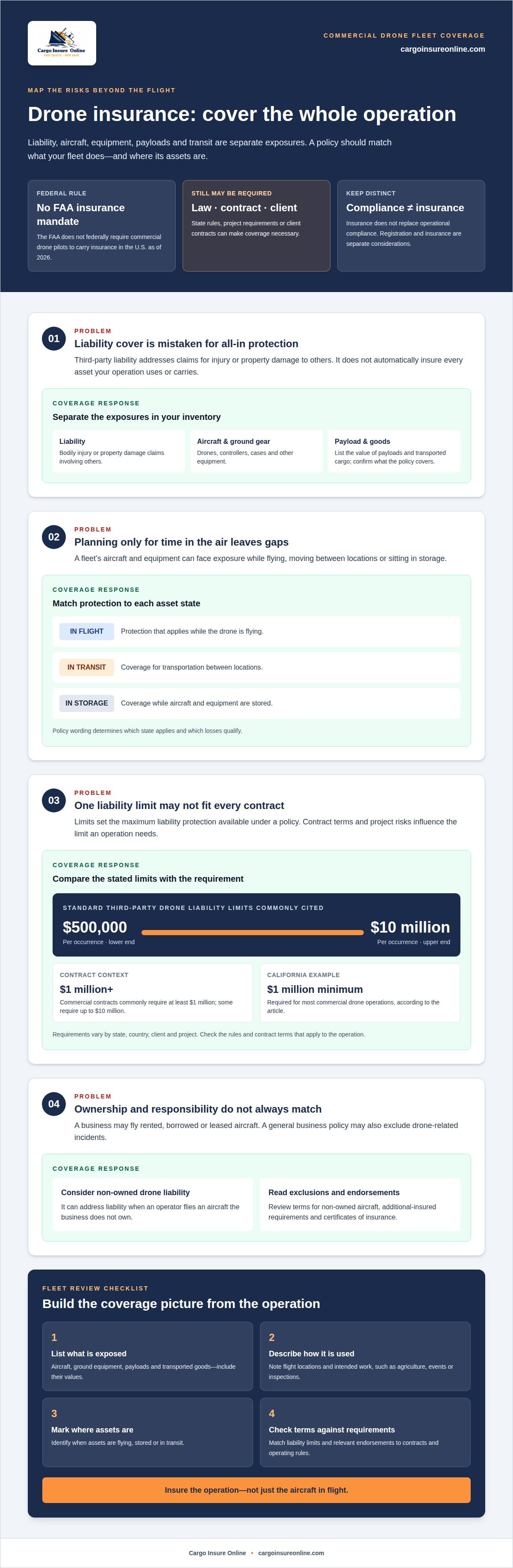
Third-party liability addresses legal responsibility when a flight harms someone or damages their property. A delivery drone that strikes a parked vehicle, for example, could lead to a property damage claim. Commercial contracts commonly require at least $1 million in liability coverage, and some require up to $10 million. More complex or higher-risk operations may need higher limits to meet contract terms and manage potential claims.
Coverage should reflect the full operation, not just time in the air. In-flight protection applies during flight; in-transit coverage concerns transportation between locations; and in-storage coverage applies while aircraft and equipment are stored. A drone show fleet may spend substantial time grounded, making storage and transit exposures relevant alongside flight risks. Policy wording determines which state applies and which losses qualify.
Ground equipment coverage can protect items such as controllers and drone cases. This matters when a logistics team relies on those items to prepare, control, or move aircraft. Payloads and transported goods are separate exposures: list their values and confirm whether the relevant policy covers them, rather than assuming liability coverage protects property carried by a drone.
Industry-Specific and Leased Drone Coverage
Industry-specific coverage reflects how a drone is used, including in agriculture, events, and inspections. Crop monitoring, event operations, and infrastructure inspections each involve different operating contexts. Businesses using rented, borrowed, or leased drones should consider non-owned drone liability coverage. It can address liability when an operator flies an aircraft the business doesn’t own, helping close the gap between ownership and responsibility.
Limits, Deductibles, and Endorsements
Limits set the maximum liability protection available under a policy, while deductibles determine the amount retained for a covered loss. Standard third-party drone liability limits commonly range from $500,000 to $10 million per occurrence. Contracts and project risks influence the needed limit. Review endorsements for non-owned aircraft, additional-insured requirements, and certificates of insurance to see whether policy terms align with a client contract.
To arrange fleet and cargo protection, prepare an inventory of aircraft, ground equipment, payloads, and transported goods, along with details of agriculture, event, or inspection flights. Describe when assets are flying, stored, or in transit. Then match liability limits and relevant endorsements to contract requirements. A commercial drone fleet logistics transit and payload insurance review can use this information to distinguish aircraft, cargo, and liability needs.
Who Needs Drone Insurance?
Commercial operators need to consider insurance when a law, client contract, or project requirement makes coverage necessary. In the United States, the FAA does not federally require commercial drone pilots to carry insurance as of 2026. That doesn’t remove state requirements or contractual conditions, and it doesn’t make insurance irrelevant to a logistics operation.
For the FAA angle, Remote ID regulations apply to drones over 0.55 lbs. The FAA establishes rules for integrating drones safely into the national airspace, while insurance addresses financial risks. Insurance does not replace operational compliance. Registration and insurance are separate considerations, so a delivery business should account for both when planning its operations.
State requirements can change the picture. California requires at least $1 million in liability coverage for most commercial drone operations. State requirements can vary, so commercial drone operators should check the rules that apply to their operations. Minnesota has unique aircraft insurance requirements that may apply to drones. These examples show why a national operating plan needs a state-by-state review, rather than assuming one rule applies everywhere.
Insurance requirements for commercial drone operations vary by country, so operators should check the rules where they fly. Drone operation requirements vary by country, so a company flying across borders needs to account for the rules in each operating location. A U.S. policy decision alone won’t settle what applies to a route that crosses into Canada.
Commercial clients can add another layer of requirements. A contractor may need proof of insurance to win a bid, and clients may request a certificate before a flight or require additional-insured status. For example, a delivery contractor bidding on a logistics project should understand the contract’s requested limits and certificate conditions before committing to the work. Contract requirements can be more specific than general rules in a state or country.
How do insurers compare on fleet, cargo, and payload coverage? Compare what each policy says about liability, aircraft, payload, cargo, and transit, then review exclusions and limits against your operation. A camera used for inspections, for instance, is different from a parcel carried for delivery, so identify each exposure clearly.
For a practical comparison, document the aircraft, cameras, payloads, cargo, flight locations, and intended operations. Include whether flights are domestic or cross-border, and note any client contract requirements. These details help frame the coverage being considered without confusing aircraft protection with cargo protection. Explore drone fleet coverage as you map those needs.
Annual and on-demand insurance costs
Commercial drone insurance pricing depends on the operation, not simply the number of aircraft. Underwriters may consider fleet size, aircraft and sensor types, pilot experience, maintenance records, incident history, team safety procedures, and flight locations. A delivery fleet carrying specialized sensors can present a different risk profile from a small team flying occasionally with basic equipment.
An annual policy is designed to cover operations throughout its policy term, rather than selected flights alone. It can suit a business flying regular delivery routes or using drones year-round. For example, a logistics company with scheduled flights can budget for recurring coverage, while its insurer assesses the fleet and operating details to determine the premium.
On-demand insurance is structured around specific flight periods or usage. It may suit a business with occasional projects or seasonal work, such as a farm using drones for crop surveys. The cost is tied to flight hours, so businesses with frequent operations should compare expected usage with the structure of annual coverage.
There isn’t one typical price that fits every fleet. Annual and on-demand coverage use different pricing bases, so compare the expected policy period and flight activity. A company flying only for a short inspection project has a different usage pattern from one running regular delivery routes. That difference can affect which structure better matches the operation.
Physical damage protection adds another pricing consideration because the value of insured aircraft and equipment shapes the risk. A fleet with costly sensors, cameras, or payload equipment differs from one with lower-value aircraft and simpler configurations. The number of aircraft matters too, but it isn’t the only factor providers weigh when setting a premium.
Claims and maintenance history can also influence underwriting. Documented maintenance procedures give providers useful information about how aircraft are managed, and incident history offers another important signal. Pilot experience, flight locations, intended use, and team safety procedures help describe the risk beyond the inventory list.
For a useful comparison, organize the same details for each quote: aircraft count and types, equipment and sensor values, flight frequency, operating locations, pilot experience, maintenance records, and incident history. Then compare annual and on-demand options against the same operating plan. This helps ensure a lower quoted premium doesn’t distract from differences in covered operations or insured property.
The price depends on the operation and is provided after a quote request. Fleet size, aircraft and sensor types, pilot experience, maintenance records, incident history, flight locations, and safety procedures all affect the assessment. A seasonal inspection team and a year-round delivery fleet should expect different factors to shape their quotes.
Common drone insurance exclusions
Aviation exclusions are a key gap to look for in commercial insurance. Standard commercial general liability policies often contain aviation exclusions that can leave drone-related incidents uncovered. For example, a delivery drone causing damage during a flight may fall outside a general business policy’s protection. Some commercial policies exclude aviation coverage or charge UAV operators higher premiums, so a general liability certificate alone doesn’t establish that drone operations are covered.
What does commercial drone payload insurance cover, and what are common exclusions? Payload coverage can insure equipment such as cameras, thermal sensors, and LiDAR units, which may be separate from aircraft coverage. Exclusions vary by policy wording, so review the covered property, operating conditions, and exclusions rather than assuming every payload or loss is included.
Separate the aircraft, payload, ground equipment, and transported goods when reviewing policy terms. A thermal camera mounted on a drone is operational equipment; a parcel carried for delivery is cargo. Those items may require different coverage, and aircraft protection alone doesn’t establish that either is insured. For each item, match its description to the policy’s insured-property language and note any applicable limits or conditions.
Flight status can also matter. A policy may distinguish between a drone in flight, on the ground, or moving between locations. Read the wording for those states and identify which parts of the operation it addresses. For example, a claim involving a drone damaged during transport raises a different question from damage during flight. Don’t treat coverage for one activity as proof that every stage is covered.
Airspace and operating conditions deserve close attention in policy language. A business planning delivery routes should compare its actual operations with the activities described in its documents. If a policy describes inspection work with cameras, don’t assume that wording covers every delivery activity. Apply the same review to locations and any stated operational restrictions.
Exclusions can also interact with liability limits. A policy showing a $1 million limit may still exclude the event or property involved in a particular claim. The limit describes the maximum available for covered claims; it doesn’t erase exclusions. Read the exclusions alongside the insuring agreement, definitions, and endorsements to see how they work together.
Use a simple review process: list each aircraft and payload, identify flight, ground, and transit activities, then compare each against the policy’s covered operations and exclusions. A LiDAR unit, thermal camera, and delivery parcel should each have a clear place in that review. This makes gaps visible before a claim, without mistaking a broad coverage label for protection of every asset.
Drone fleet insurance pricing examples
Fleet pricing starts with what the policy covers, not just how many aircraft appear on a schedule. A five-drone operation with liability coverage and limited hull protection differs from a ten-drone fleet insuring higher-value aircraft and payloads. For commercial drone fleet logistics transit and payload insurance, aircraft count is only one part of the pricing picture; liability limits, insured property, and intended work also shape the risk.
Consider a five-drone business that needs liability coverage and protection for a modest amount of hull value. Its policy structure could focus on third-party claims while insuring aircraft separately. A ten-drone operation carrying more valuable equipment may need higher liability limits and broader hull and payload protection. These fleets need different policy designs, even before providers assess operating details.
Payload value can quickly change the coverage picture. A survey operator carrying a LiDAR scanner, thermal camera, or other specialist sensor should account for that equipment separately from the aircraft. A delivery fleet also needs to distinguish its own payload equipment from goods carried for customers. Listing each exposure clarifies what the policy needs to insure and where separate cargo protection may matter.
Operational details influence pricing too. Providers may consider flight locations, pilot experience, maintenance records, incident history, aircraft types, and safety procedures. A fleet flying regular logistics routes presents a different pattern from a company deploying drones for occasional infrastructure inspections. Those differences can affect the risk profile and the coverage limits needed for contracts or clients.
Compare fleet examples by matching the same details across policy proposals:
- Aircraft: Record the fleet count, types, and total insured value.
- Equipment: Separate payloads, sensors, batteries, and ground equipment.
- Liability: Compare limits against project contracts and potential injury or property damage claims.
- Operations: Describe flight frequency, locations, and transit or storage exposures.
- Terms: Review deductibles, exclusions, and how new aircraft are treated.
For commercial drone fleet logistics transit and payload insurance, compare each policy against your actual aircraft, goods, and route exposures. A ten-aircraft fleet with costly sensors may prioritize payload protection, while a delivery operator may focus on liability and goods in transit. Premiums depend on the case and are provided after a quote request; fleet size, aircraft and sensor types, pilot experience, maintenance records, incident history, flight locations, and safety procedures affect the assessment.
Map your fleet’s insurance needs against its aircraft, payloads, and logistics operations before comparing policy structures.
Cargo Insure Online: Drones Insurance
Cargo Insure Online offers Drones Insurance for businesses assessing protection for commercial drone operations. Consider this offering when your fleet, aircraft, or drone-related risks need insurance alongside the coverage questions outlined above.
If your logistics chain also moves goods by air, sea, or truck, Cargo Insure Online offers Air Freight Insurance, Sea Freight Insurance, and Trucking Insurance for those distinct parts of a cargo journey. Identifying where drones and transported goods fit into your operation helps clarify which coverage areas matter to your business.
Bring your fleet and logistics needs into focus, then contact Cargo Insure Online to discuss your coverage priorities.
Make Your Next Coverage Decision Count
Your next step is to turn your operating plan into a clear picture of what needs protection. Map how aircraft, equipment, and goods move through your logistics operation, then use that picture to set your commercial drone fleet logistics, transit, and payload insurance priorities. A grounded coverage plan starts with the operation you actually run.
Cargo Insure Online offers Drones Insurance, alongside Air Freight Insurance, Sea Freight Insurance, and Trucking Insurance for other parts of a cargo journey. Consider these offerings in relation to the risks your business is addressing, without treating one policy as a substitute for another.
Ready to discuss your operation and its insurance needs? Contact Cargo Insure Online to take the next step. A clearer plan can help you move forward with confidence.
Frequently Asked Questions
Are spare drones covered under the same policy?
Spare drones can be included in a fleet policy when they’re listed or covered by its newly acquired aircraft terms. Some hull policies provide automatic coverage for new units for 30 to 60 days, subject to a sub-limit. Operators are typically asked to notify the insurer within 30 days of acquiring additional units. Confirm how the policy treats stored spares, their insured values, and notification requirements.
Does hull cover drones lost during a fly-away?
Hull coverage protects the physical aircraft against covered loss or damage, but a fly-away isn’t automatically covered by that description alone. Policy wording determines how it treats disappearance, loss of control, recovery efforts, and evidence of an accident. For example, a fleet record showing the aircraft’s last known status may help document what happened, but it doesn’t change the policy’s definitions or exclusions.
Does hull include the LED payload, or just the airframe?
Hull coverage may insure the airframe without automatically including an LED payload. Payloads can be insured separately, so identify the LED system as equipment and establish its value in the policy schedule or applicable coverage terms. This distinction matters if the aircraft survives an incident but its display payload is damaged, or if the payload is removed and stored separately from the drone.
How is hull premium calculated on a drone fleet?
Hull premiums are shaped by the fleet’s total insured value and composition. Aircraft replacement values, payloads, sensors, batteries, and listed ground equipment all affect the amount at risk. Fleet size and operating use also inform underwriting. For example, a fleet with specialized lighting or survey equipment presents a different insured-property profile from one with basic aircraft and no high-value payloads.
How much coverage should I purchase?
Set coverage by adding the values of the aircraft and equipment you need protected, then consider the maximum liability exposure your contracts and operations create. Include payloads and spare units rather than calculating from active airframes alone. A client contract may specify a liability limit, while an expensive sensor fleet can require a separate physical damage limit that reflects the actual equipment values.
What are the risks of a commercial drone operation?
Commercial operations can expose a business to third-party injury or property damage claims, physical loss of aircraft, and damage to payloads or ground equipment. Delivery work also involves goods moving through handling and transit stages. Imaging operations can raise personal injury claims involving privacy. For example, an inspection flight may involve both expensive sensors and captured imagery, creating distinct property and liability exposures.
How does drone transit insurance cover cargo in flight and during ground handling?
Transit protection depends on the policy’s stated journey, insured property, and handling conditions. Cargo carried by a drone is distinct from the drone itself, so aircraft hull coverage alone doesn’t establish protection for the goods. Review where insured transit begins and ends, and how the wording treats transfer or ground handling. A parcel awaiting loading may have different terms from one already airborne.
What factors affect insurance premiums for commercial drone fleets and payloads?
Insurers assess aircraft and payload values, the number of units, intended work, flight locations, and operator experience. Maintenance records, incident history, and team safety procedures also shape the risk profile. A logistics fleet carrying thermal sensors across varied locations differs from a small inspection operation with simpler equipment. Accurate inventory and operating details help insurers evaluate the exposure being insured.


