

A carrier liability disclaimer doesn’t automatically settle a claim when driver negligence damages cargo. For interstate shipments within the United States, the Carmack Amendment generally governs carrier responsibility for cargo loss or damage, and recovery is limited to the actual loss. A written claim must be submitted within at least 9 months from delivery or the expected delivery date.
It’s easy to assume carrier liability means the carrier will cover a shipment’s full value. It may not. A carrier’s legal responsibility and cargo insurance are different forms of protection, and that difference matters when goods arrive damaged, go missing, or are improperly packed or loaded.
This article explains what carrier liability may cover, how negligence and shipper responsibilities can affect a claim, and why a disclaimer may not end the discussion. It also explains how cargo insurance can help address the gap between a carrier’s liability and the value of your freight.
Key Takeaways
- Carrier liability and cargo insurance are different protections. Understand the potential coverage gap before relying on a carrier to cover the shipment’s full value.
- For ocean cargo, COGSA bars carriers from setting liability below $500 per package for lost or damaged goods, according to the U.S. Government Publishing Office.
- A freight damage claim is stronger when it shows the goods’ condition at pickup, the damage or loss at delivery, and a measurable loss.
- Loading and packaging matter: shipper-caused damage can affect whether the carrier is liable.
- When driver negligence may have caused damage, learn how the burden of proof works and what cargo insurance may add beyond carrier liability.
What is Carrier Limit of Liability for International Shipping?
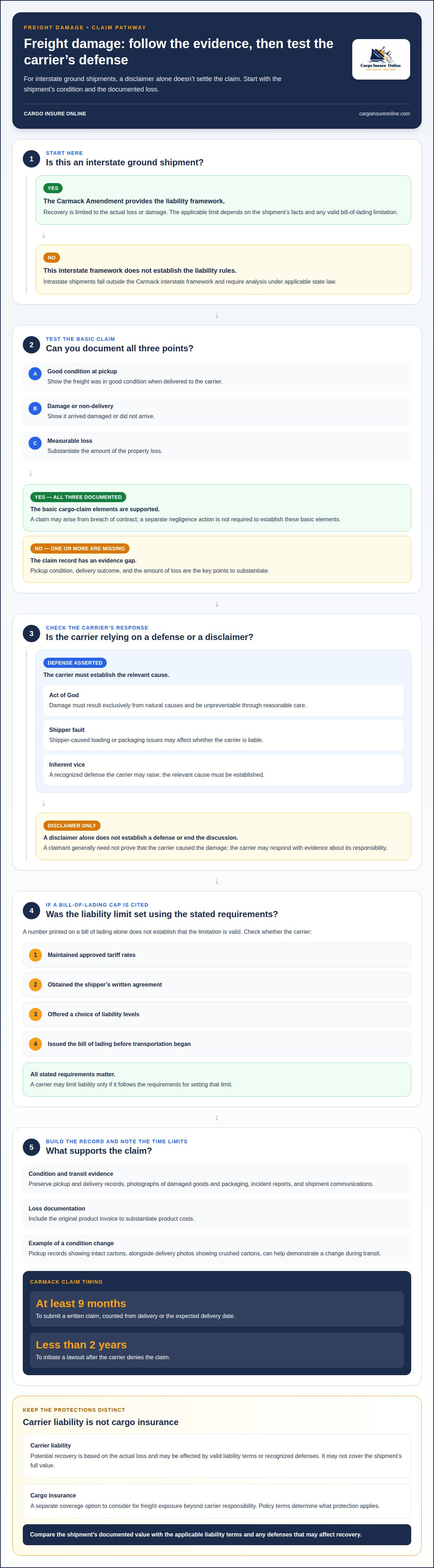
For interstate ground shipments within the United States, the Carmack Amendment sets the framework for a carrier’s liability for cargo loss or damage. The applicable limit depends on the shipment’s facts and any valid liability limitation in its bill of lading.
Defenses and Liability Limits
The Carmack Amendment limits recovery to the actual loss or damage caused by an interstate carrier, while allowing recognized defenses. This matters because a carrier may contest a claim by arguing that an exception applies, rather than relying on a disclaimer alone.
Recognized defenses include an act of God, shipper fault, and inherent vice. A carrier relying on a defense must establish the relevant cause. For an act of God, damage must result exclusively from natural causes and be unpreventable through reasonable care. Even when liability applies, a claim seeks measurable property loss, not automatic payment of the shipment’s full declared value.
Driver Status and Carrier Liability
For Carmack claims, liability is tied to the interstate carrier that receives the property and the carrier that delivers it, not simply to whether the driver is an employee. This distinction matters when an independent contractor or owner-operator handles a shipment.
Under 49 U.S.C. § 14706(a)(1), the receiving motor carrier and another carrier that delivers the freight may be liable to the person entitled to recover under the receipt or bill of lading. A driver’s contractor status therefore doesn’t, by itself, resolve which carrier may face a cargo claim; the carriers’ roles in receiving and delivering the shipment matter.
Valid Liability Limits in Bills of Lading
A carrier may limit liability only if it follows the stated requirements for setting that limit. A number printed on a bill of lading alone doesn’t establish that the limitation is valid.
The carrier must maintain approved tariff rates, obtain the shipper’s written agreement, offer a choice of liability levels, and issue the bill of lading before transportation begins. Before treating a stated cap as controlling, a shipper should determine whether those conditions were met.
The Carmack Amendment governs interstate ground shipments, not every freight movement. It doesn’t establish liability rules for an intrastate shipment, which falls outside this interstate framework and requires analysis under applicable state law.
After cargo damage, document the condition of the goods and submit a written claim to the carrier. Under the Carmack Amendment, the claimant must have at least 9 months from delivery or the expected delivery date to submit that claim. If the carrier denies it, a lawsuit must be initiated less than two years after the denial.
Are carriers liable for your freight damages?
For interstate freight, carrier liability may apply when goods are damaged or lost during transportation. A claim depends on evidence of the goods’ condition, the damage in transit, and the measurable loss.
Carrier Liability for Freight Damage
Under the Carmack Amendment, an interstate motor carrier that receives freight and another carrier that delivers it may be liable to the person entitled to recover. Because a shipment can involve multiple carriers, a claim may concern the receiving carrier, the delivering carrier, or both.
To establish a basic cargo claim, show that the freight was in good condition when delivered to the carrier, arrived damaged or did not arrive, and suffered measurable loss. The claim can arise from breach of contract rather than a separate negligence action.
Driver Negligence and Cargo Damage
A driver’s careless conduct may explain how cargo was damaged, but a claimant generally need not prove that the carrier caused the damage. A claimant may need to establish that cargo was damaged in transit, while the carrier may respond with evidence about its responsibility.
This distinction matters when a driver’s conduct is disputed. A carrier may respond with evidence of a recognized defense, such as shipper fault or inherent vice. A disclaimer alone doesn’t establish that a defense applies or resolve whether the carrier met its responsibilities.
Evidence of Driver Negligence
Evidence should connect the shipment’s condition at pickup to its condition at delivery and document the amount of the loss. Clear records help establish the claim’s basic elements, while incident details may help explain whether driver conduct contributed.
Preserve delivery records, photographs of damaged goods and packaging, and any incident reports or shipment communications. Include the original product invoice to substantiate product costs. For example, pickup records showing intact cartons and delivery photos showing crushed cartons can help demonstrate a change during transit.
Freight Coverage Gaps
A coverage gap is the difference between a carrier’s potential liability and the financial loss the cargo owner seeks to recover. Compare the shipment’s documented value with the applicable liability terms, including any bill-of-lading limitation and defenses that may affect recovery.
Carrier liability isn’t the same as cargo insurance, and carrier liability may not cover a shipment’s full value. For e-commerce goods, E-Commerce Cargo Insurance is a separate coverage option to consider for freight exposure beyond carrier responsibility; policy terms determine what protection applies.
Freight brokers require a separate look because arranging transportation and carrying freight are different roles. In interstate matters, 49 U.S.C. § 14501(c)(1) restricts certain state laws related to the price, route, or service of motor carriers and brokers transporting property. That can affect state-law claims against brokers, so identify each party’s role and the basis of the claim.
Shipper loading and packaging responsibilities
Shippers can influence cargo safety before a carrier starts a trip. Under the Carmack Amendment, shipper fault can be a defense when it caused cargo damage, so loading and packaging details may matter in a freight claim.
Responsibility depends on what caused the loss. A carrier may avoid liability when damage results from the shipper’s improper loading or packaging. For example, if goods shift because they weren’t adequately secured, that may support a shipper-fault defense. The freight’s condition at pickup and delivery can help show when the damage occurred.
Packaging should suit the goods and the handling they will encounter in transit. A weak outer carton, loose contents, or insufficient internal protection can leave a shipment vulnerable before the carrier takes custody. Conversely, damage to sturdy packaging may help document an impact during transit. Keep records of packaging condition and loading arrangements.
Hazardous materials require clear communication. A shipper that sends hazardous materials without informing the carrier may be strictly liable for resulting damages. Accurate descriptions identify the cargo and inform the carrier about what is being transported. Omitting that information can create liability beyond damage to the goods themselves.
- Record the goods’ condition and packaging before pickup.
- Keep loading records that identify how freight was secured.
- Describe hazardous materials accurately and inform the carrier.
- Photograph damaged goods, cartons, and internal packing after delivery.
These records help distinguish packaging failure from damage caused during transit. For instance, intact outer packaging with broken contents may raise different questions from crushed cartons with visible impact damage. Neither example alone determines responsibility. The cause, timing, and available evidence shape the claim.
Shipper’s interest insurance protects the cargo owner’s financial interest in the goods, rather than relying solely on a carrier’s liability. This distinction matters when a carrier disputes fault or argues that shipper loading or packaging caused the loss. Coverage depends on the policy terms and circumstances of the damage, so insurance and a carrier claim remain separate considerations.
For an e-commerce shipment, keep the product invoice, order details, pickup record, and delivery evidence together. The original invoice can substantiate product costs in a freight damage or loss claim. If packaging may have contributed to the damage, preserve it where practical; the carton and protective materials may help explain what happened.
Carrier liability compared with cargo insurance
Carrier liability is a carrier’s legal responsibility for cargo loss or damage; cargo insurance is separate financial protection for the goods. The distinction matters because carrier liability can be limited, disputed, or subject to exceptions, while insurance responds according to its policy terms. For a shipment valued above the carrier’s applicable limit, the difference may be a coverage gap.
For interstate ground freight in the United States, the Carmack Amendment governs carrier liability. Ocean freight may instead be governed by the Carriage of Goods by Sea Act, or COGSA, when it applies. According to the U.S. Government Publishing Office, COGSA bars ocean carriers from setting liability below $500 per package for lost or damaged goods. That minimum doesn’t mean every ocean loss is automatically paid at that amount.
Consider an ocean shipment packed in 40 cartons. At a $500-per-package limit, the carrier liability limit in this example is $20,000. If the shipment’s documented value is $120,000, the potential difference is $100,000. The calculation illustrates why package count, the applicable legal regime, and the shipment’s value can all affect recovery.
Cargo insurance addresses a different question: whether the policy covers the cargo loss under its terms. It doesn’t depend on proving carrier liability in the same way as a carrier claim. Coverage, exclusions, valuation, and claim requirements depend on the policy. Distinguish a demand against the carrier from a claim under cargo insurance.
Deadlines also differ by mode and legal framework. For covered ocean cargo under COGSA, a lawsuit must be filed within one year of delivery or the expected delivery date, according to the U.S. Government Publishing Office. That deadline concerns legal action against the carrier. It doesn’t by itself define the notice or claim requirements under a separate insurance policy.
For air freight, an international shipment may fall under the Montreal Convention of 1999. The applicable convention can set a liability framework distinct from domestic ground rules. The shipment’s route and mode help determine which rules apply; a single carrier disclaimer shouldn’t be treated as a universal answer for every leg.
To assess a potential gap, compare the goods’ documented value with the carrier’s applicable liability limit, then review the cargo policy’s covered risks, exclusions, and claim conditions. Include the bill of lading, package details, invoice, and damage records in that review. A $20,000 carrier limit against a $120,000 shipment, for example, signals a possible exposure, not an automatic insurance payment.
When is a carrier liable for cargo damage caused by driver negligence?
For an interstate cargo claim, liability doesn’t depend on first proving that the driver caused the damage. The claimant must show that the goods were in good condition when handed to the carrier, arrived damaged or missing, and suffered measurable loss. The burden then shifts to the carrier to prove it wasn’t at fault.
Driver negligence can help explain how damage happened, but it isn’t a separate requirement for establishing a basic cargo claim. For example, a record showing that cargo arrived damaged after a transit incident can support the claim’s timeline. The carrier may focus its response on whether a defense applies, including shipper fault or inherent vice.
A driver’s status doesn’t alone settle the carrier’s responsibility. Under 49 U.S.C. § 14706(a)(1), an interstate motor carrier that receives property and another carrier that delivers it may be liable to the person entitled to recover under the receipt or bill of lading. The carriers’ roles in receiving and delivering the shipment matter.
Build a clear record of the shipment and the damage. Useful materials can include:
- Pickup and delivery records showing the shipment’s condition at each point.
- Photographs of damaged goods, packaging, and affected cartons.
- Incident reports and communications describing the transit event.
- The original invoice supporting the claimed product cost.
Each item serves a purpose. Pickup records and delivery photos help establish when the goods’ condition changed. An incident report or carrier communication may help explain the driver’s actions. The original invoice supports the amount claimed. Together, these records make it easier to assess the facts without treating an allegation of careless driving as proof by itself.
A carrier’s disclaimer also doesn’t automatically defeat a claim. The bill of lading, shipment route, damage evidence, and any asserted defense all affect the analysis. For example, evidence that cargo was already damaged before the carrier received it could challenge the claim’s account of timing. Evidence of damage during transit supports a different account.
Keep the written claim focused on the shipment, the observed damage, and the measurable loss. Attach relevant records and state how the amount was calculated from the invoice and damaged goods. Under the Carmack Amendment, the written claim deadline is at least 9 months from delivery or the expected delivery date. Keep the submission and carrier response together.
For cargo owners who want separate financial protection from carrier liability, explore cargo insurance options and review how policy terms address the shipment’s risks.
Cargo Insure Online
Cargo Insure Online offers freight insurance options to consider alongside a carrier claim. When carrier liability limits, disputes, or shipper-related defenses may leave cargo exposed, separate insurance can provide another route to financial protection, subject to the policy terms.
Choose coverage suited to the shipment’s mode: Air Freight Insurance, Sea Freight Insurance, or Trucking Insurance. GAP Insurance is another option for addressing a difference between applicable coverage and financial exposure. These products don’t replace documenting damage or submitting a carrier claim; they address a separate part of the risk.
Explore cargo coverage for your freight with Cargo Insure Online.
Build a clearer plan for your next shipment
Use this claim as a prompt to prepare for the next shipment, not just to resolve the current dispute. Decide who will preserve shipment records, document damage, and coordinate communication if goods arrive in poor condition. A clear process keeps evidence and responsibilities organized while a claim moves forward.
A disclaimer addressing carrier liability for cargo damage caused by driver negligence should prompt a closer look at your overall protection, not end the conversation. Consider how your freight moves and where a gap between carrier responsibility and your financial exposure could affect your business. Planning ahead gives you more room to make informed coverage decisions before cargo is in transit.
Cargo Insure Online offers freight coverage options for air, sea, and trucking shipments. To discuss cargo insurance for your needs, contact Cargo Insure Online. A more deliberate plan can help you move forward with greater clarity.
Frequently Asked Questions
What is Covered?
Carrier liability may cover actual cargo loss or damage during transportation, subject to the governing rules and any valid limit. For example, if a shipment arrives with damaged goods, the claim concerns measurable property loss, not automatically every business consequence. Lost profits may be recoverable only in some claims, when the carrier had prior notice of the special circumstances that could cause them.
Cargo Liability Coverage vs Cargo Insurance: What’s the Difference?
Carrier liability is the carrier’s legal responsibility; cargo insurance is a separate policy covering cargo risks under its terms. A carrier claim may be disputed based on liability, defenses, or a valid limit. An insurance claim instead follows the policy’s coverage and exclusions. For example, a business can pursue a carrier claim while also reviewing whether its policy responds to the same damaged goods.
What Is a Cargo Claim?
A cargo claim is a demand for compensation from a carrier for goods lost, damaged, or mishandled during transportation. A shipper, consignee, or goods owner may bring one. The claim may rely on breach of contract rather than negligence. A practical claim record identifies the shipment, describes the loss, and substantiates the amount sought with documents such as the original product invoice.
What federal laws govern motor carrier liability for cargo damage in the United States?
The Carmack Amendment, codified for interstate motor carriers at 49 U.S.C. § 14706, governs many interstate cargo loss and damage claims. The Federal Aviation Administration Authorization Act also includes 49 U.S.C. § 14501(c)(1), which restricts certain state laws related to motor carriers’ and brokers’ prices, routes, or services. These federal rules concern interstate transportation; they don’t make one liability framework applicable to every shipment.
How does the Carmack Amendment affect carrier liability and cargo claims?
The Carmack Amendment establishes a federal framework for interstate motor-carrier cargo claims. A shipper may bring a claim against the originating carrier, the delivering carrier, or both. The claim focuses on cargo loss and the carrier’s responsibility under the shipment documents and applicable rules. Identifying each carrier’s role helps clarify which parties handled the freight during its journey.
Can a carrier disclaim or limit liability for driver negligence?
A disclaimer addressing carrier liability for cargo damage caused by driver negligence doesn’t automatically defeat a claim. Under the Carmack Amendment, a carrier may limit liability only if it maintains approved tariff rates, obtains the shipper’s written agreement, offers a choice of liability levels, and issues the bill of lading before shipment begins. A printed cap without those requirements doesn’t establish a valid limitation under this framework.
Does a carrier's disclaimer protect it from gross negligence or willful misconduct?
A driver negligence cargo damage claim involving a carrier liability disclaimer still depends on the governing legal framework and the facts. Under the Carmack Amendment, a carrier may avoid liability by proving a recognized defense, including an act of God, shipper fault, or inherent vice. The defense must fit the cause of the damage; disclaimer wording alone doesn’t establish that connection or resolve allegations of serious misconduct.
What deadlines apply to filing cargo damage claims and lawsuits against a carrier?
For claims under the Carmack Amendment, a written cargo claim must be submitted within at least 9 months from delivery or the expected delivery date. A lawsuit must be initiated less than two years after the claim is denied. Covered ocean cargo under COGSA has a separate lawsuit deadline: one year from delivery or the expected delivery date, according to the U.S. Government Publishing Office.


