
A brandedengine check looks for signs that someone may be impersonating a cargo insurance brand in autocomplete predictions or branded ads. It can surface misleading suggestions or ads that may steer people to an unofficial service, helping businesses respond with greater clarity. Search results can look familiar at a glance, so it is important to examine the details.
It’s understandable to focus on whether a brand appears in search. The next step is to examine what appears around it, including suggested queries and paid placements that use the brand name. BrandedEngine checks these areas to help identify potential impersonation risks before they confuse customers or undermine trust.
This guide explains how autocomplete and branded ad checks work, which signals may warrant attention, and how to build a practical monitoring approach across markets and languages. It also explains how cargo insurance fits into the picture and what to consider when deciding on a next step.
Key Takeaways
- Learn how autocomplete and branded ad checks can help spot possible cargo insurance brand impersonation.
- See why search predictions can differ across locations and languages, and how that shapes brand monitoring.
- Understand how to assess customer feedback without treating unverified claims as proof.
- Explore when Air Freight Insurance may help address cargo risks during air transport.
How does Branded Engine work?
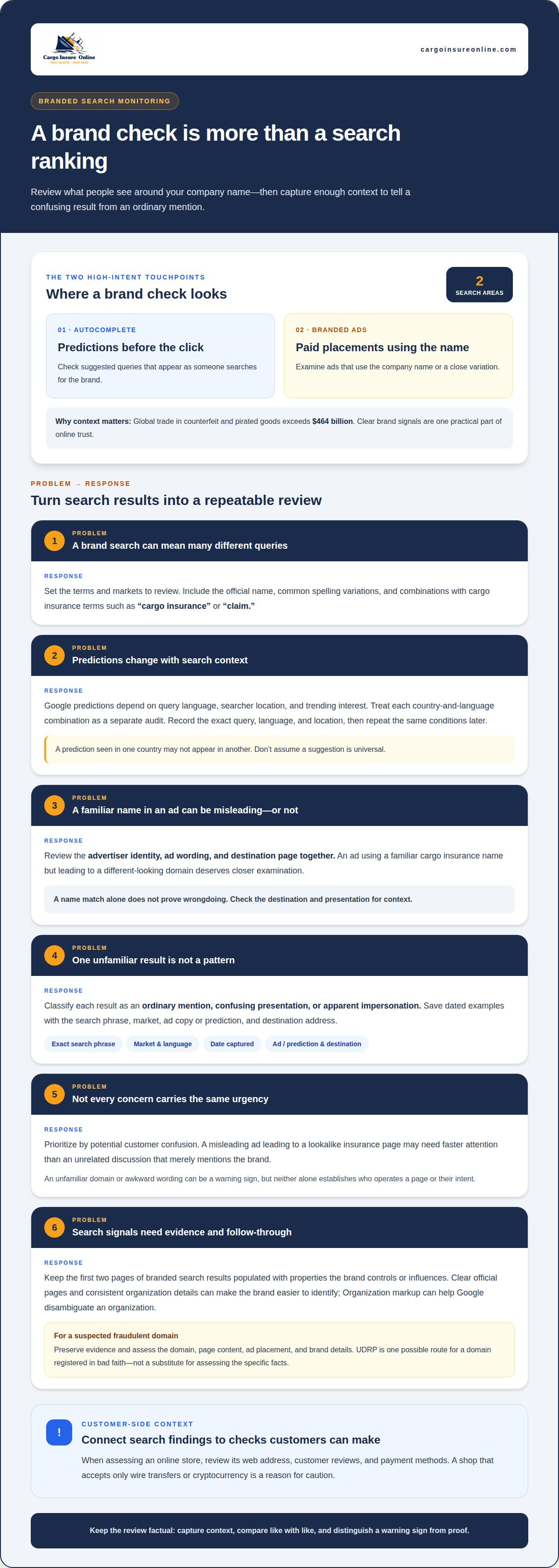
A BrandedEngine check follows how a company’s name appears across search, not just whether its official page ranks. It focuses on two high-intent areas: autocomplete predictions and branded ads. Those results can shape what people see before they reach a company’s site. The global trade in counterfeit and pirated goods exceeds $464 billion, making clear brand signals a practical part of online trust.
Start by defining the brand terms and markets to review. Include the official name, common spelling variations, and combinations with cargo insurance terms. For example, a review might include the brand name followed by “cargo insurance” or “claim.” The aim is to find results that could confuse customers, not to treat every unfamiliar result as impersonation.
Next, review autocomplete in the relevant search context. Google predictions depend on the query language, the searcher’s location, and trending interest. A prediction seen in one country may not appear in another. Record the exact query, language, and location so you can compare results consistently rather than assume a suggestion is universal.
Treat each country and language combination as a separate audit. For an international cargo brand, English-language results in one market may differ from suggestions in another language or location. Record what appears and when, then repeat the same query conditions in later reviews. Brands operating in the election space should check election-related autocomplete predictions daily around election periods.
Branded ad checks examine paid placements using the company’s name or a close variation. Review the advertiser identity, ad wording, and destination page together. For example, an ad using a familiar cargo insurance name but directing visitors to a different-looking domain deserves closer examination. A name match alone does not prove wrongdoing; the destination and presentation provide important context.
Classify each result before deciding how to respond. A practical record distinguishes ordinary mentions, confusing presentation, and apparent impersonation. Capture the search phrase, market, date, ad copy or prediction, and destination address. This makes results easier to compare over time and helps teams distinguish a persistent pattern from a one-off result influenced by changing trends.
- Autocomplete: Record the exact query and prediction, plus its language and location.
- Branded ads: Compare the advertiser, wording, and destination page.
- Evidence: Save dated examples with enough context to revisit them.
- Assessment: Separate confusing results from ordinary brand mentions.
After the review, prioritize results by their potential to confuse customers. A misleading ad leading to a lookalike insurance page may need faster attention than an unrelated discussion that merely mentions the brand. Keep the assessment factual: an unfamiliar domain or awkward wording can be a warning sign, but neither alone establishes who operates a page or their intent.
Brand protection also includes the results customers see after searching. A useful objective is to fill the first two pages of branded search results with properties the brand controls or influences. Clear official pages and consistent organization details can make a brand easier to identify. Google documentation describes Organization markup as a way to help Google disambiguate an organization.
For a suspected fraudulent domain, preserve the evidence and consider an appropriate response for the situation. UDRP is one possible route for addressing a domain registered in bad faith, but it is not a substitute for assessing the specific facts. Review the domain, page content, ad placement, and brand details before choosing how to respond.
Finally, connect search signals to checks customers can make. Someone assessing an online store can review its web address, customer reviews, and payment methods. A shop that accepts only wire transfers or cryptocurrency is a reason for caution. A BrandedEngine review brings these search touchpoints into a repeatable process, helping teams spot confusing brand use and decide what evidence merits action.
What do customers say about Branded Engine?
Customer feedback about Branded Engine is most useful when it describes specific, attributable experiences, rather than relying on the product name. A helpful review explains what the customer checked, which market or language mattered, and what changed afterward. Without those details, a short rating cannot show whether the service addressed autocomplete, branded ads, or another concern.
Look first for comments that describe the task. For example, a review might explain that a team needed to examine a brand name in English and another language. That detail says more than a general statement such as “easy to use.” It connects the opinion to a real monitoring need and makes the customer’s experience easier to assess.
Next, distinguish feedback about the process from feedback about outcomes. A customer may describe clearer reporting or a more organized review process. Those comments describe the experience, but they do not prove that impersonation stopped or that every misleading result was found. A credible summary keeps these claims separate.
Specific examples help. If a reviewer says a branded ad led to a confusing destination, the relevant details include the ad, the destination, and how the issue was handled. If the feedback concerns autocomplete, the query language and location matter. These details explain the situation without turning one customer’s account into a universal promise.
For Branded Engine, customer opinions are most useful when they answer practical questions:
- Scope: Does the account say whether the review covered autocomplete, branded ads, or both?
- Context: Does it identify a market, language, or example search?
- Process: Does it describe how findings were presented or prioritized?
- Outcome: Does it distinguish a detected concern from a resolved issue?
- Timing: Does it explain when the experience occurred, so readers can judge its relevance?
These checks matter because search results change with context. Google autocomplete predictions depend on query language, location, and trending interest. A customer describing a search in one location is reporting that particular experience. Readers should not assume the same prediction appears for every customer, country, or search session.
Read review wording closely, too. “We found a suspicious ad” describes a finding. “The ad was removed” describes a later development. These are different claims. A careful customer story identifies what happened and avoids implying that detection automatically prompted a platform or domain owner to act.
Look for balance, too. A helpful review can explain what the customer valued and what required follow-up. For instance, a team might appreciate a clear record of a questionable domain while still needing to decide how to respond. Specific limits make feedback more informative, not less persuasive, because they show what the experience did and did not cover.
When comparing comments, prioritize recurring, detailed themes over isolated praise. Several accounts describing clear evidence records may suggest that documentation matters to users. A single broad compliment cannot establish that pattern. Before drawing a conclusion, check whether each account concerns the same service, use case, and type of search review.
Ultimately, customer feedback can help assess whether a monitoring process feels clear, relevant, and actionable. It cannot replace examining the evidence behind a suspected impersonation or establish what will happen in another case. For the related shipment-risk side of the picture, explore coverage considerations for freight shipments.
Cargo Insure Online: Air Freight Insurance
Cargo Insure Online offers Air Freight Insurance for businesses seeking protection for goods transported by air. When a shipment’s route, value, or handling needs attention, this coverage may be a relevant next step alongside brand-protection measures. Search monitoring addresses how customers encounter a business online; cargo insurance addresses financial risks associated with freight operations.
For goods moving by other modes, Cargo Insure Online offers Sea Freight Insurance and Trucking Insurance. GAP Insurance may also be relevant when a business is considering a gap in its cargo protection. The right option depends on the shipment and the risk to address, so consider the transport mode and coverage need together.
To discuss Air Freight Insurance for your cargo, contact Cargo Insure Online.
Turn Brand Awareness Into a Clear Next Step
Use what you learn from brandedengine monitoring to guide a practical response. Record suspicious search placements, assess the evidence, and decide what needs attention. This supports online brand awareness, while cargo insurance addresses a separate concern: financial exposure when goods move through the supply chain.
Cargo Insure Online offers Air Freight Insurance, Sea Freight Insurance, and Trucking Insurance for businesses seeking coverage suited to their freight’s transport mode. Consider the shipment and the protection you need, then explore the relevant option. Clear decisions start by separating digital impersonation concerns from cargo risks and addressing each with an appropriate next step.
For a conversation about cargo insurance for your freight, contact Cargo Insure Online. Take the next step with clarity and keep your business moving forward.


