

A proof of delivery signed without exception can make cargo claim recovery harder, but it doesn’t automatically end the claim. A clean receipt is evidence that freight arrived in apparent good order, not conclusive proof of its condition. Timely photos, inspection records, and other evidence may help establish what happened. A cargo claim seeks compensation for damaged or missing goods, while a deduction reduces a payment, often creating a separate freight-billing dispute.
It’s easy to assume that signing a clean receipt leaves no way to pursue a claim. That isn’t always true. The key is to document the damage, preserve the evidence, and present a clear account of the loss.
This guide explains how an unqualified delivery receipt affects a claim, which documents to gather, and how to inspect freight and assess carrier liability. You’ll also learn what to do when damage appears only after delivery and how cargo insurance may help when carrier recovery falls short.
Key Takeaways
- A clean proof of delivery can make a cargo claim harder to prove, but it doesn’t automatically end your options. Build a clear record of when and how the damage was discovered.
- Gather the bill of lading, proof of delivery, value documents, photographs, and inspection records to support your claim.
- Inspect freight before signing: count the pieces, note visible damage or shortages on the receipt, and photograph the shipment’s condition.
- For concealed damage, preserve packaging and notify the carrier promptly, then document the damage and the loss amount.
- Review the applicable contract terms and carrier-liability exceptions, and consider cargo insurance when carrier recovery may not cover the loss.
Common carrier liability exceptions
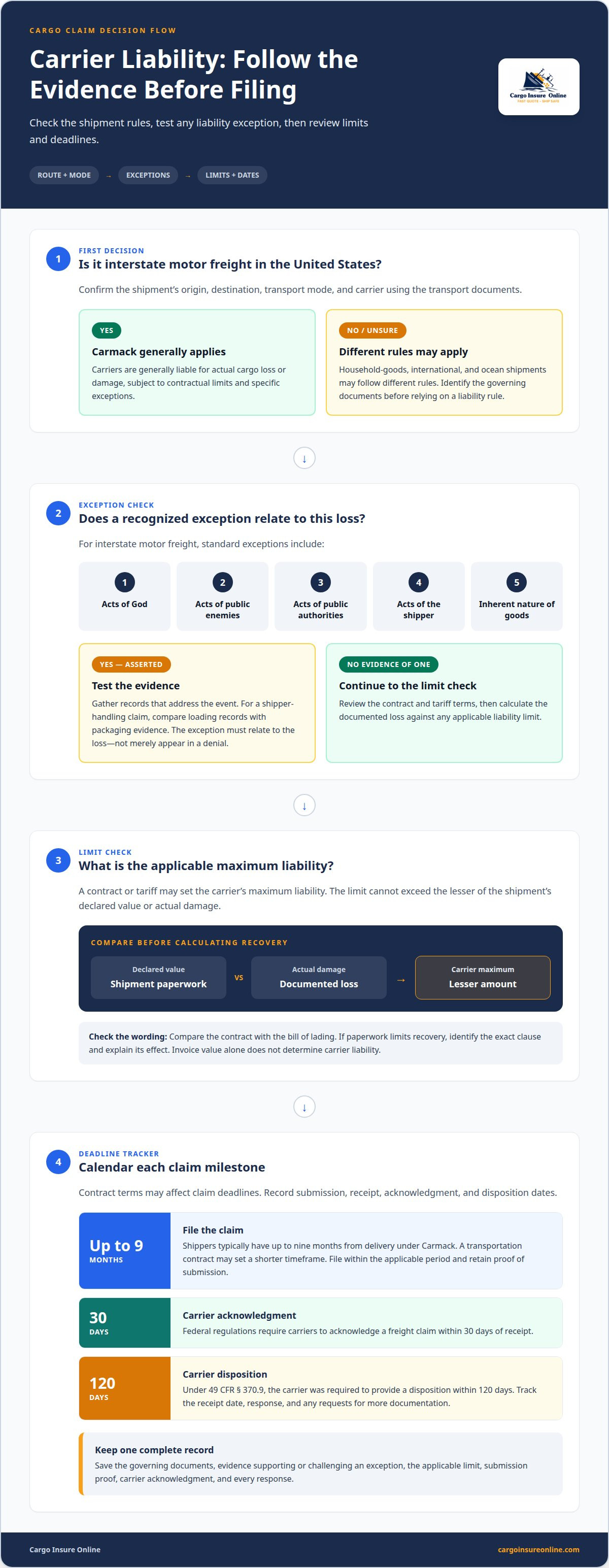
Yes. The Carmack Amendment generally applies to interstate motor freight in the United States. Household-goods, international, and ocean shipments may follow different rules. Before applying a liability rule, identify the route, transport mode, and governing documents.
Carrier tariffs and bill of lading terms may set claim deadlines, liability limits, and other conditions. If a contract exists, its claim terms may supersede the carrier’s base tariff. Compare the contract with the bill of lading before filing.
- Confirm the route and carrier type. For interstate motor freight in the United States, the Carmack Amendment generally makes carriers liable for actual cargo loss or damage, subject to contractual limits and specific exceptions. The applicable rules may vary depending on the shipment and its transport arrangements. Check the shipment’s origin, destination, mode, and carrier against the transport documents before relying on Carmack protections.
- Check whether an exception applies. For interstate motor freight, standard exceptions include acts of God, acts of public enemies, acts of public authorities, acts of the shipper, and the inherent nature of the goods. Gather evidence that addresses the event. For example, compare loading records and packaging evidence if the carrier says shipper handling caused the damage. An exception must relate to the loss, not merely appear in a denial.
- Read the liability limit before calculating recovery. A contract or tariff may set the carrier’s maximum liability, which cannot exceed the lesser of the shipment’s declared value or actual damage. Compare that limit with the documented loss and declared value. If the paperwork limits recovery, identify the exact clause and explain how it affects the amount claimed. Don’t assume the invoice value alone determines carrier liability.
- Calendar the filing and response dates. According to the U.S. House Office of the Law Revision Counsel, shippers typically have up to nine months from delivery to file under the Carmack Amendment, although a transportation contract may set a shorter timeframe. File within the applicable period and retain proof of submission. According to the Office of the Federal Register, National Archives and Records Administration, federal regulations require carriers to acknowledge a freight claim within 30 days of receipt.
- Track the carrier’s disposition. Under 49 CFR § 370.9, the carrier was required to provide a disposition within 120 days, according to the Office of the Federal Register, National Archives and Records Administration. Record the claim’s receipt date, acknowledgment, and response. If the carrier asks for additional documentation, preserve the request and your reply so the file shows what was submitted and when.
How an unqualified POD signature affects concealed-damage claims
A clean receipt records apparent good order, so later damage requires evidence explaining when it became visible. Cargo claim recovery after a proof of delivery is signed without exception starts with a clear timeline and careful documentation.
-
Record Visible Damage Before Signing
Inspect freight before signing, and note each visible problem or shortage on the delivery receipt. Identify the affected carton, pallet, or item, and describe what you see, such as a puncture, crushed corner, or wet packaging. Don’t rely only on “subject to inspection.” A specific notation gives the carrier a concrete discrepancy to assess.
Photograph the freight and the receipt notation before unloading or moving affected goods. Keep a copy of the signed document with the images. If several cartons have different problems, record each separately so distinct damage isn’t blurred into one general statement.
-
Document Damage Found After Delivery
Notify the delivering carrier as soon as you discover concealed damage, and record when you found it. Photograph the product and packaging before handling or disposal. Keep the packaging, as its condition may help show whether crushing, impact, or another event occurred during transportation.
Record who opened the shipment, what they found, and where the goods were stored. This helps distinguish damage discovered during unpacking from damage caused by later handling. A clean receipt can complicate cargo claim recovery, but it doesn’t prevent you from presenting evidence that challenges its record of apparent condition.
- Build a visual record that shows a sequence. Take a wide photograph showing the shipment’s location, followed by closer images of the packaging and damaged goods. Keep the original files and note when each image was taken. For example, images of an intact outer carton beside a damaged item may help explain why the problem wasn’t apparent at delivery.
- Match each record to the affected freight. Use item numbers, carton markings, or shipment references to connect photos, inspection notes, and the proof of delivery. If an invoice identifies goods by model or product code, use the same identifier in your notes. Consistent identifiers make it easier for reviewers to follow the evidence and identify each item.
- Prepare a concise explanation for filing. State what the receipt records, when you discovered the damage, and which evidence supports your account. A proof of delivery signed without exception can complicate cargo claim recovery, so explain the difference between the apparent condition at receipt and the concealed damage found afterward. Keep your account factual and consistent with dated records.
What Documents are Required to File a Freight Claim?
Build one claim file that connects the shipment, the damage, and the amount lost. Organize documents by purpose, then identify any missing evidence before filing.
-
Gather Transportation Documents
Gather the document recording the shipment’s carriage: a bill of lading, airway bill, ocean bill of lading, or truck bill. Add the carrier invoice and proof of delivery, such as a signed delivery receipt, drop trailer receipt, or receiving sheet. Check that shipment identifiers, delivery details, and names match across the records. Mismatches can make it harder to connect the claim to the freight.
Keep the original bill of lading and a readable copy of every supporting record. A carrier invoice can help identify the movement, while the proof of delivery records receipt. If a receiving sheet includes handwritten changes, preserve the full page so the claim file shows the complete document.
-
Capture Photographic Evidence
Photograph each damaged item, its packaging, and the wider shipment scene. Include close views that show the specific defect and wider views that identify the carton, pallet, or surrounding freight. Images should have at least 2 megapixels of resolution. Keep the original files and record when they were taken, so the photographs remain useful evidence of what occurred.
Pair each image with a short note identifying the item and the damage shown. For a broken electronic device, for example, photograph both the damaged component and its packaging. Keep packaging materials for inspection, and document their condition before disposal.
-
Assemble the Claim File
Add proof of value, such as a commercial invoice, sales contract, or bill of sale. If there’s no invoice, a screenshot of an internal accounting page may support the value. Include inspection reports or photographs, plus a quality assessment report for technical products such as electronics, pharmaceuticals, or medical equipment. These records should identify the affected goods and support the claimed loss.
For repairable goods, include a repair quote showing the work needed to restore them to good working order. A police or accident report may support an account of an incident during transportation. If damaged goods are disposed of, retain proof of disposal when available, especially if they weren’t salvaged.
- State the loss clearly. Write a claim statement identifying the commodity, extent of damage, and claimed value. Itemize the amount and explain the circumstances, linking each part to its supporting document. For most freight claims, the loss is the invoice value of damaged or missing goods less salvage value. Applicable terms may also allow freight charges on the damaged portion, disposal costs, or rework.
- File promptly, then supplement. Submit the freight claim even if the damage assessment or supporting documents aren’t complete; provide additional material afterward. Preserve a copy of the claim and the filing confirmation. Incomplete or missing documentation accounts for 35-40% of freight claim denials, so use a simple index to match each allegation to its evidence and supporting value record.
Inspecting freight before signing the proof of delivery
Use delivery time to create a clear record of condition, not just to collect a signature. A careful inspection can reveal shortages or damage before the freight leaves the receiving area.
- Count every freight piece against the paperwork. Compare cartons, pallets, or other handling units with the bill of lading and delivery documents. Record each missing or extra piece before signing, and identify the affected line or item. A count discrepancy is easier to investigate while the driver and freight are present. State what’s missing instead of relying on a general note.
Inspect visible surfaces, corners, wrapping, and pallet stability. Before unloading, photograph the freight inside the trailer, the pallet condition, and any shifted or fallen stacks. These images show the shipment’s arrangement at delivery, rather than only its condition after handling begins.
- Describe visible problems on the receipt. Write the specific condition beside the relevant shipment entry, such as “two cartons crushed” or “one pallet missing.” Avoid vague wording such as “damaged” when you can identify the item and type of damage. A clear notation links the delivery record to the discrepancy and gives the carrier a concrete reason to investigate.
Keep a copy of the completed receipt and match its details to your photographs. If the driver can’t wait for a full inspection, document what you can observe and note any visible exception before signing. A clean receipt can complicate later proof, so don’t treat a signature as a substitute for recording the freight’s condition.
- Keep cargo claims separate from invoice deductions. A cargo claim seeks compensation for damaged or missing freight. A deduction reduces a payment, often in a freight-billing dispute. These are different issues. Keep the claim evidence and freight invoice together for reference, but identify each action separately. Before disputing an invoice, connect the charge to its billing record and applicable terms.
- Check common denial reasons before filing. Packaging may be challenged as inadequate and treated as an act of the shipper. Carriers cite inadequate packaging in approximately 25% of freight claim denials. Photograph packaging from multiple angles and retain it when damage is discovered. Also track filing deadlines in the contract and tariff; missed deadlines account for 20-25% of denials. In interstate motor freight, the Carmack Amendment provides the governing framework, subject to applicable terms and exceptions.
- Keep the freight broker informed. If a broker arranged the logistics, send them copies of the receipt, photographs, and written notice. Also direct the claim to the carrier named in the transportation documents, and keep proof of each submission. A broker’s records may help trace the shipment or clarify communications, but don’t let coordination delay documenting the damage or pursuing the carrier claim.
Consequences of signing a delivery receipt without exceptions
A clean delivery receipt records apparent good order, which can make later damage harder to prove. Treat it as evidence, not the final word on what happened.
-
Review Delivery Receipt Notations
Compare the signed delivery receipt with the proof of delivery, and keep a complete copy of both. These documents record that the consignee received the shipment, while a notation can identify a visible exception. Check that the notation names the affected freight and describes its condition. “Subject to inspection” is less specific than identifying crushed cartons or a missing pallet.
Match each notation to the shipment details and delivery record. If the receipt lists a shortage but the proof of delivery appears clean, preserve both versions. The difference matters: the shipper can show what was recorded at delivery and flag the discrepancy for review.
-
Understand the Effect of Missing Exceptions
Use evidence to explain why a clean receipt doesn’t reflect the goods’ actual condition. A signature without an exception is prima facie evidence that freight arrived in apparent good order, but it isn’t conclusive proof. For concealed damage, gather dated photographs, inspection notes, and prompt notification showing when the damage became visible.
Build a timeline from delivery through discovery and reporting. Record, for example, who opened a sealed carton, what they found, and when they contacted the carrier. This account helps address the gap created by the clean receipt without claiming that a signature alone proves where the damage occurred.
- Separate delivery confirmation from acceptance of condition. Read the wording beside the consignee’s signature. A signature confirms receipt, but a clean notation can be used to argue that no apparent damage existed at delivery. It doesn’t describe concealed damage that became visible only after unpacking. Keep the original record intact; don’t alter a receipt later to add an exception.
- Connect the evidence to the shipment’s origin and handling. Compare dispatch records, packaging condition, and delivery documents. A claim is stronger when each record refers to the same goods and describes a consistent sequence. For example, note whether the packaging showed impact marks when opened, and preserve it alongside photographs. These details may help explain whether the damage occurred during transportation.
- Present actual loss, not an unsupported estimate. Identify the affected goods, explain the damage, and show how you calculated the claimed amount. Attach value records and any repair assessment to the relevant items. If goods can be repaired or salvaged, record the outcome in the claim file. An item-by-item account helps distinguish actual damage from unrelated supply or billing issues.
Cargo Insure Online: Air Freight Insurance
Cargo Insure Online offers Air Freight Insurance for businesses seeking protection for goods moving by air. It complements, rather than replaces, a carrier claim and doesn’t repair a claim already underway. Consider insurance before a future shipment, alongside reviewing delivery records, carrier terms, and the value of the goods being transported.
For shipments moving by sea or road, Cargo Insure Online offers Sea Freight Insurance and Trucking Insurance for those transport modes. Insurance may be worth considering when assessing financial exposure beyond carrier liability. Choosing cover before transit makes risk planning part of the shipping process, rather than a decision made after damage appears.
Explore your cargo insurance options or contact Cargo Insure Online at cargoinsureonline.com.
Build stronger protection into the next shipment
Use each delivery as a chance to improve the next one. Make exception recording part of receiving procedures, assign responsibility for inspection, and keep claim documents together. These habits create a clearer record if a future shipment arrives damaged or short.
Recovering a cargo claim after signing a proof of delivery without exception can be more difficult, but you can plan ahead for your next shipment. Consider how the route, goods, and possible loss affect your risk planning. Cargo Insure Online offers Air Freight Insurance, Sea Freight Insurance, and Trucking Insurance for those transport modes.
For a conversation about cargo insurance options, contact Cargo Insure Online. A practical plan can help you move forward with greater clarity and confidence.
Frequently Asked Questions
What Is a Cargo Claim, and How Is It Different From a Deduction?
A cargo claim seeks compensation for goods lost or damaged during transportation; a deduction reduces a payment owed, often on a freight invoice. They’re separate actions. For example, a consignee might claim for damaged cartons while separately disputing an unrelated billing charge. Keep the claim notice distinct from any invoice adjustment, and identify the shipment and issue in each communication.
How Do Claim Deadlines Actually Work?
Deadlines depend on the shipment’s route, transport mode, contract, and applicable tariff. For interstate U.S. freight claims under the Carmack Amendment, shippers typically have up to nine months from delivery to file, according to the U.S. House Office of the Law Revision Counsel. A transportation contract may shorten that period. A separate time limit applies to lawsuits, so record each deadline independently.
What Evidence Does a Defensible Claim Need?
A defensible claim connects the shipment’s condition, the event, and the value of the loss. Keep records establishing the goods’ identity and condition, then link each damaged item to a photograph, inspection finding, or value document. For example, label images with the carton or item number shown on the invoice. A dated sequence of receipt, discovery, and carrier notice helps explain when the damage became apparent.
Does a clean signed proof of delivery bar a cargo damage or loss claim in the United States?
No. A clean proof of delivery is evidence that freight arrived in apparent good order, but it doesn’t automatically bar a claim. It can make the claim harder to establish, especially for damage discovered later. You may still present evidence that contradicts the receipt. Preserve records showing the shipment’s condition and explain why the signed document didn’t reveal the loss or concealed damage.
What is the legal effect of signing a bill of lading or delivery receipt without exceptions?
A clean delivery receipt is prima facie evidence that goods arrived in apparent good order, not conclusive proof of their condition. The consignee may present evidence to the contrary. A bill of lading also records shipment details and carriage terms, so read its specific wording. Keep the signed document unchanged and preserve separate inspection or receiving records that clarify what the signature does and doesn’t show.
Can a consignee recover for concealed cargo damage discovered after delivery?
Yes. A consignee may pursue a concealed-damage claim, although a clean receipt can make the loss harder to prove. Notify the delivering carrier immediately after discovery, record when the damage appeared, and preserve the packaging. For example, photograph the opened carton and damaged contents together. Prompt notice and a clear timeline help distinguish damage found after delivery from damage visible at receipt.
What deadlines apply to filing cargo claims under the Carmack Amendment?
For interstate U.S. freight, the filing period is typically up to nine months from delivery under the Carmack Amendment, according to the U.S. House Office of the Law Revision Counsel; a contract may require an earlier filing. A separate time limit may apply to lawsuits over covered loss or damage. Treat filing and lawsuit deadlines as separate calendar dates, and follow the governing contract terms.
What information and documents must a cargo claim include under 49 CFR Part 370?
A written claim should identify the shipment, allege carrier liability, and state a specific or determinable amount. Include records that support those points, such as the transportation document, delivery record, evidence of value, and damage documentation. Federal regulations require carriers to acknowledge a freight claim within 30 days of receipt, according to the Office of the Federal Register, National Archives and Records Administration. Under 49 CFR § 370.9, the carrier was required to provide a disposition within 120 days.


