

There’s no universal submission schedule for open cargo policy bordereaux. The governing agreement sets the deadline, and reporting is commonly monthly or quarterly. Choosing monthly bordereau reporting or an automated digital policy changes how the data is assembled, not the agreed reporting cadence. In US program business, the required frequency can be monthly or quarterly, depending on the carrier and book size.
Spreadsheets remain familiar because they’re straightforward to use, but collecting and reshaping policy data by hand can add friction. Automation offers another way to prepare reports, while the agreement still determines when they’re due and what information they must contain.
This article explains what a bordereau reports, how monthly and quarterly schedules are set, and what to consider when comparing spreadsheet-based reporting with automation. It also clarifies how cargo insurance fits into the wider picture, so you can understand both the reporting process and the protection behind shipments.
Key Takeaways
- Use the reporting schedule and deadlines in the applicable agreement to determine when each bordereau is due.
- Separate premium reporting from claims reporting: each captures different policy, transaction, and loss information.
- Expect reporting formats to vary across counterparties, including the fields and layout they require.
- Compare spreadsheet workflows with automation by considering how data is gathered, checked, and prepared for submission.
- Automation can prepare reports on a set schedule, but it doesn’t replace the reporting terms in the agreement.
Premium and claims bordereaux
Premium and claims bordereaux report policy transactions and loss activity for an agreed period. In the United States, applicable state insurance requirements depend on the state and policy arrangement. The agreement sets the bordereau frequency and required fields.
Premium and Claims Data
A premium bordereau records written-policy transactions, while a claims bordereau tracks claim activity and losses. These separate reports help parties understand premium, capacity, and claims exposure without mixing financial and loss movements.
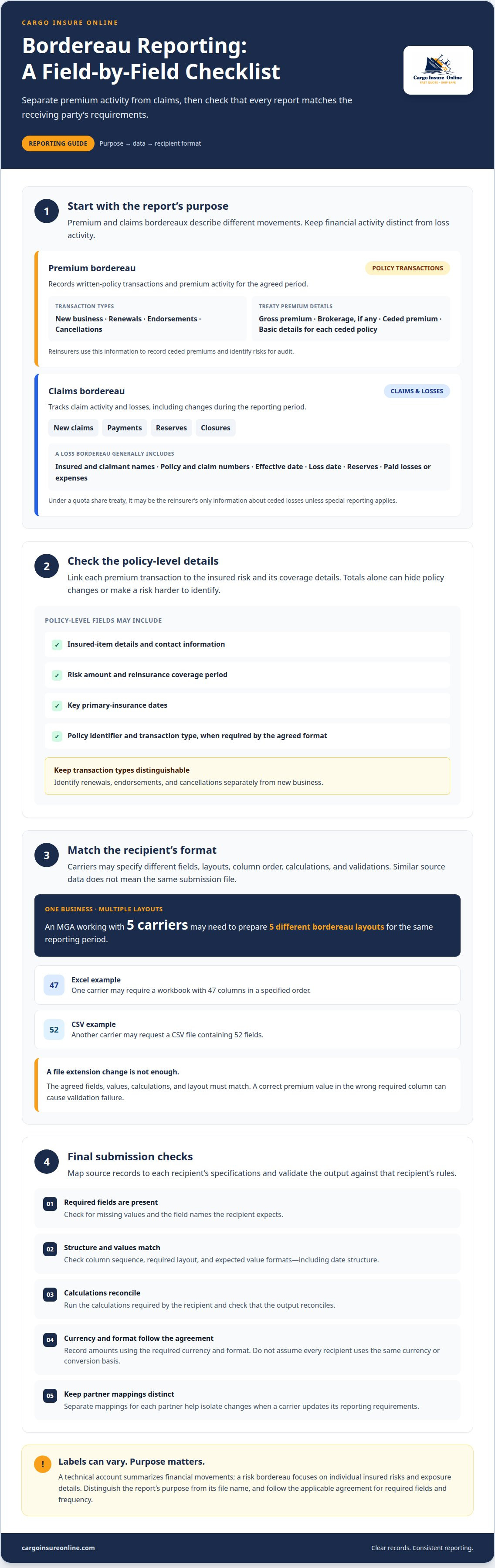
Premium reporting can include new business, renewals, endorsements, and cancellations. A treaty premium bordereau typically lists gross premium, brokerage if any, ceded premium, and basic details for each ceded policy. Reinsurers use this data to record ceded premiums and identify risks for audit.
Claims reporting captures new claims, payments, reserves, and closures. A loss bordereau generally includes insured and claimant names, policy and claim numbers, effective date, loss date, reserves, and paid losses or expenses. Under a quota share treaty, it may be the reinsurer’s only information about ceded losses unless special reporting applies.
A technical account summarizes financial movements for the relevant arrangement, while a risk bordereau focuses on individual insured risks and exposure details. These labels can vary by agreement, so distinguish the report’s purpose from its file name. Record amounts in the currency and format the agreement requires. Don’t assume every recipient uses the same currency or conversion basis.
Policy-Level Reporting Fields
Policy-level reporting links each premium transaction to the insured risk and its coverage details. This matters because totals alone can hide changes to individual policies or make a risk harder to identify.
A premium bordereau may list insured-item details, contact information, risk amount, reinsurance coverage period, and key primary-insurance dates. Include the policy identifier and transaction type when the agreed format requires them. Keep renewals, endorsements, and cancellations distinguishable from new business.
An open cargo insurance policy covers multiple shipments under continuing policy terms, rather than requiring a separate cover arrangement for each shipment. Shipment details and policy terms determine what information is recorded for each insured movement. The bordereau then reports relevant policy transactions for the reporting period.
An automated digital cargo insurance policy uses software to capture policy or shipment information and process it against configured terms. Premium calculations depend on the rating inputs and rules set for the policy; a certificate can be issued from the resulting transaction record. Automation can connect policy, claims, and accounting systems through APIs or data extracts, helping keep report data aligned with those records. It changes the preparation workflow, not the reporting obligations in the agreement.
What is a bordereau in insurance?
A bordereau is a periodic report listing specific insured risks, premiums, or losses for an insurer and its reinsurance partners. In delegated insurance arrangements, it gives the receiving party a structured view of business written during a reporting period. This data can show premium activity and exposure beyond a high-level total. The format matters: recipients need to interpret the report’s fields consistently.
Consistency can break down when a business writes through several carriers. Each carrier may specify its own format, required fields, column order, calculations, and data validations. An MGA working with 5 carriers may need to prepare 5 different bordereau layouts for the same reporting period. The primary policy information may be similar, but one partner’s required column order or field name can differ from another’s. That creates reformatting work before the report is ready to submit.
The differences can be precise. One carrier may require an Excel workbook with 47 columns in a specified order, while another may request a CSV file containing 52 fields. These examples show why changing a file extension alone doesn’t make a report carrier-ready. A submission also needs the agreed fields, values, calculations, and layout. If one carrier expects a premium field in a particular column, placing it elsewhere can cause a validation failure even when the underlying value is correct.
Carrier-specific validation helps catch issues before a file is accepted. Depending on the required format, checks may flag a missing value, an invalid date structure, or a calculation that doesn’t reconcile. Map source records to each carrier’s specifications, then validate the output against that carrier’s rules. Separate mappings for each partner make it easier to isolate changes when a carrier updates its reporting requirements.
- Excel: preserve the carrier’s workbook structure, column sequence, and required calculations.
- CSV: match the requested field names and order, then check that values use the expected format.
- Electronic submission: use the proprietary or common format agreed with the receiving party.
Standardized formats can reduce translation between partners, but they don’t eliminate every carrier-specific requirement. Lloyd’s Coverholder Reporting Standards provide a framework for reports in the Lloyd’s market; individual agreements still determine the applicable reporting details. Maintain a consistent internal record, then map it to each recipient’s required layout. This keeps the underlying information distinct from the format used to deliver it.
For shipment protection alongside clear policy records, explore cargo insurance options.
Manual spreadsheet reporting versus automated reporting
Manual reporting relies on people to collect, reconcile, and format records; automation connects those tasks to data systems. This affects workload and reporting flow, but not the agreement’s submission requirements.
Manual Bordereau Preparation
Manual bordereau preparation involves gathering policy and claims records, then assembling them into the required report. Each handoff creates another opportunity for an error or delay.
A team might export premium transactions, claims, and payments separately, then combine them in a spreadsheet. Staff must reconcile dates, policy references, and amounts before submission. Though “bordereau” entered English from French, a modern spreadsheet still needs careful handling. Open cargo cover describes how shipments are insured; a digital cargo policy describes a technology-led way to administer or issue coverage. The digital approach doesn’t automatically change the cover itself.
Processing Delays and Late Submissions
Manual processing can delay a report when information arrives late or needs correction. Changes entered in one system may take days or weeks to appear elsewhere, leaving the reporting file behind the underlying policy record.
Late submissions can also create operational pressure. Persistent delays of 3-10 days can trigger delegated authority reviews. Administrative effort depends on transaction volume, data sources, and carrier formatting needs; the work often includes gathering records, correcting errors, and preparing files. A specific monetary cost depends on the systems and staffing involved, so the practical comparison is the time and effort each workflow requires.
Integrated Reporting Infrastructure
Integrated reporting infrastructure connects policy administration, claims, and accounting records through APIs or data extracts. Staff can then prepare reports from connected data instead of repeatedly re-entering the same information.
Automation can make changes appear in connected systems immediately and free staff from routine data entry. It can also generate bordereaux on monthly, quarterly, or weekly schedules. Integration still depends on accurate source records and suitable mappings. Validation rules can flag missing fields, while staff review exceptions before submission. The reporting cadence remains the one set by the applicable agreement.
Transitioning to Automated Coverage
A transition starts by mapping the current reporting process, not by abandoning monthly bordereaux. Automation can streamline data capture while existing agreements continue to define reporting deadlines and required information.
First, identify the policy, claims, and accounting records that feed each report. Map those fields to the required outputs and configure checks for missing or inconsistent values. Test the resulting files against current reporting requirements before relying on the automated process. Then assess where data integration can reduce duplicate entry. This approach supports automated cargo insurance administration without treating automation as a substitute for reporting obligations or delegated authority.
Monthly and quarterly bordereau reporting frequency
The underlying agreement sets a bordereau’s deadline and reporting details. In US program business, carriers may require monthly or quarterly submissions, depending on the carrier and book size.
Reporting Cadence
Reporting cadence is the schedule for delivering bordereau data, commonly monthly or quarterly. The submission deadline determines which records belong in each report and when recipients receive them.
For Lloyd’s binding authority contracts, the typical deadline is 30 days after month end. Other agreements can use different dates: one example requires monthly reporting by the 10th of the following month, while another requires quarterly reporting within 30 days of quarter end. These examples show why each agreement needs its own reporting calendar.
A reinsurance contract may call for monthly or quarterly summary accounting without policy-level detail. For example, a summary-accounting clause may require a monthly account. That report can differ from a bordereau listing individual risks. The agreement defines which record is due, its reporting period, and the required level of detail.
Quarterly reporting concentrates operational pressure into three periods each year. Monthly reporting spreads the work across more submission cycles, while quarterly reporting groups activity into fewer, larger periods. Either way, teams must meet the contract deadline. In delegated authority relationships, the binder agreement between the MGA and carrier defines bordereau frequency, format, and submission deadlines.
Monthly Reporting Workflow
Monthly reporting gathers the transactions and exposure records assigned to that month, then submits them in the agreed format by the deadline. For an open cargo policy, the report can capture policy transactions during the period, including new business, renewals, endorsements, and cancellations.
The workflow matters because an omitted endorsement or cancellation can leave the period’s record incomplete. The agreement determines whether the submission lists policy-level detail or provides summary accounting. For example, a monthly bordereau due by the 10th of the following month gives the reporting team a defined cutoff and submission date.
When comparing open cargo policy monthly bordereau reporting vs automated digital policy, distinguish the reporting schedule from the way data is prepared. Automation can support the workflow, but the agreement still determines when the report is due.
For a quarterly arrangement, the same principles apply across the quarter rather than each month. Carrier B’s example requires delivery within 30 days of quarter end. A reinsurance agreement may instead require a monthly or quarterly summary with no policy-level detail. The relationship and contract terms determine which report to prepare.
The open cargo policy monthly bordereau reporting vs automated digital policy comparison also comes down to workflow. Automation can prepare reports on an agreed schedule, but it doesn’t set the contractual deadline. The agreement remains the reference for timing, content, and format. This distinction lets teams streamline preparation while preserving the reporting cadence established for each delegated authority relationship.
Bordereau reporting automation
Bordereau automation turns policy, claims, and accounting records into scheduled reports. It can prepare files monthly, quarterly, or weekly, while the contract still determines the required format, details, and submission deadline. The benefit is a more connected reporting process, not a replacement for contractual reporting.
An automated workflow can draw data from policy administration, claims, and accounting systems through APIs or data extracts. Instead of copying each record between files, the system maps information to reporting fields and produces the required output. For a coverholder working with different agreements, separate mappings can support each recipient’s layout while using consistent source records.
That connection supports underwriting and exposure monitoring. Carriers use bordereau data to review total insured values, geographic and industry concentrations, and accumulated limits. Premium reports also support ceded premium accounting and risk identification. Automation can help align those views with recorded transactions, but inaccurate source data can still produce inaccurate reports.
Claims bordereaux need the same care. They can record new claims, payments, reserves, and closures. If an outstanding reserve changes in a claims system, an integrated report can use the updated record rather than an older spreadsheet entry. For example, a reported reserve of £120,000 may miss a reduction processed three weeks earlier. Timely data connections help expose that mismatch before it travels into another report.
Automation also supports validation before submission. A reporting process can flag a missing policy number, an invalid date, or a total that doesn’t reconcile. Staff can then focus on exceptions rather than checking every field manually. Human oversight remains essential: teams still need to resolve data issues and ensure the report matches the contract.
Start with the required reports, then trace each field to its source. Map premium and claims data separately, define the recipient’s format, and test sample outputs against the agreed requirements. One relationship may require monthly reporting, while another calls for quarterly or weekly reports. Automation should follow those terms, not impose a new cadence. It can also organize premium data by state, line of business, or other required dimensions for regulatory reporting.
For cargo cover decisions, explore cargo insurance options alongside the reporting workflow.
Cargo Insure Online
Cargo Insure Online helps businesses protect freight moving by air, sea, or truck, with insurance options for different transport needs. Bordereau reporting governs how policy and claims information is recorded; cargo insurance addresses the financial risks of goods in transit. They serve different purposes, but both matter in supply-chain management.
Consider Air Freight Insurance, Sea Freight Insurance, Trucking Insurance, or GAP Insurance when assessing how shipment risks fit your wider coverage. The right option depends on the freight movement and protection required, not on whether reporting is handled in a spreadsheet or through automation.
Make your next cargo decision with clarity
Choose a reporting approach based on the records your business needs to manage, then consider cargo protection separately. Monthly bordereau reporting for an open cargo policy and an automated digital policy address different parts of the operation: one governs how policy activity is reported, while the other describes a digital way to manage coverage. Keeping those decisions distinct makes your next review more focused.
For shipments moving by air, sea, or truck, Cargo Insure Online offers Air Freight Insurance, Sea Freight Insurance, and Trucking Insurance. Consider how your goods move and which risks your cargo operation needs to address. Clear reporting supports administration; suitable insurance helps protect freight in transit.
Ready to discuss cargo protection for your shipments? Contact Cargo Insure Online to explore the available options. A practical next step can bring your coverage decisions into sharper focus.
Frequently Asked Questions
How often does a bordereau need to be submitted?
A bordereau is submitted on the schedule set by the relevant agreement, commonly monthly or quarterly. For US program business, the carrier and book size can affect the required cadence. The binder or reinsurance contract also defines deadlines and report details. If a relationship uses different agreements, each may have its own calendar, so don’t apply one reporting schedule automatically across every book.
An Analogue Relic in a Digital World?
No. A bordereau remains a practical way to communicate detailed insurance records, even though the process has moved from paper to electronic files. Excel and CSV are common formats, while some recipients use proprietary layouts. Distinguish the report’s purpose from its delivery method: a digital file can carry the same detailed risk or claims information as a paper schedule.
What data goes into a bordereau?
The data depends on whether the report covers premiums, claims, or another agreed account. A premium report, for example, can distinguish new business from renewals and endorsements, while a claims report can track payments, reserves, and closures. Some agreements allow aggregate summaries when individual-risk detail is excessive. The receiving party’s reporting requirements determine the level of detail in the submitted file.
Who prepares and uses a bordereau?
The cedant, the party that has ceded business to a reinsurer, prepares the bordereau. Reinsurers use premium data to record ceded premiums and identify risks for audit. They can also use the information to assess potential liabilities and forecast premiums. Carriers use reported exposure information to monitor accumulations, such as geographic concentration or total insured values, across the business they receive.
What information must a cargo bordereau include?
The applicable agreement determines the required fields. A cargo premium report may identify the policy and insured item, risk amount, coverage period, relevant primary-insurance dates, and premium transaction. A claims report can include claim identifiers, loss dates, reserves, and paid amounts. For a shipment endorsement, make the transaction clear in the recipient’s required format.
How often are cargo declarations and premiums reported under an open policy?
The agreement sets the reporting cadence; open cargo cover doesn’t create a universal schedule. It may require monthly or quarterly bordereaux, with the report capturing transactions assigned to each period. A shipment declaration and a premium account are related records, but their submission details depend on the policy and reporting terms. The applicable agreement determines what to report and by what deadline.
What are the risks of late, inaccurate, or missing cargo reporting?
Late or incomplete records can leave carriers and reinsurers with an outdated picture of premiums, claims, or accumulated exposure. A missing endorsement, for example, can make a period’s policy record incomplete. Inaccurate bordereau data can also weaken premium forecasts and liability assessments. For carriers compiling reports by state or line of business, missing fields can make those summaries less reliable.


