

The sales contract, not the shipping label, determines whether the buyer or seller has primary responsibility for insuring a shipment. For bulk smartphone shipment transit insurance, the Incoterms or other sale terms set that responsibility, while the policy explains who can file a claim and what evidence is required. This distinction matters if a delivery arrives damaged or goes missing.
It may seem that whoever paid for shipping should handle the claim, but payment alone does not decide responsibility. The agreed sale terms and policy wording do. Clear shipment records, device details, and photographs can also help support a claim.
This guide explains how claim responsibility works, how declared shipment value affects premiums, and what to check in coverage, limits, exclusions, and insurance options. Use it to assess protection across a shipment’s journey, from dispatch to delivery, without confusing carrier liability with cargo insurance.
Key Takeaways
- Compare all-risk, named-perils, and total-loss coverage by the events and types of loss each policy responds to.
- Use the sales terms and policy wording to understand who can file a claim, then keep shipment records and damage evidence organized.
- See how declared value shapes the premium, including why cargo valuation may use CIF plus 10% for additional shipment expenses.
- Review exclusions such as improper packaging and limits such as COGSA’s $500 per shipping unit before assessing potential gaps.
- Match per-shipment or open cargo coverage to shipping frequency, and align protection with the transport modes in your logistics chain.
Shipping Insurance for Electronics: Is It Worth It?
Cargo insurance can protect smartphones against physical loss or damage during covered transit. The policy defines the protection.
Cargo insurance protects the insured goods directly. Carrier liability is separate from cargo insurance, and recovery can depend on the circumstances of the loss.
Carrier liability may be limited and does not provide the same protection as cargo insurance. For ocean freight, COGSA limits carrier liability to $500 per shipping unit. These rules address carrier liability, not the full scope of cargo-policy coverage.
Transit Coverage Types
All-risk coverage generally protects against physical loss or damage, subject to policy exclusions. Named-perils coverage applies only to causes listed in the policy, such as theft or fire. Total-loss coverage responds when the entire insured shipment is lost or destroyed, not when only some phones are damaged. Compare these terms with the partial losses your business could absorb.
Loss, Damage, and Theft Protection
Transit coverage may address stolen, missing, or physically damaged electronics while they are on a covered conveyance. Water and moisture damage may also be covered, depending on the policy. A screen broken by impact across part of a packed shipment is a different loss from cargo theft. Check whether the policy covers partial damage, a missing carton, and loss of the full shipment.
Geographic and Route Coverage
Geographic coverage defines where protection applies, while route terms identify the journey and transit stages covered. A cargo policy may cover goods from pickup through final delivery, including border transloading. This matters when a shipment changes conveyance or passes through an intermediate country. Compare the insured origin and destination with the actual itinerary, including planned transfers between air, sea, and truck.
Covered Electronics and Cargo
Smartphones can be insured as electronic cargo alongside tablets, computers, and other high-value devices. The policy’s description of insured goods matters: the item, quantity, and shipment value should match the cargo packed. For a mixed electronics load, check whether accessories and different device types are included in the covered-goods description. Accurate details help align the insured volume with the shipment.
The value at risk helps show whether separate cargo protection is worth considering. Additional insurance is recommended for electronics worth more than USD 200. For bulk smartphone shipment transit insurance, consider the combined exposure across the load, not only the value of one handset. A covered loss may affect many units at once, while carrier liability follows separate rules and may not match the goods’ full value.
Coverage also depends on the cause and timing of a loss. A policy covering physical loss or damage during transit does not automatically protect against every business impact. Cargo insurance generally covers physical loss or damage, not financial losses caused by delayed delivery. If phones arrive late but undamaged, that delay-related loss differs from stolen or broken cargo. Review the policy terms against the specific risks along the route.
Can a buyer file the shipping insurance claim, or does the seller?
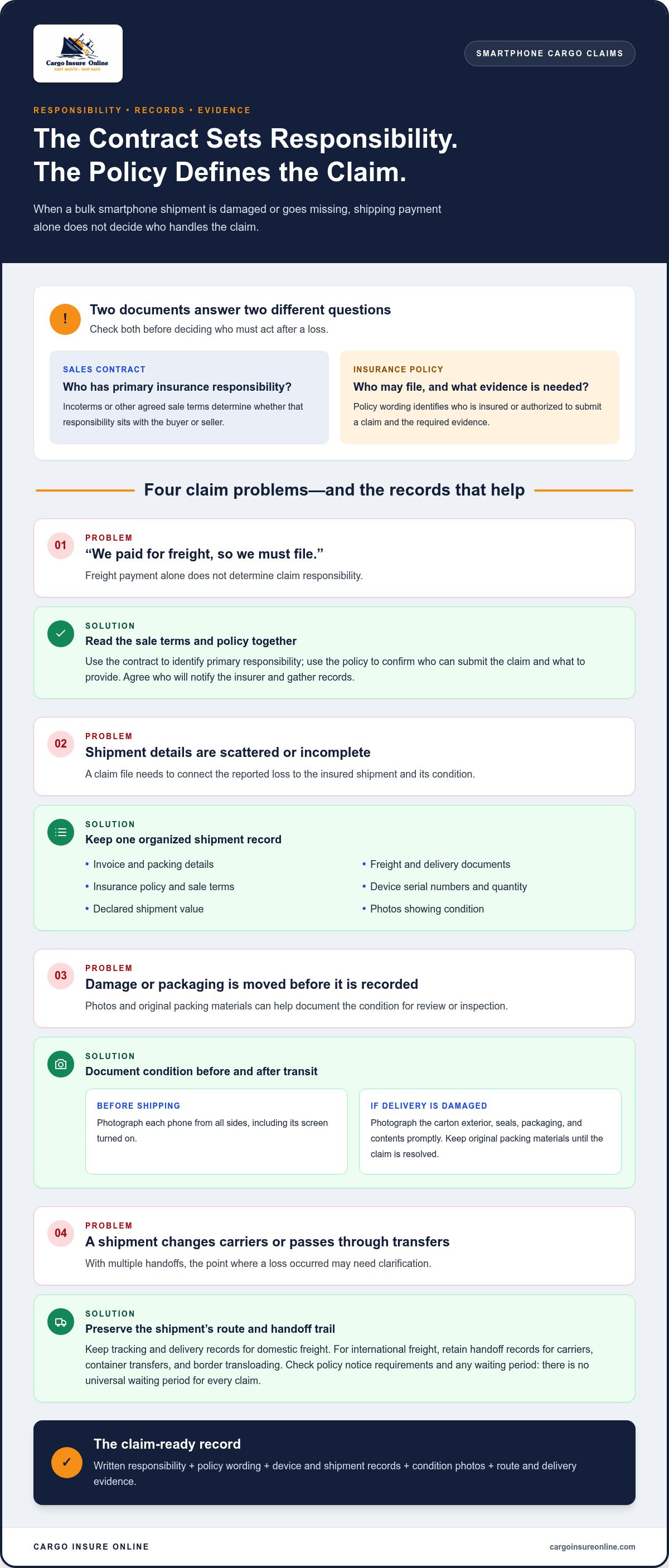
The sales contract’s Incoterms or other sale terms determine primary insurance responsibility. The policy identifies who may file a claim and what evidence is required.
Claims Documentation
A claim file connects the reported loss to the insured shipment and its condition. Keep the invoice, packing details, freight documents, and insurance policy together. Record each device’s serial number, shipment quantity, and declared value. If delivery is damaged, photograph the damage and packaging promptly, before discarding anything. Keep the original packing materials until the claim is resolved.
Before shipping, the seller should photograph each device, including all sides and its screen turned on. These images document the phones’ pre-shipment condition. Accurate shipment records also help distinguish damaged units from missing ones. For a container with mixed electronics, keep records linking affected cartons to their contents. Packaging, security measures, and clear documentation can affect the insurer’s claim assessment and the application of relevant exclusions.
Shipment Records for Claims
Shipment records create a traceable account of the cargo from dispatch through delivery. Keep serial-number lists, shipping documents, delivery records, and photographs with the sales terms. If a buyer receives a damaged carton, photograph its exterior, seals, and contents before moving or disposing of the packaging. The seller should retain the original materials because they may be needed for carrier inspection.
Who files a claim depends on the contract and policy, not simply on who arranged the freight. The sale terms may assign primary responsibility to the seller or buyer; the policy also determines who is insured or authorized to submit a claim. Shipping directly from seller to buyer does not change those written arrangements. Both parties should know who will notify the insurer and gather records if a loss occurs.
Domestic and international claims do not have one universal waiting period. Policy terms set notice requirements and any waiting period before cargo can be treated as lost. For domestic freight, tracking and delivery records can help establish the shipment’s status. International freight may involve multiple carriers, container transfers, and border transloading, so handoff records can help clarify where the loss occurred. Claim turnaround depends on the evidence, inspection needs, and whether the loss is covered.
Report damage or missing cargo promptly under the policy’s notice requirements, then preserve relevant evidence. Don’t discard packaging or alter the shipment before documenting its condition. For cargo insurance coverage, clear shipment records make the route, goods, and reported loss easier to assess. Keep communication and submitted documents organized, so the buyer and seller can track the claim without duplicating or contradicting information.
Calculating premiums from declared shipment value
Declared value is a key input to the premium, but not the only one. Cargo premiums also depend on the goods, transport mode, origin and destination, and the shipper’s claims history. For smartphones, total shipment value matters because one loss can affect many devices. An accurate declaration helps align the insured amount with the financial exposure.
A common cargo-policy valuation basis is CIF plus 10%. CIF accounts for the goods’ cost, insurance, and freight; the additional 10% allows for possible extra shipment expenses, currency fluctuations, or variable freight costs. The policy’s valuation clause explains how that basis applies. Don’t assume the declared figure automatically includes every expense or determines the amount payable for every claim.
For example, a business shipping $50,000 worth of product each month has recurring exposure to cargo loss. For a single shipment, start with the commercial invoice and the number of devices being sent. Then identify the policy’s valuation basis and include eligible freight or other costs as its terms require. Keep the calculation consistent with the documents supporting the shipment.
Under-declaring can leave a gap between the shipment’s insured value and its commercial exposure. Over-declaring does not create protection beyond the policy terms or the loss assessed. A useful declaration should be supportable, consistent, and based on the correct goods and quantity. For mixed electronics, distinguish smartphones from accessories so the declared value reflects the cargo packed for transit.
Carrier declared-value coverage and cargo insurance work differently. Additional carrier declared-value coverage is calculated against the extra value declared to the carrier, while a cargo policy provides protection under its own terms. For U.S. trucking, carrier liability under the Carmack Amendment is based on declared value. This liability framework is separate from the cargo policy’s premium calculation and coverage conditions.
Accurate valuation is especially important for high-value electronics. A bulk load may include devices with different models, unit values, or destinations. Use invoices and shipment records to support the total, and account for currency conversion if the sale and policy use different currencies. The valuation basis should match the policy, not an informal estimate or retail price unrelated to the transaction.
Before shipment, compare the declared amount with the invoice, packing list, and freight details. Check that the policy’s covered goods and route match the devices being shipped. For a quote, the premium depends on shipment value, goods, transport mode, route, and claims history; it’s provided after a quote request. This gives the insurer a consistent basis for assessing the shipment without treating carrier liability as a substitute for cargo coverage.
Policy terms, limits, and exclusions
Policy wording determines which smartphone losses qualify, how much protection applies, and what the insured must pay. Lithium-ion battery rules are relevant: UN 3481 classifies batteries contained in or packed with equipment, and smartphone battery shipments are subject to IATA air-freight and IMO ocean-freight dangerous-goods regulations.
Cargo Insurance Exclusions
An exclusion removes a cause of loss or circumstance from coverage, even when the shipment suffers physical damage. Improper packaging may be excluded for electronics, so damage to a carton packed without adequate protection can create a coverage issue. Before dispatch, check the policy’s packaging conditions against the actual packing method.
All-risk coverage still has exclusions: “all-risk” does not mean every event is insured. Distinguish transit damage from losses caused by an excluded circumstance, and read any conditions tied to the route or handling. Seizure or regulatory problems differ from physical loss during transit.
Mobile Phone Exclusions
Phone-specific terms may define what counts as a covered device, shipment, or loss. Compare the insured description with the phones’ models, quantities, and declared values. If an order combines smartphones with accessories, check that the policy wording accounts for both cargo categories. A mismatch between the goods described and those shipped can complicate a claim.
Battery compliance also affects shipment planning, though compliance and insurance coverage are separate questions. UN 3481 applies to lithium-ion batteries contained in or packed with equipment. Dangerous-goods requirements can vary by transport mode, so check the applicable requirements for the shipment. Keep battery classification and transport documentation aligned with the shipment’s mode and contents.
Deductibles and Policy Limits
A deductible is the amount the insured bears before the policy pays; the policy sets its amount and method. Check whether it applies per occurrence, shipment, or another defined basis. This matters when one event damages several cartons, because the treatment of multiple losses can affect the amount recoverable.
A limit caps the insurer’s payment under the policy. Compare it with the shipment’s declared value and any per-device or per-event sublimits. For ocean freight, COGSA limits carrier liability to $500 per shipping unit; that is a carrier-liability limit, not a cargo-policy limit. The COGSA limit has not changed since 1936.
Before accepting orders, compare the policy’s covered value, deductible, exclusions, and limits with the shipment’s exposure. A limit below the phones’ total value can leave a shortfall, while an exclusion may apply regardless of the limit. Read the definitions of “shipping unit” and “occurrence” carefully, as these terms can shape how losses are assessed.
Assessing policy needs and comparing providers
Start with shipment value, shipping frequency, route, and the losses your business could absorb. These details shape the coverage structure and help you compare policy wording, limits, and claims processes.
Assessing Coverage Needs
Match protection to the goods, route, shipment frequency, and potential loss to avoid gaps between insured cargo and your logistics operation. A single-shipment policy covers one shipment at a time; an open cargo policy covers shipments over a set period and often suits frequent shipping. Compare both with your shipping schedule and exposure.
Map each leg from origin to destination, including air, sea, trucking, and transfers. Cargo premiums depend in part on goods type and value, transport mode, origin and destination, and claims history. An exporter shipping high-value phones overseas, for example, faces a different route and handling profile from a domestic truck shipment. Check that the policy’s covered journey matches the actual logistics chain.
Scale matters, but not every item needs the same treatment. Accessories valued below USD 50 and older devices with resale values below USD 75 may not justify an insurance premium. For bulk shipments, weigh the total value at risk against the financial impact of a partial or total loss. Also compare policy limits with the shipment’s declared value.
Cargo Insurance Provider Options
In the U.S., cargo insurers and insurance intermediaries offer coverage for commercial electronics shipments. Some policies insure individual shipments, while open cargo arrangements cover shipments over a set period. The right structure depends on shipment frequency, transport modes, and route. Compare the policy itself, including covered goods, limits, exclusions, and claims procedures.
For ocean shipments, the U.S. Carriage of Goods by Sea Act limits ocean carrier liability to $500 per shipping unit. That is carrier liability, not a cargo policy limit. A provider comparison should distinguish the two, then examine how the policy addresses physical loss, damage, and the insured’s share of general average. Check how the claims process handles evidence, inspections, and notification.
Use a consistent basis for comparison. Match the shipment value, phones, origin, destination, and transport mode in each policy review. Then assess exclusions, deductibles, and whether the policy covers one shipment or open cargo. This helps distinguish differences in terms from differences in price or protection.
For air, sea, or trucking movements, explore cargo insurance options aligned with your shipment route and goods.
Cargo Insure Online: Air Freight Insurance
Cargo Insure Online offers Air Freight Insurance for businesses shipping smartphones by air, plus Sea Freight Insurance and Trucking Insurance for cargo moving by ocean or truck. GAP Insurance may also help address a financial shortfall between an insured loss and another recovery.
Choose coverage based on the route and shipment details: goods, declared value, origin, destination, and transport mode. A shipment that travels by air and then continues by truck has multiple transit legs to consider. Clear policy terms show which stages and losses the insurance addresses.
If your shipment plans involve air freight, explore Cargo Insure Online’s air freight coverage. Contact Cargo Insure Online to discuss your shipment’s insurance needs.
Put Your Next Smartphone Shipment on a Clearer Track
A clear approach to bulk smartphone shipment transit insurance starts before dispatch. Make policy review a repeatable part of shipment planning: align coverage with the route, goods, and commercial terms, then ensure everyone handling the shipment knows who maintains each record. This creates a consistent process as suppliers, destinations, and transport modes change.
Use the next shipment as a practical checkpoint. Gather its route, cargo details, and sale terms, then identify the protection you need. Cargo Insure Online offers Air Freight Insurance, Sea Freight Insurance, and Trucking Insurance for cargo moving by air, sea, or truck.
Choose a path that fits how your freight moves. Contact Cargo Insure Online to discuss coverage for your shipment. A thoughtful review now can help your team move forward with a clearer plan.
Frequently Asked Questions
What Is Freight Insurance?
Freight insurance protects goods against covered physical loss or damage while they travel on an insured journey. It is separate from carrier liability, which follows different rules and may not match the cargo’s value. For an electronics exporter, the key question is who bears the financial loss if phones are damaged, stolen, or missing between dispatch and delivery.
What Is Usually Not Covered?
Freight policies do not cover every cause of loss. Common exclusions include improper packaging, delay-related financial losses, and circumstances specifically excluded by the policy. A late delivery that leaves phones undamaged, for example, differs from a shipment with physically damaged devices. Review exclusions alongside policy conditions: covered cargo can still be affected by an excluded cause or circumstance.
What is declared value and is it the same as insurance?
Declared value is the amount assigned to goods for shipping or insurance purposes; it is not insurance itself. A carrier’s declared value can affect its liability framework, while a cargo policy is a separate contract with its own insured value, terms, limits, and exclusions. For a phone shipment, compare the declared figure with the commercial documents and the policy’s valuation basis.
What is enterprise bulk shipment coverage?
Enterprise bulk shipment coverage is cargo insurance designed around a business’s repeated or large-volume shipments, rather than an occasional parcel. It can be arranged per shipment or as open cargo coverage over a set period. An importer shipping phones regularly can assess shipment frequency, transport modes, destinations, and total exposure to find a structure suited to its logistics pattern.
What does transit insurance cover for bulk smartphone shipments?
Transit insurance can cover physical loss or damage to smartphones while they travel on a covered route and conveyance, subject to policy terms. Depending on the wording, covered events may include theft, missing cargo, water damage, or damage during handling. If a shipment transfers between aircraft and truck, check that the insured journey includes each transport leg and any covered transloading.
How much does bulk smartphone cargo insurance cost in the United States?
The premium depends on shipment value, phone type, transport mode, origin, destination, and the shipper’s claims history. The coverage limit, deductible, and policy structure also shape the quote. There is no single rate for every U.S. shipment. To get a premium, provide the shipment and route details for a quote, then compare the proposed terms with the exposure you need to insure.
How is the insured value of a bulk smartphone shipment calculated?
Start with the commercial value of the phones, then apply the valuation basis stated in the policy. A standard cargo-policy basis may use CIF plus 10%, with the additional amount accounting for possible shipment expenses, currency changes, or variable freight costs. Keep the invoice, freight charges, and packing list aligned, especially when the shipment includes devices with different models or unit values.
How do I file a claim for smartphones damaged, lost, or stolen in transit?
First, identify the insured party and follow the policy’s notice requirements. Photograph damaged phones, packaging, and delivery condition before discarding materials, and keep the original packing until the claim is resolved. Gather the invoice, freight documents, serial-number records, and proof of shipment. For missing cargo, retain tracking and delivery records. Submit a clear account of what happened and which devices were affected.


