

A spoiled load doesn’t automatically mean the carrier pays. A carrier or warehouse may be liable if negligence is proven, but liability can be limited. The shipper typically relies on cargo insurance for recovery, though responsibility may shift to the buyer under the shipment’s terms. Cold chain freight insurance can help protect cargo, but the policy wording determines which losses are covered.
That uncertainty is the challenge: a temperature breach can spoil goods before anyone knows what caused it. Coverage may also exclude spoilage linked to transit delays or refrigeration-unit failure, so the cause and policy details matter.
This guide explains who may pay after a cold-chain failure, how all-risk and named-perils policies differ, and what to look for in coverage. You’ll also learn why frozen foods and fresh produce face different temperature risks, and how shipment records can help establish what happened.
Key Takeaways
- A carrier or warehouse may be responsible when negligence is proven, but liability can be limited. Cargo insurance may help address losses beyond those limits.
- All-risk policies generally offer broader protection, while named-perils policies cover only listed events. The policy wording determines how temperature-related losses are treated.
- Temperature logs and a record of when a breach occurred, how long it lasted, and its likely cause can help clarify a claim.
- Frozen foods and fresh produce face different handling risks, from inadequate pre-cooling to airflow problems and open container doors.
- Review exclusions for delays and refrigeration failures, then match coverage to the cargo, route, and temperature requirements.
Cold chain failure causes spoilage; who pays?
A temperature excursion can turn fresh produce or frozen food into a total loss before delivery. All-risk cargo insurance may cover eligible transit losses, but the cause, policy wording, and declared value shape the claim.
Temperature Excursions and Cargo Spoilage
A temperature excursion occurs when cargo moves outside the acceptable range for that product. In a frozen-food shipment, a cooling failure can cause thawing; for fresh produce, excessive warmth can speed deterioration. The result may be rejected inventory, reduced quality, or goods unfit for sale.
To reduce risk, set the required temperature before transport, pre-cool the cargo, and keep doors open only as long as loading requires. Temperature sensors and refrigeration-unit logs can show when a breach began and how long it lasted. These records help explain the loss and support a claim.
Coverage and Responsibility for Cargo Losses
Cargo insurance protects the shipper’s financial interest in goods during transit, while carrier liability concerns the carrier’s responsibility for a loss. Carriers generally maintain cargo temperature; manufacturers and shippers communicate the required conditions and handling instructions. Refrigerated transport coverage may address cooling-system breakdowns, but exclusions can affect whether spoilage qualifies.
For interstate U.S. shipments, the Carmack Amendment governs carrier obligations and exceptions; it is not cargo insurance. Distinguish a carrier’s legal responsibility from the shipper’s policy coverage. All-risk cargo insurance can provide broad, door-to-door protection for covered losses, including some outside the carrier’s control, without requiring proof of carrier negligence. Policy terms still define covered causes and claim conditions.
Inventory Records and Declared Cargo Values
Inventory records show what was shipped, its condition, quantity, and value. For example, records for a produce shipment should connect each affected item to its shipping documents and declared value. Clear documentation helps establish the size of the loss and reduce disputes over which goods were damaged.
Premiums for refrigerated and frozen cargo depend on factors such as commodity, declared value, route, transport mode, temperature controls, and claims history. Keep invoices, packing lists, temperature data, and delivery notes together. These records connect the shipment’s value to the evidence used to assess a claim.
Insurance Exclusions and Coverage Limits
Exclusions identify losses a policy does not cover; limits cap the insurer’s payment, and a deductible is the portion the insured bears. Temperature-related exclusions may apply to spoilage caused by transit delays or refrigeration-unit failure. For a loss to qualify, the relevant cause, such as cooling-system breakdown, must be addressed in the coverage terms.
There is no single typical limit or deductible for temperature-sensitive freight. Limits depend on the insured value and shipment exposure; deductibles depend on the policy structure. Compare both with the inventory value before shipping. A higher declared value does not remove exclusions, and an all-risk label does not mean every temperature breach is covered. Review the stated causes, limits, deductible, and claim requirements together.
All-risk and named-perils policies
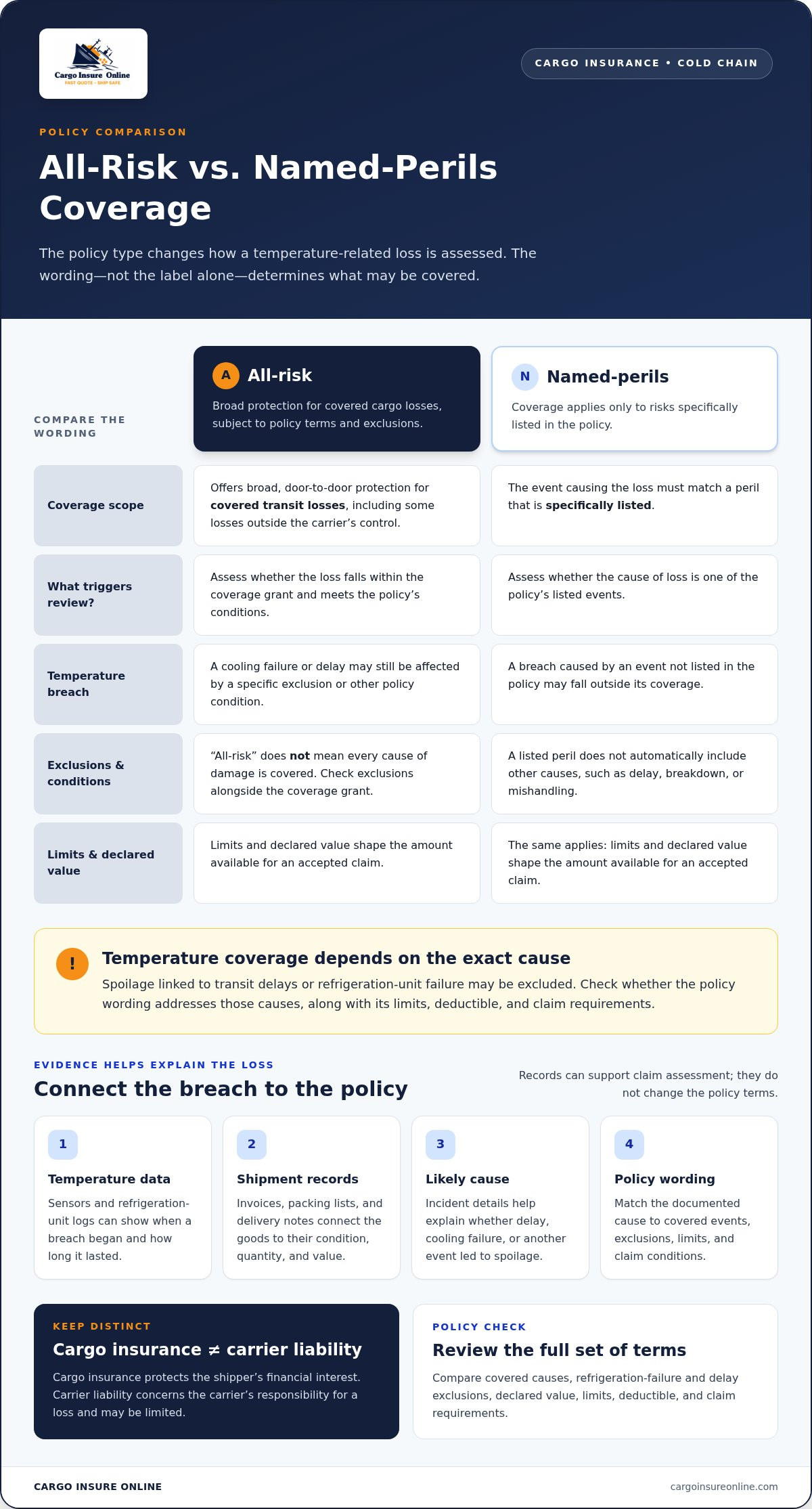
Policy type changes how a temperature-related loss is assessed. All-risk cargo insurance offers broad coverage for covered transit losses, while named-perils policies respond only to risks specifically listed in the carrier contract. For a refrigerated shipment, the distinction matters if a cooling failure, delay, or other event spoils the goods.
“All-risk” doesn’t mean every cause of damage is covered. The policy still sets exclusions, conditions, limits, and the insured value. A frozen-food shipment could fall within broad transit protection, yet a specific exclusion for refrigeration failure could affect a spoilage claim. Read the exclusions alongside the coverage grant, not as separate paperwork.
Named-perils coverage works differently: the event causing the loss must match a peril listed in the policy. If a shipment is damaged by a covered event named in the policy, the claim can be assessed under that wording. If a temperature excursion results from a cause the policy doesn’t list, the event may fall outside its coverage. The exact wording controls.
Compare the policy with the shipment’s actual logistics risks. A fresh-produce load could face delay, equipment breakdown, or mishandling. A policy that lists one peril doesn’t automatically include the others. Before transport, map each likely cause to the policy language, then note any relevant exclusions and claim conditions.
- All-risk: Broad protection for covered cargo losses, subject to policy terms and exclusions.
- Named-perils: Coverage applies to risks specifically listed in the carrier contract.
- Either type: Limits and declared values shape the amount available for an accepted claim.
For temperature-sensitive freight, review whether the wording addresses refrigeration-unit failure and transit delays. These risks matter because a shipment can spoil even without visible physical impact. Temperature records, cargo documents, and incident reports help connect the loss to its cause. They don’t change the policy terms, but they can support claim assessment.
Choose coverage by matching policy scope to cargo, route, and handling exposure, not by the label alone. For example, a shipper moving frozen goods through several transport stages should compare the policy’s covered events across the entire journey. The right fit makes exclusions easier to spot and clarifies which losses the policy can address before the shipment moves.
Cold chain expertise
Careful handling connects product requirements, equipment, people, and cold chain freight insurance across the supply chain. A shipment can leave a correctly chilled facility and still face risks during loading, transit, or handover. Each stage needs clear instructions and records that match the cargo’s temperature requirements.
Start with the product, not the truck setting. Suppliers should ensure temperature-sensitive goods reach the correct temperature before transport. Drivers need the required range and handling instructions before collecting the load. For example, refrigerated medicinal products are typically transported at +2°C to +8°C, while frozen medicinal products are typically transported at -20°C. Those ranges show why one generic setting cannot suit every shipment.
Before loading, inspect the container for air leaks, condensation, and equipment problems. Air leakage or moisture can increase the chance of a temperature breach. Confirm the cooling system is operating, and plan what staff will do if it fails. That plan should identify who to call and whether a replacement container or truck is available.
- Protect airflow: Stack cartons so cargo does not block the container’s air circulation.
- Limit exposure: Keep container doors open only as long as loading or unloading requires.
- Alert each handover: Send pre-alert notifications for outgoing and incoming shipments.
- Monitor conditions: Set sensor parameters for the commodity’s acceptable range and fluctuations.
Pre-alert notifications help prepare teams receiving cold-chain shipments. For high-value loads worth USD$500,000 or more, real-time tracking and temperature monitoring is recommended throughout transit. Sensor records can show when conditions changed, while refrigeration-unit logs help investigators trace temperature variations.
Facilities matter, too. A warehouse handover can expose cargo to warm air, delays, or a gap in monitoring. Assign responsibility for each transfer, including who records the temperature and who responds to an alert. A shared record of breach timing, duration, cause, and potential responsibility can help advance cargo insurance claims.
Good preparation supports risk control and makes a shipment easier to assess after damage. Keep product specifications, loading records, sensor data, and equipment logs together. If frozen goods arrive soft, these records can help distinguish a pre-loading issue from a transport failure. Use shipment history to identify recurring route, equipment, supplier, or facility problems, then improve the next movement.
Successfully managing these risks requires a strong understanding of transit routes, equipment limitations, and handling patterns. Experienced logistics teams can troubleshoot transport problems, respond when conditions change, and maintain suitable handling throughout a temperature-sensitive shipment insured by Cargo Insure Online.
Sector-specific risks for frozen foods and fresh produce
Frozen foods and fresh produce respond differently to temperature changes, airflow, and handling. Match monitoring, transport controls, and insurance terms to each commodity’s specific exposure.
Risks for Frozen Foods
Frozen-food risks include thawing when refrigeration fails or cargo is exposed to warmer air. A load that was not sufficiently pre-cooled can require the driver to lower the temperature during transit, adding time before delivery. That delay can disrupt the transport plan and increase exposure to further temperature changes.
Loading position matters, too. Products placed too close to a container’s cold-air inlet can face constant direct refrigeration, which may damage them. Check the loading plan and airflow before departure. Keep doors closed between handling steps, especially in warm conditions when cool air escapes quickly.
Use product-specific temperature instructions, not a generic reefer setting. Record the cargo’s condition and temperature at handover, then compare arrival readings with the required range. If a shipment shows signs of thawing, a shared record of timing, duration, and cause helps explain where the breach may have occurred.
Insurance should reflect frozen-food logistics, including exposure to cooling-system failure and delay. Review whether the policy addresses those causes and how exclusions apply. A transport plan and coverage that account for the same risks make gaps easier to identify before dispatch.
Risks for Fresh Produce
Fresh produce can deteriorate when warm air enters a container or refrigeration is uneven. Open doors in warm climates let cool air escape, while poor stacking can restrict airflow around cartons. Both conditions can create temperature variations within a load, even when the refrigeration unit is operating.
Before collection, confirm the produce is properly pre-cooled and the container can maintain the required conditions. At loading, avoid blocking air circulation or placing sensitive items directly beside the cold-air inlet. These checks help reduce uneven cooling without assuming every item responds alike.
Coordination across the supply chain is essential: suppliers, drivers, and receiving facilities need the same handling instructions. Set clear handover points and capture temperature readings at each one. For example, a record showing acceptable conditions at pickup but a later rise can narrow the period that needs investigation.
Monitoring should match the commodity and route, while insurance wording should address the risks of transporting fresh produce. Compare the expected temperature range, loading method, and likely delays with covered causes and exclusions. This alignment helps distinguish an operational breakdown from a policy gap and supports clearer claims when produce arrives damaged.
What temperature-related losses are excluded from cold chain cargo insurance?
Temperature-related losses may fall outside cargo coverage when a policy excludes the cause of spoilage. Transit delays and refrigeration-unit failures are risks that policies for temperature-sensitive cargo may exclude. The key is matching the loss event to the policy wording, not relying on the policy label alone.
Start with the cause. If frozen goods arrive thawed after a cooling system breaks down, the claim depends on whether that breakdown is covered or excluded. If fresh produce spoils during a transit delay, the delay clause matters. A single shipment can involve both events, so records should distinguish when each occurred and how it affected the cargo.
All-risk coverage is broad, but it still operates within stated terms, exclusions, and conditions. Named-perils coverage responds to the risks specifically listed in the policy. For either type, read the temperature-related wording alongside the general coverage section. A broad label cannot override a specific exclusion for refrigeration failure or delay.
Review the policy for these details before dispatch:
- Cause: Does the wording address refrigeration breakdown, delayed transportation, or both?
- Trigger: What event activates coverage, and what evidence documents it?
- Limit: How does the maximum payment compare with the declared cargo value?
- Deductible: What portion of an accepted loss remains with the insured?
- Conditions: What temperature records, shipment documents, or claim notices are required?
Preserve evidence as soon as a temperature breach appears. Save sensor readings, refrigeration-unit logs, dispatch times, handover records, and delivery inspection notes. For example, logs showing a steady temperature until a documented unit failure can help identify the cause. Unexplained gaps in the records, by contrast, can make the sequence harder to establish.
Responsibility and insurance coverage are separate questions. A carrier or warehouse may be liable when negligence is proven, while cargo insurance is assessed under its own terms. Carrier liability can also be capped by weight or dollar value. A freight forwarder’s or third-party logistics provider’s liability policy doesn’t guarantee recovery of the cargo’s full value.
Build a shared incident record with the breach timing, duration, cause, and parties involved. Keep that record with the invoice, packing list, and cargo value declaration. These details help connect the damaged goods to the transportation event and support claim review. To compare how cargo coverage can address transit risks, review cargo coverage options.
Cargo Insure Online: Air Freight Insurance
Cargo Insure Online offers Air Freight Insurance for businesses moving goods by air. It can suit temperature-sensitive cargo on an air route when you want to address transit risks through cargo coverage. Match the policy to the shipment’s declared value, route, handling arrangements, and temperature-related exclusions.
For cargo moving by other modes, Cargo Insure Online offers Sea Freight Insurance and Trucking Insurance. GAP Insurance can address a different financial exposure. The suitable option depends on how the goods move and what loss the coverage is intended to address.
Review the shipment details and policy wording, then contact Cargo Insure Online to discuss cargo coverage.
Build cargo protection into your next shipment
Make insurance part of shipment planning, not a document reviewed after cargo is already moving. For your next dispatch, bring the commodity, route, transport mode, and temperature requirements into one conversation. This connects cold chain freight insurance with the actual journey your goods will take.
Cargo Insure Online offers Air Freight Insurance, Sea Freight Insurance, and Trucking Insurance. Choose the transport mode that matches your shipment, then consider how the policy wording fits your cargo and shipping arrangements. Clear decisions before dispatch can make the protection easier to understand when plans change or a loss occurs.
Ready to discuss your cargo coverage? Contact Cargo Insure Online and take the next step with confidence.
Frequently Asked Questions
What could go wrong?
Temperature excursions, refrigeration breakdowns, power interruptions, delays, handling errors, or blocked airflow can spoil cargo. A reefer may keep running while a loading mistake exposes cartons to direct cold air; a power cut can instead raise temperatures across the load. Theft, transit accidents, or damaged packaging can cause separate losses. Keep product, route, equipment, and handover risks distinct, since each may trigger different policy wording and evidence.
What does cold chain freight insurance cover?
Coverage depends on the policy, named causes, exclusions, and insured cargo value. Cargo Insure Online’s standard Cargo Insurance provides all-risks coverage; its Air Freight Exclusive - Temperature Integrity Coverage is sensor-driven for air shipments. Temperature protection requires CIO-Tag or Envirotainer sensor data, plus proof of both excursion duration and actual damage. For a claim, connect the affected goods and recorded event to the shipment documents and applicable policy terms.
How do reefer breakdown, power failure, and temperature deviation affect coverage?
A reefer breakdown or power failure can cause a temperature excursion, but the event alone doesn’t settle coverage. Standard cargo policies exclude delay-related losses, while refrigeration failure terms depend on the policy. Air Freight Exclusive - Temperature Integrity Coverage uses CIO-Tag or Envirotainer data and requires proof of the excursion duration and actual damage. Its trigger windows are 60 minutes for salmon and pharma, and 120 minutes for tropical fruit.
What documentation is needed to file a cold chain cargo insurance claim?
Prepare the policy and certificate, commercial invoice, packing list, and transport document, such as a bill of lading or air waybill. Add temperature-sensor exports, reefer-unit logs, collection and delivery readings, and a dated incident timeline. Photos of damaged cartons and written notes from the receiving facility can link cargo condition to arrival. Keep records together and identify affected product quantities, so the claim file connects the loss, route, and declared value.
How does cargo insurance compare with carrier liability for refrigerated freight?
Cargo insurance protects the shipper’s insured interest under the policy wording; carrier liability concerns the carrier’s legal responsibility. A carrier may not owe the full cargo value, because liability can be limited by weight or a stated amount and may depend on proving negligence. Cargo insurance can help address losses beyond those limits, subject to its exclusions, deductible, and limit. Treat them as different protections, not interchangeable policies.
Which U.S. regulations and state requirements affect cold chain freight insurance?
For interstate U.S. shipments, the Carmack Amendment governs carrier obligations and exceptions; it is not cargo insurance.


