
What if your cargo is insured when a loss happens, but the claim is still reduced because the insured value falls short of the amount required by your policy? That’s why cargo coinsurance penalty calculation under open marine cover should start with the wording, not a formula. An open cover doesn’t automatically mean a coinsurance penalty applies.
If the terms feel confusing, you’re not alone. A coinsurance clause and a marine average clause may be described or applied differently, and the values used in a calculation depend on the policy’s valuation basis and declaration requirements. A formula can look straightforward but produce the wrong answer if you use a value or percentage the policy doesn’t specify.
This guide explains how to check whether your wording includes a coinsurance or average provision, identify the policy-defined values to use, and work through a simplified calculation. You’ll also see which shipment, valuation, and declaration records to gather, plus questions to ask before seeking coverage guidance. The goal is to understand what may affect a claim before relying on an estimate.
Key Takeaways
- Open marine cover doesn’t automatically mean a coinsurance penalty applies. Start by checking the exact policy wording.
- For a cargo coinsurance penalty calculation under open marine cover, use only the values and percentage defined by the applicable clause.
- Coinsurance and marine average provisions can affect claim payments differently, so don’t treat their wording as interchangeable.
- Match the shipment declaration to supporting commercial records, then verify the valuation basis, policy limit, and deductible.
- Use a simplified calculation as a guide, not a claim decision. Confirm policy terms and ask a coverage specialist about anything unclear.
Cargo Coinsurance Penalty Under Open Marine Cover: What the Clause Means
A shipment can be insured when a loss occurs, yet the claim payment may still be reduced if the policy’s required insurance level hasn’t been met. The key question isn’t simply whether cover was active. Check whether the contract contains a clause that applies to the shipment, and how that clause defines the required value.
Open marine cover provides a framework for covering shipments declared under specified policy terms. It isn’t one standard set of conditions. Declaration rules, valuation methods, limits, and claim adjustments can differ, so check the actual wording before attempting a cargo coinsurance penalty calculation under open marine cover.
What does coinsurance mean in a cargo policy?
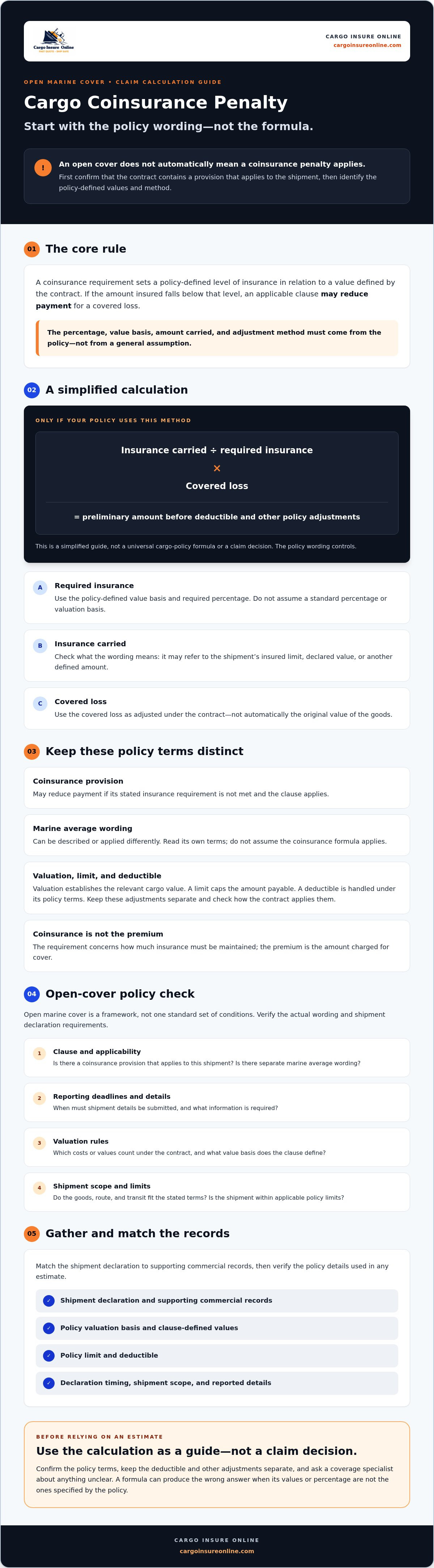
A coinsurance requirement sets a policy-defined level of insurance in relation to a value defined by the contract. If the amount insured falls below that required level, an applicable clause may reduce payment for a covered loss. The percentage, value basis, and adjustment method must come from the policy, not from a general formula.
In the broader context of Marine insurance, coinsurance can refer to a penalty for under-reporting property value. Terminology and operation vary by wording, insurer, product, and governing jurisdiction. A coinsurance requirement is not the premium: the requirement concerns how much insurance must be maintained, while the premium is the amount charged for cover.
Keep other claim figures separate. Valuation establishes the relevant cargo value under the contract. A limit caps the amount payable, and a deductible is handled according to the policy’s deductible terms. A coinsurance provision may create a separate reduction if its conditions are met.
How does open marine cover handle shipment declarations?
Under an open cover, shipments may need to be reported through the contract’s declaration process. That process may specify what details to provide and when, but there’s no single declaration method that applies to every policy. A shipment’s inclusion and insured value depend on the wording and the information reported.
Before drawing conclusions, check:
- Reporting deadlines: When must shipment details be submitted, and what information is required?
- Valuation rules: Which costs or values count under the contract?
- Shipment scope: Do the goods, route, and transit fit the stated terms?
- Maximum limits: Is the shipment within applicable policy limits?
A coinsurance penalty isn’t automatic just because a shipment was declared below a value you consider appropriate. The contract must contain an applicable provision, and any marine average wording should be read on its own terms. Similar claim reduction effects don’t make average and coinsurance provisions interchangeable.
How to Calculate a Cargo Coinsurance Penalty Step by Step
Use a formula only after confirming your policy contains a coinsurance provision that works this way. A common simplified calculation is:
(Insurance carried ÷ required insurance) × covered loss = preliminary amount before deductible and other policy adjustments
IRMI’s explanation of a coinsurance provision describes the general mechanism. Your open marine policy’s wording still controls. This isn’t a universal formula for every cargo policy, and it shouldn’t be applied to marine average wording unless the contract specifies the same method.
Which figures belong in the calculation?
Start with the policy-defined value and required percentage. Don’t assume a standard percentage or valuation basis. Then check what “insurance carried” means in your wording. It may refer to the shipment’s insured limit, declared value, or another defined amount. Use the covered loss as adjusted under the contract, not automatically the original value of the goods.
Before calculating, write down each input and where it appears in the policy or shipment records: the value basis, required percentage, amount carried, and covered loss. This makes it easier to spot when figures come from different sources or refer to different values. Keep the remaining adjustments separate. The deductible, salvage, loss valuation, exclusions, and any applicable sublimits may affect the result under the policy. Check the wording to determine how each applies and in what order.
What does a simplified worked example show?
Hypothetical figures only: Assume the policy defines the cargo value as $100,000, requires insurance at 80% of that value, and the amount carried is $60,000. The covered loss is $20,000. These numbers illustrate the arithmetic, not a real policy or claim outcome.
- Required insurance: $100,000 × 80% = $80,000.
- Insurance ratio: $60,000 ÷ $80,000 = 0.75, or 75%.
- Preliminary amount: 75% × $20,000 = $15,000 before the deductible and other policy adjustments.
The example shows how a shortfall against the required amount can reduce the covered loss used in the calculation. It does not promise a $15,000 claim payment. Actual recovery depends on the policy’s wording, valuation basis, exclusions, limits, deductible, and any other applicable terms. For a real cargo coinsurance penalty calculation under open marine cover, verify each input against the contract and shipment records.
When comparing protection for sea shipments, review the terms of sea freight insurance alongside the valuation and declaration requirements in your policy.
Does Every Open Marine Cover Apply a Coinsurance Penalty?
No. An open marine cover doesn’t automatically impose a coinsurance penalty. The policy might contain an express coinsurance clause, use a marine average provision with different adjustment wording, or contain no comparable underinsurance reduction clause. Being underinsured, by itself, doesn’t prove that a particular formula applies.
That distinction matters for any cargo coinsurance penalty calculation under open marine cover. Similar effects on a claim payment don’t make coinsurance and average wording interchangeable. Read the operative definitions and adjustment terms, not just a clause heading.
Coinsurance clause versus marine average clause
A coinsurance clause may set a required insurance level and describe how a shortfall affects a loss. A marine average provision may also affect the amount recoverable, but its trigger, value basis, and calculation must be established from the wording. A policy can define insured value and underinsurance differently for each provision. Don’t infer the clause’s effect from its label alone.
For each possibility, confirm which policy wording governs the shipment and whether definitions, endorsements, or other terms change how the clause operates. If wording in the schedule differs from an endorsement or the main policy wording, note the difference and ask which terms apply before estimating a claim.
When might the standard formula not fit?
Pause before calculating if the policy uses agreed value wording, sets a shipment specific limit, or raises questions about reporting or partial declarations. These details may change the relevant value or trigger separate policy terms. A missed declaration requirement, for example, should be investigated as a reporting issue, not automatically treated as a coinsurance penalty.
Keep the potential issues distinct:
- Coinsurance: A shortfall against a stated insurance requirement, if the clause applies.
- Under declaration: A question about whether shipment information was reported as required.
- Deductible, exclusion, or limit: Separate terms that may affect a claim without being a coinsurance penalty.
Bottom line: The policy wording determines whether and how a reduction applies. Verify the clause, shipment declaration, valuation basis, and relevant limits before using a formula or drawing conclusions about a claim.
How to Check Your Open Marine Policy Before Calculating
Before you calculate, build a clear picture of the contract and the specific shipment. A coinsurance percentage on its own isn’t enough. You also need the clause’s definition of value, the declaration details, and any limits or adjustments that may affect the claim.
Policy wording and shipment records to gather
Collect the policy schedule, open cover wording, endorsements, shipment declarations, and any valuation agreement. Match the claim shipment to its declaration using identifiers such as the shipment reference, goods description, route, and transit dates where those details are recorded. Gather invoices, freight documents, and other records that support both the shipment value and the amount declared.
Check whether Institute Cargo Clauses are incorporated into the specific policy before relying on them. Their mention in another document or a general guide doesn’t establish that they apply to your cover.
Incoterms such as CIF or FOB can help explain transaction records and how responsibilities or costs were arranged. They don’t automatically determine the insured value for a coinsurance calculation. Use the valuation basis stated in the policy and confirm how it treats relevant costs.
A practical pre-claim review sequence
Work through the file in order. This keeps the cargo coinsurance penalty calculation under open marine cover tied to the actual wording and shipment, rather than an assumed formula.
- Find the operative clause: Check the wording and endorsements for a coinsurance or average provision. Note its stated percentage and adjustment method.
- Record the value basis: Identify how the policy defines the value used to establish required insurance.
- Match the declaration: Compare the shipment details and declared amount with the policy’s reporting requirements and deadlines.
- Check scope and limits: Confirm the shipment’s transit fits the stated cover and review applicable shipment or policy limits.
- Note other adjustments: Identify the deductible and any relevant exclusions or sublimits. Keep these separate from a coinsurance calculation.
Incoterms and commercial records can help explain a value difference, but don’t substitute them for the policy’s valuation wording. If the clause, valuation, or governing jurisdiction is unclear, ask a qualified policy or claims professional for guidance. This checklist organizes the questions; it doesn’t replace claims or legal advice.
For sea shipments, review sea freight insurance information while comparing the coverage terms with your shipment records.
Choose Cargo Cover With Clear Declarations and Limits
A calculation is only useful if its inputs match the policy. Before comparing cargo cover, follow a simple path: identify any coinsurance or average clause, confirm the policy defined value and shipment declaration, calculate only if the wording supports that method, then ask about anything unclear.
Clear declarations and appropriate limits are practical topics to discuss with a coverage specialist. The goal isn’t to chase a generic percentage. It’s to understand how the policy applies to your cargo, route, shipment values, and reporting process.
Questions to ask when comparing cargo cover
Use these questions to focus the conversation on terms that can affect a shipment:
- How is shipment value defined? Ask which valuation basis applies and what records support it.
- When and how must shipments be declared? Confirm the reporting process and what happens if details are incomplete or submitted late.
- Is there an underinsurance provision? Ask how any coinsurance or average wording operates, including the calculation basis.
- How do other terms interact? Clarify the role of limits, deductibles, exclusions, and cargo specific conditions in a claim.
- Does the cover fit the shipment pattern? Compare the wording and declaration process with your cargo, routes, and shipping frequency.
Keep the answers alongside the relevant policy documents. That makes it easier to see whether a cargo coinsurance penalty calculation under open marine cover is supported by the actual terms, or whether another clause or issue needs attention. If the wording or applicable jurisdiction remains unclear, seek qualified policy or claims guidance.
Explore marine cargo coverage options
Use what you’ve learned to review whether your sea shipments, routes, cargo values, and declaration practices align with the cover you’re considering. Cargo Insure Online offers sea freight insurance, but that does not mean every open cover structure or clause is available. Review the specific terms before deciding what fits.
To compare marine shipment protection, explore cargo insurance options and consider how sea freight coverage may align with your needs.
Make Your Next Coverage Review Clearer
A cargo coinsurance penalty calculation under open marine cover starts with the policy, not a default formula. First, identify whether the wording includes a coinsurance or average provision. Then confirm the shipment’s declared value, the policy’s valuation basis, and any relevant limits or deductible before calculating.
Active cover alone doesn’t establish how a claim will be adjusted. The applicable wording, declarations, and shipment records all matter. If the clause or valuation basis is unclear, gather your documents and ask a qualified policy or claims professional for guidance.
Clear cargo values and declarations can make coverage decisions easier to assess. Cargo Insure Online offers sea freight insurance and cargo coverage across sea, air, and land freight. Explore cargo insurance options to review coverage for your shipments.
A careful review now can help you move forward with better informed coverage questions and greater confidence.
Frequently Asked Questions
Does every open marine policy have a coinsurance penalty?
No. Open marine policies don’t all contain coinsurance penalties. Wording varies by contract and governing jurisdiction. Check the schedule, policy wording, and endorsements for an express coinsurance clause or another applicable provision, such as marine average wording. Then review its definitions, valuation basis, and adjustment terms. An open cover alone doesn’t establish that a penalty applies. If the clause is unclear, ask a qualified policy or claims professional.
How do you calculate a coinsurance penalty on cargo insurance?
Use a formula only if the policy contains a matching coinsurance provision. A common simplified method is: (insurance carried ÷ required insurance) × covered loss = preliminary amount before deductible and other adjustments. The cargo coinsurance penalty calculation under open marine cover depends on the policy defined percentage, value, and amount carried. The result isn’t necessarily the final claim payment, which may also depend on limits, exclusions, deductible, and other wording.
What value should I use for an open marine cover coinsurance calculation?
Use the valuation basis defined by the policy, not an assumed market value or default industry figure. Check whether the wording refers to a declared shipment value, an agreed value, or another defined amount, and how it treats relevant costs. Compare the shipment declaration with supporting records, such as the commercial invoice and freight documents. Trade terms may help explain the transaction, but don’t replace the policy’s valuation wording.
Is a marine average clause the same as a coinsurance clause?
No. A marine average provision and a coinsurance clause may both affect the amount recoverable, but they aren’t interchangeable. Each policy may define the trigger, insured value, shortfall, and adjustment method differently. Don’t assume a familiar coinsurance formula applies to average wording, or infer the effect from a clause heading alone. Read the operative definitions and claim adjustment terms, including any endorsements that modify the wording.
Can a cargo claim be reduced if the shipment was underinsured?
It may be, but underinsurance alone doesn’t establish that a coinsurance formula applies. Check whether the policy contains an applicable coinsurance or average provision and whether its conditions are met for the shipment. Other terms can also affect recovery, including policy limits, deductibles, exclusions, and shipment specific conditions. Review the declaration, valuation basis, and claim wording before estimating a payment. A qualified claims professional can help clarify uncertain terms.
What happens if a shipment was not declared under an open marine cover?
The outcome depends on the contract. Check whether the shipment had to be declared, what information was required, and when reporting was due. Then locate the wording that explains the consequences of a missed, incomplete, or late declaration. Don’t assume the shipment is covered or excluded without reviewing those terms. Gather the shipment records and declaration history, and seek qualified policy or claims guidance if the consequences aren’t clear.
Does CIF value automatically determine the insured value under open cover?
No. CIF value doesn’t automatically determine the insured value for an open cover calculation. CIF records can help explain the transaction and included costs, but the policy’s valuation wording governs the value used for insurance purposes. Check how the contract defines shipment value and whether it includes or treats costs differently. Compare that basis with the declaration and supporting commercial documents before calculating or drawing conclusions about a possible claim adjustment.


