

What if a carrier is liable for damaged freight, but your business still can’t recover the full value of the loss? That’s the risk behind the Carmack Amendment carrier liability exceptions and shipper risk. A Carmack claim can provide a path to recovery, but it doesn’t guarantee that every shipment loss will be made whole.
If you ship goods by truck, you may expect the carrier to answer for damage that happens in transit. Whether Carmack applies depends on the shipment and the parties involved. Carrier defenses or a valid liability limit may affect what you can recover. A separate cargo insurance policy offers a different layer of risk management, subject to its own terms.
This guide explains when Carmack may apply to domestic motor-carrier shipments, the main exceptions carriers may raise, and how liability limits can shape a claim. You’ll also find a practical way to compare potential carrier recourse with cargo insurance, including trucking coverage, and identify situations where legal review matters. The goal is to understand your exposure before a loss becomes a costly surprise.
Key Takeaways
- Check the shipment’s route, transportation roles, and contracts before assuming Carmack applies to a trucking loss.
- Understand the five recognized carrier defenses, and why a defense must be established rather than merely named.
- Separate arguments about carrier responsibility from agreed liability limits that may affect the amount recoverable.
- Use the Carmack Amendment carrier liability exceptions and shipper risk framework to organize your review of contracts, cargo value, and loss evidence.
- Compare potential carrier recourse with cargo insurance as distinct tools, and review policy terms, exclusions, valuation, and claim requirements.
Carmack Amendment carrier liability: what protection does a shipper actually have?
A damaged shipment raises two separate questions: does federal law provide a claim against the carrier, and how much could that claim recover? The Carmack Amendment, codified at 49 U.S.C. § 14706, sets a federal liability framework for qualifying transportation of goods in interstate commerce by motor carriers and freight forwarders. It can provide a route to pursue recovery, but it doesn’t automatically promise payment of the cargo’s full value.
Carmack liability is the federal framework under 49 U.S.C. § 14706 for determining a motor carrier’s or freight forwarder’s responsibility for qualifying cargo loss or damage in interstate transportation.
When may the Carmack Amendment apply to a shipment?
The general focus is interstate motor carriage: goods moving across state lines under a transportation arrangement covered by the statute. Carmack also addresses freight forwarders. A company’s label alone doesn’t determine its role. Depending on what a business undertakes and does for a particular shipment, it may be treated differently. The contract, shipping documents, and transportation facts all matter.
Mixed and cross-border movements need extra care. A shipment may involve international transport, more than one carrier, or separate domestic legs. Which law applies can depend on the route and documents, including where the loss occurred. Don’t assume that a U.S. trucking leg means Carmack governs every part of the journey. Route-specific legal analysis can matter when a movement crosses borders or modes.
What does carrier liability mean for the shipper?
If Carmack applies, a shipper may have a federal claim for qualifying cargo loss or damage. That isn’t the same as automatic reimbursement. The analysis involves separate questions:
- Applicability: Does the statute cover this shipment and the party being pursued?
- Responsibility: Do the facts support liability, or can the carrier establish a recognized defense?
- Amount: What loss is recoverable, and does an effective liability limit apply?
- Proof and timing: Can the claimant document the shipment’s condition, loss, and value while meeting applicable claim and lawsuit deadlines?
That distinction is central to understanding Carmack Amendment carrier liability exceptions and shipper risk. A valid claim may still be disputed, limited, or delayed. Preserve shipment records and review the transportation documents early. Next, consider the specific defenses a carrier may raise and what those defenses must establish.
Carmack Amendment exceptions: the five defenses carriers may raise
Carmack liability isn’t automatic just because cargo arrives damaged. After a shipper establishes a qualifying claim, a carrier may try to show that a recognized cause of loss applies. The details matter: a defense must be supported by evidence and satisfy the applicable legal test. Simply naming an exception doesn’t settle the claim.
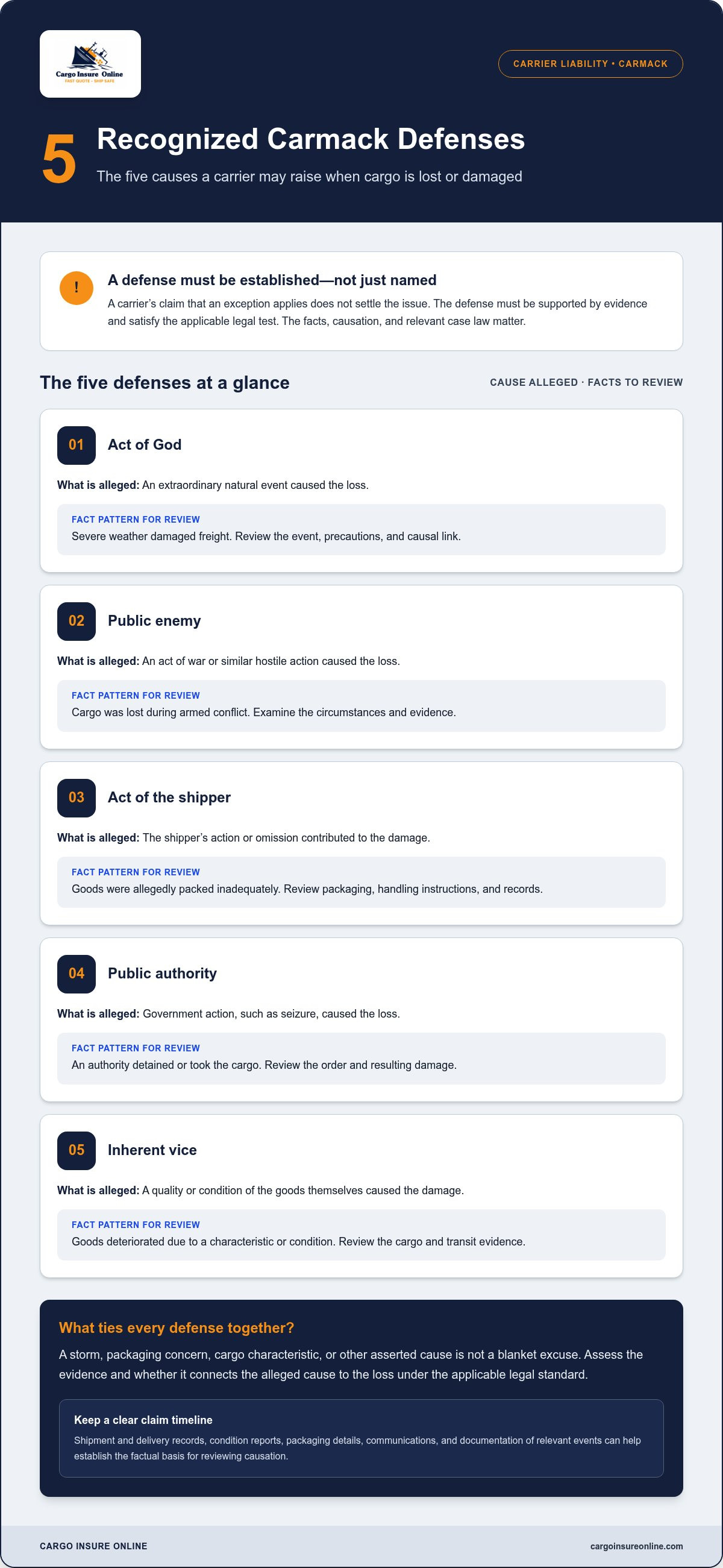
The five commonly recognized Carmack defenses are act of God, public enemy, act of the shipper, public authority, and inherent vice.
How do Carmack’s recognized defenses differ?
Each defense points to a different cause, not a blanket excuse for delay or rough handling. A storm, for example, doesn’t automatically establish an act of God defense. The carrier’s evidence must connect the event to the loss under the applicable legal standard. The same principle applies when a carrier alleges that inadequate packaging or a cargo characteristic contributed to damage.
| Defense | Plain-language description | Fact pattern for legal review |
|---|---|---|
| Act of God | An extraordinary natural event is alleged to have caused the loss. | Severe weather damaged freight. Review the event, precautions, and causal link. |
| Public enemy | An act of war or similar hostile action is alleged. | Cargo was lost during armed conflict. Examine the circumstances and evidence. |
| Act of the shipper | The shipper’s action or omission is said to have contributed to damage. | Goods were allegedly packed inadequately. Review packaging, handling instructions, and records. |
| Public authority | Government action, such as seizure, is said to have caused the loss. | An authority detained or took the cargo. Review the order and resulting damage. |
| Inherent vice | A quality or condition of the goods themselves is alleged to have caused damage. | Goods deteriorated due to a characteristic or condition. Review the cargo and transit evidence. |
Causation, supporting evidence, and relevant case law shape whether a defense succeeds. The Carmack Amendment carrier liability exceptions and shipper risk therefore call for claim-specific analysis, not a quick label.
What evidence can matter when a carrier raises an exception?
Build a clear timeline. Keep shipment and delivery records, condition reports, packaging details, communications, and documentation of relevant events. These materials can help distinguish damage that existed before pickup from events during transit or conditions recorded at delivery. They don’t determine liability on their own, but they provide a factual basis for assessing causation and the carrier’s argument.
Shippers can also review trucking cargo insurance options as another layer of risk management. Coverage depends on the policy’s wording and requirements. It doesn’t replace a legal review of a Carmack claim.
Carrier liability limits versus Carmack exceptions: where shipper risk remains
A carrier defense and a liability limit answer different questions. A defense argues that the carrier isn’t responsible for the loss under the applicable rules. A valid limitation may instead affect how much the carrier must pay, even if liability is established. Keeping the two issues separate helps clarify your actual exposure.
Can a carrier limit its Carmack liability?
Carmack allows a carrier and shipper, in certain circumstances, to agree to a lower liability level. The statute sets conditions for such agreements. Depending on the shipment and governing terms, these may involve a tariff, a meaningful choice among liability levels and corresponding rates, and the shipper’s written agreement to the selected limit. A figure printed on a bill of lading isn’t automatically enforceable just because it appears there.
Review the full transportation contract, tariff terms, booking records, and any declared-value selection. The legal requirements and their application can depend on the carrier, shipment, and agreement. Don’t assume a standard per-pound cap applies to every load, or that a declared value necessarily matches the cargo’s full commercial value. Transportation counsel can assess whether the limitation was properly established and applies to the loss.
What losses might remain with the shipper?
Start with the cargo’s documented value, then compare it with potential recovery under the governing contract and law. Even when a claim is available, the amount or timing of recovery may be uncertain. Map the gaps before a loss occurs:
- Liability dispute: The carrier may contest responsibility or raise a defense.
- Contractual limit: An enforceable limitation may leave part of the cargo value unrecovered.
- Excluded or delayed loss: Review whether delay-related or other indirect losses are recoverable under the applicable terms.
- Separate insurance terms: A cargo policy may have a deductible, exclusions, valuation rules, and claim requirements that affect payment.
These are distinct layers of Carmack Amendment carrier liability exceptions and shipper risk. A potential carrier claim and first-party cargo insurance aren’t interchangeable guarantees. Insurance may offer another way to manage eligible shipment risks, subject to policy wording, while carrier recourse still needs to be assessed separately.
For a broader look at coverage considerations, read this guide to trucking cargo insurance. Compare its terms with the contract, cargo value, and potential recovery path for each shipment.
How to assess Carmack exposure before and after a freight loss
A well-organized shipment file makes a complicated claim easier to assess. Before freight moves, capture the key facts and compare the carrier’s terms with the value at risk. If damage occurs, preserve evidence and track deadlines promptly. This five-step checklist helps organize the work.
What should a shipper review before tendering cargo?
Build a record before pickup. Keep the original bill of lading, rate or service agreement, invoices, and packing records together. Note the route, transportation parties, cargo description, and any declared value. Then compare contractual liability terms with the potential financial impact of loss or damage. Cargo insurance may provide a separate layer of protection for eligible risks, subject to policy terms. It doesn’t change a carrier’s legal duties.
- Identify transport roles: Record who arranged the shipment and who undertakes each transportation leg.
- Review route and contract: Save the route details, bill of lading, and applicable service or rate terms.
- Document cargo value: Retain invoices and records supporting the value and description of the goods.
- Assess loss evidence: If damage occurs, record the condition at delivery, note exceptions, and preserve communications and reports.
- Compare protection: Consider potential carrier recovery alongside cargo insurance terms, including applicable limits, deductibles, exclusions, and claim requirements.
For high-value technology shipments, explore this guide to electronics shipping insurance as a related risk-management topic.
What should a shipper do after loss or damage?
Act quickly, but keep the record factual. Photograph visible damage, note exceptions on delivery documents, preserve packaging when practical, and notify relevant parties promptly. Keep copies of messages and reports. A timeline can help clarify the cargo’s condition before transit, what happened along the route, and what was observed at delivery.
For claims under the Carmack Amendment, the carrier generally cannot set a claim-filing deadline shorter than nine months. A lawsuit deadline cannot be shortened below two years from the carrier’s written claim denial; the contract may provide more time for filing a claim. These are statutory minimums, not a reason to wait. Check the governing documents and seek legal advice promptly to confirm dates and requirements.
For cross-border or multimodal freight, identify the domestic motor leg separately from other transport stages. The applicable rules can depend on the route and shipment documents. A clear file helps counsel evaluate Carmack Amendment carrier liability exceptions and shipper risk against the facts. To assess a separate layer of protection, explore trucking cargo insurance options.
Carmack liability and cargo insurance: choose protection for the remaining risk
A possible Carmack claim and cargo insurance serve different roles. One is a potential legal recovery route against a responsible carrier. The other may provide first-party protection for an insured’s eligible financial interest, subject to the policy. Neither guarantees full payment. Reviewing both helps reveal where exposure may remain.
When might separate cargo insurance be worth considering?
Consider a separate coverage review if cargo value is higher than the recovery potentially available under the transportation contract, or if a loss could disrupt cash flow or operations. High-value goods, electronics, and e-commerce shipments may deserve particular attention, but examples alone don’t establish eligibility or coverage. The policy wording controls.
Online sellers managing international shipments can also read about cross-border e-commerce insurance to understand related risk considerations.
How can a shipper compare the two protection layers?
Use this framework to compare how each route works, then check the governing documents. A potential claim against a carrier doesn’t replace a policy review, and insurance doesn’t erase carrier liability.
| Review point | Potential Carmack recourse | Cargo insurance |
|---|---|---|
| Who may owe payment? | A carrier or freight forwarder, if the statute applies and liability is established. | An insurer, if the claimant has an insured interest and the loss qualifies under the policy. |
| What may trigger recovery? | A qualifying cargo loss or damage claim, subject to applicable law and contract terms. | A covered loss that meets policy conditions and claim requirements. |
| What may limit recovery? | Disputed responsibility, a recognized defense, or an effective liability limitation. | Policy exclusions, valuation terms, deductibles, and other applicable limits. |
| What governs? | The statute, shipment facts, and applicable transportation documents. | The policy wording, insured interest, and supporting claim documentation. |
For each shipment profile, compare documented cargo value with potential carrier recovery, then identify gaps that could affect your business. That’s a practical way to assess Carmack Amendment carrier liability exceptions and shipper risk without treating either recovery route as certain.
Review cargo insurance options for eligible freight risks and consider how the applicable terms align with your cargo, route, and financial exposure.
Build a clearer plan for shipment risk
Carmack can offer a path to pursue a carrier for qualifying cargo loss, but a defense or valid liability limit may affect recovery. The Carmack Amendment carrier liability exceptions and shipper risk picture depends on shipment facts, contracts, evidence, and deadlines. Preserve records and seek legal review when the situation is complex.
Before freight moves, compare cargo value with potential carrier recovery. After a loss, document the damage, follow claim requirements, and assess any remaining exposure. These steps won’t remove every uncertainty, but they can help you make informed decisions before a disruption becomes harder to manage.
Cargo insurance can provide a separate layer alongside potential carrier recourse. Cargo Insure Online offers coverage for trucking and other freight modes, as well as specialized options for high-value electronics and e-commerce shipments. Coverage depends on applicable policy terms, including exclusions, valuation, and claim requirements.
Explore cargo insurance options for your shipment and take a practical next step toward managing freight risk with greater confidence.
Frequently Asked Questions
Does the Carmack Amendment apply to every freight shipment?
No. The Carmack Amendment generally applies to qualifying interstate motor-carrier transportation and freight forwarders under 49 U.S.C. § 14706. Applicability depends on the route, transportation roles, contracts, and shipment facts. A company’s label as a broker or carrier may not settle its legal status. International, cross-border, and multimodal shipments can require route-specific review to determine which rules apply to each transport leg.
What are the five Carmack Amendment defenses?
The five commonly recognized defenses are act of God, public enemy, act of the shipper, public authority, and inherent vice, meaning a characteristic of the goods themselves. A carrier generally must support its defense and connect it to the loss. For example, a claim of inadequate packaging needs evidence about the packaging and how it contributed to the damage. Merely naming a defense doesn’t automatically defeat a claim.
Can a carrier limit its liability under the Carmack Amendment?
Yes, in certain circumstances, a carrier and shipper can agree to limit liability. The statutory framework includes requirements concerning the carrier’s tariff, the shipper’s opportunity to choose among liability levels and rates, and written agreement to the selected limit. A cap printed on a bill of lading isn’t automatically effective. Whether a limitation applies depends on the contract, shipment facts, and legal requirements, so have counsel review the terms.
Does Carmack guarantee that a shipper will recover the full value of damaged cargo?
No. Carmack may provide a path to seek recovery for qualifying loss or damage, but it doesn’t guarantee full or immediate reimbursement. The shipper must establish the claim, and a carrier may raise a recognized defense. An effective liability limitation could also affect the amount recoverable. The Carmack Amendment carrier liability exceptions and shipper risk analysis should consider responsibility, proof, contractual terms, cargo value, and timing as separate issues.
How long does a shipper have to file a Carmack claim?
A carrier generally can’t set a cargo-claim filing deadline shorter than nine months from delivery. The transportation contract may allow more time, so review the governing documents rather than assuming the minimum is your deadline. A lawsuit generally must be filed within two years from the carrier’s written denial of the claim. Track both dates carefully and ask qualified transportation counsel to verify how they apply to your shipment.
Is cargo insurance the same as Carmack carrier liability?
No. Carmack concerns potential carrier or freight-forwarder liability for qualifying cargo loss or damage. Cargo insurance is a separate coverage arrangement that may respond to an insured loss, subject to the policy and the claimant’s insured interest. Its wording, exclusions, valuation terms, deductibles, and claim requirements matter. Insurance doesn’t erase a carrier’s legal liability, and it doesn’t guarantee payment for every loss.
What should a shipper document after freight arrives damaged?
Record the condition promptly. Photograph visible damage, note exceptions on delivery documents, and preserve the packaging when practical. Keep the bill of lading, invoices, packing records, condition reports, correspondence, and any documentation of relevant transit events. A clear timeline can help distinguish pre-existing damage from damage observed during or after transport. Notify relevant parties promptly, preserve copies, and get legal advice about claim requirements and deadlines.


