

A dent discovered at delivery doesn’t tell you when it happened. If you’re asking how to prove cargo damage occurred in transit not prior to loading, start with a clear record of the shipment’s condition at each handoff, from loading through delivery. A clean bill of lading can help, but it may not tell the whole story, especially when cargo travels in a sealed container.
It’s frustrating when the shipper, carrier, and consignee each have a different account. Once damaged goods are moved, unpacked, or repaired, useful evidence can disappear. Act promptly, but describe the evidence accurately. A photo or inspection may support a timeline without proving exactly when or how the damage occurred.
This guide explains how to build a credible condition timeline using loading and delivery records, photographs, packaging details, inspection findings, and handoff documentation. You’ll learn what to preserve, when to request an inspection, and how to connect the evidence without overstating what it shows. The aim is a clearer account of the shipment’s journey, alongside informed cargo-risk planning.
Key Takeaways
- Learn how to prove cargo damage occurred in transit not prior to loading by building a timeline from loading records through delivery.
- Compare condition notes and handoff documents to spot gaps or inconsistencies, and keep original files and document versions intact.
- Separate observed facts from possible explanations so the evidence supports your account without claiming more than it proves.
- Act promptly to secure and document damaged goods, notify relevant parties, and check applicable contract, carrier, and policy requirements.
- Organize a clear claim file with a concise chronology, inventory, correspondence, and available inspection findings.
How to Prove Cargo Damage Happened in Transit: Start with the Timeline
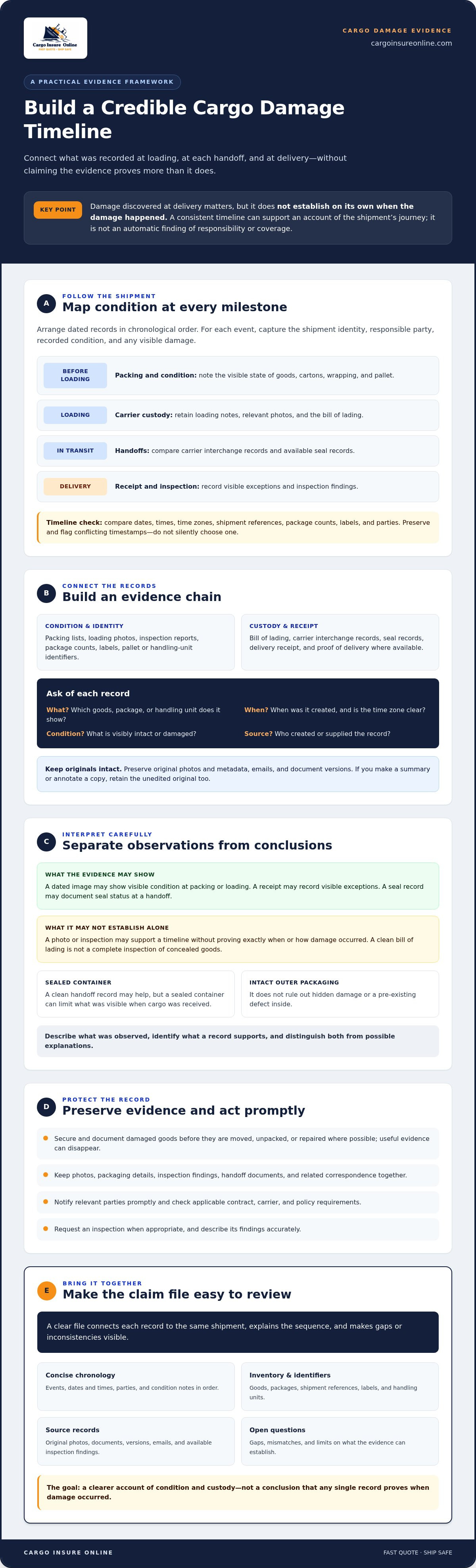
To show that damage likely occurred during transit, build a consistent timeline from the cargo’s recorded condition before loading to its inspection after delivery. Damage found at the destination is important, but it doesn’t establish on its own when the damage happened. Connect dated records across the shipment and identify what each one can and can’t confirm.
Map the key milestones: packing, loading, each carrier handoff, unloading, receipt, and inspection. For each, record the date and time, shipment identifier, responsible party, condition of the goods and packaging, and any visible damage. Compare those details across documents. A mismatch in shipment numbers or a gap between handoffs can make it harder to establish when a change occurred.
The value of a timeline depends on the shipment, the records available, and the applicable policy terms. Treat it as evidence to assess, not an automatic conclusion about responsibility or coverage.
What does a cargo damage timeline need to show?
Arrange the records in chronological order. Match shipment references, dates, times, and parties across packing records, loading notes, transport handoff documents, delivery receipts, and inspection findings. If timestamps conflict, preserve both versions and flag the inconsistency rather than silently choosing one. A gap doesn’t prove the damage happened before loading, but it limits what the records can establish.
Why condition before loading matters
The starting point matters. Dated photos from packing and loading can show the visible condition of the goods, cartons, wrapping, and pallet before the carrier takes custody. Include identifying labels and enough surrounding context to connect each image to the shipment. Record only what’s visible: intact outer packaging doesn’t rule out hidden damage or a pre-existing defect inside.
A bill of lading records cargo received by the carrier; learn more about the Bill of Lading. A clean receipt can support the account of the cargo’s recorded condition at handoff, but it isn’t a complete inspection of concealed goods. Pair it with available loading photos, packing records, and consistent shipment details. This is a practical first step in understanding how to prove cargo damage occurred in transit not prior to loading, without claiming that any single document settles the question.
For broader context on organizing claim records, see Cargo Insurance Claim Process: Fast, Digital, Painless. Keep condition documentation alongside your cargo-risk planning, and check your policy’s terms and evidence requirements for the shipment.
Build the Evidence Chain: Loading Records, Handoffs, and Delivery Inspection
Once the shipment timeline is mapped, connect each milestone to records that identify the same goods and show their condition. Preserve original files, including photo metadata, emails, and document versions. If you create a summary or annotate a copy, keep the unedited original too. This makes it easier to check when information was recorded and whether later versions differ.
Compare packing lists, loading photos, inspection reports, seal records, the bill of lading, carrier interchange records, and proof of delivery where available. Match shipment numbers, package counts, labels, pallet or handling-unit identifiers, and the parties involved. A document that looks relevant but refers to a different shipment or load unit may not support your timeline.
Which shipment records help establish condition?
Review records as a connected set, not as isolated proof. For each item, note what it records and what it cannot establish. A seal record, for example, may document a seal’s status at a handoff, while a delivery receipt may record visible exceptions. Neither alone necessarily establishes when damage occurred. For U.S. interstate motor shipments, the Carmack Amendment provides a carrier-liability framework, but first build a clear factual record of condition and custody.
Simple evidence table: Create a row for each record and include:
- Item: What goods, package, or handling unit is shown?
- Condition: What is visibly intact or damaged?
- Timestamp: When was the record created, and is the time zone clear?
- Source: Who created or supplied it?
- What it supports: Which fact does it help confirm, and what remains uncertain?
How to document damage when cargo arrives
Before moving or unpacking damaged cargo, photograph the outer packaging, labels, seals, pallet, and damage from several angles. Include identifying details so the images can be tied to the shipment. Record when and where the damage was first noticed, who was present, and any handling afterward. If the delivery receipt allows exceptions, describe visible issues specifically. A notation documents what was observed at receipt, but doesn’t prove the damage began during transit.
Keep the packaging and damaged components in their current condition until relevant parties advise otherwise, and record any necessary handling. A prompt, organized file makes it easier to assess how to prove cargo damage occurred in transit not prior to loading without treating a single photo or note as conclusive. Strong records belong alongside a broader risk plan. If you’re reviewing protection for shipments, explore cargo insurance options and check the applicable policy terms and evidence requirements.
Separate Transit Damage from Pre-Existing Damage with Corroborating Evidence
A mark, tear, or temperature alert is an observation, not a complete explanation. To assess whether damage fits a transit event or may have existed before loading, compare the evidence with the shipment’s recorded condition at each stage. Look for support across independent records, and consider other possible causes, such as inadequate packaging, a concealed defect, or handling after delivery.
For each clue, separate what was seen from what it might mean. A crushed corner could be consistent with an impact during handling, but it could also reflect weak packaging or an earlier event. Wet cartons may point to moisture exposure, but the location and timing of the wetness matter. A temperature reading outside the expected range may support a temperature excursion, but it doesn’t identify the cause by itself.
Use a three-column evidence worksheet:
- Observed fact: What does the photo, inspection, or record directly show?
- Possible explanation: What causes could fit that observation, including pre-existing or post-delivery damage?
- Supporting records: Which dated images, handoff notes, inspection findings, or sensor logs support or challenge each explanation?
What can photos, seals, and inspection findings establish?
Before-and-after images can show a change in visible condition when their dates, angles, and shipment identity are clear. Seal numbers and records of seal condition can raise useful custody questions if they don’t match across handoffs, but a seal discrepancy alone doesn’t establish when damage occurred. Inspection findings can document visible damage, while latent damage may only become apparent during unpacking. Keep those discovery stages distinct.
A clear handover record can be important to the evidence file. The Simplex Group explains how notes and photos made at delivery help document the condition observed at receipt; see the record that decides the claim. Treat that record as one part of the evidence, not a standalone verdict about cause.
When sensor and tracking data strengthen the timeline
GPS, IoT sensor logs, and time-stamped alerts may help corroborate route, handling, or environmental records. Check where a sensor was placed, whether it was functioning and calibrated, and whether data gaps or alert thresholds affect interpretation. A shock alert may show a measured event at the sensor, not the exact force on the goods. A temperature reading can support an excursion, but it doesn’t prove by itself that the excursion caused the damage.
When weighing how to prove cargo damage occurred in transit not prior to loading, look for a pattern that fits the records while acknowledging what remains uncertain. Strong conclusions rely on evidence that agrees across sources, not on treating one dramatic mark or data point as proof.
Cargo Damage: Preserve Evidence and Notify Parties
Once damage is discovered, follow a clear sequence: secure the goods, document their condition, notify the right parties, and preserve the records. Avoidable handling can change or destroy evidence, as can a rushed repair or disposal. If safety or spoilage requires immediate action, protect people and cargo first, then record what had to be done, when, and by whom.
There’s no single notice deadline for every shipment. Check the governing contract, carrier instructions, and policy for the applicable notice and claim requirements. Requirements vary by shipment and terms. Keep a dated log of every message, inspection, transfer, and decision made after discovery. That log can help explain changes to the goods after delivery.
A practical first-response checklist
Pause nonessential unpacking, repair, movement, or disposal until the condition is documented. Photograph the shipment before disturbing it. Capture both broad views and close-ups, with labels and packaging visible so the damage can be connected to the cargo.
- Secure the damaged goods and packaging, and note any urgent safety or spoilage concerns.
- Record discovery time, location, people present, and any handling already performed.
- Keep packaging and damaged components available, unless safety or another urgent need requires action. Document that decision.
Who should receive notice and what should it include?
Use the shipment and policy documents to identify the correct carrier contact, shipper, broker, insurer, or claims contact. Don’t assume every party needs the same notice. Send a concise factual account with shipment identifiers, when and where the damage was discovered, what was affected, and available photos or records. Save copies of messages and note when they were sent and received.
For a road-freight shipment, check the handoff and notice instructions in the relevant documents. The article Trucking Cargo Insurance: The 2026 Guide to Frictionless Road Protection provides related context on road-freight protection. Keep reports grounded in what you observed. If an inspection or repair changes the cargo’s condition, document the change and the reason before proceeding where practical.
A prompt, organized response supports how to prove cargo damage occurred in transit not prior to loading, but notice and evidence don’t guarantee a particular claim outcome. Review your policy’s evidence requirements as part of your shipment-risk plan. Explore trucking cargo insurance for coverage information relevant to road freight.
Turn Your Cargo Damage Evidence into a Clear, Reviewable Claim File
A well-organized claim file makes the shipment’s story easier to review. Bring the evidence together in a concise chronology, then support each event with the relevant record. Include an inventory of affected goods, condition records, correspondence, and any available inspection findings. Keep facts separate from interpretations: “carton corner crushed at delivery” is an observation; “damage occurred during unloading” is a possible explanation that needs support.
Don’t fill evidence gaps with assumptions. Note what’s missing, such as an unrecorded handoff or unavailable loading photo. This helps reviewers see both what the documents establish and where uncertainty remains. Check the policy wording and claim instructions for required documents and applicable procedures. Coverage depends on the specific policy and circumstances, so a complete file doesn’t guarantee a particular decision.
How to organize a claim-ready evidence packet
Create a dated index that links each timeline event to its source. Use consistent shipment identifiers across invoices, transport records, photographs, and correspondence. Label files clearly, preserve originals and metadata, and provide copies unless the claims contact requests otherwise. Before sending the packet, check that each record is readable and that the index describes it accurately.
- Chronology: List key shipment and discovery events in date and time order.
- Inventory: Identify the affected items and quantities using shipment documents.
- Evidence: Reference the relevant image, receipt, inspection finding, or message for each event.
- Open questions: Flag missing records or conflicting details without guessing at an answer.
Choose coverage with documentation and shipment risks in mind
Use your evidence process as one part of shipment-risk planning. Consider the freight mode, cargo type, route, and your business’s exposure when reviewing coverage options. For air shipments, Air Freight Insurance: High-Speed Coverage for Global Trade is a related topic to explore. Confirm the current policy terms and evidence requirements for the coverage you’re considering, especially when cargo value or handling needs call for closer review.
A clear claim file can help present the facts, but insurance is not a substitute for condition records, and documentation alone doesn’t determine coverage. If you’re assessing how to prove cargo damage occurred in transit not prior to loading, keep the timeline, evidence, and policy details connected while being precise about what each record can show.
Build cargo protection into the plan before a shipment moves. Explore cargo insurance options for air, sea, and trucking freight, and review the applicable terms for your shipment.
Make Your Next Shipment Easier to Review
A credible cargo damage account starts with a timeline, not a guess. Connect the recorded condition before loading to handoffs, delivery, and inspection. Preserve original records and photos, notify the appropriate parties, and separate what you observed from what you think may have happened. That’s the practical foundation for understanding how to prove cargo damage occurred in transit not prior to loading.
No single photo, seal record, or sensor alert necessarily proves when damage occurred. A clear, consistent evidence file can help reviewers assess the shipment’s history, while policy terms and circumstances guide coverage decisions. Keep documentation and insurance working together as parts of a broader shipment-risk plan.
Cargo Insure Online offers cargo insurance for air, sea, and trucking freight, with specialized coverage options for electronics and temperature-sensitive cargo. Explore the options that may fit your shipments, and review the applicable terms and evidence requirements. Explore cargo insurance options.
Build the record as each shipment moves. Clear documentation at every handoff can make the next step more manageable.
Frequently Asked Questions
How can I prove cargo was damaged during transit?
Build a dated timeline using condition records from packing and loading through handoffs and delivery. Pair photos and inspection notes with transport documents, proof of delivery, and relevant sensor or tracking data. Check that each record identifies the same shipment and goods. No single document necessarily proves when damage happened. Explain what each item supports, and disclose gaps or alternative causes rather than presenting an uncertain timeline as conclusive proof.
Can delivery photos prove cargo damage happened in transit?
Delivery photos can document the condition of the cargo and packaging at inspection, especially if they show labels, seals, and the wider shipment context. On their own, they usually can’t establish when damage occurred. Compare them with dated pre-loading images, loading records, and handoff documents. Keep original image files, including available metadata, and note who took each photo, where it was taken, and when.
What documents help show cargo was not damaged before loading?
Dated packing and inspection photos, condition reports, loading records, packing lists, and seal documentation may help establish the cargo’s recorded condition before custody transferred. Their value depends on whether they clearly identify the goods and show relevant details. Compare them with arrival evidence and transport records to check for changes or inconsistencies. If a document is missing or unclear, identify that gap instead of treating it as proof of a particular cause.
Should I note cargo damage on the proof of delivery?
Yes, record visible damage or packaging concerns on delivery documents when possible, and photograph the cargo before moving or unpacking it. Be specific about what you observe, such as a torn carton or crushed pallet edge. A notation documents the condition reported at receipt, but doesn’t automatically establish when or how the damage occurred. Follow the applicable carrier, contract, and policy instructions, since notice requirements and time limits can differ.
Can GPS or shock sensor data prove when cargo was damaged?
GPS, shock, temperature, or moisture logs may corroborate a shipment timeline when their timestamps align with transport records and inspection findings. They don’t always establish the precise cause or moment of damage. Consider sensor placement, configuration, calibration, thresholds, and data gaps. Explain what the device measured and connect the reading to physical evidence. For example, a shock alert may record an event at the sensor without proving the cargo itself was damaged by it.
What should I do if I find hidden cargo damage after delivery?
Photograph the goods and packaging as soon as you discover the damage, and record when and where you found it. Note who was present and what unpacking or handling had already occurred. Preserve affected items and packaging where practical, then notify relevant parties according to the shipment documents and policy instructions. Keep copies of communications and record any later handling. The date damage was discovered doesn’t, by itself, prove when it occurred.
Does cargo insurance cover damage that may have existed before loading?
Whether damage is covered depends on the policy wording, shipment facts, exclusions, and available evidence. If timing is disputed, reviewers may compare pre-loading records with transport documents, inspection findings, and delivery evidence. Damage discovered after arrival isn’t automatically covered or excluded. Review the applicable policy and claim instructions, and provide a factual, organized account of what the records show. Cargo Insure Online offers cargo insurance for air, sea, and trucking freight, but coverage depends on the specific terms and circumstances.


