

A carrier’s denial does not decide who pays for damaged freight. A cargo damage claim is a formal request for compensation when goods are damaged, destroyed, or lost during transit. Responsibility depends on where the damage occurred and who controlled that leg of the journey. For a warehouse manager, mitigating carrier blame in a transit damage dispute starts with distinguishing evidence of carrier responsibility from damage that may have occurred during storage or handling.
It is easy to assume the carrier is responsible when freight arrives damaged. But the timeline, shipment records, contract terms, and handoffs between carriers and warehouse teams all shape a dispute. Clear photos, inspection notes, delivery records, and prompt reporting help establish what happened and support the next steps.
This guide explains what a cargo damage claim covers, how liability and contract limits may apply, and how to respond when a carrier disputes responsibility. It also covers common causes of damage and practical ways to preserve evidence, limit further loss, and prevent repeat incidents.
Key Takeaways
- Build a clear timeline of each handoff to pinpoint when damage may have occurred and who had custody.
- Photograph damage, preserve affected goods, and organize shipment records before filing or responding to a claim.
- Review the transport contract and applicable rules to understand how liability, risk transfer, and compensation limits may apply.
- Look beyond visible impact: packaging, temperature control, stowage, and handling can all contribute to cargo damage.
- Match cargo insurance to the transport mode and shipment risks, then review the policy terms to understand its scope.
What happens when damage occurs during project logistics?
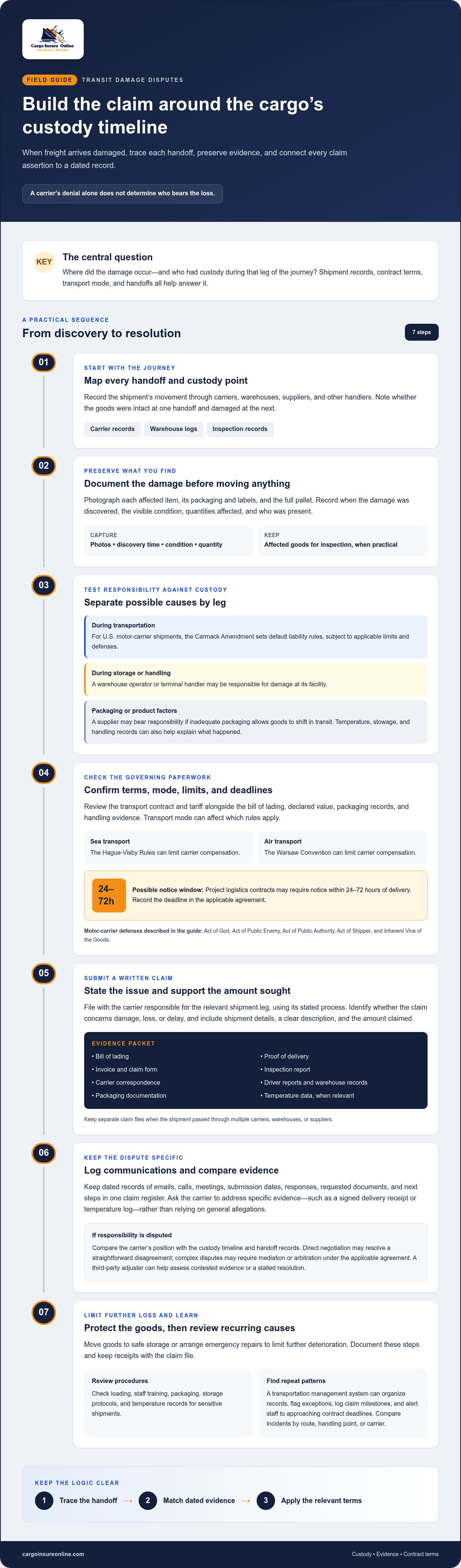
A freight claim seeks compensation for goods damaged, destroyed, or lost during transit. In project logistics, map each handoff and match the evidence to the transport leg where the problem occurred. For a warehouse manager, mitigating carrier blame in a transit damage dispute begins with a clear custody timeline.
Freight Claim Filing
File a written claim with the carrier responsible for the shipment, and identify whether it concerns damage, loss, or delay. Include shipment details, a clear description of the issue, and the amount being claimed. Attach supporting records rather than relying on a delivery note alone. Project logistics contracts may require notice within 24-72 hours of delivery, so record the deadline and follow the applicable agreement.
Keep separate claim files when a shipment passes through multiple carriers, warehouses, or suppliers. For example, record whether crates arrived damaged at the destination warehouse or were intact at the previous handoff. This timeline helps direct the claim to the party responsible for the relevant leg.
Claim Information and Damage Evidence
For a U.S. motor-carrier damage claim, identify the shipment, describe the loss or damage, state the amount sought, and provide supporting records. Useful evidence includes the bill of lading, proof of delivery, invoice, claim form, inspection report, and carrier correspondence.
Photograph each affected item, its packaging and labels, and the full pallet before moving anything. Record when the damage was discovered, the visible condition, the quantities affected, and who was present. Preserve damaged goods for inspection when practical. Warehouse records, driver reports, packaging documentation, and temperature data can help establish where and when the damage occurred.
Carrier Communication and Dispute Resolution
Submit the claim through the carrier’s stated process and keep a dated record of every email, call, and meeting. Ask the carrier to address specific evidence, such as a signed delivery receipt or temperature log, rather than trading general allegations. Track submission dates, responses, requested documents, and next steps in one claim register.
If the carrier disputes responsibility, compare its position with the custody timeline and records from each handoff. Direct negotiation may resolve a straightforward disagreement; complex disputes may require mediation or arbitration under the applicable agreement. A third-party adjuster can help assess the evidence when liability remains contested or resolution stalls. A warehouse manager can mitigate carrier blame in a transit damage dispute by tying each assertion to a dated record.
Warehouse Damage Prevention
Reduce repeat claims by reviewing loading procedures, staff training, packaging, and storage protocols. Check temperature records for sensitive shipments and assess any excursions against the product’s handling requirements. If damage occurs, move goods to safe storage or arrange emergency repairs to limit further deterioration. Document these steps and keep receipts with the claim file.
A transportation management system (TMS) can organize carrier, route, and shipment records. Use its workflow to flag exceptions, log claim milestones, and alert responsible staff to approaching contract deadlines. Compare recurring incidents by route, handling point, or carrier. This can reveal where procedures need adjustment before the next shipment moves.
Carrier liability and contractual limitations
In the United States, the Carmack Amendment sets default liability rules for motor carriers. Contracts, shipment records, transport mode, and the timing of damage can affect which party bears the loss.
Carrier Defenses and Liability Limits
Motor-carrier liability may be limited by contracts, tariffs, federal regulations, per-pound or declared-value limits, and recognized legal defenses. These include Act of God, Act of Public Enemy, Act of Public Authority, Act of Shipper, and Inherent Vice of the Goods. Before accepting a proposed limit, compare the carrier’s position with the contract, declared value, packaging records, and handling evidence.
For international shipments, the transport mode matters: the Hague-Visby Rules can limit carrier compensation for sea transport, while the Warsaw Convention can limit compensation for air transport. Preserve the relevant transport contract and shipment documents. A warehouse receipt alone may not show which terms govern the disputed leg.
Carmack Amendment Responsibility
Under the Carmack Amendment, the motor carrier responsible for a shipment may be liable for cargo damage during its transportation, subject to applicable limits and defenses. Identify the carrier on the bill of lading, then compare custody records with the damage timeline to determine whether the goods were damaged while in that carrier’s possession.
Responsibility can differ across logistics handoffs. A warehouse operator or terminal handler may be responsible for damage during storage or handling at its facility, while a supplier may bear responsibility if inadequate packaging allows goods to shift in transit. Use warehouse logs, inspection records, and packaging documentation to distinguish these possibilities.
Review the contract and tariff together. A per-pound limit can produce a different recovery basis from declared value, while contract terms may allocate responsibilities between parties. If the paperwork cites an NMFC classification, keep it with the tariff and contract, then examine what those documents say about the shipment and applicable terms. A classification reference alone does not establish when the damage occurred or who caused it.
Liability and insurance serve different purposes. Carrier liability concerns a carrier’s responsibility under applicable rules and agreements; cargo insurance may cover certain transit losses, subject to policy terms, conditions, exclusions, and limits. When an insurer pays a covered loss, it may use subrogation rights to seek recovery from the responsible third party. Keep the insurer’s claim records separate from carrier correspondence.
For a shipment crossing modes, map each contract to its transport leg before arguing blame. For example, a damaged sea shipment later moved by truck may involve different rules and documentation at each stage. Matching the mode, custody period, and applicable terms gives the dispute a clearer path. Cargo insurance for transit exposure can be relevant when carrier limits leave financial risk with the cargo owner.
Common causes of cargo damage
A claim seeks compensation for damaged or lost goods, while additional costs need separate support. Itemize handling, repair, storage, or transport expenses, then link each amount to the incident and the governing contract or policy.
Packaging, Loading, and Cargo Securement
Weak packaging can let goods shift in transit, potentially making the supplier or vendor responsible. Before loading, check carton strength, internal cushioning, pallet condition, and shipment photos against the goods’ condition. Improper stowage or securing can also cause cargo to move, collide, or topple during a journey.
Loading records can help distinguish packaging failure from handling damage. Compare the loading plan, driver reports, and warehouse inspection notes. For fragile assemblies or liquid products, tilt indicators can show whether a shipment exceeded safe tilt angles. Shock indicators are designed to detect excessive impact and provide another clue to the incident timeline.
Types of Transport Damage
Transport damage includes breakage, crushing, spoilage, contamination, theft, and pilferage. Rough handling during loading or unloading can crack cases; stacking pressure can deform cartons beneath them. Vibration and repeated micro-shocks may cause hidden damage that appears only after delivery, so inspect the contents as well as the exterior packaging.
Temperature-sensitive shipments need a different evidence trail. Reefer mechanical failure can cause temperature deviations, and a 2-degree temperature shift during refrigerated transport or storage can ruin pharmaceutical cargo or food shipments. Match temperature data with reefer records, product requirements, and inspection findings to locate the likely point of exposure.
Weather and transport accidents can damage freight despite secure packaging. Contamination may also affect goods without visible impact, while theft or pilferage can leave packaging partly intact. Record affected quantities by item and lot, then separate damaged, missing, and potentially salvageable goods. This breakdown clarifies the claimed loss and supports practical storage or disposal decisions.
The operational impact can extend beyond the damaged product. A warehouse may need extra labor for sorting, handling, repacking, and customer updates. Replacement shipments can add transport steps, disrupt schedules, and delay downstream work. Keep invoices, work logs, and delivery records tied to the incident to show which expenses arose from the damage rather than routine operations.
Cargo insurance may cover certain losses involving goods in transit, subject to policy terms, conditions, exclusions, and limits. Institute Cargo Clauses offer coverage levels ranging from basic named perils to comprehensive all-risks protection. Compare the applicable wording with the cause of loss, such as temperature deviation, poor packaging, or handling impact. Policy limits and exclusions determine what the insured can claim.
To prevent repeat incidents, review patterns by route, product type, loading method, and storage point. A pattern of crushed cartons may call for packaging or stacking changes; recurring temperature excursions point to reefer controls or handoff procedures. Use these findings to update handling instructions and reduce disruption to warehouse operations.
What is a Cargo Damage Claim?
A cargo damage claim is a formal request for compensation when freight is damaged, destroyed, or lost during transportation. To assess the claim, identify the affected goods, the likely cause, and the party responsible during that leg of the journey.
Freight Loss and Damage Examples
A freight claim can involve broken goods, missing cartons, spoiled products, or cargo destroyed in transit. For example, a pallet may arrive with its outer wrapping intact but damaged items inside, or a refrigerated shipment may spoil after a temperature deviation. Inadequate packaging can also allow products to shift and break before delivery. Each case needs evidence linking the loss to transport or handling.
Damage inside a warehouse falls on a different timeline from damage during transit. Compare arrival inspections with storage and handling records. A crushed carton recorded at receiving points to a different stage than an item found broken after internal movement. Separating these events helps identify the responsible carrier, warehouse operator, terminal handler, or supplier.
Identifying When and Where Damage Occurred
Build a custody timeline from the bill of lading, delivery receipt, inspection reports, driver reports, and warehouse records. Match each record to the shipment’s condition at a handoff. Temperature data can help locate exposure during refrigerated transport or storage, while packaging documentation can show the goods’ condition before dispatch.
Look for changes between checkpoints. If a pre-shipment inspection shows intact goods but a receiving report notes crushed packaging, the damage occurred later. If the first inspection takes place after warehouse storage, the cause may be harder to isolate. Record gaps and conflicting observations clearly instead of treating an assumption as proof.
Documenting Concealed Damage After Delivery
Concealed damage is discovered after delivery, sometimes after the proof of delivery has been signed. Photograph the unopened packaging first, then capture labels, exterior marks, internal packing, and each damaged item. Record when the damage was found, who inspected it, and the shipment identifiers that link the images to the freight.
Preserve the goods and packaging for inspection, and promptly follow the carrier’s reporting procedure. Keep the invoice, delivery receipt, inspection notes, and carrier messages together. A signed receipt does not establish the internal condition of every item; a dated discovery record helps explain when concealed damage became visible.
Claim processes depend on jurisdiction and transport mode, so identify the route and governing contract before setting a claim plan. In many jurisdictions, cargo damage claims have limitation periods often measured from the delivery date. Notice deadlines and claim requirements can differ, making the delivery date, contract terms, and transport records essential reference points.
Separate the claimed loss from its operational impact. List damaged or missing goods, then document related repair, handling, or storage expenses with invoices and work records. Schedule disruption or customer impact may matter operationally, but recovery depends on the applicable contract, rules, and evidence supporting each amount. Keep these categories distinct in the claim file.
Transport damage accountability and carrier disputes
Carrier blame is only one part of a supply-chain damage dispute. Start with the shipment’s custody timeline, then compare each handoff with contracts, transport records, and the condition documented at receipt. The key question is where the goods were, and who controlled them, when the damage likely occurred.
Separate contractual risk allocation from responsibility for causing physical damage. Incoterms® rules can affect when risk transfers between buyer and seller, while contracts define obligations between parties. For example, under FCA, risk may shift when goods are loaded onto a carrier; under DAP, it may shift when the shipment reaches its destination. Neither example alone proves who mishandled the cargo.
Build a practical accountability map for every leg: shipper, broker, carrier, terminal, warehouse, and receiver. A freight broker’s carrier selection or other actions may be relevant in some situations. Compare bills of lading, transportation logs, storage protocols, temperature data, and chain-of-custody records. Missing handoff records can leave competing accounts, so document who received, moved, or inspected the goods.
Use physical evidence to test each party’s explanation. A triggered shock indicator can provide visual confirmation of an impact, while tilt indicators show whether a shipment exceeded safe tilt angles. A professional surveyor can assess damage, investigate its cause, and estimate repair or replacement costs. An independent survey gives the parties an objective basis for discussing a valuable or complex claim.
Send written notice using the applicable carrier and contract procedures. Damage notice deadlines are often 3-7 days, but the required timeframe can vary by jurisdiction and contract terms. Keep the delivery date, notice, attachments, and carrier response together. A dated record lets warehouse staff show what they reported and when, without relying on later recollections.
For a disputed claim, present a concise sequence of evidence: shipment condition before transit, custody transfers, damage discovery, mitigation steps, and documented loss. Ask the carrier to identify which record or contract term supports its position. If direct negotiation stalls, mediation or arbitration may help address disagreements about liability, compensation, or how to interpret the evidence. A claimant may commission another independent survey if the first report appears biased, incomplete, or factually inaccurate.
Review the outcome across the supply chain, not just the individual shipment. If repeated incidents occur at the same loading point, route, or storage handoff, update procedures with the responsible party. Pre-shipment inspections can document goods and packaging before transit. Explore cargo protection for transit risks as part of managing financial exposure alongside stronger evidence and handling controls.
Review the available records and each handoff before settling on an account of responsibility. Receivers should inspect shipments for visible damage before accepting delivery whenever practical, then promptly document damage and follow the carrier’s reporting procedures. Reviewing transportation logs, storage protocols, temperature data, and chain-of-custody documents can help reconcile accounts across handoffs. A freight broker’s omissions, as well as its carrier selection, may be relevant in some claims.
Involving an expert early can help preserve evidence and avoid costly missteps in the claim process. Independent surveys can provide objective assessments to support cargo damage claim negotiations. Businesses can also reduce the likelihood of third-party freight disputes by working with reliable carriers, warehouses, and vendors.
Cargo Insure Online: Air Freight Insurance
Cargo Insure Online offers Air Freight Insurance for businesses seeking financial protection for goods moving by air. This coverage can complement a carrier claim, which may be subject to contractual limits or legal defenses. Insurance and carrier liability are separate: policy terms, conditions, exclusions, and limits determine what a covered loss may include.
Consider this coverage when air shipments carry valuable goods and a carrier’s liability may not match the shipment’s financial exposure. Review the policy wording against your cargo, route, and handling risks, then keep shipment values and records organized for a potential claim. Cargo Insure Online also offers Sea Freight Insurance and Trucking Insurance for those transport modes.
Visit Cargo Insure Online to explore Air Freight Insurance.
Turn the Next Shipment into a Stronger Plan
Use the next shipment review to turn a dispute into a better operating decision. For a warehouse manager, mitigating transit damage disputes means testing carrier blame against the evidence while tightening the handoffs your team controls. Assign one owner to review recurring incidents, update handling procedures, and share lessons with carriers and warehouse staff.
Financial protection can complement these operational controls. Cargo Insure Online offers Air Freight Insurance, Sea Freight Insurance, and Trucking Insurance. Consider how coverage for each transport mode fits your shipment risks, then review the applicable policy terms, conditions, exclusions, and limits.
If you’re planning protection for upcoming freight movements, contact Cargo Insure Online to discuss the available cargo insurance options. A clear process and a considered coverage plan can help your team move forward with greater confidence.
Frequently Asked Questions
What Is Freight Claims Management?
Freight claims management is the organized handling of shipment claims from initial notice through resolution. It involves assigning an owner, tracking correspondence, maintaining supporting records, and monitoring deadlines for each shipment. For example, a warehouse team can use a shared register to flag open claims, outstanding carrier responses, and pending inspections. This gives operations staff a reliable view of claim status without searching through separate email threads.


