

In the United States, drivers must file coercion complaints with FMCSA within 90 days of the alleged coercion action, according to the Federal Motor Carrier Safety Administration. A hijacked freight shipment can put driver coercion and the insurance investigation that follows on the same evidence trail: messages, driver records, and shipment data.
It’s a stressful combination. A missing load raises urgent questions, but a driver’s actions alone do not establish what happened or determine an insurance claim. The details matter: what pressure was applied, which safety rules were involved, and what the records show.
This article explains how federal coercion rules apply, what drivers can include in a complaint, and how investigators may examine GPS, electronic logging device, and shipping records. You’ll also learn how those findings can inform a freight insurance claim and help you understand the evidence that may shape it.
Key Takeaways
- In the United States, drivers must file coercion complaints with FMCSA within 90 days of the alleged coercion action, according to the Federal Motor Carrier Safety Administration.
- Preserve messages, emails, witness names, and driver records to help document what pressure occurred and how the driver responded.
- Coercion enforcement uses a preponderance standard, and a driver may face coercion even if they ultimately don’t violate a regulation.
- GPS, ELD, and shipping records can help investigators piece together a shipment’s route, timing, and handling.
- The FMCSA rule covers pressure to violate specified federal regulations, including those in 49 CFR parts 171-173, 177-180, 380-383 or 390-399, according to the Electronic Code of Federal Regulations.
Driver documentation of coercion
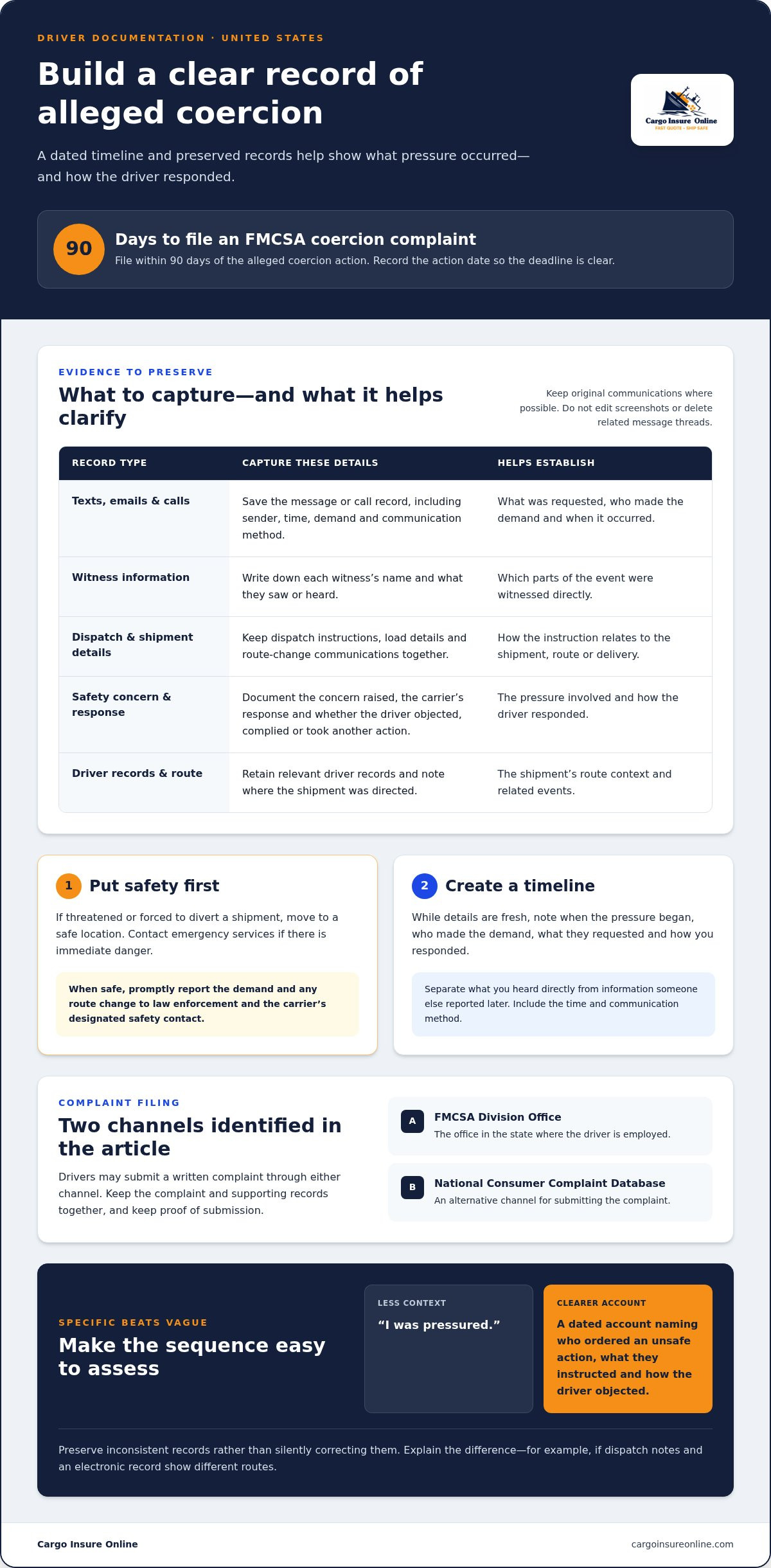
If someone threatens you or forces a shipment diversion, put personal safety first. Move to a safe location and contact emergency services if you face immediate danger. When it is safe, promptly report the demand and any route change to law enforcement and your carrier’s designated safety contact.
In the United States, drivers must file coercion complaints with FMCSA within 90 days of the alleged coercion action, according to the Federal Motor Carrier Safety Administration. Drivers may submit a written complaint to the FMCSA Division Office in the state where they’re employed or use the National Consumer Complaint Database. Record the alleged action date so the filing deadline is clear.
Build a timeline while the details are fresh. Note when the pressure began, who made the demand, what they requested, and how you responded. For example, record a dispatcher’s instruction to keep driving despite a safety concern, including the time and communication method. Distinguish what you heard directly from what someone else reported later.
Preserve records showing both the pressure and your response. FMCSA recommends including messages or emails that document coercion attempts and the driver’s responses, along with witness names. Keep original communications where possible, and do not edit screenshots or delete related message threads.
- Save texts, emails, and call records that identify the sender, time, and demand.
- Write down witness names and what each person saw or heard.
- Keep dispatch instructions, load details, and route-change communications together.
- Document safety concerns raised and the carrier’s response.
- Retain relevant driver records and note where the shipment was directed.
Specific details help distinguish coercion from a routine dispatch change. A note saying “I was pressured” provides little context. A dated account identifying who ordered an unsafe action, what they instructed, and how the driver objected gives investigators a clearer sequence to assess.
Keep the complaint and supporting records together in an organized file. If a carrier, shipper, receiver, or intermediary was involved, identify each person’s role without assuming who is responsible. Consistent documentation can also help explain a route deviation or delay during a hijacked freight shipment driver coercion insurance investigation.
Drivers can raise safety concerns while still following the formal complaint process. Preserve the evidence, submit the complaint through an available FMCSA channel within the deadline, and keep proof of submission. Clear, timely documentation creates a traceable account of the alleged coercion and the driver’s response.
Evidence standard in coercion cases
In a United States FMCSA coercion enforcement case, the standard is preponderance of the evidence, not clear and convincing evidence. In practical terms, the evidence must make the alleged coercion more likely than not. The case turns on the weight of all available facts, not whether one record proves the entire sequence on its own.
A driver does not have to ultimately violate a regulation for coercion to be found. The key issue is whether a covered party applied pressure to induce the driver to violate a safety rule. For example, a shipper’s demand to continue toward delivery despite a reported safety concern may matter even if the driver refused and stopped.
Evidence is stronger when separate records tell a consistent story. An electronic message can show the instruction, a dispatch record can identify who sent it, and a driver’s account can explain the safety concern and response. If the stated reason for a route change conflicts with the timing of a threat, that discrepancy may also help clarify what happened.
Organize the evidence into a clear sequence rather than leaving it as a pile of disconnected files:
- Identify the demand: Preserve the exact words, sender, and communication method.
- Place it in context: Connect the instruction to the transportation task, route, or delivery.
- Show the response: Record whether the driver objected, complied, or took another action.
- Compare accounts: Note where the carrier, shipper, receiver, and driver agree or differ.
- Keep records linked: Match messages and reports to the shipment and relevant events.
Consider a driver ordered to divert a load after raising a safety concern. The driver refuses, but the shipment later disappears. The refusal alone does not disprove coercion. Investigators can assess the original demand, the driver’s response, and records of the diversion and delivery events. Taken together, these details may show whether the pressure concerned a safety-rule issue or another part of the shipment’s handling.
Inconsistent records need an explanation, not silent correction. If dispatch notes show one route but an electronic record shows another, preserve both and document the reason for the difference. A clear chronology helps distinguish a routine transportation change from pressure tied to a safety concern.
For a claim involving valuable electronic cargo, records identifying the shipment can also support a focused review of electronics and high-value devices insurance. Keep coercion evidence and cargo-loss records organized as distinct, connected parts of the event.
Insurance investigations using GPS, ELD, and shipping records
For a hijacked freight shipment driver coercion insurance investigation, preserve GPS data, electronic logging device (ELD) records, shipping documents, and relevant employment records. Keep original files, and note who collected each record, when it was saved, and which shipment it relates to.
GPS points can help reconstruct a truck’s route and stops. ELD data can show driving activity and timing. Investigators may compare both with the planned route, dispatch instructions, pickup details, and delivery paperwork. For example, a recorded stop near an unexpected location may prompt questions about who ordered it and how the load was handled.
Shipping records connect the vehicle’s movements to the cargo. Preserve the bill of lading, pickup and delivery confirmations, load instructions, and communications about route changes. Check whether shipment identifiers, locations, and recorded times align across documents. A mismatch is a reason to investigate, not proof of theft by itself.
When investigating suspected internal cargo theft, insurance carriers may review employment records and analyze GPS and ELD data. Employment records can help establish which employees had assigned duties or access connected to the load. Dispatch messages and driver reports may show who gave instructions, whether the driver raised concerns, and what the carrier did next.
Follow a simple evidence-handling sequence to keep records usable:
- Save original GPS and ELD exports, along with the date and source of each file.
- Collect load documents and match them to the shipment’s identifying details.
- Preserve dispatch, carrier, shipper, and receiver communications in their original form.
- Record who accessed the cargo, vehicle, or shipment records, and when.
- Keep a timeline that links route changes, reported concerns, and delivery events.
For example, a route record may show the truck leaving its expected path, while a dispatch message records a new destination. A delivery record may then show whether the cargo reached that destination. Read these items together: the sequence can help distinguish an authorized change from an unexplained diversion.
What evidence should be preserved for a freight theft insurance investigation? Keep GPS and ELD records, shipping and delivery documents, employment records, communications, and a dated timeline that connects them. These materials can help explain the shipment’s route, custody, instructions, and handling.
What are the typical financial losses and insurance claim timelines for hijacked freight? Internal cargo theft can expose a fleet to a six-figure loss without insurance reimbursement, and related claims can take months to resolve. Coverage and the evidence gathered shape the investigation.
Claims involving suspected fraud may require coordination between insurers and law enforcement. Keep records intact, respond accurately to requests, and document what each record establishes. A hijacked freight shipment driver coercion insurance investigation uses this connected history to clarify the reported loss and how the shipment was handled.
Regulations drivers may be pressured to violate
The FMCSA rule prohibits motor carriers, shippers, receivers, transportation intermediaries, and their agents, officers, or representatives from coercing a commercial motor vehicle driver to violate specified federal regulations, according to the Electronic Code of Federal Regulations. The covered regulations are 49 CFR parts 171-173, 177-180, 380-383 or 390-399. The rule took effect on January 29, 2016.
These protections concern pressure to violate covered safety regulations, not every disagreement about a load. A broker or dispatcher demanding on-time delivery, for example, does not by itself establish coercion. The issue is whether someone covered by the rule pressured a driver to violate a regulation within the specified parts.
Common freight-hijacking tactics include false carrier identities and pressure to change a shipment’s destination. Fraudulent registration details, unfamiliar email domains, changed contact information, or unexpected insurance changes can raise concerns for brokers. A driver may also face pressure to continue an unsafe operation or follow instructions that conflict with compliance duties.
To assess a suspicious carrier change, compare the records rather than relying on a single detail:
- Review recent carrier ownership and contact changes against earlier records.
- Compare registration information with the carrier’s current operating details.
- Examine unfamiliar email domains and unexpected insurance updates.
- Match new pickup or delivery instructions to the shipment’s documented plan.
These steps can identify inconsistencies, but they do not establish that a crime or coercion occurred. For example, a new email domain combined with a sudden destination change warrants careful review, especially if the driver reports pressure. Preserve both the old and new instructions so investigators can see what changed.
Motor carriers remain responsible for FMCSR compliance by driver employees, including owner-operators. Clear communication matters: a carrier’s instruction should not push a driver toward a covered violation. The FMCSA coercion rule does not apply to Federal, State, or local government entities.
FMCSA is authorized to issue penalties against motor carriers, shippers, receivers, or transportation intermediaries that coerce drivers. The maximum inflation-adjusted civil penalty for each coercion-rule offense is $16,000 per offense. The potential penalty reinforces why brokers and carriers using services like Cargo Insure Online should treat reported pressure and suspicious shipment changes as matters for prompt review.
What are common tactics used to hijack freight shipments or coerce drivers? Schemes may involve false carrier identities, altered contact or registration details, unfamiliar email domains, and unexpected insurance changes. The Electronic Code of Federal Regulations says the rule prohibits coercion to violate specified federal regulations.
Carriers and logistics professionals must take every report of driver pressure seriously. In the United States, federal law requires regulations to ensure that commercial motor vehicle operators are not coerced to violate covered safety regulations; the cited provision is 49 U.S.C. 31136(a)(5). That requirement concerns protection from coercion to violate covered safety regulations.
The Moving Ahead for Progress in the 21st Century Act amended the Motor Carrier Safety Act of 1984 to require protection against driver coercion. The amendment is identified as section 32911, 126 Stat. 405, 818, July 6, 2012.
How common are cargo theft and driver-coercion incidents in the United States?
A single figure cannot describe every cargo theft or coercion incident across the United States. Available coercion complaint data measures reports and referrals, not every event involving a driver or shipment. Complaint counts can indicate activity, but they are not a complete count of freight theft or proven violations.
The Department of Transportation Office of Inspector General referred an average of 23 coercion-related complaints per year to FMCSA. That figure reflects referrals, not all complaints drivers may have made, and not all coercion incidents that may have occurred. It also doesn’t establish that each referred complaint led to a substantiated violation.
Historical complaint figures show why the categories need careful reading. In the complaint data discussed in the rule, FMCSA reported receiving 44 complaints in 2010. FMCSA also substantiated 20 complaints, representing 22 percent of complaints referred by the Department of Transportation Office of Inspector General for alleged violations involving acute and critical regulations. Those figures describe specific historical data, not a current annual rate for all cargo theft.
For a carrier or shipper, even one documented event can reveal a practical exposure. A shipment diverted after a carrier identity change may involve cargo theft, identity fraud, or both. A driver pressured to continue despite a safety concern raises a separate coercion question. The investigation should distinguish these issues rather than treating every missing load as proof of driver coercion.
Use records from each incident to understand patterns within your own operation:
- Log the date, shipment, route, and reported loss or pressure.
- Record whether the event involved a carrier identity or contact change.
- Separate suspected theft from allegations of pressure to violate safety rules.
- Track which records support each reported detail and which remain disputed.
- Compare internal incidents over time to spot recurring process gaps.
That history can inform operational controls and insurance discussions. For example, repeated discrepancies in carrier registration or shipment instructions may call for closer review before dispatch. A reported coercion event may point to a need for clearer escalation steps when a driver objects to an instruction.
Cargo theft and coercion figures answer different questions. Referral statistics show activity moving through a complaint channel; they do not measure the full scale of shipment theft. To understand an individual loss, connect the cargo records, driver report, and carrier documentation without overstating what any single figure proves.
If e-commerce shipments are part of your exposure, explore cargo insurance options suited to that risk.
Cargo Insure Online: Air Freight Insurance
Cargo Insure Online offers Air Freight Insurance for businesses moving cargo by air. After a shipment is hijacked or diverted, an investigation may clarify what happened, while the policy terms determine how an insured cargo loss is assessed. Keep shipment documents, driver records, and investigation materials organized to support a claim review.
For goods moving by sea or road, Cargo Insure Online offers Sea Freight Insurance and Trucking Insurance. GAP Insurance is another option for eligible cargo exposures. The right fit depends on how the goods travel and the protection selected for the shipment.
For air cargo planning or an insurance question related to a loss, contact Cargo Insure Online to discuss your needs.
Make your next coverage decision with clarity
A hijacked freight shipment driver coercion insurance investigation can inform how you prepare for future cargo risks. Use what the incident revealed to review how your goods travel, where exposure may arise, and what protection aligns with those movements. Clear decisions start with matching coverage to the transport method and cargo involved.
Cargo Insure Online offers Air Freight Insurance, Sea Freight Insurance, and Trucking Insurance. Each addresses a different transport mode, so consider the routes your shipments take when exploring coverage. Review the terms alongside your shipping arrangements and recordkeeping practices, so your next step reflects how your operation actually moves freight.
Ready to discuss cargo protection for your shipments? Contact Cargo Insure Online to explore the relevant options. A more considered plan can help you move forward with greater confidence.
Frequently Asked Questions
What is freight hijacking involving driver coercion?
It is cargo theft or unauthorized diversion combined with pressure on a driver to take an action, such as violating a covered safety rule. For example, someone may pose as an authorized contact and direct a driver to a different delivery point, while threatening consequences if the driver refuses an unsafe instruction. A diverted load alone does not establish coercion; the pressure, who applied it, and the action demanded all matter.
How do insurers investigate a hijacked freight shipment and assess liability?
Insurers examine the reported loss, shipment documents, policy terms, and the parties’ roles in arranging or handling the cargo. One key distinction is whether the policy covers the type of loss: motor truck cargo policies often exclude employee dishonesty unless they specifically include it. Investigators may also coordinate with law enforcement when fraud is suspected. The resulting records help assess coverage and responsibility separately, rather than treating theft as automatic proof of liability.
What are the reporting deadlines and legal requirements for cargo theft in the United States?
For alleged driver coercion, drivers must file a complaint with FMCSA within 90 days, either with the Division Office in their state of employment or through the National Consumer Complaint Database. The rule bars covered transportation parties from pressuring drivers to violate specified federal safety regulations; report an immediate threat or route-change demand to law enforcement and the carrier’s safety contact when safe.


