
A shipping label can cross borders with only limited protection. To understand how to insure international shipments, arrange optional coverage for potential loss, theft, or damage; most worldwide express couriers provide default coverage of up to $100 USD. For sea and air freight, marine cargo insurance can help protect the shipment beyond basic carrier liability.
It’s easy to assume the carrier’s protection covers the full value of your goods. Often, it doesn’t. The right coverage depends on what you’re shipping, how it travels, and who is responsible for insurance under the sales terms.
This guide explains how shipping insurance works and compares carrier liability with separate cargo insurance. You’ll also learn how Incoterms affect insurance responsibilities, how to assess insured value, and what to do if sea or air cargo arrives damaged or goes missing. Clear decisions help reduce surprises when a claim matters.
Key Takeaways
- Understand where cargo insurance can help and how exclusions, including unsuitable packing, may affect a claim.
- Compare carrier liability with separate insurance to see whether the shipment’s value is adequately protected.
- Use CIP and CIF terms to identify when the seller must arrange cargo insurance, and clarify responsibility under other sale terms.
- Explore how marine cargo coverage applies to sea and air freight, including the differences between partial-loss cover options.
- Build the insured value around the goods and freight costs, then learn what evidence and prompt reporting can support a claim.
What's Shipping Insurance and How Does It Work?
Shipping insurance is optional coverage that can reimburse businesses for goods lost, stolen, or damaged in transit. For U.S. exports and imports, insurance responsibility generally follows the sales contract and applicable Incoterms, rather than one universal cargo-insurance amount.
Coverage Types and Perils
All Risks coverage is generally broader than named-peril policies, which cover only listed events. The scope of protection can vary by policy, so check the terms carefully. The distinction matters: a total-loss policy may pay nothing if one item remains, even when most of the shipment is gone.
All Risks coverage can include events such as theft, fire, collision, and accidents, subject to policy terms and exclusions. Cover may also depend on who packed the goods. For example, an international shipper’s policy may cover items packed by its crew, while excluding damage or loss inside concealed boxes packed by the owner.
Shipping insurance may reimburse up to 100% of a shipment’s insured value, subject to the policy. Coverage can include damage, theft, misplaced goods, and delays, depending on the terms. Read the policy documents for covered events, deductibles, and exclusions before choosing protection.
Exclusions and Packaging Requirements
Exclusions specify losses a policy won’t cover, such as damage caused by unsuitable packing, inherent vice, or the goods themselves. Policies may also exclude wear and tear, loss of weight or volume, wilful misconduct, and leaking contents. An incident during transit doesn’t automatically mean the resulting loss qualifies for reimbursement.
Protective packaging helps reduce damage risk, but it must suit the goods and journey. Use packaging appropriate for the item, and keep shipment documents that record its contents and condition.
Calculating Insured Shipment Value
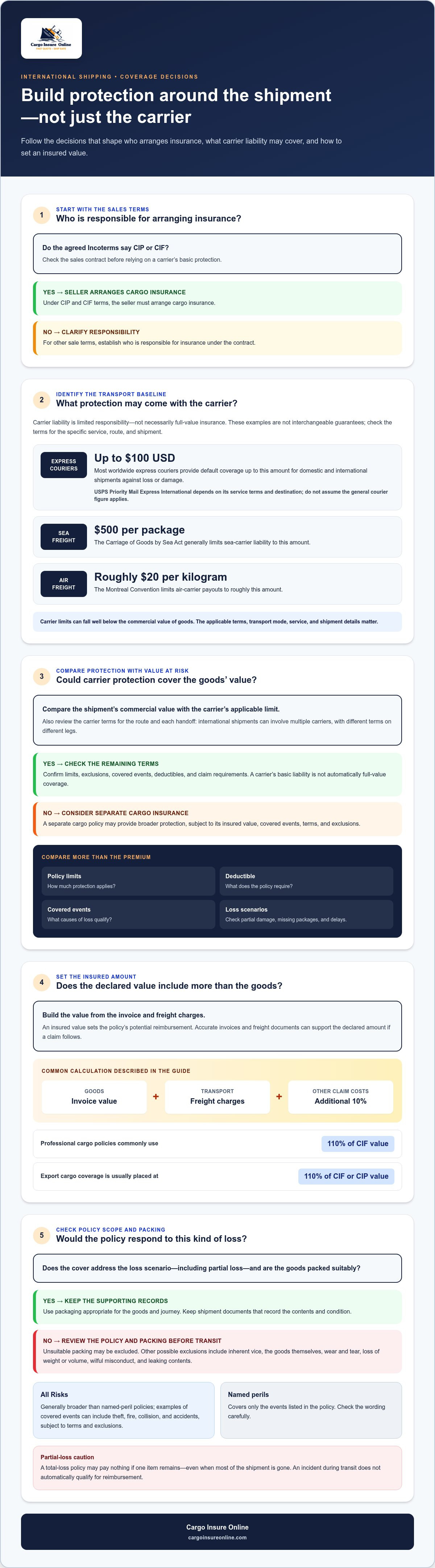
Insured value is the amount used to set the policy’s potential reimbursement, so it should reflect more than the goods alone. A common calculation includes the invoice value, freight charges, and an additional 10% for other costs that could arise in a claim.
Professional cargo policies commonly use 110% of CIF value, while export cargo coverage is usually placed at 110% of CIF or CIP value. For example, include the goods and freight when establishing the base value, then apply the relevant uplift. Accurate invoices and freight documents help support the declared amount if a claim follows.
Carrier Liability and Shipment Value
Carrier liability is the carrier’s limited responsibility for a shipment, not necessarily full-value insurance. International agreements can restrict carrier payouts. The Carriage of Goods by Sea Act generally limits sea-carrier liability to $500 per package, while the Montreal Convention limits air-carrier payouts to roughly $20 per kilogram.
Those limits can fall well below the commercial value of electronics, machinery, or other high-value goods. Most worldwide express couriers provide default coverage of up to $100 USD for domestic and international shipments against loss or damage. USPS Priority Mail Express International coverage depends on its service terms and destination; the general express-courier figure shouldn’t be treated as a guaranteed amount for that service.
Carrier-provided versus third-party insurance
Carrier liability, carrier insurance, and separate cargo insurance are different forms of protection. Compare their limits, exclusions, and claim requirements to identify where your shipment may remain financially exposed.
Carrier Liability and Shipping Insurance
Carrier liability is the carrier’s responsibility under its transport terms. Shipping insurance is a separate policy for covered losses. This distinction matters when commercial goods go missing or arrive damaged: carrier liability may be limited, while insurance responds according to its own insured value, covered events, and exclusions.
A carrier may include basic liability automatically, but that isn’t the same as full-value coverage. For example, a seller shipping electronics worth more than the carrier’s applicable limit could face a gap between the recoverable amount and the cost of replacing the goods. A separate cargo policy may offer broader protection, depending on its terms.
Compare protection across the entire transit route, not just the first carrier handoff. International shipments can involve multiple carriers, and the terms governing one leg may differ from those that apply elsewhere. Check whether coverage follows the shipment through each handoff and whether its exclusions suit the goods and route.
Compare more than the premium. Set the shipment’s declared value beside the deductible, limits, covered events, and excluded causes of loss. Then review how each policy treats partial damage, a missing package, and delayed delivery. A lower premium may mean narrower protection or a more limited claim response.
Limits on Carrier Liability
Carrier liability limits cap what a carrier may owe for a shipment; they don’t necessarily reflect the goods’ actual value. International agreements can restrict liability for export shipments, and the transport mode, applicable terms, and shipment details determine which limit applies. This matters when the invoice value exceeds the carrier’s potential responsibility.
For example, USPS Registered Mail indemnity limits are much lower than those for insured mail. This shows why a service’s name or tracking alone doesn’t establish the financial protection available. Review the carrier’s terms for the specific service and destination, then compare its liability limits with the amount at risk.
Carrier liability doesn’t replace the need to document a loss. Keep the invoice, proof of shipment, delivery records, and photographs of damaged packaging or goods. These records help establish what was shipped and what happened. The carrier and a separate insurer may require different evidence and reporting steps.
If the carrier’s terms leave a meaningful value gap, compare a separate policy’s scope and claim conditions against the goods and route. A shipment coverage comparison can help frame that review around the risks in transit, rather than the carrier’s basic liability alone.
Incoterms and responsibility for arranging insurance
The sales contract and chosen Incoterm identify which party must arrange cargo insurance. Only CIP and CIF Incoterms specifically address insurance, so the named term can change who must organize protection.
Insurance Duties Under Terms of Sale
Terms of sale allocate insurance duties between seller and buyer, making the written agreement essential. For terms other than CIP and CIF, agree separately who provides coverage and record that decision in the sales contract.
That clarity helps prevent a coverage gap between shipment and destination. The exporter may arrange a policy or pay to insure cargo under a freight forwarder’s policy when the sale terms make the exporter responsible. The arrangement should match the agreed route and shipment responsibilities.
A useful starting point for how to insure international shipments is to align the insurance arrangement with the pricing and delivery terms. The sales contract can identify who arranges coverage, the shipment value to protect, and the destination. Clear records help both parties understand their roles if a loss occurs.
Buyer and Seller Responsibilities
Under CIP, the seller must arrange insurance against the buyer’s risk of loss or damage from the point of delivery to at least the destination. This matters because the seller’s insurance duty continues even though the buyer bears the relevant risk from that delivery point.
Insurance arrangements can vary by shipping terms, so buyers and sellers should confirm who is responsible for arranging coverage. A seller using CIF therefore arranges the required insurance for the buyer’s risk, while the transport mode determines whether CIF is appropriate.
For other Incoterms, the buyer and seller should agree separately who will insure the cargo. If the foreign buyer is responsible, the exporter should verify that the buyer has arranged adequate coverage. This helps avoid uncertainty about who handles a claim if goods are damaged or lost.
Before confirming an order, match the Incoterm to the actual journey. When deciding how to insure international shipments, distinguish a sea shipment under CIF from a shipment using another transport mode under CIP, where the terms fit. Then document who arranges insurance, the covered journey, and the destination.
Finally, distinguish insurance duties from other contract responsibilities. Assigning insurance to the buyer doesn’t mean the exporter should assume coverage exists. Likewise, a seller responsible for arranging insurance should keep policy details and shipment records aligned with the agreed sale terms.
Marine cargo insurance for sea and air freight
Marine cargo insurance can protect goods moving by sea and, under some policies, by air. Match coverage to the transport mode, declared value, route, and risks the shipment faces.
Sea cargo can encounter stranding, sinking, fire, collision, rough weather, or general average. A marine policy’s coverage depends on its terms, so compare named perils and exclusions before shipment. Maritime perils account for approximately 3,000 vessel losses each year, making the specific scope of protection important to consider.
Three common coverage approaches work differently:
- Free of Particular Average: Covers partial and total losses caused by stranding, sinking, burning, or vessel collision. It also covers general average.
- With Average: Adds damage caused by exceptionally heavy weather to Free of Particular Average coverage.
- All Risks: Offers broader protection for covered loss or damage, subject to exclusions and policy conditions.
General average can affect cargo owners even when their own goods arrive intact. If a sacrifice or expense is made to protect a vessel and its cargo, the policy’s general-average terms matter. Review this provision alongside the named perils instead of judging protection by the policy label alone.
Air freight requires careful review. Marine cargo insurance may cover air shipments, while air-carrier insurance is another possible route. Compare the policy’s covered journey and exclusions with the actual route, including transfers between air and ground transport. Coverage limited to a stated leg can leave other parts of the journey exposed.
Premiums depend on factors such as cargo type, route, transport mode, and declared value. Don’t treat a general rate as a quote: the cost for a particular shipment depends on its details. Check how the policy values damaged goods, whether a deductible applies, and which documents support a claim.
At delivery, inspect the cargo and keep photographs of visible damage. Notify the insurer immediately about visible loss or damage. Report concealed or otherwise non-visible cargo loss or damage to the insurer promptly, following the policy’s claims instructions. Preserve shipping records and claim documents, and follow the policy’s claims process.
How do I calculate the value to insure for an international shipment?
Start with the goods’ invoice value, add freight charges, then include an additional 10% for other costs that could be lost in a claim. Professional cargo policies commonly use 110% of CIF value, while export cargo coverage is usually placed at 110% of CIF or CIP value. The calculation should match the valuation basis in the policy.
Use the shipment’s commercial documents to establish its value. An invoice records the goods’ value, while freight records show transport charges. Keep these documents consistent with the declared value, shipment description, and insured route. A mismatch can make it harder to explain how the amount was calculated when submitting a claim.
A practical calculation has three parts:
- Goods: Use the invoice value for the items being shipped.
- Freight: Add the freight charges associated with that shipment.
- Other costs: Add 10% for costs that could be lost in a claim.
For example, an exporter can use the commercial invoice and freight document to establish the first two parts, then apply the 10% addition. If the policy uses a 110% CIF or CIP basis, use that stated valuation method instead of mixing methods. The figures should describe the same shipment and journey.
Declared value is not the same as the carrier’s liability limit. Declared value is used to set insurance coverage, while carrier liability may be restricted by transport terms or international agreements. For electronics, compare the policy’s insured amount with the invoice and freight records, not just the carrier’s basic limit.
Check the policy schedule and supporting documents before the goods leave. Confirm that the shipment description, currency, invoice amount, freight charges, and route align. If the shipment changes, such as through a revised invoice or transport plan, update the valuation records so the policy reflects the cargo being moved.
Keep a simple calculation record with the invoice, freight evidence, and the basis used, such as 110% of CIF or CIP value. That gives the claims process a clear trail from the goods’ value to the declared amount. For shipments involving electronics or other high-value devices, explore high-value shipment coverage as part of your valuation planning.
Cargo Insure Online: Air Freight Insurance
Cargo Insure Online offers Air Freight Insurance for businesses shipping goods internationally by air. It’s a relevant option when carrier liability falls short of the shipment’s declared value or leaves transit risks uncovered. Review the policy’s covered journey, exclusions, and claim requirements against your route and shipping documents before arranging coverage.
For goods moving by sea or road, Cargo Insure Online also offers Sea Freight Insurance and Trucking Insurance. Choose coverage that aligns with the transport mode and responsibilities in your sale terms. Clear records of the cargo, value, and route help keep insurance information connected to the shipment.
Visit Cargo Insure Online to explore Air Freight Insurance for your shipment.
Build protection into your next shipment plan
Make cargo protection part of the shipping decision, not an afterthought. Before your next order moves, align the insurance arrangement with the route, goods, sales terms, and people responsible for managing risk. This gives your team a clear starting point if plans change or a claim becomes necessary.
Planning how to insure international shipments can become a repeatable business process. Organize shipment values and supporting documents, and include insurance responsibility in the order review. A consistent approach helps teams manage each new shipment with fewer last-minute decisions.
Cargo Insure Online offers Air Freight Insurance, Sea Freight Insurance, and Trucking Insurance for businesses moving goods by these modes. Choose the relevant coverage for your shipment, then review its terms against your cargo and route.
Ready to discuss coverage for an upcoming shipment? Contact Cargo Insure Online today and take the next step with a clearer plan.
Frequently Asked Questions
What Does It Mean to Insure a Shipment?
Insuring a shipment means arranging a policy that may reimburse a business for covered cargo losses. The policy identifies the insured goods, their declared value, covered events, exclusions, and claim conditions. For example, if products are stolen in transit, the policy’s terms determine whether the loss qualifies. This protection is separate from a carrier’s limited responsibility for transporting the package.
What is the declared value limit for carrier insurance?
There isn’t one universal declared-value limit for carrier coverage; the applicable amount depends on the carrier, service, route, and transport mode. Worldwide express couriers commonly provide default coverage of up to $100 USD for domestic and international shipments. Sea-carrier liability is generally limited to $500 per package under the Carriage of Goods by Sea Act, while air-carrier payouts under the Montreal Convention are roughly $20 per kilogram.
What does international shipping insurance cover and exclude?
Coverage may include loss, theft, damage, or delay, depending on the policy. Exclusions commonly include unsuitable packing, wear and tear, inherent vice, and loss of weight or volume. A fragile item damaged because it wasn’t properly protected may fall outside coverage. Before dispatch, check the policy’s covered events and exclusions against the goods, packaging, and journey.
How much does international shipping insurance cost?
Premiums depend on factors such as the shipment’s declared value, route, transport mode, cargo type, and selected coverage. The insured amount and policy terms also affect the quote. To budget accurately, gather the commercial invoice, freight charges, and shipment details, then request a quote based on that information. The price depends on the case and is given after a quote request.
How do I buy insurance through a carrier, freight forwarder, or third-party insurer?
Start by identifying who arranges protection under the sales terms. Carrier coverage may be selected during booking, a freight forwarder may arrange cargo insurance through an insurer, or a business can obtain a separate policy. Compare the covered route, insured value, exclusions, deductible, and claims process. Arrange coverage before the shipment moves, and keep policy documents with its invoice and transport records.
How do I compare carrier liability with cargo insurance?
Compare the potential carrier payout with the shipment’s declared value and likely financial loss. A high-value shipment, for example, may be worth far more than an applicable per-package or per-kilogram liability limit. Then compare cargo insurance terms, including covered events, deductibles, exclusions, and claim evidence requirements. This helps show whether separate coverage addresses a meaningful gap without treating carrier liability as full-value protection.
How do Incoterms affect responsibility for insuring international shipments?
CIP and CIF specifically assign cargo-insurance obligations. Under CIP, the seller arranges insurance against the buyer’s risk from the point of delivery to at least the destination. CIF applies only to sea and inland waterway transport and carries the same contractual insurance obligations. For other Incoterms, agree separately who arranges insurance and record that responsibility in the sales terms.
Are there restrictions on insuring certain goods or shipping routes?
Yes. Policy terms may restrict eligible goods, routes, or causes of loss, so coverage depends on the specific wording. Common exclusions can include unsuitable packing, inherent vice, and used goods. Describe the cargo and route accurately when arranging protection, especially for fragile, unusual, or high-value items. Review the limits and exclusions that apply before relying on coverage.


