
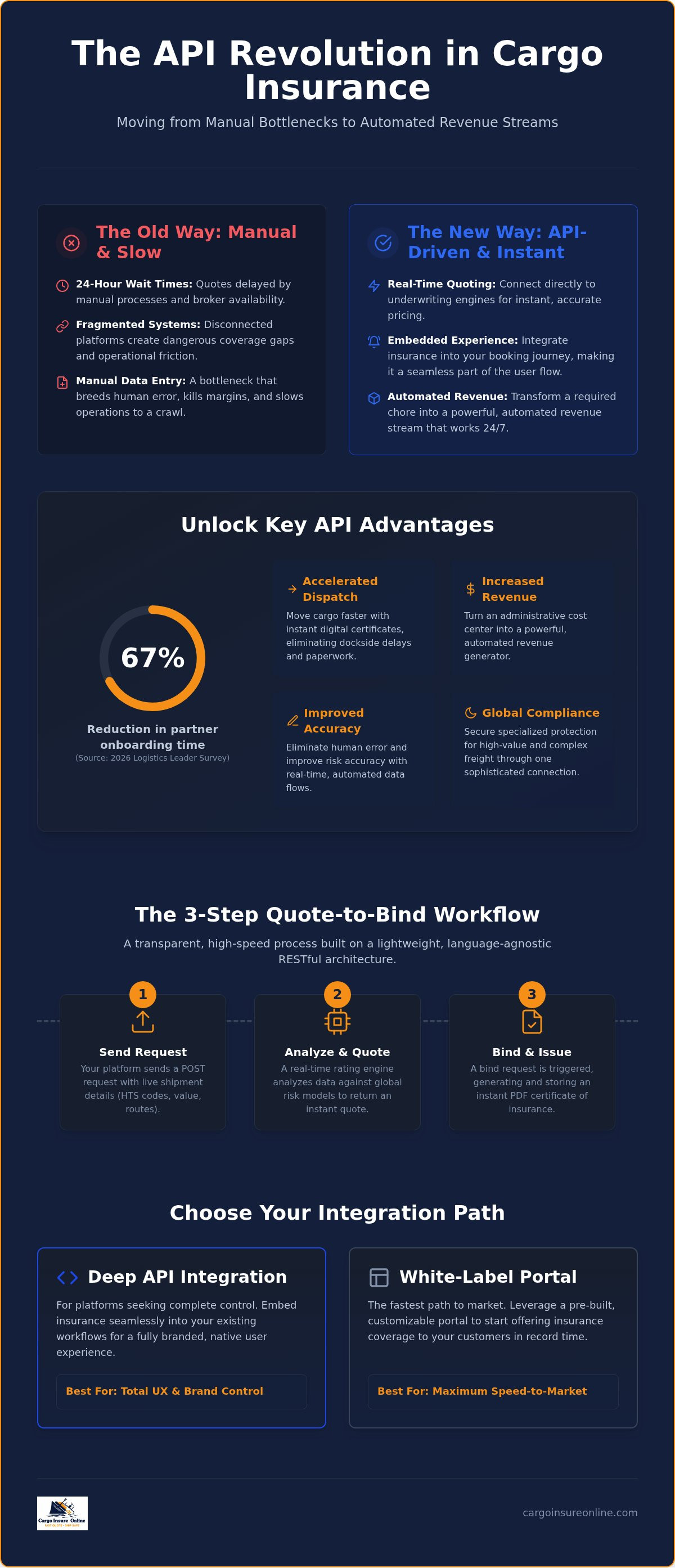
Did you know that logistics leaders using open insurance API standards have slashed their partner onboarding time by a staggering 67% in 2026? You've felt the friction of the old way. Manual data entry is a bottleneck that slows your operations to a crawl. Fragmented systems create dangerous coverage gaps, and waiting for a traditional broker to respond is a luxury your high-velocity business can't afford. It's time to trade administrative headaches for automated growth.
By implementing a modern cargo insurance API integration, you can transform your logistics platform into a revenue-generating powerhouse. You'll move from chasing paperwork to capturing instant, embedded revenue streams while providing a frictionless experience for your customers. We're moving past the era of slow-moving bureaucracy into a future of digital-first connectivity. This article breaks down exactly how to leverage real-time quoting and automated policy issuance to dominate the market. Learn how to turn insurance from a required chore into your biggest competitive advantage today.
Key Takeaways
- Eliminate 24-hour wait times by connecting your logistics platform directly to real-time underwriting.
- Leverage RESTful architecture to integrate key endpoints for quoting, binding, and document retrieval in record time.
- Discover how a cargo insurance API integration provides the ultimate balance between user experience control and automated revenue generation.
- Choose between deep API customization for total UX control or white-label portals for the fastest possible market entry.
- Secure global compliance and specialized protection for high-value freight through one single, sophisticated connection.
The Death of Manual Quoting: Why API Integration is Mandatory
The era of the "waiting game" is officially over. Traditional insurance brokers might ask for 24 hours to return a quote; in 2026, 24 hours is an eternity. If your logistics platform isn't offering instant results, you're losing customers to a faster competitor. High-velocity logistics requires high-velocity protection. Stop settling for the slow lane. A cargo insurance API integration isn't just a technical upgrade; it's a fundamental shift in how risk is managed across the global supply chain.
While Marine insurance has historically relied on manual spreadsheets and endless phone calls, the modern industry demands a digital-first approach. Embedded insurance is no longer a futuristic concept. It's the expected standard. By 2026, the shift from an administrative chore to a competitive advantage is complete. You can either be the platform that provides immediate peace of mind or the one that holds up the shipment with paperwork.
Breaking the Bureaucracy with Automation
Manual data entry is a relic that breeds human error. It causes coverage gaps. It kills your margins. When you automate the flow of data between your Transportation Management System (TMS) and the underwriter, you eliminate these bottlenecks entirely. It's about moving from friction to flow. Real-time data streams do more than just save time; they improve risk accuracy. When an API pulls live shipment details, premiums are calibrated with precision, ensuring you never overpay for protection.
For carriers, the biggest win is dispatch speed. Instant digital certificates mean your cargo moves faster. You no longer have to wait at the dock for a PDF to arrive in an inbox. This automation creates a ripple effect of efficiency across your entire operation. You don't just save minutes; you save your reputation for reliability. CIO Sphere Inc. understands that in the world of FreightTech, speed is the only currency that matters.
Meeting the 2026 Standard for Digital Logistics
Modern shippers have changed. They've been conditioned by consumer technology to expect a single-click checkout experience. If you don't offer insurance at the point of sale, you're leaving revenue on the table. A Cargo Insurance API is a real-time bridge for logistics data. This connectivity allows you to embed protection directly into the booking journey, making it a seamless part of the user experience rather than an afterthought.
This is especially critical for high-volume sectors like e-commerce. Manual systems simply cannot scale to meet the demands of thousands of micro-shipments. Whether you're securing Sea Freight Insurance for a massive container or specialized Drones Insurance for a last-mile delivery, the process must be frictionless. By adopting the 2026 standard, you transform insurance from a cost center into a powerful, automated revenue stream that works while you sleep.
How a Modern Cargo Insurance API Works
Forget the old black box of insurance. A modern cargo insurance API integration operates as a transparent, high-speed engine within your own tech stack. It's built on RESTful architecture. This means it's lightweight, language-agnostic, and lightning-fast. You aren't just sending data; you are successfully navigating innovation waters by connecting directly to global underwriting markets. This architecture allows your platform to talk to the insurer's brain in real time.
The system relies on four critical endpoints to handle the heavy lifting:
- Quoting: Instant pricing based on live shipment data.
- Binding: Locking in the coverage the moment the order is confirmed.
- Document Retrieval: Pulling PDF certificates via GET requests.
- Claims Reporting: Initiating the recovery process digitally.
The system also utilizes webhooks for real-time status updates. Instead of polling the server constantly, your platform receives an instant push notification the moment a policy status changes or a claim is updated. This keeps your user interface accurate without wasting bandwidth. It's the difference between asking "are we there yet?" and being told the second you arrive.
The Quote-to-Bind Workflow
The process is a three-step sprint. First, your system sends a POST request containing shipment details like HTS codes, voyage routes, and total value. Second, the real-time rating engine analyzes these variables against global risk models. Finally, you trigger a bind request. Within milliseconds, an instant certificate is generated and stored. No humans. No delays. Just code. If you're ready to see this in action, you can explore our developer-friendly documentation to get started.
Security and Authentication Protocols
Speed is worthless without security. We use OAuth 2.0 to ensure every handshake between your platform and our engine is authenticated. Sensitive data, such as commercial invoices for electronics and high-value devices insurance, is protected by industry-leading encryption standards. Your data stays yours. Our infrastructure is built to scale. Whether it's a quiet Tuesday or the height of the Black Friday rush, the API handles thousands of requests per second without breaking a sweat.
API vs. White Label: Choosing Your Integration Path
Choosing between a deep cargo insurance API integration and a white-label solution isn't a matter of quality. It's a matter of strategy. Do you want to build the car, or do you just want to drive it? Both paths lead to the same destination: a high-performing revenue engine. But the route you take depends on your technical resources and your desire for total control over the user journey. Don't let indecision stall your digital transformation.
A hybrid model is also a viable option for many firms. You might use APIs to handle the invisible data flow while relying on a branded cargo insurance platform for customer-facing claims management. This balances custom development with operational speed. Regarding your bottom line, these paths support diverse revenue models, from straightforward referral fees to strategic markup strategies that turn protection into a profit center.
When to Choose Full API Integration
This is the gold standard for TMS providers, ERP systems, and high-volume digital freight forwarders. If you move massive volumes, you need a native experience. A full cargo insurance API integration allows you to bake insurance directly into your checkout. No redirects. No friction. Just a single checkbox that increases your conversion rates and customer lifetime value. It's about owning the data and the experience simultaneously.
The flexibility here is unmatched. You can bundle insurance into the total shipping cost, making protection invisible but essential for your clients. It's the ultimate tool for FreightTech innovators who want to eliminate administrative chores and replace them with a seamless, automated workflow. You control the UI, the timing, and the brand touchpoints from start to finish.
When White Label Makes More Sense
Not every business has a dev team ready for a deep build today. Small to mid-sized brokers often need a professional tech stack without the six-month roadmap. White-label portals allow you to launch in weeks rather than months. You get pre-built UI components that look and feel like your brand, but the heavy lifting happens on our servers. It's a plug-and-play solution for a high-velocity world.
You still get access to world-class air freight insurance and sea freight coverage. It's about speed to market. You leverage CIO Sphere Inc.'s existing infrastructure to offer a sophisticated digital experience immediately. It's the fastest way to stop being a traditional broker and start being a digital-first partner. Stop waiting for "someday" and start generating revenue now.
The Developer’s Checklist for Seamless Integration
Legacy systems rely on static forms and manual glossaries. Modern developers don't. A successful cargo insurance API integration requires a robust technical foundation, not a stack of PDFs. Before you write a single line of production code, you need to verify the infrastructure. Does the provider offer a clear sandbox? If you're stuck testing in a live environment, you're already behind. Speed is the goal; precision is the requirement. You want a partner that treats their API as a product, not an afterthought.
Mapping your data fields is the next critical hurdle. You must ensure your internal shipment objects are compatible with global ISO standards. This isn't just about labels; it's about seamless data translation across international borders. From HTS codes to voyage details, every field must be airtight. Don't let a mismatched data type be the reason a high-value shipment goes unprotected. If the data doesn't flow, the cargo doesn't move. Reliability starts with clean code and standardized schemas.
Phase 1: Discovery and Sandbox Testing
Start by obtaining your API credentials and diving into the documentation. You aren't just looking for endpoints; you're looking for clarity. Run test quotes for every mode you support, from sea freight to trucking. This is where you stress-test the rating engine. You should also verify document generation for specialized coverage. For instance, ensure your electronics shipping insurance certificates include the necessary high-value tech clauses automatically. Simulate a reefer product failure or a total loss. If the sandbox doesn't mirror reality, your integration won't survive production.
Phase 2: Production Deployment and Monitoring
Moving to production is a milestone, not the finish line. You need comprehensive logging for every request and response. Standardized API programs report 41% lower integration maintenance costs compared to proprietary methods, so stick to the standards. When a rate timeout occurs, your system shouldn't crash; it should adapt. Implement smart retry logic for transient network failures to maintain a frictionless user experience. You're building a revenue engine, so monitor it like one. Track your conversion rates and premium volumes in real time. High-velocity logistics requires constant optimization. Ready to build? Get your developer API key today and start integrating.
Cargo Insure Online: Your Sophisticated API Ally
Legacy brokers are stuck in a world of paper trails and manual approvals. We aren't. CIO Sphere Inc. represents the modernizing force in global trade. We've replaced bureaucratic delays with high-energy, digital-first solutions. A cargo insurance API integration with us means you're partnering with a sophisticated ally that values your time. We don't just provide coverage; we provide the technological nervous system for your logistics engine. It's time to move beyond the administrative chore and into a future of empowered, automated growth.
Our reach is global, but our expertise is specialized. Whether you're moving freight by air, sea, or land, our single API covers it all. We've mastered the complexities of 2026's most demanding niches, ensuring your platform can handle any challenge. We provide specialized protection for:
- Drones Insurance: Securing the future of autonomous last-mile delivery.
- Reefer Product: Protecting temperature-sensitive cargo with precision.
- High-Value Tech: Robust coverage for electronics and mobile devices.
The journey doesn't end at binding. We've revolutionized the backend to ensure frictionless claims. We're moving the industry from digital binding to digital payout. When a loss occurs, our automated workflows kick in to minimize disruption. You get speed, clarity, and relief when you need it most. It's a seamless, positive experience designed to keep your business moving forward without the traditional friction of insurance recovery.
Built by Tech Experts for Logistics Innovators
We didn't build this platform for the status quo. We built it for the disruptors. Our architecture is optimized for speed, delivering sub-second response times for global quotes. This ensures your user experience remains lightning-fast, even during peak shipping seasons. We offer a flexible framework that adapts to your specific business model. Whether you're a digital freight forwarder or a global ERP, our system scales with you. Our support team speaks your language. We provide unrivaled assistance for developers and product teams, ensuring your cargo insurance API integration is smooth and successful from day one.
Ready to Build Your Insurance Engine?
The roadmap to your own branded insurance solution is shorter than you think. You don't need a massive development cycle to start generating new revenue streams. You can get your credentials and begin exploring our sandbox environment today. It's time to stop managing insurance as a chore and start leveraging it as a competitive asset. The future of logistics is connected, automated, and instant. Are you ready to lead? Connect with the CIO tech team and get your API keys now to start your journey.
Dominating the Digital Trade Frontier
The days of waiting for a broker's email are over. In 2026, speed is the only metric that matters. You've seen how manual processes create bottlenecks and how a modern cargo insurance API integration replaces friction with flow. By automating your insurance workflow, you aren't just saving time; you are unlocking a scalable revenue stream that works at the speed of global trade. It's time to stop reacting to the market and start defining it.
Whether you need sub-second quote responses or global coverage for air, sea, and land transport, the infrastructure is ready. We provide the specialized protection your innovators need, including niche coverage for drones and high-value tech. This is about more than just insurance; it's about empowering your users with a seamless, single-click experience. Stop managing administrative chores and start leading with a platform that never sleeps.
Scale your logistics platform with our Cargo Insurance API and turn protection into your biggest competitive advantage today. The future of logistics is digital, automated, and yours for the taking. Let's build something extraordinary together.
Frequently Asked Questions
What is a cargo insurance API?
A cargo insurance API is a digital bridge that connects your logistics platform directly to an underwriter's rating and policy engine. It allows for a seamless cargo insurance API integration where quotes are generated and policies are bound in real time without manual intervention. This technology eliminates traditional paperwork and phone calls; instead, it uses code to secure shipments instantly within your existing workflow.
How long does it take to integrate a cargo insurance API?
Integration timelines typically range from a few days to several weeks depending on your technical resources and the depth of customization required. A basic setup using our standardized RESTful endpoints can be live very quickly. If you're building a fully custom native checkout experience within a complex ERP system, the process may take longer to ensure all data fields are mapped perfectly to global ISO standards.
Can the API handle specialized goods like drones or reefer cargo?
Yes, our API is specifically designed to handle niche and high-value cargo that legacy brokers often struggle to quote. This includes Drones Insurance for autonomous delivery fleets and Reefer Product coverage for temperature-sensitive shipments. The rating engine analyzes the specific risks associated with these goods in real time. You can also secure specialized protection for electronics and high-value devices through the same single connection.
Does the API support global shipping routes?
Our API provides comprehensive global coverage across all major freight modes, including air, sea, and land transport. Whether you're shipping via Sea Freight Insurance across the Pacific or utilizing Trucking Insurance for cross-border logistics, the system calculates risk based on international routes and local requirements. This ensures your shipments are protected regardless of their destination; providing a truly borderless solution for modern, high-velocity global trade.
Is there a sandbox environment for developer testing?
We provide a dedicated sandbox environment where your developers can test every aspect of the cargo insurance API integration without risking live data. This environment allows you to simulate various scenarios, such as high-value losses or complex routing, to ensure your error handling and data mapping are airtight. You'll have access to full documentation and test credentials to verify that your system is production-ready before you go live.
How are insurance claims handled through an integrated API?
Claims are managed through a digital-first workflow that prioritizes speed and transparency. When a loss occurs, your platform can initiate a claim directly via a dedicated API endpoint, pushing all necessary shipment and policy data to our team instantly. This eliminates the need for manual form submissions and long wait times. We aim to move from digital binding to digital payout, ensuring your customers experience relief rather than bureaucratic friction.
Can I use the API for white-label insurance branding?
Absolutely, our White Label Solutions are built to empower you to offer insurance under your own brand. You can choose to use our pre-built UI components for a fast launch or use the API to build a completely custom, native experience. This allows you to maintain a consistent brand journey for your customers while leveraging our sophisticated underwriting engine and global infrastructure to handle the heavy lifting behind the scenes.
What are the security requirements for API integration?
Security is a non-negotiable priority for all our digital connections. We utilize OAuth 2.0 and robust API key management to ensure every data exchange is fully authenticated and authorized. All sensitive information, including commercial invoices and shipment details, is protected by industry-standard encryption during transmission. Our infrastructure is designed to handle thousands of requests per second securely; protecting your commercial data while maintaining the high-speed performance your logistics operations demand.


