

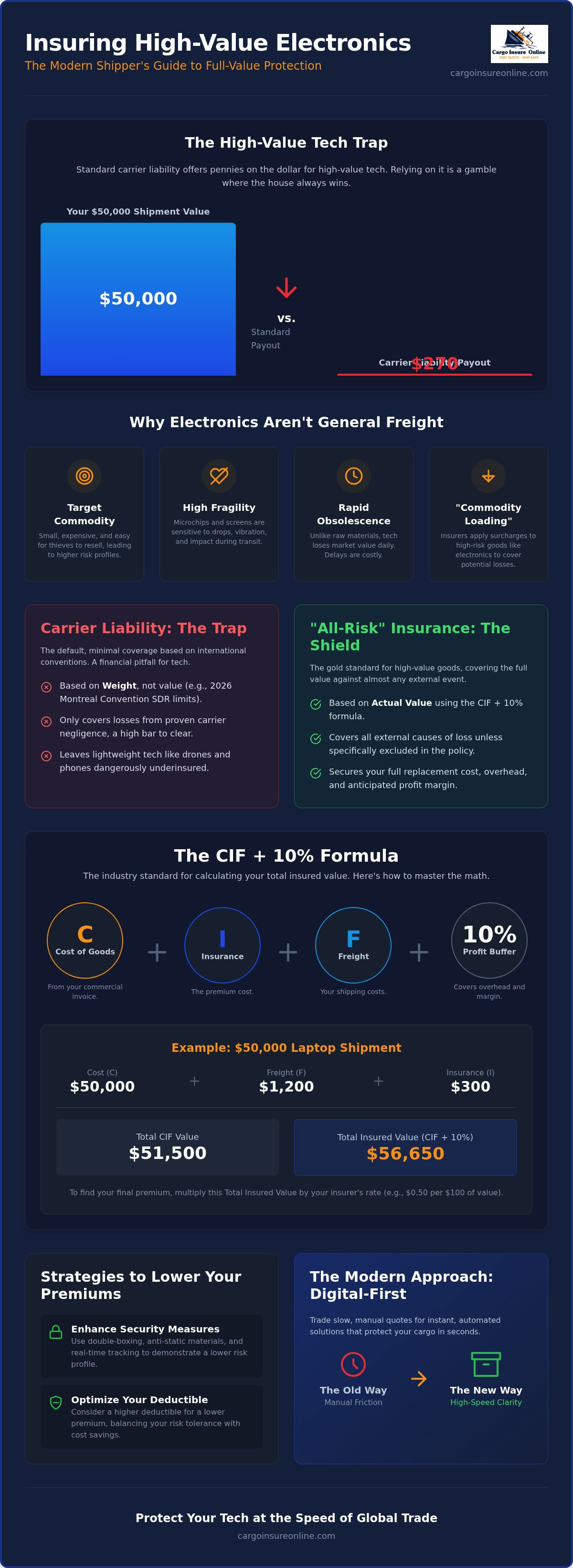
If your $50,000 shipment of semiconductors gets crushed, a standard carrier might hand you a check for $270 and call it even. That isn't a safety net. It's a rounding error. Relying on carrier liability for tech cargo is a gamble where the house always wins. You know that high-value electronics demand precise protection, but the industry often hides behind opaque fees and manual quote processes that feel like they belong in the last century. This guide changes that. We'll show you exactly how to calculate insurance for high-value electronics using the CIF+10% standard to ensure your full replacement value and profit are locked in.
Stop guessing at "commodity loading" and start mastering the math. We're breaking down the 2026 SDR rates for air and sea freight, explaining why weight-based liability is a trap for lightweight, high-cost tech. You'll learn the specific formulas for "All-Risk" premiums and how to leverage digital-first automation to bypass slow brokers. We are moving from manual friction to high-speed clarity. It's time to protect your tech at the speed of global trade.
Key Takeaways
- Master the CIF + 10% formula to secure your tech's full replacement value plus profit.
- Discover how to calculate insurance for high-value electronics to avoid the trap of weight-based carrier liability.
- Identify the 2026 Montreal Convention SDR limits that leave your drones and mobile phones dangerously underinsured.
- Leverage security measures and deductible strategies to lower your premiums while maintaining "All-Risk" protection.
- Trade slow manual quotes for instant digital solutions that protect your high-value cargo in seconds.
Why Electronics Cargo Insurance Calculation Differs From General Freight
Shipping a pallet of bricks is simple. Shipping a pallet of GPUs is a high-stakes operation. General freight rates don't apply to tech because electronics are "Target Commodities." They are small, expensive, and incredibly easy for thieves to liquidate. This high risk profile triggers "Commodity Loading," a surcharge that reflects the increased likelihood of theft or transit damage. You also have to account for the "Obsolescence Factor." Unlike raw timber or steel, a smartphone loses market value every single day it spends in a warehouse or on a ship. Because these goods are constantly in motion, they fall under the specialized category of Inland Marine Insurance. Learning how to calculate insurance for high-value electronics starts with understanding that tech isn't just cargo; it's a mobile asset with a ticking clock.
The Fragility and Theft Premium
Microchips and mobile phones carry risk profiles that bulk goods can't match. They are fragile. One severe vibration or a drop in a "Last Mile" delivery hub can brick an entire shipment. This is why your premium calculation isn't a static number. It hinges on your packaging quality. If you use double-boxing, anti-static materials, and real-time sensor tracking, you aren't just being careful. You are actively lowering your risk profile. Mastering how to calculate insurance for high-value electronics means factoring in these physical variables to secure the best possible rates. High-end tech demands high-end handling, and your insurance math should reflect that reality.
Defining All-Risk Coverage for Tech
Don't settle for "Named Perils" coverage. It only protects you against specific events listed in the fine print. For tech, you need the gold standard. This is why electronics shipping insurance must be All-Risk by default. It covers every external cause of loss unless it is explicitly excluded. In the fast-moving logistics landscape of 2026, shippers are abandoning annual "best guess" policies in favor of digital-first, per-shipment math. You need protection that moves as fast as your supply chain. Modern electronics shipping requires a policy that accounts for the full value of the device, not just its weight on a scale.
The High-Value Math: Calculating CIF + 10% for Tech Shipments
Stop guessing. Start calculating. When you're moving high-end tech, the valuation isn't just the price on the box. You need a formula that accounts for the reality of global trade. The industry standard is CIF + 10%. This ensures that if your shipment vanishes, you aren't just breaking even; you're staying in business. To get started, consult the authoritative definition of shipping terms to understand your exact liability under different Incoterms. Mastering how to calculate insurance for high-value electronics involves a specific, four-step process that moves you from raw costs to a bulletproof premium.
Follow these steps to determine your coverage needs:
- Step 1: Determine the 'C'. This is the Cost of Goods. Pull this directly from your commercial invoice.
- Step 2: Add 'I' and 'F'. 'I' represents the Insurance Premium, and 'F' represents the Freight or shipping costs.
- Step 3: Apply the '+ 10%'. Multiply the sum of your Cost, Insurance, and Freight by 1.10. This creates a buffer for anticipated profit.
- Step 4: Multiply by the Rate. Take your total CIF + 10% value and multiply it by your insurer's rate (e.g., 0.50 per $100 of value).
Why the '+ 10%' is Non-Negotiable
You aren't just insuring a product. You're insuring your time, your overhead, and your future sales. The 10% buffer covers the administrative chaos that follows a total loss. It protects your margins. Whether you are calculating for air freight insurance or sea freight, this markup is the global benchmark for professional risk management. It handles the hidden costs like replacement logistics and expedited shipping for new stock. Without it, a claim might cover your bill but leave your bank account in the red.
Example Calculation: From Laptop Pallet to Premium
Let's look at a real-world scenario. Imagine you're shipping a pallet of laptops with a commercial value of $50,000. Your freight cost is $1,200. Your estimated insurance is $300. First, add them up to get $51,500. Now, apply the 110% multiplier to reach $56,650. This is your "Insured Value." If your rate is 0.50 per $100, you divide $56,650 by 100 and multiply by 0.50. Your premium is roughly $283.25. It's a small price for total peace of mind. You can adjust this math by choosing a higher deductible to lower your immediate outlay. If you want to skip the manual spreadsheets, you can generate a precise quote in seconds at Cargo Insure Online.
Carrier Liability vs. All-Risk: Why the 'Per-Kilo' Rule is a Financial Trap
Carrier liability is not insurance. It is a legal limit of responsibility designed to protect the carrier, not your balance sheet. If you're shipping high-end tech, relying on these international conventions is financial suicide. Under the Montreal Convention for air freight, liability is capped between 17 and 25 Special Drawing Rights (SDR) per kilogram. In 2026, that translates to roughly $23 to $34 per kilo. For a lightweight drone worth $3,000, you're looking at a payout that won't even cover the shipping costs, let alone the hardware. Sea freight is even worse. The Carriage of Goods by Sea Act (COGSA) often limits recovery to just $500 per package. If a container of servers goes overboard, that $500 limit destroys your margins instantly.
Standard carriers also hide behind "Act of God" clauses. If a storm damages your cargo or a fire breaks out in a warehouse, they often owe you nothing. They aren't responsible for events deemed beyond their control. This is why savvy businesses are shifting toward inland marine insurance for high-value items. It fills the massive gap left by weight-based liability rules. When you learn how to calculate insurance for high-value electronics, the first step is realizing that "free" carrier coverage is a dangerous myth.
The 'Per-Kilo' Nightmare for Mobile Phones
Weight-based math is a trap for the tech sector. A modern smartphone weighs about 200 grams but carries a retail value of $1,200 or more. Under standard air carrier liability, a total loss might result in a $20 payout for a $1,200 loss. That is a 98% value gap. You can't run a business on those odds. This disparity is why Mobile Phone Shipping Insurance is a requirement, not an option. It ensures you're covered for the invoice value, not the weight of the plastic and glass. Mastering how to calculate insurance for high-value electronics means ignoring the scale and focusing on the invoice.
Burden of Proof: Why All-Risk Wins
Carrier liability is a legal battleground. To get paid, you must prove the carrier was negligent. You have to show they specifically dropped the box or failed to secure the load. Good luck getting that evidence from a global logistics giant. All-Risk insurance flips the script. You only need to prove the loss happened while the policy was active. It doesn't matter who was at fault. This occurrence-based logic saves you weeks of legal frustration and manual paperwork. By choosing digital-first protection, you move from fighting for pennies to receiving fast, automated settlements. Knowing how to calculate insurance for high-value electronics means factoring in the "cost of proof," and All-Risk makes that cost zero.
Reducing Your Premium: Security Measures and Deductible Strategy
You've mastered the CIF+10% formula. Now, it's time to optimize the rate itself. Insurance isn't a static tax on your logistics. It's a risk-based variable. If you want to lower your costs, you have to prove you're a lower risk than the average shipper. This is where security measures and deductible strategies come into play. When you understand how to calculate insurance for high-value electronics, you realize that small adjustments in packaging and routing can lead to massive savings on your annual outlay. It's about taking control of the math rather than letting the market dictate your expenses.
Start by cutting the "broker tax." Traditional insurance brokers are slow. They rely on manual spreadsheets and legacy relationships that add unnecessary markups to your tech premiums. Automated platforms like CIO remove these layers of friction. By using real-time data to assess risk, these digital engines provide a "digital discount" that old-school firms simply can't match. You aren't just buying insurance; you're buying efficiency. Don't pay for a broker's expensive lunch. Pay for high-speed protection that respects your bottom line.
Smart Packaging for 2026 Logistics
Underwriters look for data, not just promises. If you ship sensitive components, tamper-evident seals and double-boxing are the bare minimum. For shipments requiring environmental control, IoT sensors are a game changer. These devices do more than just monitor reefer cargo insurance parameters; they provide a digital breadcrumb trail that speeds up claim approvals for high-value tech. When you can prove your cargo stayed secure and within spec, your risk profile drops. This transparency is the ultimate premium reducer. Professional packing isn't an overhead cost; it's an investment in lower insurance rates.
Choosing the Right Deductible for Your Margins
The deductible is your most powerful lever. A zero-deductible policy feels safe, but it's often the most expensive way to insure cargo. If your business can absorb a $500 or $1,000 loss without a cash flow crisis, you should raise your deductible. This shift lowers your per-shipment cost immediately. For high-volume trucking cargo insurance, scaling your deductibles across thousands of units can save tens of thousands in premiums. It's about protecting your margins while maintaining essential protection against catastrophic losses. Balance your cash flow against your risk tolerance to find the sweet spot.
Mastering how to calculate insurance for high-value electronics means balancing these variables in real-time. Don't let legacy processes drain your budget. You can secure specialized, all-risk protection without the manual headache. Start your journey toward frictionless logistics and get an instant quote from Cargo Insure Online today.
Frictionless Protection: Get Instant High-Value Quotes with Cargo Insure Online
Knowing how to calculate insurance for high-value electronics is a vital skill. But you shouldn't have to spend your afternoon trapped in a spreadsheet. Manual math is a relic of the past. Cargo Insure Online (CIO) replaces slow, error-prone calculations with a high-speed digital engine. In just 30 seconds, you can move from a shipment manifest to a binding quote. We've automated the CIF+10% standard so you can focus on scaling your business, not auditing your insurance broker. It's about empowering you with speed and total clarity.
We don't do "Named Perils." For tech shippers, All-Risk is the only acceptable standard. Whether you're moving specialized drones, mobile phones, or high-end semiconductors, our policies cover the full asset value by default. This protection extends across air, sea, and land freight in over 200 countries. It's global coverage without the global bureaucracy. We provide the clear math you need and the high-speed claims process you deserve. No more waiting for "commodity loading" approvals. We offer instant digital solutions for a digital-first world.
White-Label & API: Embedding Insurance into Your Tech Stack
Modern logistics providers are embedding our engine directly into their own tech stacks. By using branded cargo insurance platforms, they offer instant protection to their own clients without leaving their dashboard. This level of automation is critical for high-volume e-commerce. If you're managing thousands of daily shipments, manual quotes are an impossible bottleneck. We provide the infrastructure for cross-border e-commerce insurance that scales at the speed of global trade. We remove the friction, you keep the profit.
Ready for an Instant Quote?
Enter your value. Select your route. Identify your commodity. Get your rate immediately. Shippers in 2026 are ditching traditional brokers because they value their time and their peace of mind. They want digital allies, not administrative hurdles. Stop settling for pennies on the dollar from carrier liability and start protecting your true margins. You've seen the math. Now, see the results. Get your instant electronics insurance quote now and experience the relief of frictionless, high-speed protection.
Secure Your Margins at the Speed of Tech
Weight-based liability is a trap. All-risk is the requirement. You've seen the 2026 math. You know that CIF + 10% is the only way to protect your full replacement value and your future margins. Mastering how to calculate insurance for high-value electronics isn't just about risk mitigation; it's about competitive advantage. Bypass legacy brokers and their manual quotes. Stop gambling on weight-based payouts. You're locked in with precise, value-based protection.
We've replaced the bureaucratic friction with a digital-first alliance. You deserve specialized electronics and drone protection that works at the same high speed as your supply chain. Global all-risk coverage and instant digital quotes turn administrative chores into a thing of the past. It's time to trade the manual headache for automated clarity. Your hardware is sophisticated. Your insurance should be too.
Stop guessing. Protect your high-value tech in seconds with Cargo Insure Online.
The future of logistics is frictionless. You have the formulas and the strategy. Now, take the final step toward total peace of mind and watch your business thrive on every lane.
Frequently Asked Questions
How do I calculate the insured value for high-value electronics?
You determine the insured value by totaling the commercial invoice price, the cost of freight, and the insurance premium itself, then adding a 10% buffer. This specific math ensures you don't just recover your costs but also your anticipated profit. Learning how to calculate insurance for high-value electronics requires this exact CIF+10% standard to avoid financial gaps. It is the only way to stay whole after a total loss in the 2026 logistics market.
What is the CIF + 10% formula in cargo insurance?
The CIF + 10% formula represents Cost, Insurance, and Freight plus a 10% markup. This uplift isn't a random fee. It's a strategic buffer that covers your overhead, administrative headaches, and lost sales margins if a shipment disappears. Most international trade contracts require this valuation because it standardizes risk across different freight modes. It transforms a simple reimbursement into a comprehensive recovery plan for your business operations.
Is carrier liability enough for shipping smartphones or laptops?
Carrier liability is never enough for high-tech cargo. Standard carriers pay based on the weight of your goods, not their market value. If a pallet of laptops is crushed, a weight-based payout might only cover 2% of your actual loss. You aren't shipping bricks; you're shipping precision hardware. Relying on carrier liability is a choice to self-insure the remaining 98% of your asset's value. All-risk insurance is the only logical alternative.
How much does it cost to insure a drone shipment?
Premium costs for drones depend on the specific risk profile of your transit lane and the total insured value. Factors like specialized packaging and real-time sensor tracking can often lower your rate. While general freight rates exist, high-value tech requires specialized underwriting that accounts for fragility and theft risk. You can skip the manual estimations and get a precise rate for your drone shipment using our digital engine in under 30 seconds.
Does the shipping mode affect the cost of electronics insurance?
Transport mode significantly impacts your premium because each method carries unique risks. Air freight is faster and often safer from physical damage, but it's a prime target for high-speed theft. Sea freight involves long-term exposure to moisture and container shifting. When you analyze how to calculate insurance for high-value electronics, you must weigh these environmental factors against your delivery speed. Each mode requires a tailored approach to ensure your tech arrives intact and fully covered.
What is 'commodity loading' in tech insurance premiums?
Commodity loading is an additional surcharge applied to target commodities that are prone to theft or damage. Electronics, mobile phones, and drones fall into this category because they are high-value and easily resold on secondary markets. Insurers use this loading to balance the increased risk profile of tech cargo compared to bulk materials. It isn't a penalty; it's a reflection of the specialized security and handling required to move high-end hardware globally.
Can I get an instant cargo insurance quote for high-value goods?
You can secure a binding quote for high-value tech shipments instantly through Cargo Insure Online. We've eliminated the slow, manual broker process that usually takes days. Our digital platform specializes in electronics and drone protection, providing all-risk coverage across 200 plus countries. You enter your shipment details and receive a rate in 30 seconds. It is a frictionless experience designed for the speed of modern global trade.
How does a deductible affect my electronics insurance premium?
Your deductible acts as a lever to control your upfront costs. Choosing a higher deductible lowers your per-shipment premium because you are agreeing to take on a small portion of the initial risk. This is an effective strategy for high-volume shippers who want to protect their cash flow while maintaining coverage for catastrophic losses. It's about finding the balance between your immediate insurance outlay and your business's ability to absorb minor incidental damages.


