
Your cargo moves at the speed of global trade. Your insurance is likely stuck in a 1990s paper trail. Waiting 24 hours for a broker quote isn't just annoying. It's a liability that leaves your high-value freight exposed to the "per-kilo trap" of carrier limits. You need cargo insurance online that matches the velocity of your supply chain. No more waiting. No more administrative bottlenecks. Just instant, A-rated protection that works as hard as you do.
We agree that the traditional insurance model is broken. It's too slow, too opaque, and far too manual for a modern logistics professional. This 2026 guide promises to show you exactly how to secure full-value cargo protection in under 60 seconds while eliminating every ounce of administrative friction. We'll preview the latest digital certificate tech, explore seamless API integrations for high-volume shipping, and help you ditch the hidden exclusions of carrier liability for good.
Key Takeaways
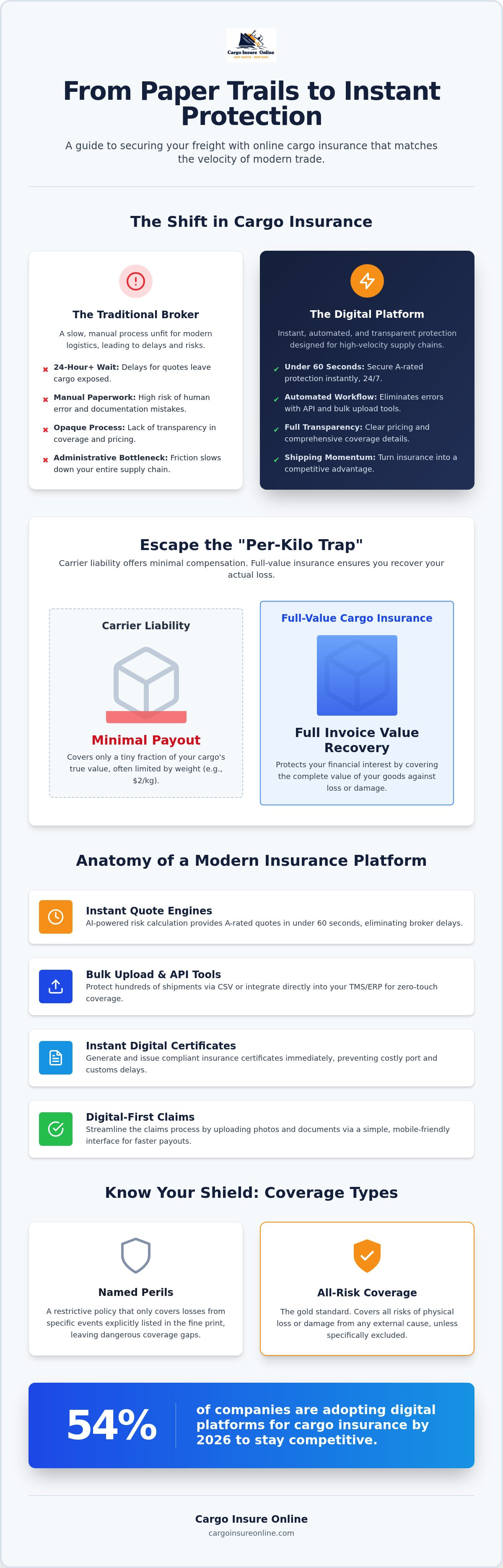
- Ditch the 24-hour broker wait and secure A-rated freight protection in under 60 seconds using real-time digital engines.
- Stop falling for the "per-kilo trap" and use cargo insurance online to ensure full-value recovery where carrier liability falls short.
- Automate your workflow with bulk upload tools and API connectivity to protect hundreds of shipments with a single click.
- Identify specialized coverage needs for high-stakes cargo, including high-value electronics, e-commerce parcels, and temperature-sensitive reefer goods.
- Shift from administrative friction to shipping momentum by mastering a simple two-step process for instant digital certificate issuance.
What is Cargo Insurance Online? Beyond the Digital Policy
Cargo insurance online isn't just a digital version of a paper policy. It is a cloud-native engine designed for instant freight protection. In the past, securing coverage meant long phone calls and faxed forms. Today, it means real-time API connectivity that issues certificates as fast as you can type. Modern logistics professionals don't have 24 hours to wait for a broker's response. They have shipments leaving docks every minute. Digital platforms provide full-value protection that starts exactly where your data does.
Global trade has evolved far beyond the traditional frameworks of Marine Insurance. While the core principles remain the same, the execution has moved from mahogany desks to high-speed servers. Cargo insurance online transforms a slow administrative chore into a competitive advantage. It allows you to bid on contracts with confidence, knowing your coverage is already locked in. No more waiting. Just shipping.
The Death of the Manual Insurance Broker
Traditional brokers are slow. They are opaque. They are often buried in mountains of paperwork that invite human error. One mistyped digit on a manual certificate can stall a shipment at a terminal for days. Digital insurance flips the script. It is transparent and instant. Automation removes the friction by pulling data directly from your shipping manifests or bulk uploads. You get a seamless workflow instead of a bureaucratic headache. This shift reduces the risk of clerical mistakes and ensures that your documentation is always compliant with international standards. It's about empowering the user through speed and clarity. You aren't just buying a policy; you're upgrading your entire logistics tech stack.
All-Risk vs. Named Perils: Know Your Shield
Not all coverage is created equal. Named perils policies only cover specific disasters listed in the fine print. If your loss isn't on that list, you're out of luck. This creates a dangerous gap in your financial protection. All-Risk is the gold standard for global trade. It covers everything except for specific, clearly defined exclusions. Modern online platforms simplify this choice by prioritizing comprehensive All-Risk coverage. This protection is backed by A-rated giants like Chubb and Lloyd's. This level of backing ensures global trust and financial stability. You get a shield that actually works when the unexpected happens. It's the difference between hoping you're covered and knowing you're protected.
By using a digital-first platform, you can secure this high-level protection in under 60 seconds. You don't need to be an insurance expert to get expert-level results. The platform handles the complexity while you focus on moving your goods across the globe. It's time to stop letting administrative bottlenecks dictate your shipping schedule.
The Anatomy of a Modern Cargo Insurance Platform
Legacy systems are rigid. Modern platforms are fluid. A true 2026 cargo insurance online stack isn't just a website; it's an intelligence layer that integrates directly into your daily operations. It replaces the friction of manual data entry with the speed of automated risk assessment. You aren't just buying a policy. You're deploying a tool that scales with your shipment volume. In 2026, 54% of companies are adopting digital platforms for cargo insurance to stay competitive. This isn't a trend; it's the new industry standard.
- Instant Quote Engines: AI calculates risk based on commodity, route, and carrier history in under 60 seconds.
- Bulk Upload Tools: Protect 100+ shipments simultaneously with a single CSV file.
- Seamless API Integration: Embed insurance triggers directly into your TMS or ERP for zero-touch coverage.
- Digital Claims: Turn a "yawn" administrative process into a "yay" payout by uploading photos and documents through a mobile-first interface.
Instant Quotes: From Booking to Payout
Freight moves 24/7. Traditional brokers don't. Online platforms eliminate the "business hours" bottleneck by providing around-the-clock access to A-rated coverage. This availability is vital for urgent port clearances where a missing certificate can lead to thousands in demurrage fees. By using real-time data, these engines provide precise pricing that reflects current global conditions. It's about moving from a reactive "wait and see" approach to a proactive "quote and go" strategy. You get the documents you need before the truck even hits the dock. This speed ensures your supply chain never stops for paperwork.
API and White Label Solutions for Logistics Pros
For freight forwarders and brokers, insurance shouldn't be a separate step. It should be a value-add. Modern platforms offer white label cargo insurance solutions that allow you to brand the experience as your own. This builds trust with your shippers while automating a revenue-generating service. Integration ensures every load meets the necessary Federal Motor Carrier Safety Administration (FMCSA) insurance requirements without manual oversight. You can eliminate the risk of uncovered loads while providing a premium experience for your clients. It is high-tech protection made simple. If you're ready to modernize your workflow, check out our branded cargo insurance platform for your business.
Carrier Liability vs. Cargo Insurance: The 'Per-Kilo' Trap
"My carrier already has insurance" is the most expensive myth in logistics. It's a dangerous assumption that leaves your balance sheet vulnerable. Carriers don't provide insurance. They provide limited liability. This distinction is the difference between a full recovery and a total financial disaster. If your $50,000 shipment is lost, a carrier might only offer you pennies on the dollar based on weight. Securing cargo insurance online is the only way to close this gap and protect your actual invoice value.
The financial math is often brutal. Under standard carrier terms, compensation is calculated by the kilogram; not the value of the goods. Imagine a 100kg shipment worth $20,000. If the carrier liability is capped at $20 per kilo, you only get $2,000 back. You just lost $18,000 because you relied on a carrier's fine print. This weight-based calculation is a trap for high-value freight. Beyond the low payouts, carriers are legally exempt from liability for "Acts of God," strikes, and even civil unrest. You need a shield that covers the full value of your goods regardless of the cause of loss. Digital platforms make this protection instant and effortless.
Decoding the Montreal Convention for Air Freight
International air cargo follows the rules of the Montreal Convention. As of late 2024, air carrier liability is limited to 26 Special Drawing Rights (SDRs) per kilogram. While this is a slight increase from previous years, it remains insufficient for high-value electronics or medical devices. A small box of high-end components weighs very little but costs a fortune. If that box disappears, a weight-based payout won't even cover your shipping costs. You can secure high-speed, full-value protection through air freight insurance designed for the 2026 supply chain.
Ocean Freight and the 'General Average' Nightmare
Ocean shipping introduces a unique risk called "General Average." This maritime law means that if cargo is sacrificed to save the ship, all shippers on that vessel share the financial loss. You could be forced to pay for someone else's lost containers just to get your own goods released from the port. Under the Carriage of Goods by Sea Act (COGSA), carrier liability is often capped at just $500 per package. If your container holds $100,000 in inventory, a $500 check is an insult, not a recovery. Comprehensive sea freight insurance is the only way to bypass these archaic rules. It ensures your cargo insurance online covers your specific risks so your goods reach their destination without surprise costs.
Niche Protection: High-Value, Reefer, and E-Commerce
General freight policies often fail when the stakes get specific. A standard agreement might cover a pallet of paper towels, but it crumbles the moment you ship high-value semiconductors or temperature-sensitive pharmaceuticals. You need cargo insurance online that understands the unique DNA of your goods. In 2026, generalized protection is a liability. Specialized cargo requires specialized shields that account for theft, spoilage, and platform-specific compliance. Don't settle for "close enough" when your most profitable shipments are on the line.
Safeguarding High-Value Tech and Electronics
Electronics are the primary targets for organized cargo theft. They are small, high-value, and incredibly easy to liquidate on the secondary market. Beyond theft, the internal components of modern tech are hypersensitive to the micro-vibrations and humidity changes of a long-haul journey. Standard carrier limits won't even cover the cost of the packaging for a crate of high-end GPUs. Electronics Shipping Insurance is a full-value shield against transit-related loss. Protecting these assets requires a digital-first approach that provides instant coverage for every high-stakes load. You can learn more about securing your hardware in our electronics shipping insurance guide.
Cold Chain and Reefer Logistics
Temperature integrity is the heartbeat of cold chain logistics. If a reefer unit fails on a Tuesday, you shouldn't be finding out about the financial loss on a Friday. Modern insurance platforms integrate with temperature integrity data to provide clear, evidence-based claims processing. It's not just about a broken cooling unit; it's about the spoilage and delay that follow. This coverage is non-negotiable for anyone moving food, flowers, or medicine. Without it, a simple mechanical glitch becomes a total loss. Secure your perimeter with reefer cargo insurance that moves at the speed of your sensors.
Cross-Border E-Commerce and FBA
Digital storefronts move fast, but their insurance requirements move faster. If you're selling on Amazon FBA or Shopify, you're familiar with the strict compliance hurdles that can pause your account in an instant. Online sellers need the ability to generate certificates of insurance that satisfy these platforms immediately. This includes navigating complex global tax and insurance regulations for cross-border trade. We're also seeing the rise of drones and UAVs for last-mile delivery, creating entirely new risk profiles that traditional brokers simply aren't equipped to handle. Mastering cross-border e-commerce insurance is the only way to scale your global footprint without friction. Secure your specialized coverage in seconds by getting a quote at Cargo Insure Online today.
How to Get a Cargo Insurance Quote in 60 Seconds
Speed is the ultimate currency in 2026 logistics. Traditional insurance feels like a brake on your business momentum. Digital cargo insurance online acts like an accelerator. You don't need a broker's cell number or a stack of paper forms. You just need a laptop and 60 seconds. This process is designed to be frictionless, transparent, and immediate. It moves from a complex administrative hurdle to a simple four-step workflow that fits into your coffee break.
- Step 1: Activate Your Engine. Create your free CIO account. There are no registration fees. You only pay when you decide to insure a shipment.
- Step 2: Define Your Load. Enter the origin, destination, and commodity. Whether it's high-value electronics or reefer goods, the system adjusts in real-time.
- Step 3: Compare and Select. Review instant quotes from A-rated global insurers like Chubb and Lloyd's. You get full transparency on coverage limits and terms.
- Step 4: Secure and Ship. Buy securely through the platform. Your digital certificate is available for download the moment the transaction clears.
No Paperwork, No Hassle
You don't need a deep technical background to secure your freight. The platform translates complex jargon into clear, actionable choices. The "Pay-As-You-Go" model is built for the modern economy. No annual minimums. No hidden commitments. You scale your protection up or down based on your actual shipping volume. If you're managing a team, the SaaS interface allows for multiple users on a single account. This ensures that your shipping department, logistics manager, and accounting team are all on the same page. It's about empowering your entire organization with speed and clarity.
Securing Your Supply Chain for 2026
Digital-first insurance is the best ROI in modern logistics. It prevents the "per-kilo trap" we discussed earlier and ensures your port clearances happen without delay. Before you hit "send" on that next shipment, run through this final checklist: Verify your commodity classification, double-check your cargo value, and ensure your certificate matches your bill of lading. By automating this process, you eliminate the human error that leads to rejected claims. You're not just buying a policy; you're building a more resilient supply chain. The future of freight is frictionless. Stop waiting for the old world to catch up. Get your instant cargo insurance quote now and keep your business moving at full speed.
Accelerate Your Supply Chain with Instant Protection
The old ways of insuring freight are dead. You don't have time for manual brokers or the "per-kilo trap" that leaves your balance sheet exposed. You need speed. You need precision. We've shown you how cargo insurance online transforms a bureaucratic chore into a 60-second win. By choosing a digital-first approach, you're securing full-value protection backed by A-rated giants like Chubb and Lloyd's. You're moving from a defensive posture to a competitive advantage. No more waiting. Just results.
Take control of your logistics workflow today. With zero registration fees and instant digital certificates, there is no reason to leave your high-value electronics or reefer goods to chance. You've mastered the 2026 guide. Now it's time to execute. Secure your cargo in under 60 seconds; Get a Quote. Your freight is moving fast. Your insurance should move even faster. It's time to eliminate the friction and start shipping with total confidence. Let's get your goods protected.
Answers for the Modern Shipper
Is online cargo insurance as reliable as a traditional broker?
Online platforms are actually more reliable because they utilize the same A-rated paper from global leaders like Chubb and Lloyd's while removing human error. You aren't losing the expertise; you're gaining an automated system that never sleeps and doesn't make clerical mistakes on your certificates. This digital-first approach ensures your documentation is always accurate and compliant with international standards.
What does 'All-Risk' cargo insurance actually cover?
All-Risk is the gold standard for global trade. It covers all physical loss or damage from any external cause, unless specifically excluded in the policy. By using cargo insurance online, you're typically accessing Institute Cargo Clauses (A) level protection. This is the most comprehensive shield available for your freight, covering everything from theft to rough handling during transit.
How much does cargo insurance online typically cost?
While specific premiums vary based on commodity and route, industry data shows per-shipment coverage is generally priced between 0.1% and 2% of the declared cargo value. For international shipments, you'll often see rates between 0.3% and 0.5% of the total value. This is a small price to pay to avoid the total financial loss of an uninsured shipment that falls into the carrier liability trap.
Can I get insurance for high-value electronics or drones?
Yes. Specialized products exist specifically for high-value electronics, mobile phones, and even drones used for last-mile delivery. These items are often excluded or severely limited by standard carrier agreements due to their high theft risk. Digital platforms allow you to add these niche protections instantly, ensuring your most expensive assets are fully covered from door to door.
Does my carrier's liability coverage protect the full value of my goods?
Absolutely not. Carrier liability is restricted by weight, not value. As established earlier, air carriers are limited to 26 SDRs per kilogram, and ocean carriers often cap out at just $500 per package under COGSA. Cargo insurance online is the only way to guarantee you're reimbursed for the full invoice value of your goods if they are lost or damaged.
What happens if my shipment is delayed but not damaged?
Most standard policies focus on physical damage, but modern digital platforms offer specific endorsements for delay and temperature integrity. If your reefer unit fails or a strike stalls your shipment, these specialized products can help recover the resulting financial losses. This is critical for businesses moving time-sensitive or perishable goods where a delay is just as costly as damage.
How long does the cargo insurance claim process take online?
Digital claims reporting turns a months-long paper trail into a streamlined digital workflow that can start the moment you notice a problem. By uploading evidence like photos and bills of lading through a mobile-first interface, you can initiate the process instantly. This transparency usually leads to a much faster resolution compared to the "wait and see" approach of traditional, paper-based brokers.
Can I integrate cargo insurance into my own Shopify or Amazon store?
Yes. You can embed insurance triggers directly into your Shopify or Amazon FBA workflow using API integrations or white-label solutions. This ensures every order is automatically protected without manual entry or separate paperwork. It's the ultimate "set it and forget it" solution for high-volume online sellers who need to meet platform compliance requirements while scaling their global footprint.


