

What if your cargo policy limit looks high enough, but a claim still leaves your business paying part of the loss? That’s cargo underinsurance risk: a mismatch between your shipment’s financial exposure and the value or terms used to insure it.
The coverage limit is only one part of the review. The declared value, shipment documents, valuation terms, and deductible can all affect how much protection a policy provides. If those details don’t line up, the gap may only become clear after something goes wrong.
This guide explains common causes of underinsurance and offers a repeatable checklist for reviewing each shipment. You’ll learn what to compare across shipment values and policy terms, and when tailored cargo coverage or GAP insurance may be relevant. GAP insurance isn’t a universal fix. Its role depends on the policy wording and the exposure you’re addressing. A consistent review can help you make more informed coverage decisions.
Key Takeaways
- Understand how cargo underinsurance risk differs from exclusions, deductibles, and carrier liability.
- Spot valuation mismatches by comparing shipment records with policy wording and limits.
- Review each shipment before dispatch, and repeat the review when goods, routes, values, or terms change.
- Coordinate sales, logistics, and insurance records so declared values stay aligned.
- Consider coverage tailored to the freight mode or goods category, and evaluate GAP insurance when it addresses an identified exposure.
What Cargo Underinsurance Risk Means for Your Shipment
Cargo underinsurance risk is the possibility that the amount insured under a policy is less than the shipment’s relevant financial exposure, leaving a potential shortfall if a loss occurs. The word “relevant” matters: policies can define insured value and covered components differently, so there’s no single valuation basis for every shipment.
An invoice is a useful starting point, but it may not show the whole exposure. Depending on the shipment and policy, freight, duties, or other expenses may be treated differently. Read the declared value, supporting records, and policy wording together. For foundational context, Marine insurance principles explain concepts that inform cargo coverage, though the policy determines the terms that apply.
How can cargo coverage fall short after a loss?
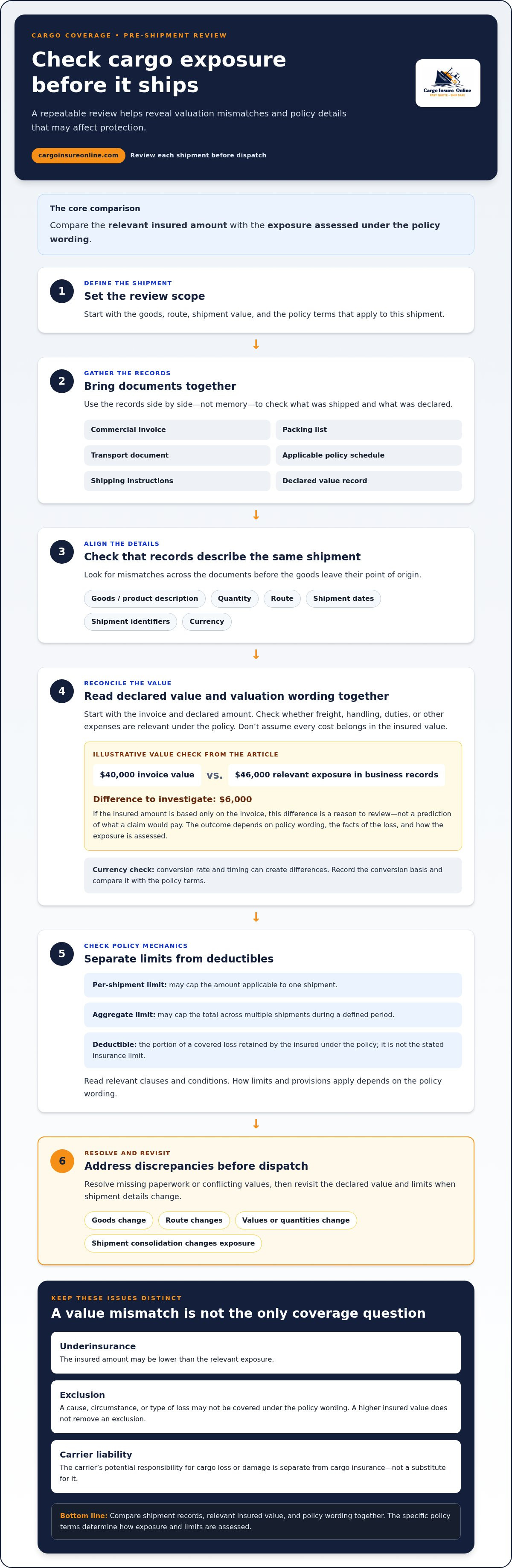
Start by comparing the applicable insured amount with the loss being assessed under the policy. For example, imagine a shipment with an invoice value of $40,000, while business records show a relevant exposure of $46,000. If the insured amount is based only on the invoice, there may be a $6,000 difference to investigate. That difference doesn’t establish what a claim would pay. The outcome depends on the policy wording, the facts of the loss, and how the exposure is assessed.
This is the practical core of cargo underinsurance risk: a figure on one document may not match the amount that matters under the policy. Reviewing each shipment before dispatch gives you time to reconcile records and coverage details.
Underinsurance, exclusions, and carrier liability are different
These terms describe different issues:
- Underinsurance: The insured amount may be lower than the relevant exposure.
- Exclusion: The policy doesn’t cover a particular cause, circumstance, or type of loss under its wording. A higher insured value doesn’t remove an exclusion.
- Deductible: The portion of an otherwise covered loss that the insured is responsible for under the policy. It affects the amount considered for payment, not the stated insurance limit.
Carrier liability is separate. It concerns the carrier’s potential responsibility for cargo loss or damage, which isn’t the same as protection from cargo insurance. Review the carrier’s liability terms alongside the shipment’s insured value and policy terms, not as a substitute for them.
How Cargo Underinsurance Risk Builds From Valuation and Policy Terms
A shipment’s insured amount depends on more than a number entered on a form. The invoice, declared value, currency, quantity, product description, and policy limit all matter. If these details don’t align, the amount shown as insured may not reflect the exposure assessed under the policy.
Which shipment values should a shipper compare?
Start with the commercial invoice and declared amount, then compare them with the policy’s valuation wording. Freight, handling, and other charges may be relevant if the policy includes them. Don’t assume every cost belongs in the insured value. Also compare the currency, quantity, product description, and shipment identifiers across records so you can resolve discrepancies before dispatch.
Before dispatch, reconcile the commercial invoice, packing list, shipping instructions, declared value record, and applicable policy wording. Currency conversion can also create differences, depending on the rate and timing used. Record the conversion basis and compare it with the policy terms rather than assuming every document uses the same method.
How do limits, deductibles, and shipment changes affect exposure?
A per-shipment limit may cap the amount applicable to one shipment, while an aggregate limit may cap the total across multiple shipments during a defined period. A deductible is different: it’s the portion of a covered loss retained by the insured under the policy. Check the relevant clauses and any conditions attached to a limit, since how these terms apply depends on the wording.
Consolidation can change the exposure. Several orders may travel together, and a single shipment record may not show the full value under a shared booking. Rising cargo values, revised quantities, or a changed route can also make an earlier review outdated. Revisit the declared value and limits when shipment details change instead of carrying forward an old figure by default.
The International Union of Marine Insurance’s overview of underinsurance in cargo policies discusses how provisions such as “average” may affect a claim. Their application is policy-specific. Don’t assume every cargo policy uses the same clause or calculation. As a next step, compare your documented exposure with the relevant cargo coverage options and policy terms.
How to Assess Cargo Underinsurance Risk Before Shipping
A consistent pre-shipment review turns cargo underinsurance risk into a checkable process. Start with the goods, route, shipment value, and policy terms. Compare records side by side rather than relying on memory. The International Union of Marine Insurance offers an authoritative definition of underinsurance. For a specific shipment, the applicable policy wording determines how insured value and limits are assessed.
What records help reveal a potential coverage gap?
Gather the commercial invoice, packing list, transport document, and applicable policy schedule. Check that each describes the same goods, quantities, route, and shipment dates. Resolve missing paperwork or conflicting values before the goods leave their point of origin. A mismatch isn’t automatically a coverage gap, but it needs to be addressed before you can make a reliable comparison.
Use a simple comparison: the relevant insured amount versus the exposure defined by the policy wording. Don’t assume the invoice amount is the policy’s valuation basis or that every expense belongs in the insured amount. Read the applicable terms and record what they say.
A shipment-by-shipment underinsurance review
- Identify the shipment. Record the goods and product description, transit mode, route, planned dates, and parties with a financial interest in the cargo.
- Reconcile values and terms. Compare the documented shipment value with the policy’s applicable valuation language and limits. If the currency, quantity, or descriptions differ, flag the discrepancy rather than silently adjusting a figure.
- Resolve open questions. Note missing documents, unclear valuation components, or a limit that may not fit the shipment. Route each issue for policy-specific review and document the decision before dispatch.
Use this table to make the review repeatable. Complete it for each shipment, relying on the policy wording rather than assumptions when recording limits and open questions.
| Document | Stated value or details | Applicable limit | Open questions |
|---|---|---|---|
| Commercial invoice | Goods description, quantity, currency, declared value | Record the relevant policy limit | Does the description and value align with the policy basis? |
| Packing list | Packages, quantities, product details | Check any applicable shipment limit | Do quantities match the invoice and transport document? |
| Transport document | Route, shipment dates, cargo details | Compare with applicable policy terms | Do the route and dates match the insured shipment? |
| Policy schedule and wording | Declared amount and valuation terms | Note relevant limits and conditions | Which terms need clarification before dispatch? |
Close the loop before release: reconcile the records, flag discrepancies, and document decisions. This gives your team a clear record of the exposure review and a repeatable starting point when shipment details change.
How to Reduce Cargo Underinsurance Risk Across Shipments
A strong review isn’t a one-time box to tick. Build it into dispatch, then repeat it whenever shipment values, goods, routes, or policy terms change. This keeps decisions traceable as operations shift instead of relying on an old value or familiar route as a proxy for current exposure.
Build a repeatable shipment documentation routine
Assign clear ownership of the review, while sales, logistics, and insurance teams keep their records aligned. Sales can maintain the commercial value and goods description. Logistics can verify quantities, route, mode, and dates. The insurance owner can compare those details with applicable policy terms. Shared responsibility works best when one person or team is accountable for closing gaps.
Keep each shipment’s invoice, packing list, and transport documents together. Use consistent records for goods descriptions, quantities, declared values, routes, and dates. If documents conflict or information is missing, log the issue, assign someone to resolve it, and record the final decision. That history helps the next reviewer understand what changed and why.
Review coverage when freight or goods change
Switching between air, sea, and trucking freight is a cue to revisit the shipment review. So is a change in goods category. Electronics, drones, mobile phones, and temperature-sensitive reefer products may call for closer attention to policy wording and applicable limits. Don’t assume terms that fit one shipment automatically fit another. Compare the specific wording with the updated cargo, route, and handling requirements.
Make the review easy to reuse with this compact checklist:
- Confirm the goods description, quantity, shipment value, route, mode, and dates.
- Gather supporting shipment documents and note missing or inconsistent details.
- Compare the records with applicable policy wording and limits.
- Assign each open question to an owner and document how it was resolved.
- Repeat the review before dispatch and whenever shipment or coverage details change.
This process helps identify discrepancies, but it doesn’t guarantee that a loss will be covered. Claim treatment depends on the applicable policy terms and the facts. For coverage options aligned with your freight mode or goods category, explore cargo insurance options.
Close Cargo Underinsurance Risk With a Tailored Coverage Review
A useful coverage review follows four steps: establish the shipment’s financial exposure, compare it with the applicable policy terms, resolve mismatches, and document decisions. This turns cargo underinsurance risk from a vague concern into a focused review of goods, records, limits, and wording. It doesn’t predict a claim outcome, but it helps identify questions to address before the shipment moves.
Match the review to freight mode and goods
Start with how the cargo will travel. Air freight, sea freight, and trucking each call for a review aligned with the relevant mode and policy terms. Then consider the goods themselves. E-commerce shipments, electronics, drones, mobile phones, and reefer products may need closer attention during the review. The right comparison depends on the shipment and wording, not on an assumption that one policy basis fits every cargo type.
GAP insurance may also be worth evaluating if your review identifies a specific difference between an exposure and existing policy terms. Its relevance depends on the wording and the gap you’re addressing. Don’t assume it fills every shortfall or applies to every loss. Compare the identified exposure with the terms in place before deciding whether it’s relevant.
What to prepare for a cargo coverage review
Bring the records together before reviewing coverage options. A clear file makes it easier to focus on the actual exposure instead of chasing scattered details. Prepare:
- Shipment values and supporting records
- Goods descriptions and quantities
- Route, freight mode, and shipment dates
- Transport documents and current policy terms
- A short list of discrepancies, open questions, and decisions already made
Then compare the documented exposure with the applicable valuation wording and limits. Note what aligns, what doesn’t, and what needs policy-specific review. If a route, product, quantity, or declared value changes, update the review instead of relying on an earlier assessment.
Cargo Insure Online offers cargo coverage options across air, sea, and trucking freight, with specialized options for e-commerce and goods such as electronics, drones, mobile phones, and reefer products. Explore its cargo coverage options to connect your shipment review with coverage tailored to the freight mode or goods category. Clear records support a sharper review and more informed coverage decisions.
Make Your Next Shipment Coverage-Ready
The clearest way to manage cargo underinsurance risk is to review each shipment before dispatch: establish its relevant exposure, compare the records with policy wording and limits, resolve discrepancies, and document decisions. Repeat the process when goods, values, routes, or terms change. A consistent review helps your team catch mismatches early and make more informed coverage decisions.
Coverage needs can differ by freight mode and cargo. Cargo Insure Online offers options for air, sea, and trucking shipments, as well as e-commerce, electronics, drones, mobile phones, and reefer products. GAP insurance may also be relevant, depending on the exposure under review and the specific policy terms.
Ready to connect your shipment review with suitable coverage options? Explore cargo coverage options for your shipments. A clearer picture of your exposure is a practical step toward shipping with greater confidence.
Frequently Asked Questions
What is cargo underinsurance risk?
Cargo underinsurance risk is the possibility that the amount insured is less than the shipment’s relevant financial exposure under the policy. A mismatch can arise if the declared amount doesn’t align with the policy’s valuation terms or applicable limits. It’s different from an exclusion, which concerns a loss the policy doesn’t cover, and a deductible, which is the portion of an otherwise covered loss retained by the insured. Exact claim treatment depends on the policy wording and facts.
How do I know if my cargo is underinsured?
Compare the shipment’s documented value with the policy’s applicable valuation wording and limits. Review the commercial invoice, packing list, transport document, declared amount, currency, and policy schedule. Look for mismatched goods descriptions, quantities, routes, dates, or values, and identify which charges the wording includes. A discrepancy signals a question to resolve, not an automatic finding that a claim would be short. Review each shipment before dispatch and document any unresolved issue.
Can carrier liability cover the full value of my shipment?
It may not. Carrier liability is separate from cargo insurance and can be limited by applicable laws, conventions, and contract terms. As general reference points, COGSA has a sea-freight limit of $500 per package and the Montreal Convention has an air-freight limit of approximately $20 per kilogram. Whether either applies depends on the shipment and circumstances. Review the relevant terms, and don’t assume carrier liability matches the shipment’s full financial exposure.
What happens if the insured value is lower than the cargo loss?
The claim may be assessed using the policy’s valuation terms, limits, conditions, and verified facts of the loss. If the insured amount is below the relevant exposure, a financial shortfall may result. Some policies may also contain underinsurance or “average” provisions that affect how a claim is calculated. These provisions don’t apply identically across policies, so don’t assume a specific payment or formula without reviewing the actual wording.
Does cargo insurance cover freight and other shipping costs?
It depends on the policy’s valuation basis and wording. Freight, handling, duties, and other expenses may be treated differently, so don’t automatically add them to or exclude them from the insured value. Check which components the policy recognizes, how it defines insured value, and whether conditions or limits apply. Reconcile the wording with invoices and shipment records before dispatch so the declared amount has a clear, documented basis.
Can cargo be underinsured even when I have an all-risk policy?
Yes. “All-risk” describes a broad type of coverage, not unlimited insurance or protection against every possible loss. The policy can still have limits, deductibles, exclusions, valuation conditions, or other terms that affect a claim. The insured amount may also be below the relevant shipment exposure. Review both the amount and the wording. Don’t treat the label alone as proof that the full value or every cause of loss is covered.
How often should a business review its cargo insurance values?
Review values shipment by shipment before dispatch, then repeat the review whenever goods, declared values, routes, freight modes, or policy terms change. Set a regular internal review schedule as well, so recurring shipments and records don’t drift out of alignment. Have sales, logistics, and the person responsible for insurance reconcile their documents, record discrepancies, and document decisions. The right review frequency depends on how often your cargo and shipping arrangements change.


