
What if cargo insurance could appear in your shipping workflow as naturally as a delivery option? A logistics company white label insurance program can put coverage in front of customers under your brand, without asking your team to build every part of the insurance operation from scratch. To make that offer useful, connect it to the shipment details customers already provide and make the policy information easy to find.
It’s reasonable to worry that insurance could slow booking, create support headaches, or blur who handles policies and claims. A well-planned journey addresses those risks by keeping coverage optional, explaining the handoffs, and making responsibilities clear from the start.
This 2026 guide explains how white-label cargo insurance fits logistics operations and what to consider before launch. You’ll compare building in-house, referring customers, and using a platform-led approach against consistent criteria, then map the technology, workflow, partner roles, and performance measures involved. Cargo Insure Online provides white-label solutions alongside air, sea, and trucking freight insurance, helping logistics and e-commerce businesses shape a branded offer around their shipment types.
Key Takeaways
- See how a branded insurance offer can complement shipping services without disrupting the customer journey.
- Understand how logistics partners, insurance providers, technology platforms, and policyholders fit into the model.
- Compare building in-house, referring customers, and partnering on logistics company white label insurance by control, workload, and technology ownership.
- Map a practical launch around your customer base, shipment mix, workflow, responsibilities, and performance measures.
- Explore how Cargo Insure Online’s white-label solutions connect with air, sea, and trucking cargo coverage, plus specialized goods offerings.
Why logistics companies are adding white-label insurance to shipment workflows
A shipment involves more than moving goods from one place to another. Customers also need to understand how cargo protection fits their plans. A logistics company white label insurance offer can put that choice alongside shipping services under the logistics company’s brand, without making the logistics company the insurer.
White-label insurance follows the broader white-label product model: one company provides an offering that another presents under its own brand. In insurance, the branded experience may be customer-facing, while the underlying policy, terms, and claims decisions remain tied to the insurance arrangement behind it. Branding doesn’t change what a policy covers.
What does white-label insurance mean for a logistics company?
The logistics partner can introduce the option in its booking journey and explain how customers can access it. The insurance partner supports the coverage itself. For example, a shipper booking an air freight shipment might see an optional cargo insurance offer before confirming the shipment. The precise workflow depends on the arrangement, but customers should be able to distinguish shipping charges and services from insurance details.
For shippers, a relevant offer can make coverage easier to find while they’re considering shipment details. For logistics businesses, it can complement existing services and extend the customer experience. For insurance partners, logistics channels provide a way to present relevant coverage to customers arranging shipments. These are potential benefits, not guaranteed results. Assess the offer by how clearly it fits the booking journey and answers customer questions.
Where can cargo insurance fit in the shipping journey?
Keep the offer close to the decision, but don’t make it a hurdle. Possible touchpoints include the booking flow, shipment confirmation, or an account dashboard where customers manage shipments. An optional offer at booking connects the decision with shipment details. A confirmation message or dashboard can provide another place to review the choice and related information.
Coverage discussions should reflect the shipment mix. Air, sea, and trucking shipments can have different coverage considerations, and specialized goods such as electronics or temperature-sensitive products may need particular attention. Don’t imply that a single policy protects every cargo type or risk. The policy’s terms, exclusions, and limits define the actual protection. The partner arrangement should also make clear who handles customer questions, policy administration, and claims inquiries.
That clarity matters. A branded interface can feel simple, but customers still need to understand what they’re buying and where to turn for support. For a broader look at the model and its launch considerations, read this white-label cargo insurance guide.
How a white-label cargo insurance program works behind the brand
A branded offer is the visible layer, not the whole insurance arrangement. Behind it, several parties may contribute to the journey: the logistics company introduces the option, an insurance partner provides the insurance framework, a technology platform may connect parts of the experience, and the shipper decides whether to purchase and becomes the policyholder if they do. The selected solution and agreement determine the exact setup.
Who does what in a branded insurance arrangement?
The logistics company creates the customer-facing moment. It can present an optional offer alongside a shipment transaction and show customers where to find more information. Its role in communicating the offer should be distinct from making decisions about the insurance itself.
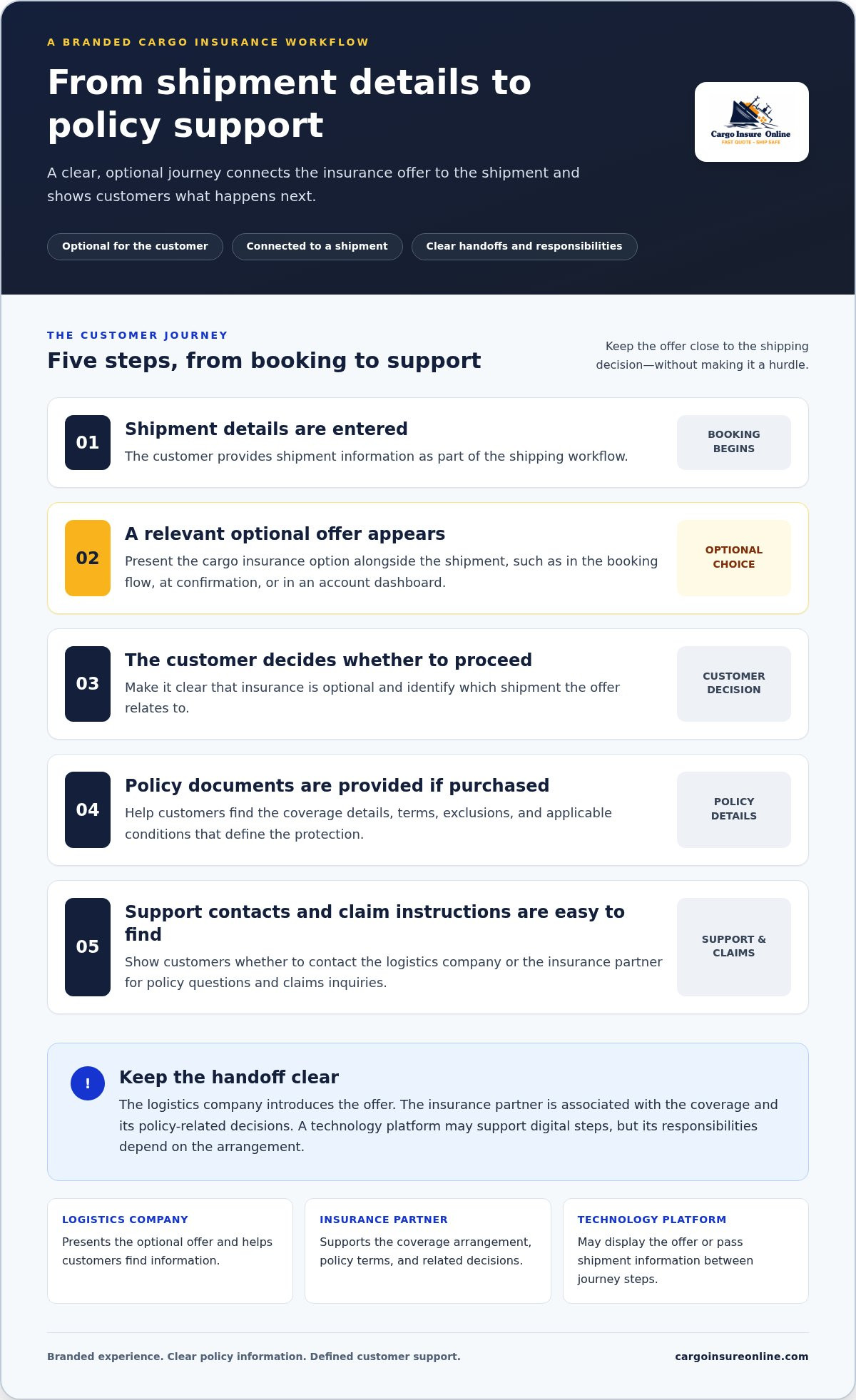
The insurance partner is associated with the coverage, including its terms and policy-related decisions. Those terms, exclusions, and applicable conditions determine what protection a policy provides. A technology platform may support digital steps, such as displaying an offer or passing shipment information between parts of the journey. Don’t assume the platform owns underwriting, policy administration, or claims handling. Responsibilities vary by arrangement, so map them clearly before launch.
What should the customer journey make clear?
Customers need to recognize that insurance is optional, understand which shipment the offer relates to, and know what happens if they choose it. Policy documentation should identify the coverage and explain its terms and exclusions in accessible language. Make support contacts and claims instructions easy to locate, so customers aren’t left guessing whether to contact the logistics company or the insurance partner.
For example, a shipper booking sea freight could see an optional cargo insurance offer linked to that shipment. If selected, the journey should make clear how policy documents are provided and where to find claims instructions. The same principle applies to air or trucking shipments, though the offer and coverage details should reflect the relevant arrangement. Data exchanged to support the journey, and how it moves, depend on the selected solution. Define what information is shared and which party is responsible for each customer-facing step.
A simple journey: Shipment details entered → relevant optional offer displayed → customer chooses whether to proceed → policy documentation provided if purchased → support and claims instructions remain accessible.
This is the operational core of logistics company white label insurance: align the branded touchpoint with clear policy information and well-defined handoffs. A logistics insurance market size analysis offers broader market context, but a workable program depends on how these roles fit your shipment journey. Explore Cargo Insure Online’s white-label solutions as you shape that model.
Build, refer, or use a white-label platform: compare the operating models
The right model depends on what your logistics company wants to control and what it can support over time. Compare more than launch effort. Product upkeep, customer communications, technology ownership, and insurance-related responsibilities continue after the first offer goes live.
| Model | Brand and customer journey | Workload and technology |
|---|---|---|
| Internal build | Potentially high control over branding and workflow. | The company takes on substantial responsibility for creating and maintaining the program and its supporting technology and operations. |
| Referral | The insurance partner is typically more visible, and customers may move to its experience to learn more or proceed. | The logistics company can focus on introducing the offer, with less control over the partner’s customer journey and technology. |
| White-label partnership | The offer can be presented under the logistics company’s brand, with the customer journey shaped by the agreed arrangement. | Responsibilities and technology ownership are shared or assigned by agreement, rather than automatically sitting with one party. |
When does an in-house insurance build make sense?
An internal build may suit a company seeking greater control and prepared to own the work behind it. That means planning for specialist staffing, operational processes, customer support pathways, and ongoing product and technology maintenance. A polished launch is only one milestone. The company also needs capacity to manage changes and keep the program aligned with its business.
Don’t assess this route on initial development alone. Consider who will maintain the experience, coordinate insurance-related operations, and oversee customer communications over time. No model removes the need to define responsibilities clearly.
How do referral and white-label models differ?
A referral model makes it easier to introduce customers to an insurance offer, but the insurance partner may take a more prominent role in the next steps. A white-label arrangement can keep the logistics brand more visible across customer touchpoints. The exact level of continuity depends on the agreement and solution, so don’t assume white-label automatically means a fully integrated journey or that the logistics company owns the underlying technology.
For a practical comparison, score each approach against four questions: How much brand control do you need? How much operational work can your team sustain? Who owns and maintains the technology? Who handles each customer-facing responsibility? For logistics company white label insurance, the strongest fit is the model your company can operate consistently, not simply the one that appears quickest to launch.
Plan the launch: map coverage, customer experience, and operations
A practical launch starts with the shipment, not the software. For logistics company white label insurance, scope the offer around the customers you serve and the freight they move. Then design the customer journey, assign owners, and decide what you’ll measure. This keeps the plan grounded in daily operations instead of assumptions about a one-size-fits-all policy.
How should logistics companies scope the offer?
Start by grouping customers and shipments. Consider customer segments, freight modes, routes, and the cargo categories moving through your network. Air, sea, and trucking can involve different operational contexts, so coverage discussions and customer information should reflect the shipment rather than treating every load alike.
For air cargo considerations, see the air freight insurance guide. For road shipments, the trucking cargo insurance guide adds freight-specific context. In each case, policy terms and exclusions determine the protection provided.
How can teams prepare workflows and measure adoption?
Sketch the journey from booking through any offer, customer choice, policy documentation, support, and claims instructions. Make the offer clearly optional. Identify where customers find policy details and how questions reach the right party. Assign internal owners for the offer, operations, technology coordination, and customer communications, then align handoffs with the insurance partner’s responsibilities.
- Define customers: Identify the shipper groups the offer is designed to serve.
- Map shipments: Separate air, sea, trucking, routes, and relevant cargo categories.
- Shape the offer: Clarify what customers see and where they can review policy information.
- Design the workflow: Map booking, selection, documentation, support, and claims information.
- Assign ownership: Name internal leads and document partner handoffs.
- Set measures: Establish a baseline and track engagement, offer completion, service questions, and workflow friction where data permits.
Review those measures together. For example, low completion may point to unclear offer wording or a difficult step, while repeated questions can reveal gaps in customer communications. Use the data to spot areas for improvement, not as a promise of a particular adoption or business result. Keep policy documentation and customer support routes visible throughout the journey.
Ready to shape a branded cargo insurance offer around your shipment mix? Explore Cargo Insure Online’s white-label solutions.
Bring branded cargo insurance to market with Cargo Insure Online
A strong program should fit the way your logistics business sells and manages shipments. Cargo Insure Online’s white-label solutions support branded insurance offers for logistics and e-commerce businesses, connecting the operating model to the customer journey without requiring every partner to build an insurance operation from scratch.
That fit starts with the freight itself. Cargo Insure Online provides insurance for air, sea, and trucking freight, alongside specialized offerings for electronics, high-value devices, drones, mobile phones, and temperature-sensitive goods. These categories give logistics companies useful starting points for considering how coverage relates to their shipment mix. Policy terms and exclusions define the protection, so don’t present one category as covering every shipment or risk.
What makes a logistics-focused insurance partner relevant?
A partner focused on cargo insurance brings freight and shipment types into the conversation from the beginning. That context can help a logistics company consider where a branded offer belongs, which customers it may serve, and how it relates to air, sea, or road freight workflows. Specialized goods can also be part of the discussion when relevant to the business. The aim is a practical fit between the offer and the operating model, not a generic add-on.
What should a logistics company prepare to get started?
Bring a clear picture of your business and the customer experience you want to create. A focused first discussion can cover:
- Shipment modes: Air, sea, trucking, and any relevant specialized goods.
- Customer segments: The shipper types you serve and their distinct needs.
- Booking channels: Where customers arrange shipments and where an optional offer could appear.
- Current pain points: Questions, handoffs, or friction in the shipment journey that a new offer should address.
- Desired experience: How your brand should appear, what customers need to understand, and where policy documents and service instructions should be easy to find.
These details help frame logistics company white label insurance around real workflows and clear responsibilities. They also create a useful basis for aligning the branded experience, coverage categories, and customer communications with your business model.
Ready to explore a branded cargo insurance approach for your logistics operation? Explore white-label cargo insurance solutions.
Make cargo protection part of a smoother shipping journey
A successful logistics company white label insurance program is more than a branded offer. It matches coverage discussions to the freight you handle, makes policy information easy to find, and clearly assigns customer support and claims responsibilities. Choosing between an internal build, referral, or white-label partnership also means weighing control against the ongoing work your team can own.
Cargo Insure Online offers white-label solutions for logistics and e-commerce businesses, with cargo insurance spanning air, sea, and trucking freight. That gives your team a focused starting point for considering how a branded offer could fit your shipment mix and customer journey.
Bring your shipment modes, customer segments, booking channels, and workflow goals into the planning conversation. Then turn the right model into a clear, practical next step. Explore white-label cargo insurance solutions and move your branded offer forward with confidence.
Frequently Asked Questions
What is white-label insurance for a logistics company?
White-label insurance lets a logistics business present an insurance offer through its own brand and customer experience. The underlying policy and insurance responsibilities are governed by the program arrangement and policy documents, not by branding alone. For logistics company white label insurance, the offer may appear in a shipment-related journey, such as during booking. Customers should be able to identify the coverage terms, exclusions, and where to find policy and claims information.
How does white-label cargo insurance work?
A logistics company presents a branded insurance offer at a relevant customer touchpoint, and customers review the offer and policy information before deciding whether to proceed. Insurance and technology partners support their defined roles under the program. The exact steps can vary, including how shipment details are exchanged, how documents are delivered, and who handles service questions. Make those handoffs clear so customers know where to find policy details and claims instructions.
Can a freight broker offer cargo insurance under its own brand?
A freight broker may explore a white-label arrangement to present cargo insurance as part of its customer experience. The suitable operating model, partner responsibilities, and applicable requirements depend on the broker’s business and jurisdictions. Start by mapping shipment types, customer touchpoints, and how an optional insurance offer will be explained alongside carrier liability. Keep the distinction clear: the insurance policy’s terms define its protection, so customers shouldn’t confuse it with a carrier’s liability.
What is the difference between white-label and embedded insurance?
White-label describes an insurance offer presented under a partner’s brand; embedded insurance describes an offer placed within a related purchase or service journey. The two ideas can overlap. For example, a logistics company might present its branded cargo insurance offer during shipment booking. The customer experience depends on the program design, while the policy documents and partner arrangement determine coverage terms, responsibilities, and service processes.
Does white-label cargo insurance cover air, sea, and trucking shipments?
Coverage depends on the program, policy wording, shipment details, and applicable terms. Cargo insurance can be offered for air, sea, and trucking freight, but don’t assume one policy covers every mode, shipment, or risk. Logistics companies should make the scope and exclusions clear and ensure customers can access relevant policy documents and claims instructions. Cargo Insure Online offers cargo insurance across these freight categories.
How long does it take to launch a white-label insurance program?
There’s no single launch timeline that applies to every program. Timing can depend on scope, technology work, operational readiness, partner processes, and applicable review requirements. Avoid planning around a generic estimate. Define target customers, shipment workflows, ownership, and customer communications early to make the work easier to organize. A phased launch may also help a team learn from the customer journey and refine it over time.
What should a logistics company evaluate in a white-label insurance platform?
Evaluate how the arrangement fits your shipment workflows, branding goals, team capacity, and customer service needs. Clarify what shipment data moves through the journey, who owns each step, how customers receive policy documents, and where support and claims instructions appear. Compare options using the same criteria, including technology responsibilities and ongoing operations. Ensure customer-facing explanations match the applicable program and policy documentation, rather than promising coverage or outcomes those documents don’t support.


