

The concealed cargo damage notification deadline by freight mode isn’t one universal countdown. A shipment governed by COGSA may require written notice of concealed damage within 3 days of delivery, while international air cargo under the Montreal Convention allows 14 days for a written damage complaint. Missing the applicable notice window can complicate a later claim, even if you submit it on time.
The rule that applies can depend on the route, governing regime, carrier terms, and insurance policy. Promptly notifying the carrier also isn’t the same as filing a formal claim.
This guide compares key timelines for air, ocean, U.S. domestic trucking, international road, and rail. You’ll learn how to identify the relevant regime, send a clear written notice, and document photos, packaging, delivery records, and other evidence before conditions change. We’ll also distinguish carrier notification, legal claim-filing limits, and cargo-insurance reporting requirements, so you can track each deadline separately.
Key Takeaways
- The concealed cargo damage notification deadline by freight mode depends on the route, governing regime, contract, and carrier terms. Identify the rules that apply to your shipment.
- For international air cargo, a 14-day written damage notice commonly applies under the Montreal Convention when it governs the shipment.
- Track carrier notice, formal claim filing, legal action, and cargo-insurance reporting on separate timelines. One report may not satisfy the others.
- When damage appears, preserve the packaging and photograph the goods, labels, seals, and delivery condition before anything changes.
- Use a shipment checklist to record the discovery date and each relevant deadline, especially when a route includes multiple transport legs.
Concealed Cargo Damage Notice: What the Deadline Actually Applies To
The concealed cargo damage notification deadline by freight mode concerns damage that wasn’t reasonably visible when the shipment was handed over. It sets the window for alerting the carrier, not automatically the deadline for every step that follows. The applicable timeline can depend on the bill of lading, contract, route, governing law, and any relevant treaty. There is no single notice period for every shipment.
What counts as concealed cargo damage?
Damage visible at delivery, such as a torn carton or visibly dented crate, can be recorded at handover. Concealed damage appears later, often during unpacking or inspection. For example, internal packaging might be crushed beneath an intact outer box, or water damage might be hidden inside sealed packaging. These examples describe when damage is discovered, not whether a carrier or insurer will accept responsibility.
Keep a clear record of the cargo at handover and when you discover damage. Note the delivery condition on the receipt where possible, then photograph the packaging, labels, seals, affected goods, and damage as found. Record when and where you opened or inspected the shipment. These details can help establish what was visible at delivery and when the concealed problem came to light. For background on how a freight claim fits into carrier liability and filing processes, see this overview.
Does notifying the carrier mean a claim has been filed?
No. A brief message saying “damage found” can alert the carrier, but it may not include the information or supporting materials required for a formal written claim. Depending on the applicable rules and contract, a claim may need to identify the shipment, describe the loss, and state the amount sought. A lawsuit is a separate legal step with its own limitation period.
Notice alerts the carrier; a formal claim seeks recovery; legal action challenges an unresolved dispute in court. Keep these steps distinct, and track them separately from insurer reporting. A cargo policy may set its own notification or documentation requirements, independent of carrier procedures. Reporting to the carrier doesn’t necessarily notify the insurer, and notifying the insurer doesn’t necessarily satisfy the carrier’s rules.
- Carrier notice: Reports the damage promptly under the applicable carrier terms or regime.
- Formal claim: Requests recovery and follows the required filing process.
- Lawsuit: Starts legal proceedings within the applicable limitation period.
- Insurance report: Follows the policy’s separate reporting and evidence requirements.
Before relying on a deadline, match it to the route and transport documents. Cross-border journeys or shipments with multiple legs can involve more than one contract or legal framework. Identify the applicable terms and preserve records while the condition of the cargo and packaging is still clear.
Concealed-Damage Notification Deadlines by Freight Mode
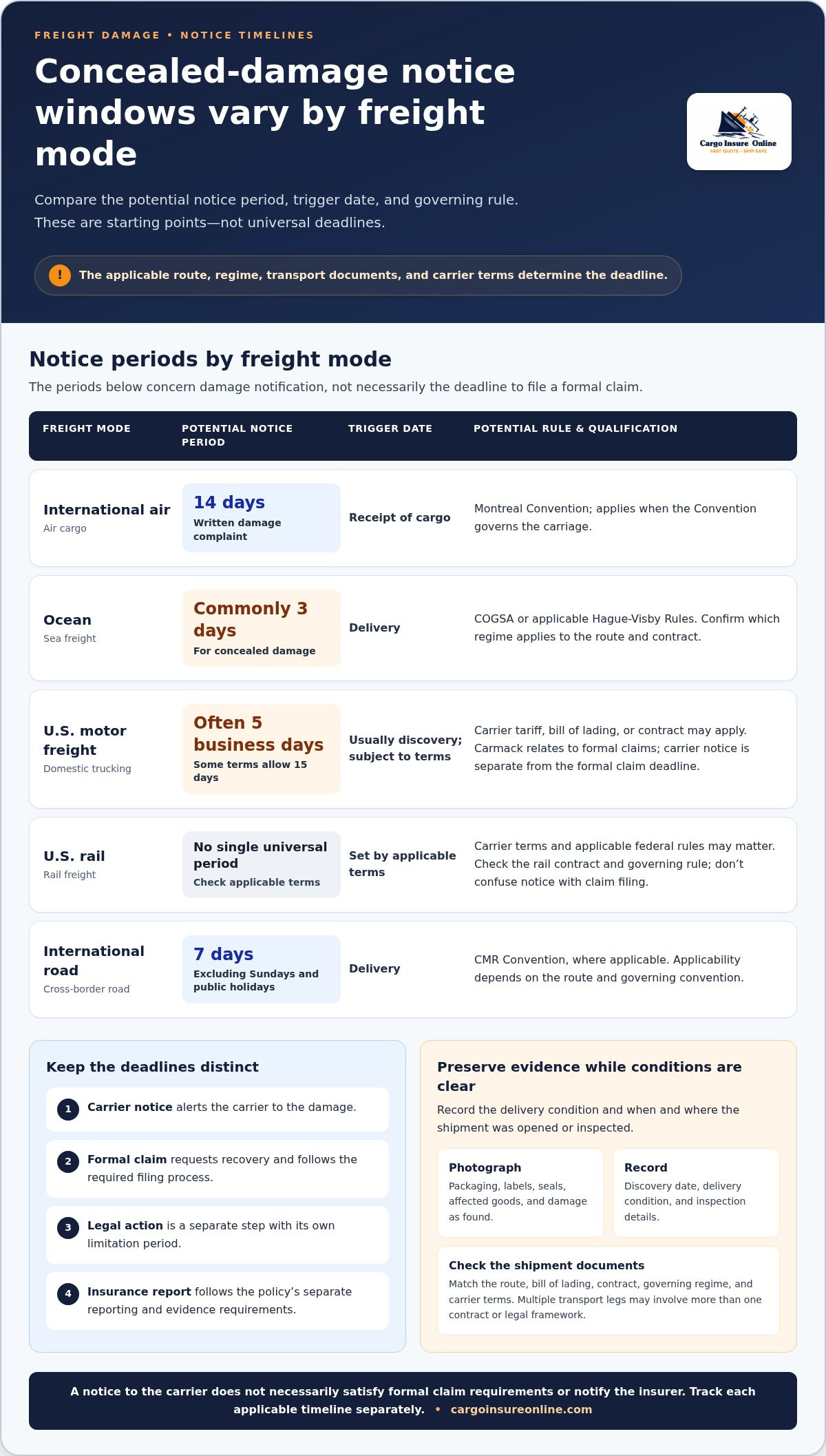
Use this as a starting point, not a universal deadline chart. The concealed cargo damage notification deadline by freight mode depends on the governing regime, route, transport documents, and carrier terms. The notice periods below concern reporting damage, not necessarily filing a formal claim.
| Mode | Potentially applicable rule | Notice period | Trigger date | Qualification |
|---|---|---|---|---|
| International air | Montreal Convention | 14 days in writing for damage | Receipt of cargo | Applies when the Convention governs the carriage. |
| Ocean | COGSA or applicable Hague-Visby Rules | Commonly 3 days for concealed damage | Delivery | Confirm which regime applies to the route and contract. |
| U.S. motor freight | Carrier tariff, bill of lading, contract; Carmack for formal claims | Often 5 business days from discovery; some terms allow 15 days | Usually discovery, subject to the terms | Carrier notice is separate from the formal claim deadline. |
| U.S. rail | Carrier terms and applicable federal rules | No single universal concealed-damage notice period | Set by applicable terms | Check the rail contract and governing rule; don’t confuse notice with claim filing. |
| International road | CMR Convention, where applicable | 7 days, excluding Sundays and public holidays | Delivery | Applicability depends on route and governing convention. |
Air and ocean freight: treaty and carriage-rule timelines
For international air carriage governed by the Montreal Convention, a written complaint for cargo damage is commonly due within 14 days of receipt. For ocean freight, COGSA and the Hague-Visby Rules have distinct legal scopes, although a three-day written notice period is commonly cited for concealed damage under applicable rules. Don’t assume a rule applies just because the shipment traveled by air or sea. Check the route, bill of lading, and contract to identify the applicable requirements.
Road and rail freight: carrier terms and formal claims
For U.S. motor shipments, carrier terms commonly require prompt reporting of concealed damage. The NAFEM overview of new guidelines for concealed damages describes a five-day reporting window; carrier tariffs may differ. Under Carmack, a U.S. motor carrier generally can’t set a formal claim deadline shorter than nine months from delivery. That is a claim-filing period, not a concealed-damage alert window. Rail deadlines also depend on the applicable rule and contract, so track them separately.
For every mode, confirm the trigger date and counting method in the governing documents. Track the carrier’s notice deadline, formal claim deadline, and cargo-insurance reporting requirement separately. Cargo insurance for air, sea, or trucking freight is a separate part of shipment risk management. Review cargo insurance options alongside your reporting process.
Notice Deadline vs. Claim Deadline: The Difference That Protects Your Options
A damage report, a formal claim, a lawsuit, and an insurance notification are separate actions. Each can have different deadlines and requirements. The concealed cargo damage notification deadline by freight mode tells you when the carrier must be alerted under the applicable rules or terms. It doesn’t automatically tell you how long you have to file a claim, start legal action, or report the loss under a cargo policy.
Missing a carrier’s notice term may complicate the carrier’s inspection or affect rights under the contract. Missing a formal claim deadline or a lawsuit limitation can have different, potentially more serious consequences. The outcome depends on the governing law, contract, and facts. Don’t assume that missing one deadline automatically decides every part of a claim, or that meeting it guarantees recovery.
What belongs in an initial damage notice?
Send a concise written alert through a traceable channel if the carrier’s procedure allows it. Include shipment identifiers, delivery and discovery dates, a factual description of the damage, and the number of affected packages. Keep a copy and record when it was sent and received. The notice creates an early record of what you found, but it may not meet the requirements for a formal claim or replace supporting documents.
Sample timeline, not a universal schedule
- Delivery: Record the date and any visible condition or exceptions.
- Discovery: Note when damage is found and preserve photos and packaging.
- Carrier notice: Alert the carrier within the deadline that applies to the shipment.
- Insurer reporting: Report separately according to the policy’s requirements. This may need to happen promptly, not after the carrier process.
- Formal claim: Submit the required claim materials within the applicable filing period.
- Legal action: Track any separate suit limitation; don’t treat claim submission as a lawsuit.
Why insurance reporting has its own clock
Carrier liability and cargo insurance are distinct risk-transfer arrangements. A carrier notice follows the carriage rules or contract; an insurance report follows the policy. Review the policy’s notice and cooperation requirements alongside the carrier’s process, and keep proof of each communication. For shipment-specific context, see Air Freight Insurance: High-Speed Coverage for Global Trade.
Keep one record with separate entries for discovery, carrier notice, insurer reporting, claim filing, and any legal deadline. That separation makes the next step clear without treating one message as a substitute for all the others.
What to Do When You Discover Concealed Damage
Act quickly, but don’t let the rush destroy useful evidence. These steps help you create a clear record while identifying the relevant concealed cargo damage notification deadline by freight mode and following the carrier’s and insurer’s separate procedures.
Build a clear evidence file before the scene changes
Start with the shipment as you found it. Photograph the full delivery area, then take close-ups of the goods, packaging, labels, seals, and any visible handling marks. Keep damaged items and packaging together for possible inspection, where safe and practical. Don’t discard, repair, or alter them unless necessary for safety or you receive written instructions about handling.
- Pause disposal. Set damaged goods and packaging aside. Make the area safe without destroying evidence.
- Document condition. Take wide and close-up photos. Record which packages and quantities are affected, plus the exact time and date you discovered the damage.
- Identify the shipment. Gather the proof of delivery, bill of lading, packing list, shipment reference, and any delivery exception notes. Keep them with your photos and inspection records.
Send a concise notice and follow the required process
- 4. Notify relevant parties. Use the carrier’s required notice channel. Include the carrier and shipment reference, delivery and discovery dates, affected packages, and a factual description of the damage. Send the alert within the applicable timeframe, and save the message and proof of submission.
- 5. Retain the record. Log the dates of delivery, discovery, notice, and any inspection. Save correspondence, replies, transport documents, photos, and any written instructions about the goods.
Keep the initial notice factual. Avoid guessing how or when the damage happened. If an inspection is arranged, note when it occurs and what was examined. For ocean shipments, these records can help organize the damage report and related documentation; read more about sea freight insurance.
Notify your cargo insurer separately and follow the policy’s reporting and cooperation requirements. Carrier notice doesn’t automatically count as an insurance report. For cargo-risk planning alongside a stronger evidence process, explore cargo insurance options.
A Reliable Cargo-Damage Deadline Checklist for Every Shipment
Turn deadline research into a simple shipment record before cargo moves. If damage appears later, you’ll have the key details ready to identify the applicable concealed cargo damage notification deadline by freight mode and act without treating one rule as universal.
Check the documents that control your shipment
Review the transport documents and terms tied to the shipment, then record the answers in one place. A cross-border route or a journey with multiple transport legs may involve more than one carrier, contract, or governing regime. Review each relevant document rather than assuming the first leg’s rules apply to the entire journey.
- Mode and route: Record each transport mode and the shipment’s origin, destination, and border crossings.
- Governing regime and contract: Note the potentially applicable law or treaty, plus the bill of lading, air waybill, carrier tariff, and transport contract.
- Notice details: Identify who must receive notice, the deadline and trigger date, the accepted notice channel, and any required information or supporting records.
- Separate deadlines: Track the date damage is discovered, the carrier notice deadline, the formal claim deadline, any suit limitation, and the policy reporting deadline.
For road-freight risk context, see Trucking Cargo Insurance: The 2026 Guide to Frictionless Road Protection. Keep the source document or policy reference beside each deadline so it’s clear where the date came from and what action it applies to.
Keep cargo protection separate from carrier deadlines
Carrier liability and cargo insurance address different parts of shipment risk. Carrier procedures govern how and when to report damage and pursue a carrier claim. Insurance has its own policy terms and reporting requirements. Cargo insurance doesn’t replace prompt carrier notice, and sending notice to a carrier doesn’t automatically meet policy obligations.
Cargo Insure Online offers Air Freight Insurance, Sea Freight Insurance, and Trucking Insurance for shipments moving by those modes. Treat coverage as a separate layer in your risk plan, alongside accurate shipment records and a clear reporting process.
Ready to review cargo protection for your shipments? Explore cargo insurance solutions.
Keep Every Shipment’s Deadlines and Records in Sync
The concealed cargo damage notification deadline by freight mode depends on the shipment’s route, governing rules, and carrier terms. Identify the applicable deadline before you need it, then keep carrier notice, formal claim filing, legal time limits, and insurance reporting on separate tracks.
If damage appears, preserve the goods and packaging where practical, document what you find, and keep dated proof of each report. Clear records help you act promptly and organize the cargo-risk process, but they don’t replace the requirements in your transport documents or policy.
Cargo Insure Online offers cargo coverage for air, sea, and trucking freight, plus specialized options for electronics, drones, mobile phones, and temperature-sensitive cargo. Consider coverage as a separate layer of shipment planning, alongside a reliable notice and documentation process. Explore cargo insurance solutions for your shipments and move forward with a clearer plan for protecting your cargo.
Frequently Asked Questions
How long do I have to report concealed cargo damage after delivery?
There’s no single deadline for every shipment. The concealed cargo damage notification deadline by freight mode depends on the route, governing law or treaty, transport contract, and carrier terms. For example, a 14-day written complaint may apply to damage under the Montreal Convention for applicable international air carriage. Ocean and road-freight terms can differ, while rail notice periods depend on the applicable rules and contract. Review the documents promptly and report damage as soon as you discover it.
Is the concealed-damage notification deadline different for air, ocean, and trucking freight?
Yes. Applicable international air carriage under the Montreal Convention generally has a 14-day written damage-complaint period from receipt. A three-day written notice period is commonly associated with concealed ocean damage under applicable rules, but the route and contract matter. U.S. trucking deadlines often come from carrier terms, not one universal alert period. Identify the regime and contract for your shipment, and keep carrier notice separate from formal claim filing and insurer reporting.
Does the Montreal Convention give me 14 days to report concealed air cargo damage?
For cargo damage on international air carriage governed by the Montreal Convention, a written complaint is generally due within 14 days from receipt. The Convention must apply to the shipment, and the deadline concerns written notice of damage, not every later step. Review the air waybill and applicable carriage terms, send the complaint through the required channel, and retain proof of submission. Also review your cargo policy for a separate insurance reporting requirement.
Is three days the deadline for reporting concealed ocean freight damage?
Three days is a commonly cited written-notice period for concealed damage under applicable ocean-carriage rules, including COGSA in relevant cases. It isn’t a universal deadline for every ocean shipment. The governing regime, route, bill of lading, and contract can affect which requirement applies and how the period is counted. Give written notice promptly after discovery, and refer to the controlling documents rather than assuming every ocean shipment follows the same rule.
Does the nine-month cargo claim deadline apply to concealed-damage notification?
No. For U.S. motor freight subject to the Carmack Amendment, nine months is the minimum period a carrier can allow for filing a formal written claim from delivery. It is not a concealed-damage notification period. Carrier tariffs or contracts may set a much shorter window for an initial damage alert. Keep the two dates separate, and identify the applicable rules for your mode, route, and carrier before relying on a deadline.
What should I do immediately after discovering concealed freight damage?
Pause disposal or repairs where safe and practical. Photograph the goods, packaging, labels, seals, and delivery surroundings, then record the discovery date and time, affected packages, and shipment reference. Preserve the proof of delivery, bill of lading, packing list, and any exception notes. Notify the carrier through the required channel and save proof of submission. Report separately to your cargo insurer under the policy’s requirements, since carrier notice may not count as an insurance report.
Can I file an insurance claim after notifying the carrier?
Yes. Notifying the carrier and reporting a loss to your cargo insurer are separate actions, each with its own process and deadlines. Send the insurer notice according to your policy, even if the carrier has already been alerted, and keep copies of both communications. Provide the shipment and damage records requested under the applicable process. Carrier notice doesn’t automatically satisfy policy requirements, and an insurance report doesn’t guarantee coverage or a claim payment.


