
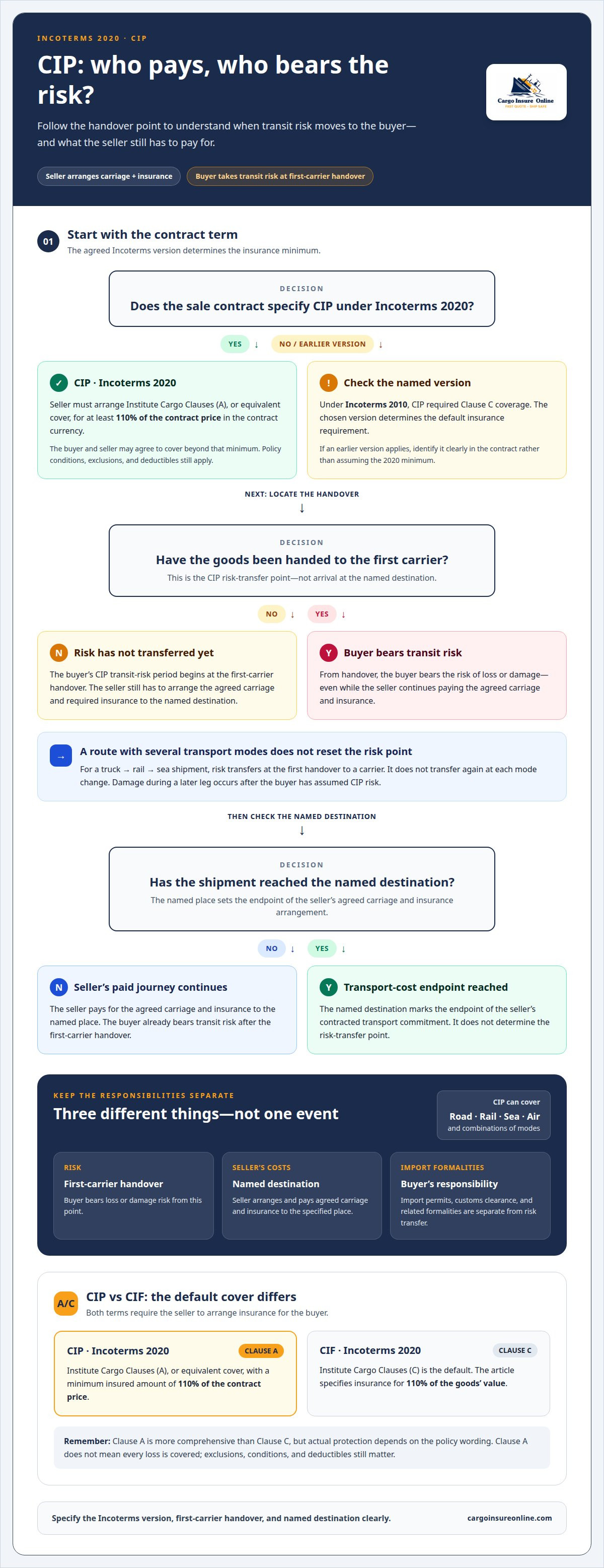
Under Incoterms 2020, the CIP Incoterms 2020 requirement for Institute Cargo Clauses (A) means the seller must arrange at least that level of cover, or equivalent insurance, for at least 110% of the contract price. CIF has a lower default cover requirement: Institute Cargo Clauses (C). In both cases, the seller arranges insurance, but under CIP risk transfers to the buyer when the goods are handed to the first carrier, not when they reach the destination.
That split can seem counterintuitive: the seller pays for carriage and insurance, but the buyer bears the risk for much of the journey. The details matter when you compare the protection required under CIP and CIF or decide whether you need additional cover.
This guide explains which Incoterms require the seller to buy insurance, what Institute Cargo Clauses (A) means compared with Clause C, and how CIP allocates risk and shipment costs. It clarifies where the seller’s obligations end, where the buyer’s begin, and what the insurance requirement does and does not protect.
Key Takeaways
- Understand how the insurance obligations under CIP differ from those under CIF, and what the coverage levels mean for each party.
- See why the buyer can carry transit risk even while the seller pays for carriage and insurance.
- Learn what “all risks” cover generally means, and why policy terms, exclusions, and deductibles still matter.
- Clarify how transport costs, insurance, and import responsibilities are divided between seller and buyer under CIP.
- Explore how freight insurance can help address cargo risks across air, sea, and trucking shipments.
What are the different levels of insurance coverage in CIF and CIP?
Incoterms 2020 sets different minimum insurance levels for CIP and CIF. The main difference is the required Institute Cargo Clauses, not who arranges insurance.
CIP Seller Insurance Obligations
Under CIP, the seller must buy insurance for the buyer’s benefit, meeting Institute Cargo Clauses (A) or equivalent coverage. The minimum insured amount is 110% of the contract price, in the contract currency. That percentage gives the buyer a defined minimum, but it doesn’t mean every loss is covered. Policy exclusions, conditions, and deductibles still apply.
The seller should provide the buyer with the insurance policy or certificate as evidence of cover. This document identifies the insured shipment and helps the buyer make a claim. If the seller fails to obtain the required insurance, they have not met the CIP insurance obligation, and the buyer may lack the protection the term requires.
Carriage and Insurance to Destination
CIP requires the seller to arrange and pay for carriage and insurance to the named destination. The contract should identify that destination clearly, such as a specific depot or delivery location in the destination country. Naming a precise place defines the endpoint of the seller’s transport-cost commitment. It does not change the separate point at which transit risk transfers.
The seller’s payment for carriage and insurance covers the agreed journey to the named place. Import customs clearance and related formalities are separate responsibilities under CIP, generally assigned to the buyer. For example, a named inland depot and a named door location are different endpoints, so the contract wording affects the carriage arrangement.
CIP and CIF Coverage Differences
CIP and CIF both require the seller to arrange insurance for the buyer, but Incoterms 2020 sets different default clauses. CIP requires Institute Cargo Clauses (A), or equivalent coverage. CIF’s default remains Institute Cargo Clauses (C), with insurance for 110% of the goods’ value. Clause A is more comprehensive than Clause C, but policy terms still define actual cover.
That distinction matters when selecting a version for the sale contract. Under Incoterms 2010, both CIP and CIF required Clause C coverage. Under Incoterms 2020, CIP’s minimum increased to Clause A, while CIF retained Clause C. Parties using an earlier version should identify it clearly in their contract; the chosen version determines which default insurance requirement applies.
Required insured amount under CIP: the seller must insure the goods for at least 110% of the contract price, in the contract currency. The buyer and seller can agree to additional cover beyond that minimum.
If the seller doesn’t obtain the required cover: they have not met the CIP insurance obligation, and the buyer may lack the required protection if the cargo is lost or damaged. The insurance document provides evidence of the cover arranged for the shipment.
When does risk transfer from seller to buyer in CIP?
Under CIP, the buyer assumes the risk of loss or damage when the seller hands the goods to the first carrier. This happens before the shipment reaches its named destination. The seller may still have to pay the agreed transport costs after the buyer assumes transit risk. These are separate obligations: the party paying for the journey does not necessarily bear its risks.
Consider a multimodal shipment that travels by truck, then rail, then sea. Risk transfers when the goods are first handed to a carrier, not at each later change of transport mode. If damage occurs during the sea leg, the buyer already bears the risk under CIP, even though the seller arranged and paid for carriage to the destination. The route does not shift the transfer point.
CIP means “Carriage and Insurance Paid To.” Under Incoterms 2020, it can be used for any transport mode or combination of modes, including road, rail, sea, air, or inland waterway transport. Its broad transport category makes it suitable for more than port-to-port shipments. The key is identifying the first carrier and the named destination in the sale contract.
The named destination sets the endpoint for the seller’s paid carriage and insurance. It could be a seaport, an inland container depot, or a door location in the destination country. For example, naming an inland depot rather than a destination seaport can change how far the seller’s contracted transport must extend. It does not postpone the buyer’s risk transfer until delivery there.
Import clearance is a separate responsibility. Under CIP, the buyer handles import permits, import customs clearance, and related formalities. These tasks do not determine when risk passes or when ownership changes hands. The contract should distinguish the named destination, the first-carrier handover, and any separate ownership terms so they are not treated as the same event.
For a buyer, the practical focus is the shipment’s first handover, not simply its arrival date. For a seller, the focus is arranging carriage and required insurance to the agreed destination while documenting delivery to the first carrier. That distinction helps both parties understand who bears transit risk at each stage. For multimodal movements, cargo insurance for freight shipments can be relevant to managing exposure across the journey.
Institute Cargo Clauses (A) or equivalent coverage
Under Incoterms 2020, CIP insurance must meet Institute Cargo Clauses (A) or equivalent coverage. The label sets a minimum, while the policy wording determines how protection applies to a particular freight shipment.
Institute Cargo Clauses (A) Coverage
Institute Cargo Clauses (A) is described in Incoterms 2020 guidance as an “all-risks” standard for cargo insurance. It provides broader cover than Institute Cargo Clauses (C), which remains the CIF default. For an export sale, that distinction helps the parties identify the baseline protection the seller must arrange under CIP.
“All risks” does not mean every loss during loading or transport is covered. The insurance contract governs covered events, conditions, exclusions, and deductibles. The buyer’s practical protection depends on how those terms apply to the goods and the shipment’s route.
Coverage Exclusions and Limitations
Institute Cargo Clauses (A) coverage remains subject to policy exclusions, conditions, and applicable deductibles. These terms determine how the broad “all-risks” standard responds to a claim. The policy wording, not the clause label alone, determines whether a specific loss qualifies for cover.
For example, a buyer reviewing a damaged shipment needs to consider the cause of loss and the policy terms. The “all-risks” description does not establish that every cause or circumstance is covered. Exclusions and conditions can affect the outcome, while a deductible can affect the amount payable.
Equivalent coverage means insurance that meets the CIP requirement without using the exact Institute Cargo Clauses (A) wording. Compare the protection the policy provides, not just the name on its certificate. This matters when a seller arranges cover under different policy terms for an international shipment.
The seller’s insurance obligation and the buyer’s choice to obtain additional protection are separate. Under CIP, the buyer is responsible for any insurance beyond the seller’s required minimum. The parties can discuss the protection their goods need and record agreed arrangements in the sale contract. Clear wording distinguishes required cover from additional protection.
For example, an exporter and buyer could agree that the seller arranges the CIP minimum while the buyer obtains additional cover. The contract should clarify who arranges each policy and which shipment it applies to. This avoids treating “all risks” as unlimited cover or assuming the seller’s policy automatically includes every requested protection.
For CIP shipments, the insurance document gives the buyer evidence of the cover arranged. Review it alongside the policy terms: the clause, insured goods, route, exclusions, conditions, and deductible all shape the protection. This makes “Clause A or equivalent” a more useful description of the actual insurance obligations.
Buyer and seller allocation of shipment costs and risks
In international trade, CIP separates who pays for carriage and insurance from who bears transit risk. The 2020 rules allocate tasks between buyer and seller, but the sale contract still needs clear wording about the named destination and chosen version. That distinction helps prevent a common mix-up: paying for transport doesn’t mean carrying the risk throughout the journey.
The International Chamber of Commerce (ICC) structures each Incoterm around 10 seller obligations and 10 buyer obligations. Under CIP, the seller arranges and pays for transportation and insurance to the agreed destination. The buyer assumes risk when the goods are handed to the first carrier. The parties therefore have different responsibilities during the same journey.
The seller’s cost responsibilities include carriage to the named destination, insurance for the buyer, and applicable export licenses and export customs formalities. The Incoterm assigns those export tasks and costs. For example, naming an inland depot gives the seller a different transport endpoint than naming only a destination seaport.
Under CIP, the buyer handles import permits, import customs clearance, and related formalities. The buyer also bears risk after the first-carrier handover, even while the seller continues paying for contracted carriage. When a shipment passes through several carriers, the handover point matters more for risk allocation than its later arrival at the destination.
Compare CIP with CPT to see why insurance is a distinct obligation. Under CIP, the seller pays for transportation and buys insurance for the buyer. Under CPT, the seller pays for transportation but is not required to provide insurance. The transport-cost arrangement may look similar, but the insurance obligation changes who must arrange cargo cover.
The 2020 rules don’t set every term of the sale. They don’t determine the goods or contract price, the payment method or timing, or when ownership transfers. Parties should handle those issues separately in their agreement. They should also state the Incoterms version clearly, since contracts may use an earlier or later version by agreement.
To allocate responsibilities clearly, the parties can distinguish them in the contract:
- Seller: arrange and pay carriage, obtain the required CIP insurance, and handle allocated export formalities.
- Buyer: take transit risk after handover to the first carrier and handle import clearance and related formalities.
- Both parties: identify the named destination and Incoterms version, then address payment, ownership, and other sale terms separately.
This allocation clarifies each party’s costs, tasks, and risks across an international shipment. The named destination sets the seller’s carriage endpoint, while the agreed Incoterms version determines the applicable rule wording.
Institute Cargo Clauses A requirement
The key point in the CIP Incoterms 2020 Institute Cargo Clauses A requirement is its role as the seller’s insurance minimum. It sets a contractual baseline, not a guarantee that every shipment loss will be covered. Buyers and sellers should distinguish the Incoterm obligation from the wording and limits of the policy actually arranged.
Version matters. Under Incoterms 2010, CIP’s required insurance level was Institute Cargo Clauses (C). Incoterms 2020 raised the CIP minimum to Institute Cargo Clauses (A), or equivalent coverage. The change affects contracts that expressly select the 2020 rules. A shipment loaded under a contract using an earlier version is not automatically governed by the newer minimum.
Make the chosen version explicit in the sale contract, alongside the named destination. For example, the parties can identify CIP, the agreed place, and Incoterms 2020 together. That makes the intended rule easier to distinguish from a contract using Incoterms 2010. It also helps prevent a reference to CIP alone from obscuring which insurance baseline the parties selected.
“Or equivalent” allows the seller to meet the requirement with coverage that provides an equivalent level of protection, even if the policy does not use the exact Clause A wording. The label alone does not establish equivalence. Review the policy terms and evidence of cover, including the insured cargo, shipment route, exclusions, conditions, and applicable deductible.
Clause A is described as an all-risks standard, but that phrase does not mean unlimited protection. A claim remains subject to the policy’s terms and exclusions. Buyers should distinguish the seller’s required insurance from any additional protection they want. Under CIP, the buyer is responsible for insurance beyond the seller’s minimum.
Insurance evidence helps make the arrangement usable. Under CIP, the seller must provide the buyer with the insurance policy or certificate. Keep that document with the relevant sale and shipment records. Incoterms do not specify which documents the seller must provide to facilitate customs clearance in the buyer’s country, so the parties should address those requirements separately.
For an e-commerce shipment, the CIP minimum and a separate cargo policy serve different roles. The first is the seller’s obligation under the agreed Incoterm; additional cover may address the buyer’s wider cargo needs. Explore E-Commerce Cargo Insurance when you need cargo protection beyond the seller-arranged CIP coverage.
Cargo Insure Online
Cargo Insure Online helps businesses manage cargo risks with insurance for air, sea, and trucking freight. If the seller-arranged cover under a CIP contract leaves you considering protection beyond the required minimum, cargo insurance may be a relevant next step. The right fit depends on your shipment, transport mode, and coverage needs.
For example, a buyer may consider separate protection for goods moving by air, sea, or road, while a business reviewing a financial gap may consider GAP Insurance. These options do not change CIP’s risk-transfer point or replace the need to understand the seller’s policy terms. They can address cargo-related exposure beyond the Incoterm’s allocation.
Contact Cargo Insure Online to discuss your cargo insurance needs.
Make the next shipment easier to plan
Use the CIP Incoterms 2020 Institute Cargo Clauses A requirement as a starting point for a deliberate insurance conversation, not as the final word on your shipment’s protection. Bring the cargo, transport plan, and contract terms into that discussion early. This gives your business a clearer basis for deciding whether the agreed insurance arrangement fits the exposure you want to manage.
A useful next step is to align your trade and insurance decisions before shipment arrangements are underway. This can help keep the contract language, cargo details, and coverage expectations consistent as responsibilities pass between trading partners. Cargo Insure Online offers cargo insurance for air, sea, and trucking freight, giving businesses a way to explore protection suited to their transport needs.
Contact Cargo Insure Online today to discuss your cargo insurance needs. A clear plan can make the next shipment easier to approach with confidence.
Frequently Asked Questions
Which Incoterms include insurance by default?
CIP and CIF are the Incoterms rules that require the seller to purchase cargo insurance for the buyer. The minimum cover differs: CIP under Incoterms 2020 requires Institute Cargo Clauses (A) or equivalent, while CIF defaults to Institute Cargo Clauses (C). This insurance obligation doesn’t mean every other Incoterm prohibits insurance; it means the seller isn’t required by those rules to arrange it.
Is CIP used for all modes of transport?
Yes. CIP can apply to any transport mode, including shipments that combine modes. For example, goods might travel by truck to a rail terminal and then continue by sea. The contract should clearly name the destination, whether it is a seaport, inland depot, or door location. The first-carrier handover remains important for identifying when transit risk passes, even on a multimodal route.
What Is an Incoterms Clause?
An Incoterms rule is a standardized trade term that allocates specific delivery tasks, costs, and risks between a seller and buyer. It helps parties describe responsibilities in a sales contract, such as who arranges carriage or handles export formalities. It does not replace the full contract: payment timing, ownership transfer, product requirements, and remedies for non-conforming goods need separate terms.
What is the seller responsible for under CIP?
Under CIP, the seller arranges and pays for carriage to the contract’s named destination, obtains the required insurance for the buyer, and handles the assigned export formalities. Paying for transport does not keep transit risk with the seller until arrival. When the goods are handed to the first carrier, the buyer assumes risk, even though the seller’s contracted carriage continues.
What should exporters know before using CIP?
Exporters should state the Incoterms version and named destination precisely in the sale contract. These details help identify the seller’s carriage commitment and applicable insurance minimum. Exporters should also account for the export licenses and customs formalities assigned to the seller. CIP does not decide the sale’s payment terms or ownership transfer, so these should be addressed separately.
What’s the difference between CPT and CIP?
Both terms require the seller to arrange and pay for carriage to a named destination, but CIP also requires the seller to arrange insurance for the buyer. CPT does not require the seller to provide insurance. For a buyer comparing terms, the key distinction is who must arrange cargo cover, not simply who pays the freight bill. Under CIP, risk transfer still relates to delivery to the first carrier.
What are the seller's insurance obligations under CIP Incoterms 2020?
The seller must arrange insurance for the buyer’s benefit under CIP Incoterms 2020, using Institute Cargo Clauses (A) or equivalent cover. The insured amount must be at least 110% of the contract price, in the contract currency. The buyer should distinguish that minimum from any additional protection they want, since extra insurance beyond the seller’s required cover is the buyer’s responsibility.
Does CIP Incoterms 2020 require Institute Cargo Clauses (A) coverage?
Yes. CIP under Incoterms 2020 requires Institute Cargo Clauses (A) or equivalent insurance coverage. “Equivalent” allows different policy wording, but the cover must satisfy the required level. Clause A is described as an all-risks standard, not unlimited protection: exclusions, conditions, and deductibles still apply. The policy terms determine how cover responds to a particular loss during the shipment.


