
For high theft target commodity trucking, security endorsement requirements are separate from practical cargo-theft controls. In the United States, drivers whose commercial license is required to transport placarded hazardous materials must apply for a Hazardous Materials Endorsement Security Threat Assessment under 49 CFR 1572. Protecting other high-risk freight calls for layered safeguards, not just paperwork.
A valuable load can attract attention at pickup, during a stop, or while parked. Locks and seals matter, but so do tracking, driver routines, and clear fleet procedures. The goal is protection that works throughout the journey, not reliance on a single device or rule.
This guide explains where theft risks arise and how locks, tracking devices, fleet procedures, cameras, and alarms can help reduce exposure. It also covers how trucking insurance can complement these safeguards by addressing cargo-related financial risk.
Key Takeaways
- Separate hazardous-materials endorsement rules from the security steps used to protect other high-risk freight.
- Identify vulnerable moments across pickup, stops, parking, and delivery, then build safeguards around the full route.
- Combine trailer locks and tamper-evident seals with tracking that can flag unusual activity.
- Use clear fleet procedures for driver selection, load handoffs, parking, and recipient verification.
- Pair cameras and alarms with monitoring, and consider cargo insurance as part of a wider risk-management plan.
1. Cargo theft risks and common locations
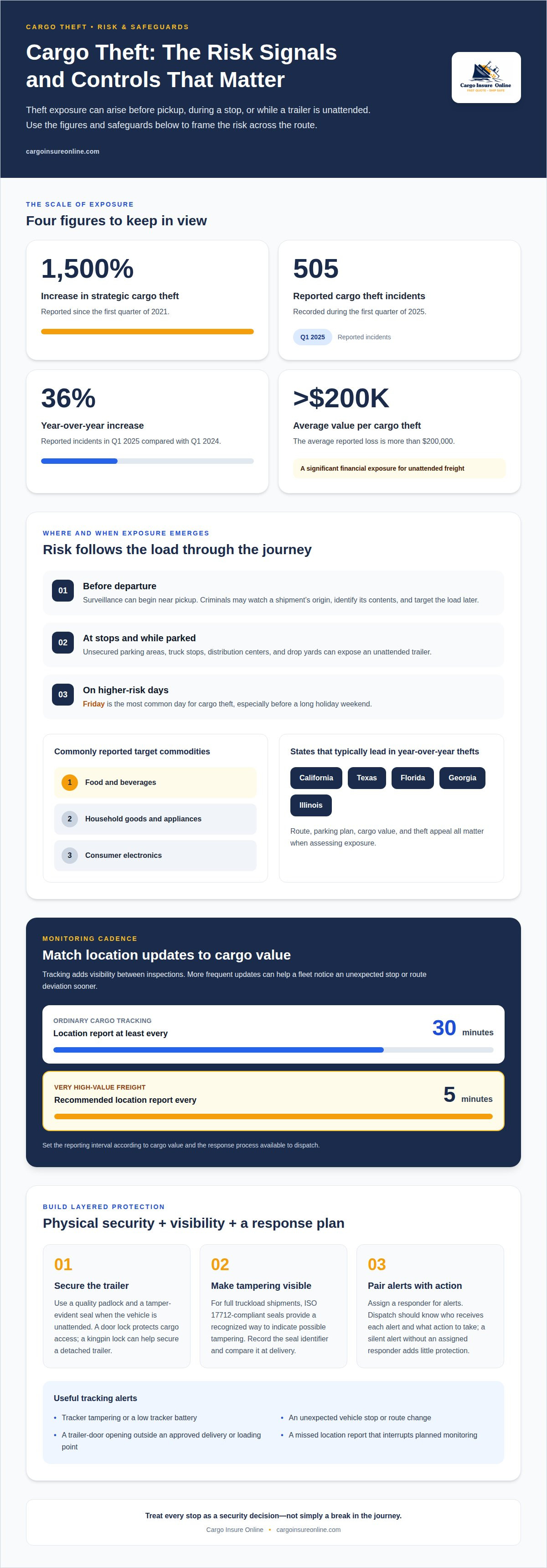
Cargo theft can begin before a truck leaves the pickup point. Criminals may watch a shipment’s origin, identify its contents, and target the load later. Unsecured parking areas, truck stops, distribution centers, and drop yards all create exposure when a trailer is unattended. Drivers hauling valuable freight should treat every stop as a security decision, not simply a break in the journey.
In the United States, food and beverages are commonly reported theft targets, followed by household goods and appliances, then consumer electronics. California, Texas, Florida, Georgia, and Illinois typically lead in year-over-year thefts. A load of televisions or mobile devices may attract attention because it is valuable and relatively easy to resell. Cargo value and theft appeal make the route, parking plan, and safeguards especially important.
Timing and location can affect risk. Friday is the most common day for cargo theft, especially before a long holiday weekend. Theft may occur at a truck stop or distribution center, but surveillance can begin near pickup. Drivers should avoid isolated parking when possible, keep load details private, and follow planned routes. An unplanned stop can expose a shipment to unfamiliar risks.
“Security endorsement” can mean two different things. A trucking insurance endorsement changes policy terms for specified cargo, such as defining covered theft losses, limits, conditions, or exclusions. It does not automatically cover every theft scenario; the policy wording determines the protection. A Hazardous Materials Endorsement, or HME, is a separate credential for qualifying commercial drivers, not an insurance endorsement for high-theft goods.
There is no single cargo limit, deductible, or premium for every high-theft shipment. Limits depend on the insured cargo value and policy terms; deductibles and premiums reflect factors such as the commodity, route, shipment exposure, and security controls. Understand each figure in the context of the specific policy rather than treating it as a universal trucking rate.
For U.S. drivers, HME requirements apply when their state-issued commercial license is needed to transport materials requiring hazardous-material placards. The Transportation Security Administration recommends that new and renewing applicants apply at least 60 days before they need an eligibility determination. From October 1, 2026, the fee for new and renewing applicants is $88.25, according to the Transportation Security Administration. A new or renewing applicant with a valid TWIC pays the reduced fee of $41, according to the Transportation Security Administration. These credential rules are distinct from cargo-theft insurance terms.
Vehicle and cargo theft costs trucking companies and the industry hundreds of millions of dollars each year. The average value per cargo theft is more than $200,000, underscoring the financial stakes when freight is left unattended.
Strategic cargo theft has risen 1,500% since the first quarter of 2021. There were 505 reported cargo theft incidents during the first quarter of 2025, and reported cargo theft incidents increased 36% in the first quarter of 2025 compared with the first quarter of 2024. These figures give carriers added context for weighing exposure at unsecured parking locations, truck stops, distribution centers, and drop yards.
2. Locks and tracking devices
A lock creates a physical barrier; a seal makes interference easier to spot. Drivers should secure trailer doors whenever the vehicle is unattended, using a quality padlock and a tamper-evident seal. For full truckload shipments, ISO 17712-compliant seals provide a recognized way to indicate possible tampering. Record the seal identifier on shipping documents, then compare it at delivery. A broken seal or mismatch calls for an immediate report and clear documentation.
Choose locks that match the trailer hardware. A kingpin lock can help secure a detached trailer, while a door lock protects access to the cargo compartment. Neither replaces the other. Drivers should remove vehicle keys, lock cab doors, and check that trailer doors are fully latched before leaving. If a seal is fitted, record its condition before departure and at each handoff.
Tracking adds visibility between inspections. For ordinary cargo tracking, devices should report vehicle location at least every 30 minutes. For very high-value freight, the recommended interval is every 5 minutes. More frequent updates can help a fleet notice a route deviation or unexpected stop sooner, while longer gaps may leave a wider blind spot. Set the reporting interval according to cargo value and the response process available to dispatch.
Location alone is not enough. Configure alerts for events such as:
- Tracker tampering or a low tracker battery.
- An unexpected vehicle stop or route change.
- A trailer-door opening outside an approved delivery or loading point.
- A missed location report that interrupts the planned monitoring pattern.
Dispatch should know who receives each alert and what action to take. For example, an unplanned door-opening alert during a highway stop should prompt a call to the driver and a review of the vehicle’s location. A silent alert without an assigned responder adds little protection. Test the workflow with drivers and dispatch so everyone knows how to report a suspected breach.
For higher-value loads, a covert GPS device can be placed within the cargo or wired into the trailer. A concealed tracker can provide a second location signal if a visible unit is damaged or removed. Limit installation details to staff who need them, and include the device’s power status and reporting schedule in routine checks. Combining concealed and visible tracking with door alerts and physical locks creates several opportunities to detect interference.
For shipments of phones or other valuable electronics, consider how electronics and high-value devices coverage fits alongside these physical safeguards. Locks and trackers support loss prevention; they do not replace clear documentation of the shipment and its condition.
3. Security procedures for fleet owners and managers
Security rules vary with cargo value, theft appeal, route, and handling. Electronics, pharmaceuticals, food, and metals each create different risks, so insurers set requirements through the applicable policy terms and endorsements. A high-value electronics load may call for tighter access controls, while temperature-sensitive food also needs procedures to protect the shipment during delays.
Insurers’ security requirements appear in the endorsement and policy wording. They may address driver selection, parking, tracking, seals, route planning, and recordkeeping. There is no single checklist for every high-theft shipment; the declared cargo, transit conditions, and agreed safeguards shape the applicable terms.
Build a written process before dispatch. Owners and managers should complete employment and criminal background checks on new employees and contractors, and use experienced, senior drivers for high-target loads. The recommended nationwide criminal background check covers the past 7 years. Pair it with reference checks, then train drivers on reporting suspicious activity, securing the vehicle, and contacting dispatch.
For the load itself, managers can require drivers to witness loading and verify the cargo count when the customer permits it. If loading is not witnessed, mark the bill of lading “Loading not witnessed.” Keep shipment documents, dispatch instructions, seal details, route changes, and incident reports together. These records help document which controls were followed and when each handoff occurred.
Parking and routing rules should be explicit. For high-risk commodities, drivers should not stop within 250 miles of the pickup point. They should avoid isolated locations, park in well-lit, busy, or secured areas, and lock the truck and trailer while parked. Remove the keys. Keep a high-target load attached to its tractor unless it is inside a fenced, locked, secure area. If a relay is needed, arrange a face-to-face transfer.
Federal or state rules do not impose one universal security checklist for every high-value or theft-target shipment. Security recommendations are voluntary and do not ensure compliance with legal or regulatory requirements. A separate rule applies to hazardous materials: U.S. drivers whose state-issued commercial license is required for placarded materials must undergo an HME Security Threat Assessment under 49 CFR 1572.
If a carrier misses an endorsement requirement, the policy wording determines how that affects a claim. A breach can affect coverage when the endorsement makes the safeguard a condition or excludes losses tied to noncompliance. Keep dispatch logs, driver training records, bills of lading, and security reports to document how the shipment was handled.
Requirements are tailored to cargo value, theft appeal, route, and handling, and appear in the applicable policy terms and endorsements. High-value electronics may require tighter access controls, while temperature-sensitive food needs procedures to protect it during delays. Requirements for pharmaceuticals and metals depend on their specific risks and the agreed safeguards.
4. Cameras, alarms, and integrated security
A camera records activity; an alarm draws attention to a possible breach. Combined with monitoring, they support a more coordinated security strategy. For a truck carrying theft-attractive freight, the goal is a connected response: detect an event, identify its location, and direct someone to act. A camera without a review process may capture useful footage only after the load is gone.
Start by mapping the shipment’s vulnerable points. At a warehouse, these might include the loading bay and the gate used by departing vehicles. On a tractor-trailer, cameras can show the cab area, trailer doors, or activity around the vehicle. Each view should answer a practical question, such as whether someone approached a parked trailer or opened its doors.
Tie alarms to events that matter to the load. Examples include an unexpected door opening, movement outside a planned stop, or an alarm signal from a secured yard. These are setup examples, not universal policy requirements. The fleet’s written procedure should explain which events trigger a dispatch call, who contacts the driver, and when to escalate the incident.
Clarify the response sequence before a shipment leaves. Dispatch can receive an alert, check the vehicle’s location, and contact the driver through the established channel. If the driver reports a suspected break-in, staff can preserve camera footage, note the event time, and follow the company’s incident-reporting procedure. Assign responsibility clearly: an alert needs a responder, not an unattended inbox.
Position cameras to support useful review. A loading-bay view can help establish when a trailer was sealed, while a yard camera can show who approached it later. Keep footage with the shipment or incident record, including the relevant date, location, and vehicle identifier. Limit access to staff responsible for dispatch, security, or an investigation.
- Before pickup: confirm cameras cover the loading area and vehicle exit.
- During transit: route alarm notifications to a named dispatch role.
- After an alert: record the time, location, driver contact, and response.
- After delivery: retain relevant footage with shipment records when an incident occurred.
Test the workflow with a planned alarm or camera review before relying on it for a high-value load. Confirm that the signal reaches the right person and dispatch can identify the shipment. If an alert arrives during a driver handoff, the procedure should still make clear who takes responsibility. Cameras, alarms, and monitoring work best as coordinated layers alongside physical safeguards and documented fleet procedures.
Coordinate each tool within the same security plan. Cameras help review activity, alarms flag possible events, and monitoring connects those signals to an organized response. Treating them as separate features can fragment protection; coordinating them keeps attention on the shipment and the action required when a concern arises. Keep each component’s purpose clear when reviewing the security plan.
5. What cargo insurance coverage is required for high-theft commodities?
There is no single cargo insurance limit for every high-theft load. The right protection depends on the cargo’s value, how it moves, and the policy’s covered causes of loss. A theft endorsement may add terms for particular goods or safeguards, but the wording determines what applies. To assess high theft target commodity trucking security endorsement requirements, match the cargo description and shipment value to the coverage being considered.
Read the policy’s theft language alongside its exclusions and conditions. A policy may define covered theft differently from breakage or an unexplained shortage. For example, a missing sealed pallet and a stolen trailer involve different circumstances and evidence. Identify the records the policy requires, such as shipping documents, delivery records, or an incident report. Clear descriptions help distinguish documented theft from a discrepancy discovered during inventory.
Limits and deductibles affect how a covered loss is handled. A limit sets the maximum payable under the applicable terms, while a deductible is the amount retained before insurance responds. Compare both with the shipment’s declared value and the largest load carried together. For mixed goods, understand how the policy treats each commodity and its stated value. Reviewing high theft target commodity trucking security endorsement requirements alongside these terms can show whether coverage matches the shipment.
Premiums depend on the shipment and its risk profile, not on a universal rate. Relevant factors can include the goods, cargo value, route, handling arrangements, claims experience, and security procedures. For example, a shipment of consumer electronics using planned stops may present a different risk profile from a mixed load with changing routes. The policy terms and underwriting details determine how these factors apply.
Before dispatch, organize the information used to describe the exposure:
- Cargo: record the commodity, quantity, and shipment value.
- Movement: document origin, destination, carrier, and planned route.
- Safeguards: note the locks, seals, tracking, and monitoring procedures used.
- Evidence: retain bills of lading, delivery records, and incident documents.
These records connect a claim to the shipment and its handling. They can also help reveal a gap, such as cargo value exceeding the applicable limit or an unmet security condition. Keep policy wording accessible to dispatch staff so they can understand relevant terms before pickup, during transit, and at delivery.
For a shipment-specific coverage discussion, explore cargo coverage options and consider how the cargo, value, route, and safeguards fit together. Clear shipment details create a more focused starting point for evaluating protection before a high-theft load moves.
A cargo limit sets the maximum payable under the applicable terms, while the deductible is the amount retained before insurance responds. Premiums depend on factors such as the goods, cargo value, route, handling, claims experience, and security procedures.
Cargo Insure Online: Trucking Insurance
Cargo Insure Online offers Trucking Insurance for businesses moving freight by road. For theft-target cargo, consider how the shipment, its value, route, and security procedures fit your insurance needs. Clear shipment details help frame the coverage discussion.
For loads such as valuable electronics, Electronics & High-Value Devices Insurance may also be relevant. Cargo Insure Online offers Air Freight Insurance and Sea Freight Insurance for shipments using those transport modes. Start by identifying how the cargo travels and the financial exposure you need to address.
Share your trucking cargo needs and shipment details with Cargo Insure Online to discuss coverage options.
Build security into every shipment plan
Make cargo protection a regular planning decision, not a last-minute response to a new route or different load. Assign someone to review how changing cargo types affect operating procedures and insurance needs. This keeps requirements for high-theft-target commodity trucking security endorsements aligned with how your business moves freight.
Coverage should fit the transport mode and cargo involved. Cargo Insure Online offers Trucking Insurance, Air Freight Insurance, and Sea Freight Insurance. Choose the next step based on the shipment you need to protect, whether it moves by road, air, or sea.
A clear conversation about your cargo and transportation needs can help put the coverage discussion in context. Contact Cargo Insure Online today to discuss your freight insurance needs and move forward with confidence.
Frequently Asked Questions
Which commodities are considered high-theft targets in U.S. trucking?
Food and beverages, household goods and appliances, and consumer electronics are commonly identified as theft-attractive freight in the United States. A shipment’s appeal can also depend on resale potential, ease of concealment, and how identifiable the goods are. Mixed loads deserve attention too: one valuable, easy-to-resell product can increase exposure across the shipment, even when the rest of the cargo is less attractive.
Are GPS tracking, geofencing, or cargo sensors required for high-theft freight?
No single rule makes GPS, geofencing, or cargo sensors mandatory for every high-theft shipment. Requirements depend on the applicable policy wording, shipper instructions, and the shipment’s security plan. A GPS device can help locate a vehicle, while geofencing can flag movement beyond a set boundary; cargo sensors can report specific conditions when used. Treat these as distinct tools and follow the written requirements for the load.


