

A server rack can arrive in an apparently sound crate yet still have suffered a hard impact or tip during transit. A shock sensor and tilt indicator can record those events and help document a server rack insurance claim.
That evidence matters, but each indicator tells a different part of the story. Shock indicators respond to sudden impacts; tilt indicators reveal when a crate has moved beyond its set angle. Together, they can help receiving teams spot risk and focus inspections where they matter.
This guide explains how shock and tilt indicators work, what they can reveal about server rack transport, and how to use their readings in an insurance claim record. It also covers orientation-sensitive cargo, the limits of indicator evidence, and how freight insurance can help protect valuable equipment in transit.
Key Takeaways
- Recognize that impact, ongoing vibration, and compression can each put server racks at risk during transport.
- Use shock and tilt indicators to distinguish sudden impacts from crates tipped beyond their set angle.
- Read indicator results as evidence of a handling event, then prioritize a closer inspection of the equipment.
- Pay particular attention to orientation-sensitive cargo, since a tilt event can signal risk even when the crate looks intact.
- Keep indicator readings and inspection records together to support a clearer review if damage is found.
What types of physical stress occur during server rack transport?
Server racks face three distinct physical stresses in transit: impact shock, sustained vibration, and compression. A sudden jolt may occur if a crate is dropped or struck during loading. Repeated vibration can loosen connections over time, while stacking pressure or shifting cargo can deform packaging. Because these forces affect equipment in different ways, a visual check alone may not reveal every risk.
Shock indicators detect sudden acceleration or deceleration that may threaten cargo. Visual indicators change when an impact crosses their set threshold; commonly stated activation ranges run from 15 to 75 g. The correct threshold depends on the indicator and the shipment’s handling needs. For example, a crate may show no obvious exterior damage after a hard knock, yet its indicator can record that the impact crossed the device’s threshold.
Vibration creates a different pattern of risk. When transport vibration matches a component’s natural resonant frequency, movement can intensify. Repeated motion may contribute to mechanical fatigue, loosen connectors, or affect drives. During sea freight, prolonged rolling can be particularly troublesome for rack-mounted drives with spinning platters. Unsecured cables may swing like pendulums, transferring vibration to connected ports and cards.
Compression can occur when cargo presses against a crate or stacked loads bear down on its packaging. A tilted or shifting rack may also concentrate pressure at one contact point. Internal bracing helps hold components in place relative to the chassis, while suitable crating and vibration-dampening mounts address other stresses. These measures complement indicators: monitoring records an event, while packaging helps limit movement and force.
Shock data can help identify where risks cluster in the supply chain. Record each triggered indicator alongside the crate identification, route leg, carrier handoff, and receiving inspection. Repeated triggers after a particular loading point or on one transport lane can guide a focused review of that stage. A pilot across carriers and lanes can establish baseline false-positive rates before teams interpret patterns or update carrier scorecards.
For a server rack transit shock sensor and tilt indicator insurance claim, connect each reading to the shipment’s condition and handling record. At receiving, photograph the indicator and crate before moving or unpacking them. Document visible damage and inspection findings together, then compare the record with the route and handoffs. A triggered shock indicator can point to an impact or drop even when the carton looks intact; the inspection helps connect that event to the equipment’s condition.
A server rack transit shock sensor and tilt indicator can help organize an insurance claim record by distinguishing an impact signal from an orientation event. Keep the sensor reading, crate identification, and receiving notes together to make the shipment history easier to review.
How could shock indicators minimize shipping damage of servers in transit?
Shock indicators make handling events visible and help teams identify crates that need closer inspection. Custom crating, internal bracing, and vibration-dampening mounts help limit movement; indicators show whether an event occurred.
Tilt-Sensitive Cargo Damage
Tilt-sensitive cargo may be affected when a crate moves out of its intended upright position. A tilted container can let liquids shift or spill and place unexpected stress on batteries, electronics, or machinery.
For a server shipment, the indicator flags an orientation event, not the specific damage inside. Receiving teams can prioritize the affected crate, inspect its contents, and record findings before storage or installation. Medical devices can also become unusable after a hard impact or unexpected tip, even if the temperature remained within range.
Server Components at Risk
Server components at risk include rack-mounted drives, connectors, cards, and internal cabling. A hard knock can affect components without leaving obvious marks on the crate, while vibration may loosen connections or contribute to mechanical fatigue.
Unsecured cables can swing during transit and transfer motion to connected ports or cards. After an indicator triggers, receiving teams can focus their inspection on those connections and drive operation rather than relying on the crate’s appearance alone. Humidity presents a separate risk: prolonged exposure can corrode connector pins, circuit-board traces, and chassis components.
Monitoring to Reduce Damage and Claims
Visible indicators provide an early signal of handling conditions that may need attention. Shock indicators show when an impact crosses their set threshold, helping receiving teams identify crates for prompt inspection before equipment enters storage or a data center.
Pair indicator results with crate identification, route records, and inspection notes. Together, these records can help show where an event occurred during a multi-leg journey and support a focused supply-chain review. Using shock, tilt, and humidity indicators together documents different transit conditions and can help prevent avoidable claims, returns, and customer dissatisfaction.
Handling Responsibility and Damage Prevention
Handling responsibility depends on when an indicator triggers and which party had custody at that point in the journey. A triggered device can provide evidence for a carrier dispute, but it does not prove the cause or extent of equipment damage on its own.
Reduce risk with custom crating, internal bracing to immobilize components, and vibration-dampening mounts. Secure the rack inside the vehicle with blocking, straps, or bracing to limit movement during braking and cornering. At receiving, photograph the crate and triggered indicator, then document visible damage and inspection results. This connects the handling record to the equipment’s condition.
Tilt indicators for monitoring whether shipments remain upright
Transit shock sensors detect sudden impacts; tilt indicators show when a crate exceeds its set angle. For server shipments, choose monitoring that suits the rack’s handling risks and gives receiving teams clear evidence to guide inspection.
Upright Orientation Monitoring
A tilt indicator is a visual device that activates when a crate exceeds its designated tilt threshold. Many models trigger within a range of 30 to 80 degrees, while some detect tilting beyond 80 degrees.
For a rack, the useful tilt threshold depends on its rated angle and required transport orientation. A triggered indicator signals an orientation event, not the precise force or resulting damage. Pairing its reading with a receiving inspection helps teams identify crates that need closer attention. Temperature readings are separate: a tilt indicator records orientation, not temperature conditions.
Indicators for Orientation-Sensitive Shipments
Orientation-sensitive shipments need tilt monitoring when a change in angle could affect the cargo. A server rack should travel in the orientation specified by its design, and the indicator threshold should reflect that requirement.
For server shipments, a practical option is to use a visual tilt indicator alongside a shock indicator. The tilt device flags a crate tipped beyond its set angle; the shock device responds to sudden acceleration or deceleration. Neither reading alone proves equipment damage. For a claim review, record the indicator state and photograph it with the crate before unpacking, then document inspection findings.
Indicator Options and Placement
Single-use visual indicators are simple to inspect, while electronic loggers can record more precise impact data. Loggers may suit high-value cargo or recurring disputes, though they add cost. Choose based on whether a visible threshold alert or detailed event data better fits the shipment’s monitoring needs.
For visibility, place one shock or tilt indicator on a crate’s end panel and another on its side panel. An additional indicator can be placed inside the crate. Standardize placement across shipments and establish a receiving process for recording triggered devices and taking claim photos. Consistent positioning makes readings easier to compare across carriers and route legs.
Shipment Indicator Costs
Single-use visual shock and tilt indicators cost a few dollars per label. Electronic loggers cost more because they capture more detailed data. The choice often depends on shipment value, recurring-lane needs, and whether a visual alert or recorded event detail is more useful.
For a one-way shipment, a visual indicator may provide a straightforward threshold warning. For recurring shipments or repeated disputes, logger data can help compare handling events over time. Whichever option you choose, consistent placement and a documented receiving inspection make the record more useful when assessing a transit damage claim.
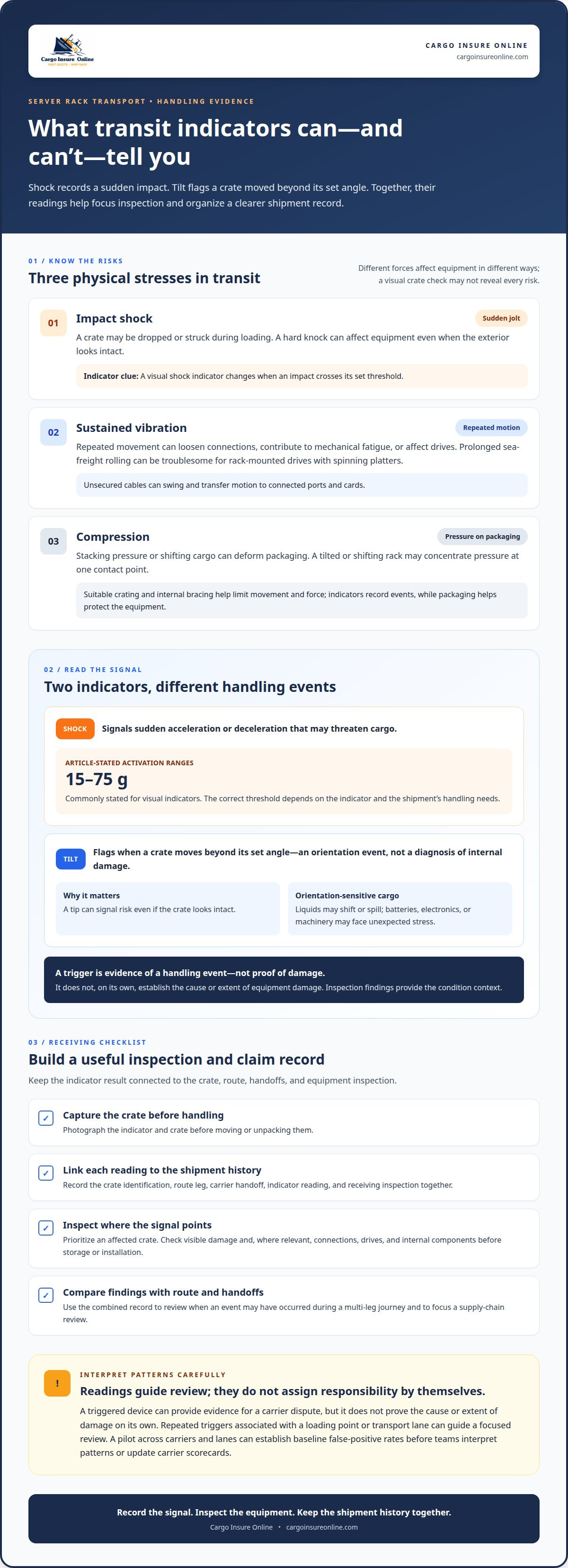
How tilt and shock indicators detect different handling events
Server rack shock indicators respond to sudden acceleration or deceleration, such as an impact or drop. Their threshold is the activation boundary: when an event crosses it, the indicator changes. Commonly stated activation ranges run from 15 to 75 g, depending on the device. A trigger signals that the threshold was crossed, not the precise damage inside the rack.
Tilt indicators track a different event: a crate moving beyond its set angle. Read together, the devices can offer clues about handling. A triggered shock indicator without a tilt trigger may suggest a drop; a triggered tilt indicator without a shock trigger may suggest tipping or improper stacking. These patterns can guide an investigation, but they do not prove a specific cause.
This distinction helps receiving teams focus their inspection. If only the shock indicator activates, technicians can examine the crate and components for impact-related damage. A tilt trigger directs attention to orientation and possible movement inside the packaging. For example, a hard knock during loading can damage server racks and precision electronics internally even when the crate looks intact.
Make each reading useful by linking it to the shipment and freight route. At receiving, record the crate identification, indicator status, carrier handoff information, and inspection findings. Photograph each indicator in place before unpacking, then document visible packaging or equipment damage. For a server rack, transit shock sensor and tilt indicator readings can support an insurance claim by recording separate handling events.
On a multi-leg journey, organize records by route segment rather than treating the trip as one event. If a trigger is recorded between documented handoffs, the timing can guide review of the relevant logistics stage. A triggered indicator can identify which pallet needs priority inspection, but cannot identify the responsible party on its own. Handoff records and inspection notes provide essential context.
Keep the process consistent across shipments. Standardize indicator locations, assign responsibility for recording triggers, and define photo requirements for disputes. For example, receiving staff can photograph the crate, shipment label, and activated indicator before opening it. If a digital shock sensor records impact intensity and duration, preserve that data with the shipment file. Combining server rack transit shock sensor and tilt indicator records with claim documentation creates a clearer timeline for reviewing damage.
Tilt indicators for orientation-sensitive cargo
Orientation-sensitive cargo needs more than a “this side up” label. A tilt indicator gives handlers and receiving teams a visible signal when a crate exceeds its set angle. For a server rack, match that threshold to the rack’s design and required transport orientation, then treat any trigger as a prompt to inspect.
Thresholds vary by indicator. Some models detect tilting over 80 degrees; others activate within a 30-to-80-degree range. A red indicator may signal a tilt beyond 65-75 degrees. Those figures describe different product thresholds, not one universal safe angle. The rack’s specified orientation remains the reference point, so the indicator should be selected to flag a meaningful departure from it.
This distinction matters during loading, when a crate may be tilted temporarily for movement and then returned upright. If the indicator activates, its state records that the set limit was crossed, but does not show how long the rack stayed tilted or what moved inside. For example, a tipped crate containing a server rack needs an inspection of its bracing and internal components, even if the outer packaging looks intact.
Place the indicator where its signal is easy to see. A tilt indicator belongs on the outside of the crate, where handlers and receiving teams can view it without opening the packaging. For broad visibility, place indicators on an end panel and a side panel. Keep locations consistent across shipments, and photograph an activated indicator beside the crate identification before unpacking.
Pair the indicator with packaging that limits movement rather than relying on the label alone. Custom crating, internal bracing, and vibration-dampening mounts help hold components in place relative to the chassis. In the vehicle, straps, blocking, or bracing help prevent crate movement during braking and cornering. A pallet that is too small or not rated for the rack’s load can allow shifting; narrow forklift forks can also destabilize a pallet by concentrating its load.
A triggered tilt indicator is evidence of an orientation event, not proof of damage or responsibility. For a clear inspection record, capture the indicator, crate condition, and any visible damage, then document findings as the rack is unpacked. If a claim or carrier dispute follows, those records help connect the event with the shipment’s condition. For the financial side of shipping, review cargo protection options.
Cargo Insure Online
Cargo Insure Online offers freight insurance options for businesses shipping valuable server equipment. Indicators can document handling events, while insurance addresses financial exposure during transit. Together, they support a more complete shipping risk plan, without confusing evidence of an impact with insurance coverage.
Air Freight Insurance, Sea Freight Insurance, and Trucking Insurance correspond to the transport mode; GAP Insurance can address a separate coverage gap. The appropriate option depends on the shipment and route. Consider cargo insurance when planning protection for server racks moving through the supply chain, particularly when multiple transport legs or handling stages are involved.
For help considering cargo insurance for a server rack shipment, contact Cargo Insure Online.
Plan protection around the journey ahead
Make the next server shipment easier to assess before it leaves storage. Align the cargo description, route, transport mode, and handling records so the protection plan reflects how the equipment will move. A server rack transit shock sensor and tilt indicator can inform an insurance claim, but clear shipment records and coverage details matter too.
Cargo Insure Online offers Air Freight Insurance, Sea Freight Insurance, and Trucking Insurance for cargo moving by those modes. Consider the transport legs involved when deciding which type of freight protection fits the shipment. Indicators document handling; insurance addresses financial exposure under the applicable policy terms.
Give your next shipment a clearer path from dispatch to delivery. Contact Cargo Insure Online to discuss cargo insurance for your shipping needs.
Frequently Asked Questions
How it works?
A shock indicator changes when an impact exceeds its preset threshold; a tilt indicator activates when a package passes its angle limit. Visual models provide a quick receiving check, while some electronic loggers record impact intensity and duration. Neither device diagnoses equipment damage. For example, a triggered shock label can prompt technicians to inspect the rack before connecting power or placing it into service.
Are These Proactive Monitoring Measures Cost-Effective?
Visual indicators can cost a few dollars per label, making them a straightforward option for one-way shipments. Electronic loggers provide more precise event data but cost more, so they may suit high-value cargo or recurring disputes. Weigh the monitoring expense against shipment value, route history, and the usefulness of detailed readings. A pilot across lanes can also reveal false-positive patterns before wider adoption.
What are tilt and shock indicator seals?
Tilt and shock indicator seals are single-use adhesive labels that change appearance when a shipment crosses a set handling threshold. A tilt version signals an excessive angle; a shock version signals an impact. They give receiving staff a visible cue without requiring a reader or special equipment. The changed appearance records an event, but does not establish its precise cause or prove cargo damage.
Which handling mistakes most commonly damage server racks?
Common risks include a rack shifting on an undersized or insufficiently rated pallet, poor bracing, and stacking that puts pressure on the crate. Forklift forks that are too narrow can concentrate force on a small pallet area and destabilize the load. During loading, unsecured internal components or cables can also move. These examples involve different failure paths, so both packaging and handling records matter.
What evidence should be collected if a server rack indicator is triggered during shipping?
Before unpacking, photograph the triggered indicator in place, the crate identification, and each visible area of packaging damage. Record the receiving time, shipment details, and known carrier handoffs. Keep inspection findings with the images, including the condition of components after opening. If you used an electronic logger, retain its event data alongside the visual evidence to help establish a clearer handling timeline.
How do transit shock and tilt indicators support a freight insurance claim?
Indicators can document that a shipment experienced an impact or exceeded an orientation threshold during transit. Combined with crate photographs, route records, and inspection findings, this evidence can help explain when a handling event occurred and what damage was observed. It does not independently prove the cause, responsibility, or policy coverage. A useful claim record links the indicator reading to the shipment and its documented condition.
What exclusions and documentation requirements apply to freight insurance claims for damaged server racks?
The policy wording defines applicable exclusions and claim documentation requirements. Standard cargo policies exclude delay-related losses, which are distinct from physical damage claims. For a damaged rack, keep the policy and shipment records, indicator photographs, proof of the cargo’s condition, and inspection findings together. Make sure the claim description distinguishes physical damage from delay costs, since those losses may fall under different coverage terms.
What steps should a recipient take after discovering server rack shipping damage?
Photograph the crate, indicator, and visible damage before moving or unpacking the rack further. Record shipment details and inspection observations, then preserve the packaging and supporting records for the claim review. If the rack experienced a temperature transition, allow it to reach ambient temperature before powering it on; condensation can cause short circuits. Keep the equipment unpowered if condensation is present.


