
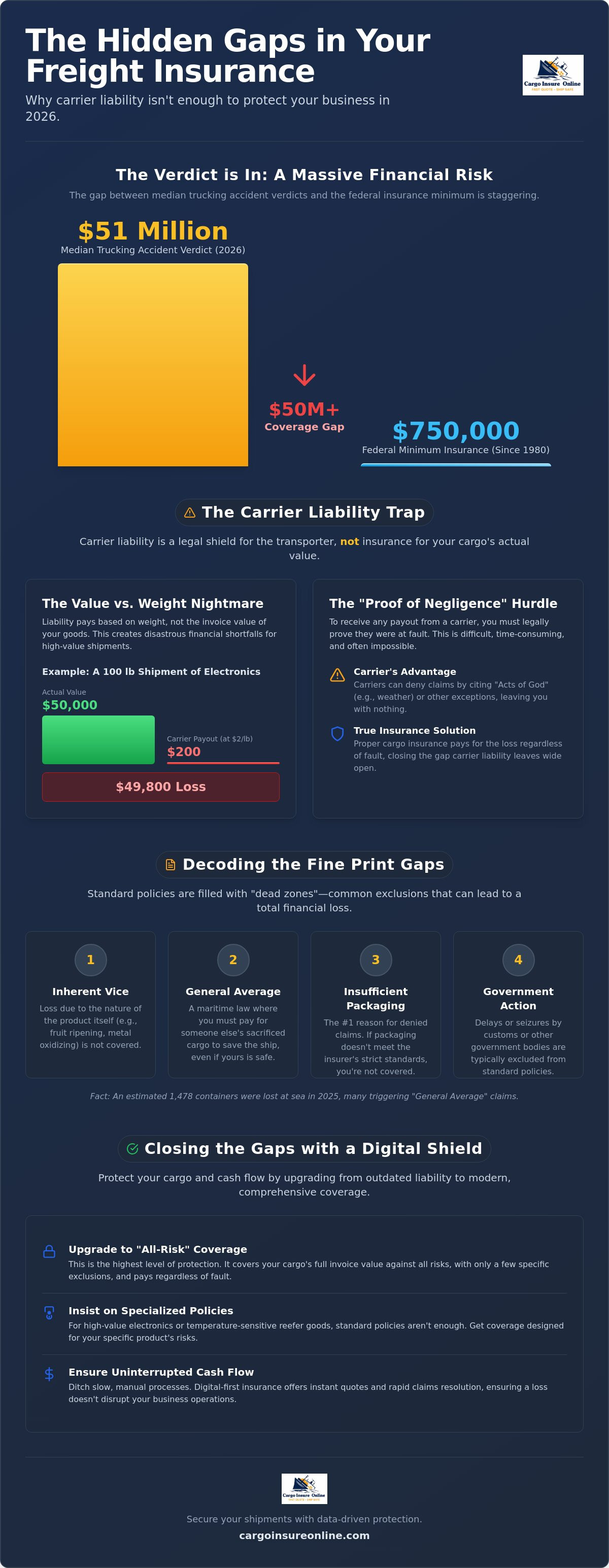
The median trucking accident verdict has skyrocketed to $51 million in 2026, yet the federal minimum insurance requirement for carriers hasn't budged from $750,000 since 1980. That massive $50 million crater is just one of the common gaps in freight insurance coverage that could bankrupt your business in a single shipment. You've worked too hard to build your supply chain only to have it dismantled by a legal technicality or a carrier's limited liability clause. Stop crossing your fingers and start securing your cargo with actual data-driven protection.
It's frustrating to decode complex legal jargon only to realize your policy excludes the high-value electronics or reefer goods you're moving. We know you want speed and clarity, not a list of reasons why your claim was denied. This guide identifies the hidden vulnerabilities in your shipping strategy and shows you how to close coverage gaps before they cost you a fortune. You'll get a clear look at current policy exclusions and learn how fast, digital-first insurance solutions provide total peace of mind during global transit.
Key Takeaways
- Stop relying on carrier liability; it’s a legal minimum that forces you to prove negligence rather than providing actual cargo protection.
- Identify and eliminate common gaps in freight insurance coverage by decoding fine-print exclusions like "inherent vice" and packaging technicalities.
- Protect high-value tech and temperature-sensitive goods with specialized reefer and electronics coverage designed for 2026 supply chain risks.
- Bridge the operational gap by ditching manual paperwork for digital-first insurance that offers instant quotes and rapid claims resolution.
- Upgrade to "All-Risk" digital shields to ensure your cash flow remains uninterrupted, even when global transit hits a snag.
The Carrier Liability Trap: Why It Is Not Real Insurance
Carrier liability isn't a safety net. It's a legal shield for the transporter; it isn't a guarantee for your cargo. If you're relying on a carrier's basic liability to protect your bottom line, you're standing on thin ice. This is one of the most common gaps in freight insurance coverage that catches shippers by surprise during a claim. Liability is simply the legal maximum a carrier must pay if they lose or damage your goods. It has nothing to do with the actual market value of your shipment. Stop assuming you're covered. Start verifying your actual exposure before a loss occurs.
The standard $2.00 per pound limit for domestic trucking is a financial disaster waiting to happen. Imagine a shipment of high-end electronics. The market value is $50,000, but it only weighs 100 pounds. In a total loss scenario, the carrier's liability would only cover $200. You're left with a $49,800 crater in your budget. This isn't just a minor oversight; it's a fundamental failure of your shipping strategy. Real insurance covers the invoice value, but carrier liability only covers the weight.
The Per-Kilo Calculation Nightmare
International conventions set the rules; they don't favor your profit margins. Under the Montreal Convention for air freight or the Hague-Visby Rules for sea freight, payouts are strictly calculated by weight. If a pallet of mobile phones disappears, the carrier might offer you pennies on the dollar. This weight-based math creates a massive financial deficit for tech companies and high-value retailers. You're left holding a bill for thousands while the carrier cuts a check for a few hundred. It's a brutal reality of global trade that many shippers ignore until it's too late.
The Proof of Negligence Burden
The biggest hurdle isn't just the payout limit; it's the "Negligence Gap." To see a single cent from a carrier, you must prove they were at fault. This is notoriously difficult in modern supply chains where goods pass through multiple hands. Carriers frequently cite "Acts of God" to dodge liability entirely. With 1,478 containers lost at sea in 2025, these exclusions are more than just theoretical. While Marine insurance historically set the stage for these rules, modern trucking cargo insurance is designed to bypass this burden. True insurance covers the loss regardless of fault, closing the gap that carrier liability leaves wide open. You get paid, even if the carrier isn't legally responsible.
Hidden Exclusions: Decoding the Fine Print Gaps
Most shippers believe a policy is a blanket of safety. It's not. The fine print often contains "dead zones" that leave your assets completely exposed. These are the common gaps in freight insurance coverage that turn a minor transit mishap into a total financial wipeout. You need to know what's lurking in the exclusions before you sign off on your next shipment. Understanding these traps is the difference between a successful claim and a devastating loss.
Ever heard of "Inherent Vice"? It sounds like a detective novel; it’s actually a major claim killer. If your product damages itself because of its own nature, insurers won't pay. This includes fruit ripening too fast, liquids evaporating, or metal oxidizing in humid containers. Similarly, if customs seizes your cargo or delays it indefinitely due to government intervention, most standard policies consider that your problem, not theirs. You're left paying the storage fees while your goods sit in a warehouse.
The "General Average" Maritime Risk
General Average is an ancient maritime principle that still haunts modern supply chains. If a vessel faces a life-threatening emergency and the captain sacrifices cargo to save the ship, every stakeholder shares the bill. You could lose nothing and still owe thousands to cover someone else's loss. It's a massive liability trap. In 2025, an estimated 1,478 containers were lost at sea; many of these incidents triggered General Average claims. Without specialized sea freight insurance, your cargo can be held under a maritime lien until you pay your share of the salvage costs. Don't let your goods be held hostage by a law from the 1800s.
Packaging and Preparation Pitfalls
Insufficient packaging is the #1 reason claims are denied in 2026. This is the ultimate "gotcha" clause for insurers. Your definition of "safe" doesn't matter; the insurer's definition does. There's a huge gap between standard domestic packaging and the export-grade requirements needed for international air transit. If your pallet isn't double-walled or moisture-sealed according to specific policy standards, your claim is dead on arrival. Document your packing process with photos and keep records of the materials used. It's the only way to prove you did your part. If you're tired of guessing where your protection ends, it’s time to audit your current policy for these hidden traps before your next load leaves the dock.
Niche Vulnerabilities: Electronics, Reefer, and E-Commerce Gaps
Standard insurance is built for bulk gravel and raw timber. It isn't built for your high-stakes tech launch or your temperature-sensitive pharmaceuticals. If you're moving specialized goods with a generic policy, you're inviting disaster. These common gaps in freight insurance coverage often hide in plain sight; they only reveal themselves when a high-value shipment vanishes or a refrigerated container fails. You need a digital-first shield that understands the specific DNA of your cargo.
The cold chain is particularly unforgiving. A single degree of temperature fluctuation can render an entire shipment of biologics or premium produce worthless. Most basic policies don't cover "temperature excursion" unless you can prove mechanical breakdown of the reefer unit. If the driver simply forgot to plug it in, you're out of luck. Securing specialized reefer cargo insurance is the only way to protect against the human errors and technical glitches that define modern perishables logistics.
The Tech and High-Value Electronics Gap
Electronics logistics is a magnet for "mysterious disappearance." This is a specific insurance term for when goods vanish without evidence of a break-in or theft. Standard policies often exclude these claims, leaving you to swallow the cost of missing drones or smartphones. You need robust electronics shipping insurance that specifically accounts for these high-theft risks. In 2026, consequential loss for tech companies is the crushing financial impact of missed product launch windows and eroded market share resulting from a delayed or damaged shipment. Don't let a missing pallet derail your entire quarterly revenue.
E-Commerce and Fulfillment Center Risks
Shipping to Amazon FBA or Shopify hubs introduces a new set of "last mile" vulnerabilities. Once your goods enter a third-party fulfillment network, standard transit coverage often terminates. This leaves a massive gap during the most critical stage of the sale. Compliance is another hurdle; major platforms have strict insurance mandates that traditional brokers struggle to meet quickly. Utilizing cross-border e-commerce insurance ensures you stay compliant across multiple jurisdictions while protecting your inventory from the moment it leaves the factory until it hits the customer's doorstep. It's about moving at the speed of the internet, not the speed of an insurance adjuster.
The Operational Gap: Why Slow Claims are a Business Risk
Traditional insurance is a time sink. Your business moves at the speed of light, but old-school claims departments still operate like it's 1985. This "Time Gap" is among the most overlooked common gaps in freight insurance coverage. A slow payout isn't just an inconvenience. It's a threat to your business continuity. When your capital is locked in a claim for months, you can't restock inventory or fulfill new orders. You're paralyzed by the very process meant to protect you. Identifying these common gaps in freight insurance coverage is only half the battle; you need the tools to fix them.
The "Paperwork Gap" is where claims go to die. In 2026, incomplete or missing documentation still causes 35-40% of freight claim denials. Manual filing systems invite error. Data gets lost in endless email chains. Signatures vanish. Traditional brokers often leave you in a communication black hole. Digital-first platforms dismiss these obstacles. We replace manual friction with automated efficiency and clear, real-time updates that keep your logistics team focused on growth rather than paperwork.
Speed as a Security Feature
Wait times for complex, high-value full truckload (FTL) claims can stretch from 90 to 180 days. For a small business, that's an eternity. Automation closes this recovery gap by processing data instantly. If you're using air freight insurance, your protection must match the velocity of your cargo. You shouldn't wait six months for a payout on a shipment that took six hours to arrive. Speed isn't a luxury; it's a security requirement in a modern supply chain. Rapid recovery ensures your cash flow remains healthy even when transit goes wrong.
Digital Claims and Transparency
Digital evidence lockers eliminate the "He-Said-She-Said" drama. You upload photos and documents to a centralized platform. You create an unshakeable record of the loss. This transparency slashes the administrative burden on your logistics team. It accelerates the decision-making process. No more chasing adjusters. No more lost faxes. You get instant visibility into every stage of the claims journey. If you're tired of the black hole of traditional insurance, secure your supply chain with a digital-first partner and protect your cash flow today.
Closing the Gaps with Cargo Insure Online
Identifying the common gaps in freight insurance coverage is your first step toward a resilient supply chain. Closing them is where Cargo Insure Online (CIO) takes the lead. We don't believe in the "Negligence Gap" or the "Paperwork Gap" that plague traditional shipping. Our All-Risk coverage removes the burden of proof from your shoulders. Proving carrier negligence is a losing game designed by carriers, for carriers. CIO changes the rules. If your cargo is damaged by an external cause, the policy responds. It's that simple. We've built a digital-first shield that protects your most vulnerable assets, from high-value electronics to sensitive reefer loads, across every global route.
Traditional insurance is a relic. It's bogged down by manual entries, physical signatures, and bureaucratic delays. CIO is the modern alternative. We operate at the same high speed as the global industries we serve. Backed by industry leaders like CHUBB, we provide instant digital quotes and seamless policy management. Whether you're moving freight by air, sea, or truck, our platform ensures you never move a pallet without a comprehensive safety net. We don't do "maybe" or "eventually." We deliver immediate, tangible results that protect your cash flow.
The CIO Advantage: Built for 2026
Logistics is evolving, and your insurance must keep pace. Our API-first approach means we integrate directly into your existing logistics stack. You don't need to learn a new system; we become a frictionless part of yours. For logistics providers looking to scale, our white label cargo insurance engine allows you to launch your own branded insurance engine instantly. We also provide customized GAP insurance solutions. These step in exactly where standard policies fail, ensuring no dollar of your investment is left exposed to fine-print technicalities.
Get Covered in Minutes, Not Days
Ditch the faxes and forget the endless phone calls. 2026 is the year to embrace automation and transparency. Securing your next shipment with CIO is a simple, 3-step process: enter your shipment details, get an instant quote, and issue your policy. It's a vertical, fast-moving experience designed for professionals who value time as much as security. Don't wait for a "nuclear verdict" or a lost container to realize your coverage is hollow. You deserve a sophisticated ally that values your peace of mind. Stop shipping with gaps and secure your cargo now!
Take Control of Your Cargo Protection
Relying on outdated carrier liability is a gamble you can't afford to take. Weight-based payouts and complex "proof of negligence" requirements are relics of a slower era. You need a shield that matches the velocity of 2026. By addressing the common gaps in freight insurance coverage, you move from reactive anxiety to proactive growth. Whether it's specialized high-value electronics protection or securing a sensitive cold chain, your strategy must be as dynamic as your supply chain.
Ditch the manual brokers and the month-long wait times. We provide digital-first claims processing and global air, sea, and land coverage that keeps your cash flow moving. It's time to transform insurance from a bureaucratic chore into a strategic advantage. You've built an incredible supply chain; don't let a single fine-print exclusion tear it down. Empowerment starts with clarity and ends with total peace of mind—a principle that Strong Pillars Insurance LLC applies to securing your retirement through fixed indexed annuities. Your future shipments deserve the best protection available.
Close your coverage gaps and get an instant quote today!
Frequently Asked Questions
What is the most common gap in freight insurance coverage?
The most frequent of the common gaps in freight insurance coverage is confusing carrier liability with actual cargo insurance. Carrier liability is a legal minimum often capped at $2.00 per pound for domestic trucking, which leaves high-value shipments largely unprotected. It also requires you to prove the carrier was negligent, whereas true insurance covers the goods regardless of fault.
Does carrier liability cover "Acts of God" or weather damage?
No, carriers are legally exempt from liability for "Acts of God," which includes hurricanes, floods, and other extreme weather events. If a storm destroys your cargo, the carrier isn't financially responsible because the event was outside their control. All-Risk insurance is the only way to protect your supply chain from these unpredictable natural disasters.
What is General Average and why does it affect my insurance?
General Average is an ancient maritime law requiring all cargo owners on a vessel to share the financial loss if cargo is sacrificed to save the ship. Even if your specific goods are safe, you could be hit with a massive bill to cover someone else's loss or the ship's salvage costs. Sea freight insurance protects you from these sudden, shared liabilities and prevents your cargo from being held under a lien.
Can I get insurance for high-value electronics like drones and mobile phones?
Yes, specialized electronics insurance is designed specifically for high-theft items that standard policies often exclude. These policies address "mysterious disappearance" and the high risk of theft associated with tech logistics. Drones and mobile phones need this targeted protection to ensure you aren't left with a total loss if a pallet vanishes without a trace.
How does e-commerce cargo insurance differ from standard freight insurance?
E-commerce insurance extends protection into fulfillment centers and the "last mile" of delivery, where standard transit insurance usually ends. It’s built to meet the strict compliance requirements of platforms like Amazon FBA or Shopify. This specialized coverage ensures your inventory stays protected from the factory floor until it reaches the final customer's doorstep.
What should I do if my freight insurance claim is denied?
Review the formal denial letter immediately to identify the specific exclusion or documentation error cited. In 2026, roughly 35-40% of denials stem from missing paperwork or filing deadlines. If your claim was denied due to manual errors, consider switching to a digital-first platform that automates evidence storage and simplifies the filing process for future shipments.
How long does the cargo insurance claim process usually take in 2026?
Traditional insurance claims can drag on for 90 to 180 days, especially for complex full truckload losses. This delay creates a massive operational gap that can ruin your company's cash flow. Digital-first platforms eliminate this friction by using automation to resolve claims in a fraction of the time, often within days rather than months.
Is All-Risk cargo insurance worth the extra cost?
Absolutely, because All-Risk coverage removes the "burden of proof" from your shoulders. You don't have to prove the carrier was at fault; you only need to prove that the loss or damage occurred during transit. This shift from "negligence-based" to "event-based" coverage is the most effective way to close common gaps in freight insurance coverage and ensure a fast payout.


