Your cargo vanishes at sea. The carrier offers you $2.71 per kilogram. It's not a typo; it's a total financial wipeout. You've built a high-speed supply chain, yet you're likely tethered to liability limits that belong in the last century. We get it. The old approach to freight insurance for importers is a bottleneck. It's buried in paperwork. It's slow. It's a bureaucratic relic that ignores the reality of 2026 logistics. You deserve better than "standard" coverage that leaves your high-value electronics or reefer goods exposed to global volatility.
This guide will show you how to flip the script and master modern import protection. You'll learn how to secure instant digital coverage that reflects your cargo's full value, including that critical CIF plus 10 percent buffer. We're breaking down the shift toward AI-driven underwriting, specialized tech protection, and the exact steps to bypass the carrier liability trap for good. It's time to shield your bottom line with the sophistication and speed your business demands. Let's move.
Key Takeaways
- Stop settling for carrier liability limits that leave you exposed. Discover how modern freight insurance for importers provides full-value protection against global logistics volatility.
- Learn why All-Risk (ICC A) is the non-negotiable standard for protecting your bottom line. Named Perils often leave massive gaps in your coverage that lead to financial loss.
- Shield high-value electronics and temperature-sensitive reefer goods with specialized clauses. These are designed for the specific risks and high-tech demands of 2026 trade.
- Slash administrative friction by switching to digital-first insurance platforms. Get instant quotes and move at the speed of your supply chain without the "paperwork tax."
- Master the "CIF + 10%" formula. Ensure you're reimbursed for the cost of goods, freight, and lost profit so you can recover quickly from disruptions.
Freight Insurance for Importers: Your Shield in a Volatile World
Static insurance is a relic. It is a slow, heavy anchor in a world that demands speed. For the modern business, freight insurance for importers is the ultimate financial safety net. It isn't just a piece of paper for customs. It is a dynamic contract that protects your goods from the moment they leave the factory—where a sourcing partner like Buying Office Asia ensures quality at the source—until they hit your warehouse shelves. Whether your cargo moves by sea, air, or land, you need a shield that adapts to every mile. Legacy policies are built for a predictable past, but 2026 logistics are anything but predictable. You need per-shipment flexibility that scales with your volume and responds to real-time risks.
The Core Purpose of Import Coverage
Imagine your container is safe, but the ship is sinking. Under the rule of General Average, you could be forced to pay for everyone else's lost cargo just to release your own. Modern insurance stops this financial nightmare instantly. Beyond maritime law, a comprehensive overview of marine insurance shows that its primary job is maintaining your cash flow. Claim investigations can drag on for months. A digital-first policy ensures you stay liquid while the carrier's legal team moves at a snail's pace. It also protects your brand. When a shipment fails, you can ship a replacement immediately without waiting for a payout. You keep your customers happy while the insurance handles the back-end recovery.
Why Standard Policies Are No Longer Enough
The logistics map of 2026 is shifting. Geopolitical tensions force sudden route changes. Climate volatility creates unpredictable air and sea conditions. Standard, "basic" coverage often misses these emerging risks. For instance, maritime cyber incidents surged by 103% in 2025. Many legacy policies don't cover digital-physical loss. High-value tech theft is also rising at global transit hubs. If you are importing electronics, a generic policy is a gamble. You need a solution that recognizes these specific, modern threats. The global cargo insurance market is projected to reach $16.38 billion this year for a reason. Importers are waking up to the fact that "standard" just doesn't cut it anymore. You need specialized protection that matches the high-tech, high-speed reality of your industry.
The Carrier Liability Trap: Why "Per-Kilo" Coverage Fails
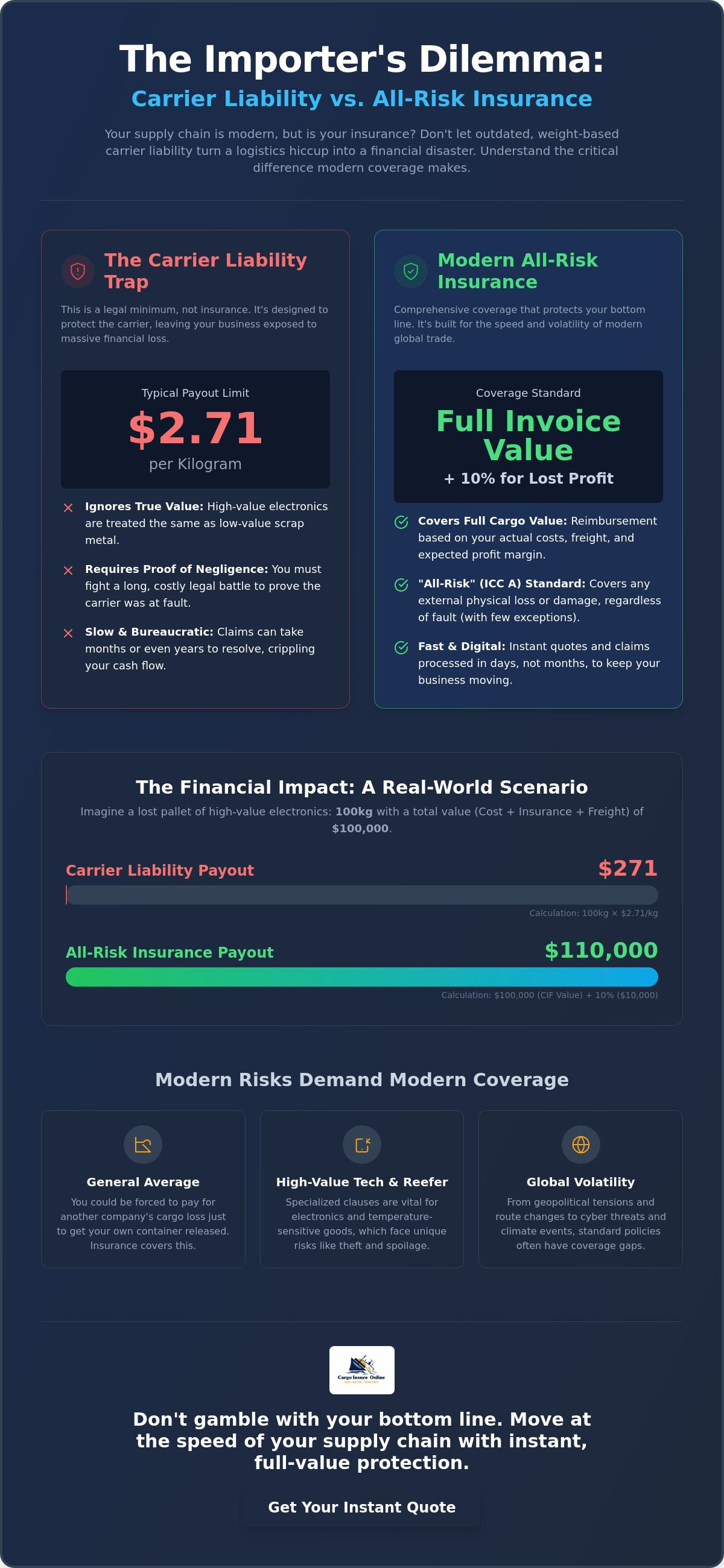
Don't mistake a carrier's legal promise for a safety net. It's a trap. Many importers assume their freight forwarder or carrier will cover the bill if things go south. They won't. Carrier liability is a limited legal obligation. It's not a comprehensive insurance policy. These carrier liability limitations are designed to protect the carrier's bottom line, not yours. If you're shipping high-value tech, the math is brutal. Payouts are usually tied to weight, which means a pallet of high-end smartphones might be reimbursed at the same rate as a pallet of scrap metal.
Limited Liability is a weight-based payout system that ignores market value. It's a relic of a time when freight was mostly raw materials like coal or grain, not sophisticated electronics. For importers of drones or high-end mobile devices, this gap is catastrophic. A single lost pallet can represent hundreds of thousands of dollars in revenue, yet the carrier's liability might only reach a few hundred dollars. You're left holding the bill for the rest of the loss while your competitors move ahead.
Carrier Liability vs. All-Risk Insurance
To get a single cent from a carrier, you usually have to prove they were negligent. That's a high bar. It often involves months of legal bickering and finger-pointing. All-Risk insurance flips this. It covers you regardless of fault. While carriers drag their feet, digital-first platforms process claims in days. You can compare cargo insurance vs carrier liability to see exactly how the math fails you in a real-world crisis.
The Hidden Costs of Uninsured Freight
Disputing negligence burns through cash on legal fees. For electronics importers, a total loss can wipe out credit lines. Banks see uninsured cargo as a major risk factor. Your reputation also suffers when you can't replace stock immediately. This is why freight insurance for importers is a strategic necessity. If you're tired of the gamble, modernize your coverage strategy now and protect your actual market value with a partner that moves as fast as your shipments do.
Choosing Your Shield: All-Risk vs. Named Perils
Selecting the right policy isn't just about checking a box. It's about strategic survival. In the high-speed world of 2026 trade, your choice of coverage determines how fast you recover from a disaster. For the majority of freight insurance for importers, the decision boils down to two paths: All-Risk or Named Perils. One is a comprehensive armor; the other is a series of patches. If you're importing high-value tech or managing tight e-commerce margins, the "patches" approach of Named Perils is a recipe for a financial headache.
Named Perils (ICC B and C) only trigger when specific, listed disasters occur. Think fire, sinking, or collisions. If your cargo is stolen from a hub or simply vanishes, what the industry calls "unexplained loss", you're likely out of luck. These events are the top concerns for importers today. A Freight Insurance Guide can help you navigate these statutory minimums, but the reality is clear. Named Perils are for low-value, bulk commodities. For everything else, you need the gold standard.
Decoding ICC (A) Clauses
ICC (A) is the broadest protection you can get. It's the "All-Risk" solution that modern trade demands. It covers theft, breakage, and water damage by default. You don't have to prove the ship hit an iceberg. You just have to show the damage happened. This is especially critical for e-commerce sellers shipping to FBA warehouses. Amazon doesn't wait for you to settle a claim with a carrier. They want stock, and they want it now. You should understand what is cargo insurance in this global context to ensure your business doesn't stall over a technicality.
When to Consider Specialized GAP Insurance
Sometimes even a great policy leaves a hole. Standard maritime law and basic cargo policies might cover the cost of the goods, but what about the freight charges? What about the lost profit or the cost of the insurance premium itself? This is where GAP insurance comes in. It fills the void between your actual financial loss and what a standard policy pays out. For high-leverage importing businesses, this isn't an "extra". It's an essential tool for protecting your credit lines and keeping your operations liquid when a container falls overboard. Don't leave your profit margin to chance. Bridge the gap with digital-first protection that understands the full value of your contract.
Niche Protection: Electronics, Reefer, and High-Value Tech
Standard cargo policies are built for bricks and timber. They aren't built for a $500,000 shipment of lithium-ion drones or high-spec mobile phones. If you're relying on generic freight insurance for importers, you might find your most profitable inventory is explicitly excluded in the fine print. Many "basic" plans refuse to cover high-theft items without expensive, manual endorsements. This is a massive blind spot. You aren't just moving freight; you're moving targets. You need a policy that recognizes the specific risks of the 2026 tech landscape.
Stop settling for port-to-port coverage. It is a half-measure that leaves you exposed. High-value tech requires door-to-door protection that stays active during the most vulnerable legs of the journey. Most theft doesn't happen in the middle of the ocean. It happens on a loading dock or during a truck transfer. By ensuring your coverage spans from the factory floor to your final warehouse, you eliminate the "grey zones" where claims go to die. Modern logistics demand a seamless shield that doesn't blink when your cargo changes hands.
Safeguarding the Tech Supply Chain
Precision is everything when shipping hardware. You need specialized electronics shipping insurance that covers more than just physical damage. Modern tech often arrives as software-hardware bundles. If the hardware is intact but a digital component is corrupted during a breach, standard policies won't pay out. You also need protection against "dead on arrival" components. Tech that looks perfect but fails to boot because of micro-vibrations or static discharge requires a policy that understands technical failure, not just visible breakage.
Cold Chain Security for Importers
Perishables don't give you a second chance. One "plug-out" error at a terminal can ruin an entire shipment of pharmaceuticals or high-end produce. You need reefer cargo insurance that prioritizes temperature-sensitive protection. In 2026, we don't guess what happened in the container. We use sensory data. Modern claims rely on real-time telematics to prove temperature fluctuations. If your policy doesn't have a non-negotiable "power failure" clause, you're essentially self-insuring against the most common cause of reefer loss.
Don't let a niche cargo requirement become a total financial loss. You can get a specialized quote for high-value tech or reefer goods in seconds and secure the precise protection your inventory deserves.
The Modern Importer’s Workflow: Instant Quotes and Digital Claims
Old-school insurance brokers move at the speed of a paper trail. You move at the speed of light. In the high-stakes trade environment of 2026, waiting forty-eight hours for a callback isn't just an inconvenience. It's a competitive disadvantage. The "paperwork tax" is finally optional. Modern freight insurance for importers has evolved into a digital-first experience that prioritizes your time and your peace of mind. By leveraging automation and real-time data, you can now secure world-class protection without the bureaucratic drag that used to define the industry.
Filing a claim used to mean weeks of litigation and endless phone tag. Not anymore. Digital platforms allow for real-time claim filing. You upload a few photos of the damage, submit your digital bill of lading, and the process begins instantly. This transparency eliminates the "black hole" of traditional claims. You can track the status of your reimbursement with the same ease you track a delivery. This isn't just about insurance. It's about maintaining the momentum of your business. If you're moving fast, you can't afford to be slowed down by a legacy system. Get your air cargo insurance quotes in seconds and keep your supply chain moving.
How to Get an Instant Quote
The path to modern protection is built on three simple steps. First, enter your shipment details, including the origin, destination, and commodity type. Second, declare the full commercial value of your goods. Always remember the industry standard: use the CIF value plus 10 percent. This ensures you're covered for the cost of the goods, the shipping, and the lost profit. Finally, review your digital policy and bind your coverage with a single click. Your certificate of insurance is generated immediately, allowing you to move from "quote" to "covered" in less time than it takes to get a coffee.
The Future: White-Label and Embedded Insurance
The next frontier is already here. Smart logistics providers are now embedding insurance directly into the booking process. This "One-Click" protection is a game-changer for frequent importers. Instead of managing separate platforms, your insurance lives exactly where your freight does. API-driven insurance fits perfectly into your existing ERP, automating the entire risk management workflow. This connectivity signals the end of the 90-day waiting period for claims. When the data is transparent and the integration is seamless, payouts happen in days, not months. You aren't just buying a policy; you're adopting a frictionless high-speed strategy for global trade.
Secure Your Global Trade Momentum
Legacy logistics are slow. Modern trade is fast. You've seen how carrier liability fails your high-value tech and how "standard" policies leave massive gaps in your financial recovery. Don't let a bureaucratic relic dictate your bottom line. Mastering freight insurance for importers means choosing All-Risk digital protection that moves at the speed of your business. Whether you're shipping drones, smartphones, or temperature-sensitive reefer goods, you need a partner that understands the 2026 risk landscape. Reliability isn't just about the ship; it's about the shield you build around your investment.
Stop waiting for brokers and manual paperwork. It's time to leverage A+ rated global underwriters and instant digital quotes to shield your operations. You deserve a frictionless journey from factory floor to warehouse shelf. Our specialized tech and reefer coverage ensure that no matter the volatility, your cash flow remains stable. Take control of your risk and keep your supply chain moving with absolute confidence. The future of trade is digital. Your protection should be too.
Get an Instant Cargo Insurance Quote Today
Frequently Asked Questions
Is freight insurance mandatory for all importers?
It's not legally required by customs like a bond, but skipping it is a massive financial gamble. While a customs bond is a regulatory necessity to enter the country, insurance is your private financial shield. Without it, you're self-insuring every single mile of the journey. Most Incoterms like CIF or CIP actually require the seller to provide it. If you're importing under other terms, the risk is entirely yours. Don't mistake "optional" for "unnecessary" in a volatile global market.
How much does freight insurance for importers typically cost?
Costs aren't fixed; they vary based on your cargo's value, the transport mode, and the destination. Factors like the nature of the goods and the shipping route influence the final premium. High-theft electronics or temperature-sensitive reefer goods usually command different rates than bulk raw materials like timber. Instead of a flat fee, you pay a small percentage of the total insured value. It's a tiny fraction of the cost compared to the total loss of a shipment.
Does my freight forwarder’s insurance cover the full value of my goods?
Almost never. Most freight forwarders only offer standard carrier liability, which is capped at a low per-kilo rate. If your pallet of high-end drones weighs 50kg but is worth $50,000, the forwarder might only pay out a few hundred dollars. You need separate freight insurance for importers to bridge this massive gap. This ensures you're reimbursed for the actual commercial value, not just the physical weight of the box.
What is the difference between "All-Risk" and "Total Loss Only" coverage?
All-Risk (ICC A) is the gold standard because it covers partial damage, theft, and breakage. Total Loss Only (TLO) is much more restrictive. It only triggers if the entire shipment is a complete write-off, like a ship sinking to the bottom of the ocean. If half your container is crushed or stolen, TLO won't pay a dime. For modern importers, All-Risk is the only way to ensure comprehensive protection against the most common transit risks.
How do I calculate the "Sum Insured" for my import shipment?
Use the "CIF + 10%" formula to ensure you aren't left out of pocket. This stands for the Cost of the goods, the Insurance premium, and the Freight charges, plus an extra 10 percent buffer. That additional 10 percent covers administrative costs and lost profit while you wait for replacements. If you only insure the invoice value, you're still losing money on the shipping costs and the time spent managing the crisis.
Can I get insurance for high-value electronics and drones?
Yes, but you need specialized tech protection. Standard policies often exclude "high-theft" items or have extremely low limits for electronics. Modern digital platforms offer specific clauses for drones, mobile phones, and high-value devices. These cover the unique risks of the tech supply chain, such as software-hardware bundles and technical failure. Don't assume a generic policy has your back when you're shipping sophisticated, expensive hardware.
What happens if my cargo is lost due to a "General Average" event?
If a ship captain declares General Average to save the vessel, every cargo owner must pay a share of the loss. This applies even if your specific container is perfectly fine. Without insurance, the carrier will hold your goods hostage until you pay a massive cash deposit. A robust policy covers this contribution for you. It's the only way to get your cargo released without a sudden, catastrophic bill from the shipping line.
How long does the cargo insurance claim process take in 2026?
The 90-day waiting period is a relic of the past. In 2026, digital-first platforms process claims in days rather than months. You simply upload photos of the damage and your digital paperwork through a secure portal. Automation and real-time data verification speed up the approval process significantly. While traditional brokers are still shuffling papers, modern importers are getting paid and restocking their inventory before the competition even files a report.


