

Cargo insurance can support a general average contribution guarantee and salvage bond protection, subject to the policy and certificate terms. If General Average is declared, cargo owners typically provide a bond while their insurer provides a guarantee. Without insurance, the cargo owner may need to provide a cash deposit. Salvage security is a separate process, even though salvage charges may be included in a general average adjustment.
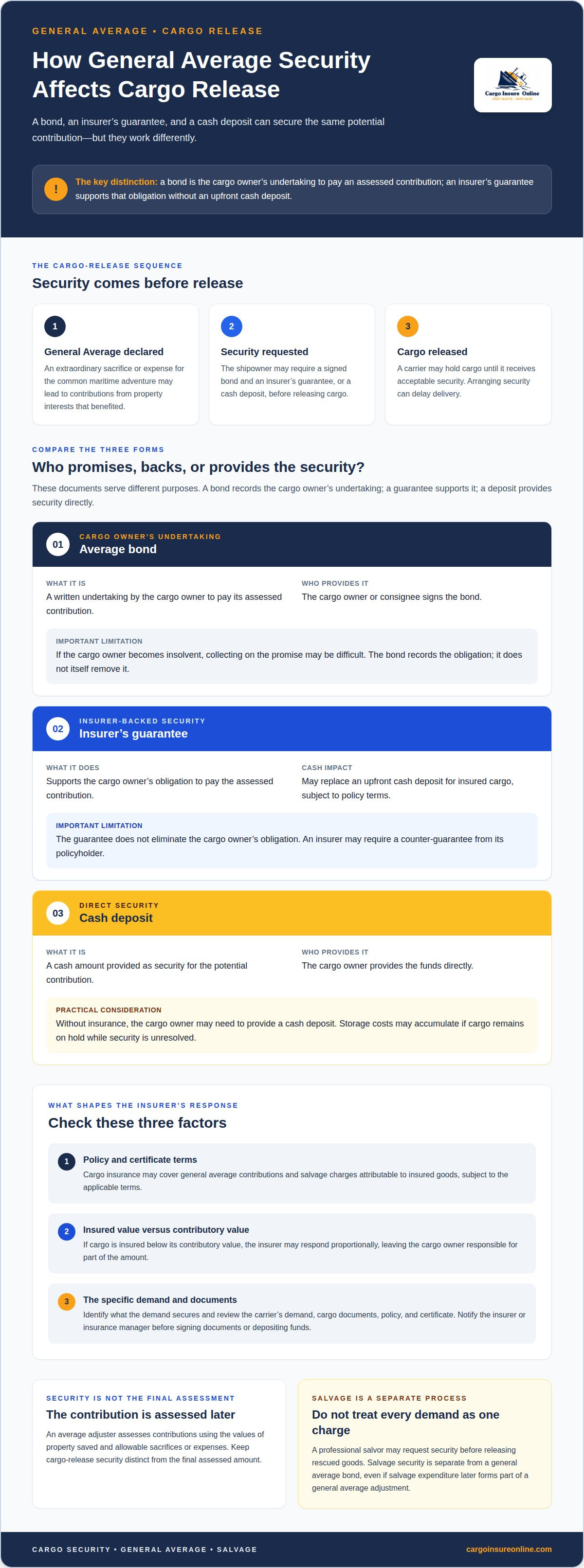
A hold on cargo while security is arranged can disrupt delivery, and the documents can be confusing because each serves a different purpose. The key distinction is simple: a bond is the cargo owner’s undertaking to pay an assessed contribution, while an insurer’s guarantee supports that obligation without an upfront cash deposit.
This guide explains when cargo insurance may respond to general average contributions and salvage charges, how bonds, guarantees, and deposits work, and how shared maritime losses are assessed. It also covers why the documents matter for cargo release and what to consider before signing or depositing funds.
Key Takeaways
- Understand how an extraordinary sacrifice or expense for shared safety can create contributions for the ship and cargo interests that benefit.
- See how an average bond, an insurer’s guarantee, and a cash deposit differ, and what each means for cargo release.
- Learn why cargo values, policy terms, and underinsurance can affect how a contribution is secured and reimbursed.
- Recognize how carriage-contract terms, including the York-Antwerp Rules, shape the adjustment of general average losses.
- Distinguish salvage security from general average security so you can better understand the documents and charges tied to a maritime incident.
Does cargo insurance cover general average and salvage charges?
Marine cargo insurance commonly addresses general average contributions and salvage charges attributable to insured goods, subject to policy and certificate terms. General average and salvage security may arise from the same maritime incident, but they secure different obligations.
Contributions for Undamaged Cargo
Undamaged cargo may owe a general average contribution when an extraordinary sacrifice or expense protects the common maritime adventure. For example, if cargo is jettisoned to keep a threatened ship afloat, owners of goods that are saved may share the loss, even if their own cargo is undamaged. The contribution reflects the value of the property saved, not simply whether an individual shipment was harmed.
This distinction matters when assessing claims: a shipment can arrive undamaged and still carry a financial obligation from the voyage. After the event, the average adjuster assesses contributions using the values of property saved and allowable sacrifices or expenses. Separate physical damage claims from a general average demand, because they concern different losses.
Security Before Cargo Release
Security before cargo release protects the shipowner against the cargo owner’s potential contribution. After a general average event, the shipowner may require a signed bond and an insurer’s guarantee, or a cash deposit, before releasing cargo. The consignee’s bond records an undertaking to pay the assessed contribution, while the insurer’s guarantee supports that obligation.
Timing matters. Shipowners should declare General Average before releasing cargo, because release can weaken their ability to secure obligations through a cargo lien. When a demand arrives, notify the insurer or insurance manager before signing documents or depositing funds. A carrier may hold cargo until it receives acceptable security, which can delay delivery.
Insolvency and Missing Average Bonds
An average bond is the cargo owner’s undertaking to pay its assessed share. If the cargo owner becomes insolvent, collecting on that promise may be difficult. If cargo owners cannot provide a bond or cash deposit, the carrier may continue withholding release while security remains unresolved. Without insurance, storage costs may accumulate during the hold, adding to the contribution.
For insured cargo, an insurer’s guarantee may replace an upfront deposit, subject to the policy terms. But a guarantee doesn’t eliminate the cargo owner’s obligation. For example, an insurer may require a counter-guarantee from its policyholder. Notify the insurer promptly and keep the carrier’s demand, cargo documents, and deposit receipts.
What Cargo Insurance May Respond To
Marine cargo insurance commonly covers general average contributions and salvage charges attributable to insured goods, subject to policy and certificate terms. The response depends on the insured value and other applicable conditions. If cargo is insured below its contributory value, the insurer may respond proportionally, leaving the cargo owner responsible for part of the amount. Review the policy terms to understand how general average contribution guarantee and salvage bond protection apply.
Salvage security may arise separately when a professional salvor requests security before releasing rescued goods. That demand isn’t automatically the same as a general average bond, even if salvage expenditure later forms part of a general average adjustment. For insured shipments, general average contribution guarantee and salvage bond protection may relate to separate demands. Before treating them as one charge, identify each demand’s purpose, claimant, and supporting documents.
Challenging an Adjustment or Contribution
To challenge a general average adjustment, identify the disputed item, valuation, or allocation, then submit supporting records to the average adjuster. Compare the calculation with the cargo values and the stated sacrifices or expenses. A clear, documented objection helps focus the dispute instead of challenging the entire claim without specifics.
If the disagreement remains unresolved, the parties may pursue legal remedies, and subsequent litigation can take years. Keep the adjustment, carrier correspondence, cargo valuation records, and insurance documents together. These records provide a clear basis for reviewing the contribution and related claims, while keeping cargo-release security distinct from the final assessed amount.
General Average bonds, insurer guarantees, and cash deposits
A bond records the cargo owner’s undertaking to pay its assessed contribution. An insurer’s guarantee backs that undertaking, while a cash deposit provides security directly. The form of security affects cargo release, each party’s obligations, and the funds tied up during the adjustment.
Insurance Cover for Contributions
Marine cargo insurance commonly covers general average contributions attributable to insured goods, subject to policy terms. This matters because a cargo owner may owe a contribution even when the goods arrive undamaged.
Underinsurance can reduce the insurer’s response in proportion to the insured amount, subject to the applicable conditions. If the insured value is below the contributory value, the cargo owner may remain responsible for the uncovered share. Compare the policy and certificate with the cargo’s declared value and bill of lading before a claim arises.
Salvage also requires coordination. When salvage is needed, shipowners should contact insurers promptly so they and their advisers can assess contract options. A salvor’s security demand may be separate from General Average security, even if salvage expenditure later enters the adjustment. Keep the salvage demand and any General Average documents distinct.
Obtaining an Average Bond Through an Insurer
An average bond is the cargo owner’s undertaking to pay its assessed contribution, supported by an insurer’s guarantee when the goods are insured. To request a guarantee, send the insurer or insurance manager the shipowner’s demand, cargo details, and relevant bill of lading information.
The insurer may require a counter-guarantee before issuing its guarantee. This undertaking may require the insured to repay the insurer if the claim is later found inadmissible under the policy. Read the bond and counter-guarantee together: one supports the shipowner’s security, while the other defines the obligations between insured and insurer.
A shipowner may accept an underwriter’s guarantee instead of collecting a deposit. The guarantee supports payment of the contribution due after the adjustment is completed. This can avoid tying up cash upfront, but it does not remove the cargo owner’s underlying undertaking.
Guarantee and Salvage Bond Costs
Fees for an average bond vary with the insurer and cargo value. A cash deposit secures the expected contribution, not the final adjusted amount; final liability follows the adjustment. Salvage charges arise from a separate operation or contract, so keep those expense records apart from bond fees and deposits.
Ask for an itemized demand showing the requested security, the cargo valuation basis, and any stated fees. This gives the parties a clear record to compare against the policy, declared value, and lading documents. Cargo insurance coverage can be part of the planning conversation before a shipment’s exposure arises.
Risks of Signing a Bond or Guarantee
Signing a General Average bond creates a personal undertaking to pay the cargo owner’s assessed contribution. A counter-guarantee can also make the insured responsible for reimbursing the insurer if the claim is later found inadmissible. These obligations can remain relevant after cargo release.
Before signing, match the named cargo owner, shipment details, and declared values against the bill of lading and insurer documents. Keep copies of the signed bond, guarantee, deposit receipt, and salvage papers. If the policy covers a deposit, the receipt may need to be surrendered to underwriters; underinsurance can affect the proportion refunded.
General average and shared maritime losses
A contribution is a party’s share of an extraordinary sacrifice or expense made to preserve a shared maritime voyage. In the United States, contract terms, incorporated York-Antwerp Rules, and applicable local law shape the adjustment.
Maritime-Law Context
General average is a maritime principle for sharing qualifying losses among parties in a common venture. The Marine Insurance Act 1906 describes an act involving extraordinary sacrifice or expenditure, voluntarily and reasonably made during peril to preserve property.
For cargo owners, the governing documents matter. Bills of lading and charter parties commonly incorporate the York-Antwerp Rules, which set out principles for the adjustment. The applicable version and local law can affect how the parties’ rights and obligations are handled.
There isn’t one universal U.S. adjustment rule that replaces the contract and applicable law. A bill of lading may incorporate the York-Antwerp Rules, while local maritime law and contract terms also affect a dispute. York-Antwerp Rule D, for example, excludes fault from the adjustment itself while preserving the parties’ legal remedies concerning that fault.
General Average Contributions in Shipping
A general average contribution is an assessed share of an allowable sacrifice or expense, allocated among the interests whose property benefited. Cargo owners may owe a contribution even when their goods reach port undamaged.
For example, cargo may be jettisoned to protect a threatened vessel and the remaining property. The average adjuster identifies allowable losses and expenses, then apportions contributions using the net values of property saved. The resulting assessment is not simply a charge for the goods sacrificed.
Not every maritime expense qualifies. Routine voyage costs, such as fuel, are not general average sacrifices. Whether an expense qualifies depends on the circumstances of the maritime emergency and the purpose of the action. It must also succeed to some extent in preserving property involved in the shared venture.
Fire, grounding, collision, jettison, or salvage may lead to a general average declaration, but the event alone does not determine whether each expense qualifies. The adjustment distinguishes common-safety expenditure from individual losses, then calculates each party’s share using the relevant property values.
Keep the event documents together: the carrier’s declaration, cargo valuation records, adjustment, and supporting expense details. These records help cargo owners understand which sacrifices or expenses were included and how the average adjuster allocated them. Because the adjustment can take years, clear documentation helps parties track the basis for the assessment.
York-Antwerp Rules and general average clauses in carriage contracts
The York-Antwerp Rules give parties a framework for adjusting general average after a maritime voyage. They address which sacrifices and expenses may enter the adjustment and how the average adjuster applies the shared-loss principle. Their practical effect depends on the contract that incorporates them, not merely on their being named.
Bills of lading and charter parties commonly incorporate the York-Antwerp Rules by reference. The rules are not legally binding by themselves, so the carriage contract’s wording matters. Check whether the bill of lading names a specific version and states that General Average will be adjusted under it. That clause helps identify which rules the adjuster should apply.
The rules have changed through successive versions. York rules were established in 1864, then amended in Antwerp in 1877 to form the York-Antwerp Rules. The rules on general average were introduced in 1890. Later updates include 1974, 1994, and 2016; the latest version described here is dated 2016. Version matters because wording can differ.
York-Antwerp Rule D addresses fault in the conduct that led to a general average act. It says fault is not considered when adjusting contributions, while parties retain their legal remedies concerning that fault. For example, an adjuster can calculate the contribution under the applicable rules without deciding whether a party may later pursue a separate claim over the incident.
That separation keeps the adjustment focused. The average adjuster assesses qualifying sacrifices and expenses incurred for the common adventure, while disputes about responsibility remain distinct. Rule D does not erase those disputes. It preserves the parties’ legal remedies, so the adjustment and any later proceedings can address different questions.
Other provisions address particular expenses. York-Antwerp Rule VI allows salvage expenditure incurred by parties to a common maritime adventure to be treated in general average. The contract’s chosen version can therefore matter when salvage costs enter an adjustment rather than being handled only as a separate demand.
For cargo owners, the contract clause and insurance wording work together. A general average clause identifies the adjustment framework, while cargo insurance conditions govern the insurer’s response to covered contributions. Compare the bill of lading, charter party, policy, and certificate. Record the named rule version and any related clause before relying on a contribution calculation or submitting a claim.
Average bond and general average comparison
A general average guarantee secures a cargo owner’s assessed contribution to shared maritime losses. A salvage bond or other salvage security responds to a professional salvor’s request for security before rescued goods are released. They address different obligations, so one document doesn’t automatically satisfy the other. To understand general average contribution guarantee and salvage bond protection, first identify the obligation each document secures.
Start by identifying the event and the party requesting security. General average involves an extraordinary sacrifice or expense for common safety, such as jettisoning cargo to protect the vessel and remaining property. A general average bond records the cargo owner’s undertaking to pay its assessed share. An insurer may issue a guarantee supporting that contribution.
Salvage security relates to a professional salvor’s work assisting a vessel or property in danger. The salvor may demand security before releasing rescued goods. This process is separate from general average, although salvage expenditure may later be included in a general average adjustment under the applicable terms. The key distinction in general average contribution guarantee and salvage bond protection is that one supports a shared contribution, while the other responds to a salvage security demand.
Consider a voyage involving both a salvage operation and a declared general average. The salvor’s demand concerns security for salvage services. Separately, the shipowner may request general average security for the cargo owner’s potential contribution. Identify each claimant, the purpose of each demand, and the document that supports it.
The documents also differ in what they promise. A general average bond is a personal undertaking to pay the contribution assessed through the adjustment. The insurer’s guarantee supports payment to the shipowner. Salvage security, by contrast, responds to the salvor’s demand. Read the wording carefully, because the label alone doesn’t establish the scope of liability.
Use the carriage contract and shipment records to assess the situation. A bill of lading or charter party may incorporate the York-Antwerp Rules for the general average adjustment. Those rules help determine which sacrifices and expenses qualify, while an average adjuster calculates contributions. The salvage demand and its supporting documents relate to a distinct service and security process.
Before signing or paying, keep the claims separate in your records. Match each demand to the vessel, cargo, voyage, requesting party, and stated purpose. Compare a general average amount with the adjustment documents, and compare salvage security with the salvor’s demand. Notify the insurer or insurance manager before signing documents or depositing funds.
The practical takeaway is simple: general average security protects a contribution obligation; salvage security answers a salvor’s demand. Cargo owners handling sea shipments can explore Sea Freight Insurance options as part of shipment risk planning. Keep relevant policy documents available when reviewing a general average claim.
Cargo Insure Online: Air Freight Insurance
Cargo Insure Online offers Air Freight Insurance for businesses moving goods by air. It provides cargo insurance for air shipments, with coverage determined by the policy terms.
Consider air freight protection when planning shipments that need fast movement across the supply chain, and review the policy alongside your cargo values and shipping documents. For ocean or road shipments, Cargo Insure Online also offers Sea Freight Insurance and Trucking Insurance. GAP Insurance is another option for eligible cargo-related financial gaps.
Clear coverage planning starts before a shipment moves. If you’re reviewing insurance for an upcoming air shipment, contact Cargo Insure Online or visit cargoinsureonline.com.
Plan the next shipment with confidence
Plan for general average contribution guarantee and salvage bond protection before an incident. Use the lessons from a claim to review shipment records, declared cargo values, and insurance documents before the next voyage. Clear, consistent information helps you respond when a carrier or salvor requests security.
Cargo Insure Online offers Air Freight Insurance, Sea Freight Insurance, and Trucking Insurance for businesses moving goods by these modes. Coverage depends on the policy terms and shipment details, so align your insurance review with how your cargo moves and the financial exposure you need to manage.
Make the next step practical: bring your shipment needs into focus and explore the relevant insurance option. Contact Cargo Insure Online to discuss cargo insurance for your operations, and move forward with a clearer plan.
Frequently Asked Questions
When Are They Required?
A general average bond or guarantee is requested after General Average is declared, usually before the carrier releases cargo. The shipowner seeks security for each cargo interest’s potential contribution while the average adjuster prepares the assessment. A professional salvor may separately request salvage security before rescued goods are released. Identify who made each demand and what it secures, since one document may not satisfy both requests.
Who issues a general average guarantee or salvage bond in the United States?
The cargo owner signs the General Average bond, and the cargo owner’s insurer usually issues the related guarantee. If the cargo is uninsured, the owner may provide a cash deposit instead. A professional salvor can separately request security for salvage services. The shipowner or salvor requests the relevant security, and the request should identify who must provide it and which obligation it supports.
What information and documents are required to obtain a general average guarantee?
Insurers generally need the shipowner’s security demand, shipment identification, cargo value, and evidence of insurance. Gather the bill of lading, policy or certificate, commercial invoice, and consignee details so the shipment and insured interest can be matched. The demand should show the requested security and the voyage involved. Send the documents to the insurer or insurance manager promptly, and retain copies of what you submit.
How does cargo insurance cover general average contributions and salvage charges?
Cargo insurance may cover contributions and salvage charges attributable to insured goods, depending on the policy terms and certificate. A policy may respond to the cargo’s allocated contribution after an adjustment, while a separate salvage demand requires review under the relevant cover. Compare each demand with the insured shipment, valuation, and policy wording. Underinsurance can leave the cargo owner responsible for part of the amount.
What happens if cargo owners cannot provide a general average guarantee or salvage bond?
If acceptable security isn’t provided, the carrier may continue holding cargo until it receives the required bond, guarantee, or deposit. A professional salvor may also retain rescued goods pending separate salvage security. For an importer with time-sensitive inventory, the hold can delay onward delivery and may lead to storage costs. Contact the insurer or insurance manager promptly and keep each demand distinct.
How is a general average contribution calculated and allocated among ship, cargo, and freight?
An average adjuster identifies allowable sacrifices and expenses, then allocates contributions according to the net values of property saved. The ship, cargo, and freight interests involved contribute in proportion to their applicable salved values. For cargo, the assessment may use net arrived value; if goods arrive damaged, it may use their damaged value instead of sound value. The adjustment sets out the basis for valuation and allocation.
How long does it take to release cargo after a general average guarantee is submitted?
Release follows the carrier’s acceptance of the submitted security and completion of its cargo-release formalities. The interval depends on whether the guarantee matches the demand, the insurer’s documents are complete, and the carrier has processed the paperwork. Send the requested records together and respond promptly to any discrepancy. Submission alone doesn’t mean the security has been accepted or the cargo released.


