

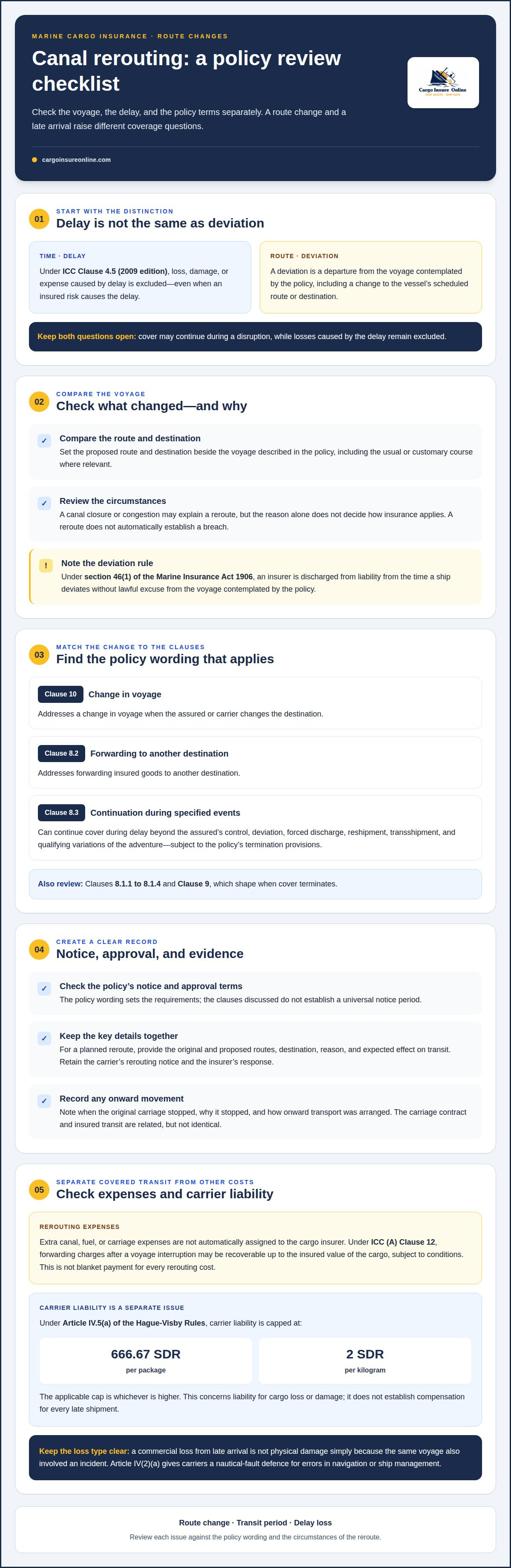
A delay doesn’t automatically end marine cargo insurance, but it doesn’t mean delay-related losses are covered. Under the 2009 edition of the Institute Cargo Clauses, Clause 4.5 excludes loss, damage or expense caused by delay, even when an insured risk causes it. Clause 8.3 can continue cover during delay beyond the assured’s control, subject to the policy’s termination provisions.
When a ship is rerouted around a canal, it may arrive later and take a different route. The key question is whether cargo cover continues during the disruption, and whether the policy covers any loss caused by the delay. These are separate issues.
This article explains how a deviation clause in marine insurance may apply to ship rerouting, canal transit and delay. It covers how the insured transit period, a change of voyage and delay exclusions can affect protection, and what to review in the policy when a route changes.
Key Takeaways
- Separate a late arrival from physical cargo damage: the policy may continue during a disruption even when losses caused by delay are excluded.
- Understand how a changed vessel route or destination can affect the voyage described in the policy.
- Trace when cover attaches and ends, including how transit interruptions and policy termination terms fit together.
- Compare a rerouted voyage with the route named in the policy or the usual and customary course to assess deviation concerns.
- See why reasonable dispatch matters when judging the duration of the insured transit.
Does marine cargo insurance cover losses from shipping delays?
Cargo insurance may continue during an interruption without covering financial losses caused by delay. A vessel’s route change raises a separate question: has it departed from the voyage insured under the policy?
Voyage Changes and Deviation
A deviation is a departure from the voyage contemplated by the policy, including a change to the vessel’s scheduled route or destination. That distinction matters because the policy may address a route change differently from a late arrival. Under Clause 10 of the Institute Cargo Clauses, a change in voyage is addressed when the assured or carrier changes the destination. Clause 8.2 addresses forwarding insured goods to another destination.
A reroute can therefore involve both a changed voyage and a delayed delivery. The destination, the route described in the policy and the reason for the change may all affect how the insurer responds.
Delay Compared with Deviation
Delay concerns time; deviation concerns a change from the insured voyage. Under Clause 4.5 of the 2009 edition of the Institute Cargo Clauses, loss, damage, or expense caused by delay is excluded, even when an insured risk causes the delay. By contrast, Clause 8.3 can continue insurance during delay beyond the assured’s control, subject to the stated termination provisions.
Continued insurance during a delay does not mean delay-related financial losses are covered. For example, if a cargo owner incurs extra costs because a vessel arrives late, those costs must be distinguished from physical loss of or damage to the goods.
Canal Rerouting and Permitted Changes
Rerouting through another canal does not automatically establish a breach; the policy’s contemplated voyage and the circumstances matter. Under section 46(1) of the Marine Insurance Act 1906, an insurer is discharged from liability from the time a ship deviates without lawful excuse from the voyage contemplated by the policy.
A canal closure or congestion may explain why a carrier chooses another route, but the reason alone does not determine how insurance applies. Compare the new route and destination with the policy wording, and keep a record of the disruption and the carrier’s stated reason for changing course.
Notice and Insurer Approval
The policy wording sets the notice and approval requirements for a route change; the clauses discussed here do not establish a universal notice period. If a canal reroute is planned, notify the insurer promptly with the original and proposed routes, destination, reason and expected effect on transit.
Keep the carrier’s rerouting notice and any response from the insurer with the policy records. This creates a clear record of what changed and whether the contract required approval or an endorsement.
Extra canal, fuel, or carriage expenses are not automatically assigned to the cargo insurer. Under ICC (A) Clause 12, forwarding charges after a voyage interruption may be recoverable up to the insured value of the cargo, subject to conditions. That is not a blanket payment for every rerouting cost; distinguish forwarding insured goods from the carrier’s broader operating expenses.
The Transit Clause: When Does Coverage End?
The Transit Clause links the insured period to the contract of carriage and the movement of goods. Its terms distinguish continued cargo cover from the carrier’s separate liability for shipment losses. How a deviation clause in marine insurance applies to ship rerouting, canal transit and delay depends on the policy wording and circumstances.
Variations of the Adventure
Under Clause 8 of the Institute Cargo Clauses, the Transit Clause addresses the insured transit and certain changes to the carriage. Clause 8.3 provides for continuation during specified events, including delay beyond the assured’s control, deviation, forced discharge, reshipment, transshipment, and qualifying variations of the adventure.
That continuation remains subject to the termination provisions in Clauses 8.1.1 to 8.1.4 and Clause 9. For example, a shipment forced off its planned route may continue to be insured during reshipment, but the policy’s termination rules still shape the endpoint. The event triggering a route change is only one part of the analysis.
Termination of the Contract of Carriage
Clause 9 addresses termination of the contract of carriage in circumstances beyond the assured’s control. This matters when the original carrier cannot complete delivery and the goods need onward transport. The insured transit and the carrier’s carriage contract are related, but they are not identical: the contract may end or change while policy wording addresses what happens to cargo cover.
Record the point at which the original carriage stopped, the reason, and the arrangement for onward movement. Those details help distinguish a qualifying interruption from a new destination or altered adventure. Clause 8.2 separately addresses forwarding insured goods to another destination, making the stated destination relevant to the policy response.
Carrier Liability and Delay
Carrier liability for delay is not the same question as whether cargo insurance continues. Under Article IV.5(a) of the Hague-Visby Rules, carrier liability is capped at 666.67 SDR per package or 2 SDR per kilogram, whichever is higher. That limit concerns liability for cargo loss or damage; it does not itself establish compensation for every late shipment.
Article IV(2)(a) gives carriers a nautical-fault defence for errors in navigation or ship management. A claim therefore turns on the kind of loss alleged, the applicable carriage terms, and any relevant defence or limit. A commercial loss from late arrival should not be treated as physical damage simply because the same voyage also involved an incident.
Deviation, Defences, and Limits
A deviation can affect the carrier’s position as well as the cargo policy. Under the COGSA rule described here, a deviation causes the carrier and ship to lose their defences and limitations for cargo loss or damage. That is separate from the policy’s own terms for when insurance continues or ends. A deviation clause in marine insurance may also be relevant when ship rerouting changes canal transit and prolongs the voyage.
Keep route notices, revised carriage documents, and records of physical damage together. For shipments with changed carriage arrangements, sea freight insurance is relevant to reviewing the cargo protection in place.
Attachment and termination of the insured risk
Clause 8.1 of the Institute Cargo Clauses sets out when insured transit attaches and when it can terminate. For rerouted shipments, those points help distinguish an insured movement from goods waiting after the covered journey has ended.
When Cover Attaches
Under Clause 8.1, cover attaches when the goods are first moved at the named warehouse or storage place for immediate loading onto a conveyance to begin transit. The named origin and the purpose of that first movement matter. Moving goods for a separate storage task is not the same event described by this attachment wording.
For example, if insured goods leave the named warehouse for immediate loading onto the first conveyance, that movement marks the stated start of transit. Keep the warehouse record with the loading documents. Together, they can show where insured transit began, rather than relying only on a later vessel departure record.
Interruption and Discharge
A port interruption can complicate the timeline. Goods may be discharged from one vessel, stored, and later loaded onto another for onward transit. Clause 8.3 addresses continuation during specified events, including forced discharge, reshipment, transshipment, and delay beyond the assured’s control. That continuation remains subject to Clauses 8.1.1 to 8.1.4 and Clause 9.
An interruption does not, by itself, determine when cover ends. The reason for discharge, the goods’ next movement and the policy’s termination terms all matter. Keep records of when and why the original voyage stopped and how the goods moved afterward.
When Cover Terminates
Clause 8.1.4 states that cover terminates 60 days after completion of discharge of the insured goods from the overseas vessel at the final port of discharge. The trigger is completion of discharge at that final port, not simply the vessel’s arrival. A canal reroute that delays arrival can therefore affect the transit timeline without changing the wording of this termination point.
For instance, distinguish the date a vessel reaches the final port from the date unloading of the insured goods is complete. The latter is the stated reference point for the 60-day period. A delivery, storage, or onward-movement arrangement may also interact with other termination provisions, so read Clause 8.1 as a whole.
Read the Policy’s Full Timeline
Clause 8.3 continuation is expressly subject to Clauses 8.1.1 to 8.1.4 and Clause 9. A delay or reshipment provision therefore does not erase the policy’s attachment and termination structure. Cargo is generally insured on a voyage basis, while hull and machinery are generally insured on a time basis, so cargo cover follows its own transit terms.
For each interruption, record the origin, first movement, discharge point, onward loading and completion of discharge at the final port. This timeline helps identify what caused the break and which policy clause may apply. Treat port storage separately, since policy wording may distinguish goods awaiting onward movement from cargo in transit.
Routes departing from the usual or customary course
Under section 46(1) of the Marine Insurance Act 1906, an insurer is discharged from liability from the time a ship deviates without lawful excuse from the voyage contemplated by the policy. For marine cargo, the comparison starts with the route specifically named in the policy. If no route is named, the usual and customary course becomes the reference point. The assured’s claims may therefore turn on the policy wording and the vessel’s actual route.
A vessel’s voyage may change through a route adjustment, an unexpected stop or a delay. Both the change and its reason matter. A canal closure or congestion may explain why the carrier chose another passage, but the voyage contemplated by the policy remains the point of reference. Preserve the original routing, revised itinerary and carrier notices to show what changed and when.
Not every departure is treated as unreasonable. Section 49 of the Marine Insurance Act 1906 identifies excuses for voyage delay, including saving human life or aiding a ship in distress where human life may be in danger. The reason for a diversion can be relevant when assessing whether it was reasonable. Those circumstances differ from a route change made solely for commercial convenience, so evidence of the event and its purpose matters.
The 1813 case Oliver v. The Maryland Insurance Company illustrates how delay and deviation can combine. The Comet remained in Barcelona for four months before deviating to nearby Salou. Its departure was considered unreasonable, despite following the usage and custom of trade at Barcelona. Chief Justice Marshall believed a jury should decide whether fear of Algerine privateers reasonably caused the delay. If that apprehension was reasonable, he considered it capable of excusing the deviation. The case shows that custom alone did not settle the question.
For a rerouting claim, create a concise timeline showing the insured route, where the vessel departed from it, the carrier’s recorded reason and the onward course. Add port or canal notices and communications explaining the decision. For perishable goods, document any effect of the delay on their condition separately from the route change. Late delivery and physical cargo damage are distinct facts; the policy wording and evidence must connect each claimed loss to its cause.
Route records help cargo owners explain the voyage without relying on the word “deviation” alone. Compare the planned and actual passages, then check whether the policy names a route or refers to customary practice. This gives the insurer a clearer basis for assessing the insured’s position and any resulting claim.
Duration of the insured transit
Transit duration is not simply the vessel’s estimated arrival time. Section 48 of the Marine Insurance Act 1906 requires the insured adventure to be prosecuted throughout its course with reasonable dispatch. For a rerouted container, that makes the reason for extra time and the voyage’s progress important, not just the difference between scheduled and actual arrival.
Reasonable Dispatch and a Longer Route
Reasonable dispatch concerns how the insured voyage is conducted, not a guarantee of a fixed transit time. Weather, mechanical problems, canal restrictions and port congestion can interrupt a voyage. The relevant questions are how the delay arose and whether the voyage continued with reasonable dispatch in the circumstances. A longer journey alone does not explain the cause or determine how the policy responds.
For example, vessel traffic in the Panama Canal was significantly restricted during the 2024 drought. A route change in response can extend a shipment’s transit, but the new course, interruption, and reason for the change help explain the timeline. Keep carrier notices and revised schedules with the shipment documents.
Separate Transit Time from the Insured Period
A longer passage and the duration of insurance are related, but not identical. A vessel may remain at sea longer while the policy’s transit wording continues to define the insured movement. Institute Cargo Clauses Clause 8.3 addresses continuation during specified delays and variations, subject to termination provisions. The distinction matters: cover continuing during delay does not turn financial losses caused by delay into insured losses.
Consider a vessel rerouted from the Suez Canal to the Cape of Good Hope. That change may increase shipping time by 10-15 days. Record the original route, the revised course, the disruption prompting the change, and each major transit event. Those details help distinguish a delay arising from rerouting from a separate event that physically damages cargo.
Build a Clear Transit Timeline
A timeline helps cargo owners explain the length of an interruption without treating every late arrival alike. Record the key events in order:
- The planned departure, route, and destination shown in the shipment documents.
- The date and stated reason for the interruption, such as weather or canal restrictions.
- The revised routing, transshipment or discharge events, and arrival at the destination.
Compare that record with the policy’s wording on insured transit and termination. The final port event matters because the policy may use discharge, rather than arrival, as a timing trigger.
Clear transit records connect the cause of delay with the cargo’s actual journey. Explore cargo insurance options for protection aligned with your shipment’s route and transit needs.
Cargo Insure Online: Air Freight Insurance
Cargo Insure Online offers Air Freight Insurance and Sea Freight Insurance for businesses moving goods by air or sea. If a canal reroute changes your shipment’s schedule, these policies are relevant options to consider alongside the route and transit terms discussed above.
For a sea shipment, consider Sea Freight Insurance; for goods moving by air, consider Air Freight Insurance. The relevant option depends on the transport mode and the risks addressed in the policy wording. Transit delay and physical loss are distinct, so review how the policy treats each before arranging cover.
Choose cargo cover suited to your shipment with Cargo Insure Online.
Make the Next Shipment’s Cover Clear
A deviation clause in marine insurance can affect how ship rerouting through a canal changes the insured voyage and transit period. Before shipping, match the policy wording to the planned route, transport mode and likely handoffs. Keep route changes and carrier updates with the shipment records so the reasons for a revised journey are clear.
Cargo Insure Online offers Air Freight Insurance, Sea Freight Insurance and Trucking Insurance for goods moving across these transport modes. Consider the relevant cover when planning a shipment, rather than waiting for an unexpected reroute to review protection. Match the cargo movement to the insurance category that fits it.
Contact Cargo Insure Online to discuss cover for your shipment. A clearer plan can help you move forward with confidence.
Frequently Asked Questions
Does my coverage continue if the vessel is rerouted?
Cover may continue during specified disruptions, but a reroute does not automatically preserve every part of the insurance. For example, the Institute Cargo Clauses address continuation during certain deviations and interruptions, subject to termination terms. Compare the new route with the insured voyage, and keep the carrier’s notice and revised itinerary. Physical cargo damage and commercial losses caused by late arrival are assessed differently.
What should I do if my cargo is stuck at a port due to disruption?
Document the interruption and the cargo’s condition while it is at port. Keep the vessel’s arrival and discharge records, the carrier’s disruption notice, storage details and communications about onward carriage. Photograph any damage or compromised packaging, especially for temperature-sensitive goods. Retain receipts for necessary handling or forwarding expenses, separately from commercial losses caused by delay. These records help show where the cargo was, what happened and which costs arose from the interruption.
What is a deviation clause in marine insurance?
A deviation clause addresses how insurance responds when a vessel departs from the voyage contemplated by the policy. The planned route, destination and reason for the change can affect the insured risk. For instance, a vessel diverted after a canal closure may take a substantially different passage. Read the clause alongside the policy’s transit and termination wording, not as a standalone promise that covers every reroute.
How do marine insurance policies define deviation from the insured voyage?
For marine insurance, deviation generally means departing from a route designated by the policy or, if none is designated, from the usual and customary course. A carrier’s revised itinerary is useful evidence, but compare it with the route contemplated in the insurance contract. Note whether the vessel changed course, destination, or both. A stop or delay may also matter when it alters the insured adventure, rather than simply extending its duration.
What are the consequences of unauthorized deviation for hull and cargo insurance coverage?
For cargo insurance, section 46(1) of the Marine Insurance Act 1906 says an insurer is discharged from liability from the time a ship deviates without lawful excuse from the contemplated voyage. Hull cover is a separate insurance contract, so cargo wording alone cannot establish its consequence. Shipowners should compare the vessel’s route with the hull policy’s terms and preserve the reason, timing, and records of any route change.
Does a deviation caused by delay, weather, danger, or a canal blockage affect insurance cover?
Yes, the cause and circumstances matter, but delay and deviation are separate issues. Section 49 of the Marine Insurance Act 1906 identifies excuses for voyage delay, including saving human life or aiding a ship in distress where human life may be in danger. Weather or a canal blockage may explain a changed route, but the explanation alone does not establish how the policy treats the deviation or resulting loss.
How do Institute Cargo Clauses and hull policy terms address deviation and route changes?
The Institute Cargo Clauses address cargo transit, specified continuation during disruption, and certain voyage changes. For example, Clause 8.3 covers continuation during listed events, subject to termination provisions. Hull and machinery insurance is generally written on a time basis, unlike cargo insurance, which is generally voyage-based. That distinction means the cargo clauses do not determine hull cover; the vessel’s hull policy must be read on its own terms.
What steps should shipowners and cargo owners take to preserve coverage after an unexpected rerouting?
Shipowners and cargo owners should keep a shared record of the route change. Preserve the original itinerary, revised route, carrier or vessel notices, reason for the diversion, port discharge records and onward transport documents. Notify the insurer promptly through the process stated in the policy, and keep the response with the shipment file. If cargo is damaged, document its condition separately from costs caused by late delivery or storage.


