

A refurbished consumer electronics freight transit valuation policy should link the declared value to transaction records and evidence of the goods’ condition. For customs valuation, the WTO Customs Valuation Agreement makes the price actually paid or payable the primary method, subject to specified conditions. Customs value is not automatically the same as insurance value, so keep the two purposes distinct.
A recent sale price may seem to tell the whole story, but refurbished devices can vary by model, age, functionality, and condition. A figure without supporting detail may not show exactly what was shipped or how its value was determined.
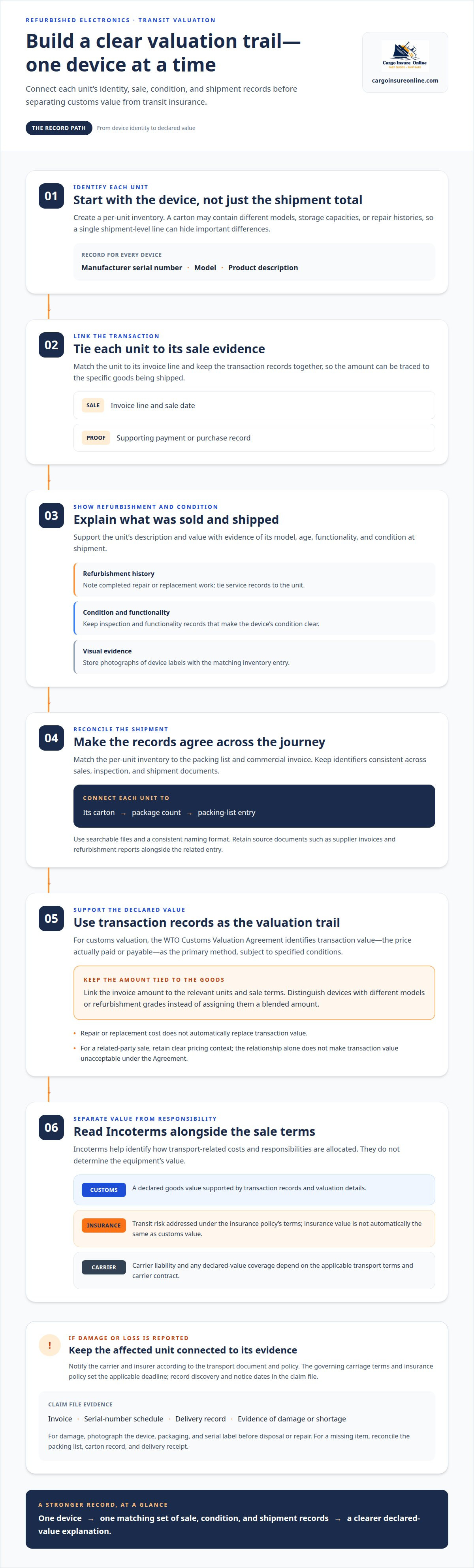
This guide explains how invoices, per-unit records, serial numbers, refurbishment and condition evidence, and the agreed transaction value create a clearer valuation trail. It also explains how Incoterms identify costs and responsibilities assigned to each party. Together, these records make the declared value easier to understand and support while refurbished electronics are in transit.
Key Takeaways
- Keep itemized shipment records that connect each device to its serial number, sale documents, and refurbishment history.
- Support declared values with transaction records and evidence that explains each device’s model, age, and condition.
- Use inspection and functionality records to make the refurbished goods’ condition clear at the time of shipment.
- Read the Incoterms alongside the sale terms to understand how transport-related costs and responsibilities are allocated.
- Keep customs valuation and freight insurance distinct: one supports a declared goods value, while the other addresses transit risk under the policy’s terms.
Per-unit documentation and serial-number records
A shipment-level invoice can hide important differences between refurbished devices. Build the record around each unit, linking its serial number to its model, condition, refurbishment work, and transaction value. For example, a carton of computers may contain different models, storage capacities, or repair histories. An itemized schedule makes those distinctions clear to customs, buyers, and insurers.
Start with a per-unit inventory that matches the packing list and commercial invoice. Use the manufacturer’s serial number as the primary identifier, then record the model and any other product identifier shown on the device. Keep identifiers consistent across sales records, inspection results, and shipment documents. If a device label does not match its invoice line, it may be harder to establish which item was affected or valued.
- Identity: Record the serial number, model, and product description for each device.
- Transaction: Link each unit to its invoice line, sale date, and supporting payment or purchase record.
- Refurbishment: Note completed repair or replacement work, with service records tied to the unit.
- Shipment: Connect each device to its carton, package count, and packing-list entry.
Keep records in searchable files, using a consistent naming format such as shipment reference, model, and serial number. Store photographs of labels alongside the inventory entry, rather than in an unindexed folder. A spreadsheet may suit a small consignment; larger international shipments benefit from records that can be filtered by serial number or invoice line. Retain supporting source documents for each entry, including supplier invoices and refurbishment reports.
For goods entering the European Union, product records also support traceability. The European Union states that the General Product Safety Regulation has applied to refurbished products since 13 December 2024. Keep the documentation associated with each product aligned with its shipment identity. Clear records help distinguish a refurbished device intended for reuse from an item lacking evidence of its repair and resale history. This matters for environmental reuse claims and for a shipment presented as a commercial alternative to new equipment.
How should shippers report freight damage or loss, and what deadlines apply? Notify the carrier and insurer according to the process in the transport document and policy, then provide the invoice, serial-number schedule, delivery record, and evidence of damage or shortage. The governing carriage terms and insurance policy set the applicable deadline, so record discovery and notice dates in the claim file.
For a damaged tablet, photograph the device, packaging, and serial label before disposal or repair. Match the images to the unit’s invoice entry and inspection record. For a missing computer, reconcile the packing list, carton record, and delivery receipt. This evidence connects the affected item to its declared value instead of relying on the shipment total. A consistent file makes the claim easier to explain and the individual units easier to identify.
Valuation of used and refurbished equipment
A refurbished consumer electronics freight transit valuation policy should distinguish the goods’ transaction value from carrier liability and insurance. Incoterms can clarify who arranges transport, but they do not determine the equipment’s value.
Coverage Limits for Refurbished Electronics
Carrier coverage for used or refurbished equipment depends on the applicable transport terms and carrier contract. Refurbished status alone does not establish whether a shipment is excluded or limited. Describe the goods accurately and understand the applicable terms before dispatch. For example, do not assume that declaring a laptop’s value removes a carrier liability limit or creates separate insurance protection.
Valuing Used Equipment
For customs valuation, the WTO Customs Valuation Agreement identifies transaction value, the price actually paid or payable, as the primary method, subject to specified conditions. A refurbished laptop’s repair or replacement cost does not automatically replace its transaction value. Keep the sale record and supporting valuation details together. For a related-party sale, retain clear pricing context, since the relationship alone does not make transaction value unacceptable under the Agreement.
Base the valuation on records that describe the equipment as sold and shipped. For example, distinguish phones with different models or refurbishment grades instead of assigning them a blended amount. Link the invoice amount to the relevant goods and record the sale terms. A refurbished consumer electronics freight transit valuation policy works best when each figure has a clear purpose, whether it represents the sale, transport allocation, or carrier declaration.
Suitable packaging can reduce damage and disputes by limiting movement and protecting devices inside their cartons. Choose packaging suited to the item, separate equipment that could touch or scratch, and photograph the packed goods. For a computer, retain images showing its condition and packaging before dispatch. If damage is later reported, these records help distinguish transit damage from pre-existing marks.
Carriers calculate charges for declared-value coverage under their own service terms and pricing rules. There is no single fee or coverage limit that applies to every major U.S. carrier. The carrier’s terms explain whether a charge applies and how the declared amount affects liability. Keep the relevant service terms with the shipment record instead of relying on an assumed rate.
For an international consignment, use the Incoterm and sale contract to understand who arranges and pays for transport. The declared value still needs its own supporting basis. The purchase of refurbished equipment can support a circular economy, but repair history alone does not establish an appliance’s transaction value. Keep these details distinct in the refurbished consumer electronics freight transit valuation policy.
Freight charges for declared-value coverage depend on the carrier’s rules and the shipment’s declared amount. For separate transit protection, Electronics & High-Value Devices Insurance addresses electronics shipments.
Functionality and condition evidence
A refurbished device’s description should match its tested performance and visible condition. Link inspection results to each unit before dispatch so the declared grade reflects the product being sold. Evidence such as a working screen, tested ports, and recorded battery condition is more useful than a broad “refurbished” label. Use the same grade and description in the sales listing, invoice, and inspection record.
Use documented test results to show what the seller examined and what each result means. For a phone, checks might cover the display, buttons, camera, charging, and battery health. For a laptop, record tested functions and any repaired or replaced components. These examples are not universal test standards; they show how unit-specific evidence can clarify a device’s condition at sale.
Battery grades need particular care. Grade A refurbished products often have battery health of at least 90%, while Grade B products often have battery health of 80%. Those thresholds vary by seller. Record the actual test result and the grading criteria used, rather than assigning a grade without supporting measurements. A clear record helps explain why two devices of the same model may have different values.
- Function: Record the tests performed and their pass, fail, or repair outcome.
- Appearance: Describe visible wear consistently, such as marks on a screen or casing.
- Battery: Preserve measured battery health and the seller’s grading basis.
- Repair: Connect repair records and replaced parts to the specific device.
- Identity: Match the test report to the unit’s serial number and sales description.
Photographs add context to written grades. Capture the exterior and any notable wear before packing, then keep the files with the inspection report. For example, images of a laptop casing can help distinguish pre-existing marks from damage reported after transit. Do not present a cosmetic grade as proof of full functionality; these describe different aspects of condition.
Warranty terms can also help describe the selling arrangement, but they don’t replace test evidence. Refurbished electronics warranties commonly range from 90 days to one year or longer, depending on the seller, marketplace, and product tier. Keep the applicable warranty document with the sale file. It may clarify the seller’s stated coverage period, while the inspection record shows the device’s documented state before shipment.
A considered resale process treats evidence as part of the product record, not an afterthought. Store test results, repair notes, photographs, and sales descriptions together. If a device is regraded after repair, retain both the earlier assessment and the updated result. This timeline shows how its condition changed and supports a more transparent description of the refurbished goods in transit.
Incoterms and declared value
Incoterms allocate specified costs, tasks, and delivery risks between seller and buyer. They clarify shipment responsibilities, but do not establish the goods’ value.
Declared Value Versus Freight Insurance
A declared value is an amount recorded for a shipment purpose; freight insurance is a separate policy governed by its own terms. Recording a value with a carrier does not automatically create insurance coverage. For refurbished phones, keep transaction evidence separate from insurance documents. Each serves a different role when a shipment is assessed after loss or damage.
Valuation Limits and Liability Rules
For U.S. freight, liability depends on the transport mode, applicable rules, and carrier contract terms. No single limit applies to every shipment; a declared amount affects liability only as the relevant terms allow. Review the transport document alongside the declared-value entry so the selected amount and any applicable conditions are clear before dispatch.
Customs value is a separate question. According to the WTO, transaction value, the price actually paid or payable, is the primary customs valuation method, subject to specified conditions. Incoterms can help identify which party pays particular transport costs, but they do not replace customs valuation rules.
Calculating Declared Value Charges
Carriers set declared-value charges under their service terms and pricing rules. The applicable charge and any liability cap depend on the carrier’s terms for that shipment, not on a universal rate. Review the charge alongside the service selection and declared amount, then keep the shipment record showing what was submitted and accepted.
There is no single typical fee or coverage limit shared by all major U.S. freight carriers. A carrier’s published service terms explain whether a charge applies and how the stated value affects its liability. Charges for declared-value coverage follow carrier-specific rules; compare the service and declared amount under the same carrier’s terms.
For an international purchase, match the Incoterm named in the sale contract to the actual delivery arrangement. Then identify which party arranges and pays for each transport leg. This helps reconcile the invoice with freight documents without treating a shipping-cost allocation as the device’s transaction price. Transport costs for a refurbished laptop may be assigned differently from those for a phone sold under another delivery arrangement.
For each shipment, align the invoice, Incoterm, transport document, and declared-value entry. If the buyer pays freight separately, preserve that allocation in the records. If the seller arranges carriage, retain the shipment documents showing the agreed service. Keep the process clear: document the sale terms, separate the goods’ transaction value from transport charges, and make the selected carrier terms easy to find.
A battery replacement or repair may explain a device’s condition, but does not by itself determine its transaction value or carrier liability. Keep those records distinct. This supports circular-economy trade in refurbished electronics without confusing the product’s sale value, the shipping-cost allocation, and the amount entered for carrier liability.
How is declared value different from freight insurance for electronics shipments?
A declared value records an amount for a shipment or carrier-liability purpose. Freight insurance is a separate contract that may cover transit loss or damage under its policy terms. For refurbished electronics, a number on a shipping document does not by itself establish insurance protection. Keep the carrier declaration and insurance documents as separate records.
For example, a seller shipping refurbished phones might declare a value with the carrier while arranging separate cargo insurance. The declaration can affect how carrier liability is assessed under the contract. Insurance responds under its own terms, including covered events, exclusions, and applicable limits. Neither record replaces the invoice or evidence supporting the goods’ transaction value.
- Carrier declaration: Record the amount submitted and the carrier document where it appears.
- Insurance policy: Keep the policy schedule and terms with the shipment file.
- Sale evidence: Preserve invoices and unit records supporting the electronics’ value.
- Loss evidence: Connect delivery records and damage documentation to the affected goods.
These records answer different questions. The invoice supports the amount the buyer agreed to pay for the refurbished goods. The carrier document shows the value submitted under the transport arrangement. The insurance policy sets out coverage terms for the insured shipment. If a laptop arrives damaged, the invoice helps establish its sale value, while photographs and delivery records document the reported damage. The carrier and insurer assess the matter under their respective terms.
Keep amounts consistent when they describe the same goods, but do not assume they serve identical purposes. Transport charges, sale terms, and the declared amount can appear in separate records. A clear file explains each figure and its role. For an international shipment, keep the commercial invoice, carrier paperwork, packing record, and insurance documents together under references that connect them.
When a loss occurs, follow the notice and claim process in the applicable carrier documents and insurance policy. Describe the affected shipment and units clearly, and provide supporting records. A complete claim file can include the invoice, itemized inventory, delivery receipt, photographs, and repair assessment. Keep copies of communications and note when the loss was discovered and reported. The relevant contract or policy sets the applicable reporting requirements.
Before dispatch, compare three things: the goods’ sale evidence, the value entered for carrier purposes, and the insurance documentation. Resolve differences by documenting why amounts vary, such as separate transport charges or distinct valuation bases. Don’t treat a carrier’s declared-value option as a substitute for a separate insurance policy. For a shipment that needs transit protection, explore cargo insurance options and review how the coverage terms align with the goods and route.
The declared amount may be relevant when a carrier reviews a shipment under its terms. Any insurance coverage is separate and subject to its own terms, exclusions, and applicable limits.
Cargo Insure Online: Electronics & High-Value Devices Insurance
Cargo Insure Online offers Electronics & High-Value Devices Insurance for businesses shipping refurbished electronics. It may suit shipments by air, sea, or truck when you want cargo insurance separate from carrier-declared value. The company also offers Air Freight Insurance, Sea Freight Insurance, and Trucking Insurance for those transport modes.
Use unit records, transaction evidence, and shipment details to identify the goods being insured. Insurance terms define the protection, while customs value and carrier liability serve different purposes. Clear documentation connects the shipment to its refurbished condition and declared value.
Contact Cargo Insure Online to discuss insurance for your electronics shipment.
Make your next shipment decision with clarity
A refurbished consumer electronics freight transit valuation policy is most useful when it turns your records into a clear basis for decisions before the goods move. For your next shipment, align the commercial terms, transport arrangement, and protection you want in place. This ties the valuation process to the actual route and transaction, rather than to a number on a document alone.
As you plan, consider the transport mode alongside the shipment’s declared value and insurance needs. Cargo Insure Online offers Air Freight Insurance, Sea Freight Insurance, and Trucking Insurance, helping you consider protection in line with how your electronics will travel. Choose the option that fits your shipment and documentation.
Contact Cargo Insure Online to discuss your electronics shipment and move forward with greater clarity.
Frequently Asked Questions
What does freight transit valuation cover for refurbished consumer electronics?
It records the value assigned to the electronics while they are moving, helping distinguish goods value from transport charges or insurance terms. For a partial loss, unit-level values can identify the affected portion of a mixed shipment instead of relying only on the consignment total. For example, separate values for refurbished laptops make a missing unit easier to identify in shipment records.
What documentation is needed to establish the value of refurbished electronics?
Use the commercial invoice, purchase or sales records, and an itemized inventory linking each device to its value. Add records explaining the goods’ refurbishment and condition, such as repair documentation and inspection results. Keep shipment documents with these records under a shared reference. If an invoice is corrected, retain both versions and note the reason to show how the final declared amount was reached.
How should refurbished electronics be valued: purchase price, repair cost, or replacement cost?
For customs valuation, begin with the transaction value: the price actually paid or payable, subject to specified conditions under the WTO Customs Valuation Agreement. Repair cost can help explain a device’s condition, but it doesn’t automatically replace the transaction value. Replacement cost is a different basis. If transaction value can’t be used, the Agreement provides sequential alternative methods in articles 2-7 for determining customs value.
What risks and exclusions apply to batteries, screens, and other electronics components in transit?
Coverage for batteries, screens, and other components depends on the applicable transport terms and carrier contract; refurbished status alone does not establish an exclusion or limit. Record each unit’s condition and package it to limit movement and protect it from damage.


