

The broadest cover isn’t automatically the right fit. In an Institute Cargo Clauses A, B, and C coverage comparison, Clause A provides the broadest protection, subject to exclusions; Clause B covers specified named risks, while Clause C offers the most limited cover. Premiums generally vary with coverage scope, with broader protection typically costing more.
Choosing between them means weighing possible cargo losses against the protection you need. Each clause treats losses differently, so the label alone won’t tell you whether a particular incident is covered.
This guide compares covered risks, exclusions, and relative premiums. It also explains how cargo type and route can shape your decision, helping you assess which clause fits your shipment.
Key Takeaways
- Read the exclusions alongside the coverage label to understand where protection stops.
- Compare the premium against the risks your shipment could face, not just the upfront cost.
- Use the named-perils structure of Clauses B and C to identify which specific events are covered.
- Factor in cargo characteristics and the shipping route when deciding which level of cover fits.
- Explore how air freight insurance can support your shipment’s protection needs.
What are Institute Cargo Clauses (A, B, and C)?
Institute Cargo Clauses define which losses marine insurance covers during transit. Clause A offers the broadest protection, while B and C cover specified named risks.
Clause A All-Risks Coverage and Exclusions
Clause A provides all-risks cover for goods in transit, subject to the policy’s exclusions. “All risks” doesn’t mean every loss is covered. Unlike B and C, Clause A doesn’t restrict cover to a defined list of named events. For a claim, the insurer must demonstrate that an exclusion applies.
The current clauses are numbered CL382 for A, CL383 for B, and CL384 for C. These editions took effect on 1 January 2009, replacing the 1982 editions.
Covered and Excluded Marine Cargo Risks
Clauses B and C use named-perils wording, so the event must match a listed risk. Under C, covered risks during carriage include fire, explosion, vessel sinking, and collision. B also covers earthquake and seawater entering a ship, container, or place of storage. C excludes earthquake and seawater entry, making these distinctions important when assessing a marine route.
| Clause | Coverage structure | Examples of covered risks |
|---|---|---|
| A | All risks, subject to exclusions | Malicious damage; theft, pilferage, or robbery |
| B | Named perils | Fire, explosion, earthquake, seawater entry |
| C | More limited named perils | Fire, explosion, collision, vessel sinking |
Choose by matching likely cargo and route exposures to covered events, then reviewing the policy exclusions.
Shared Exclusions and Coverage Restrictions
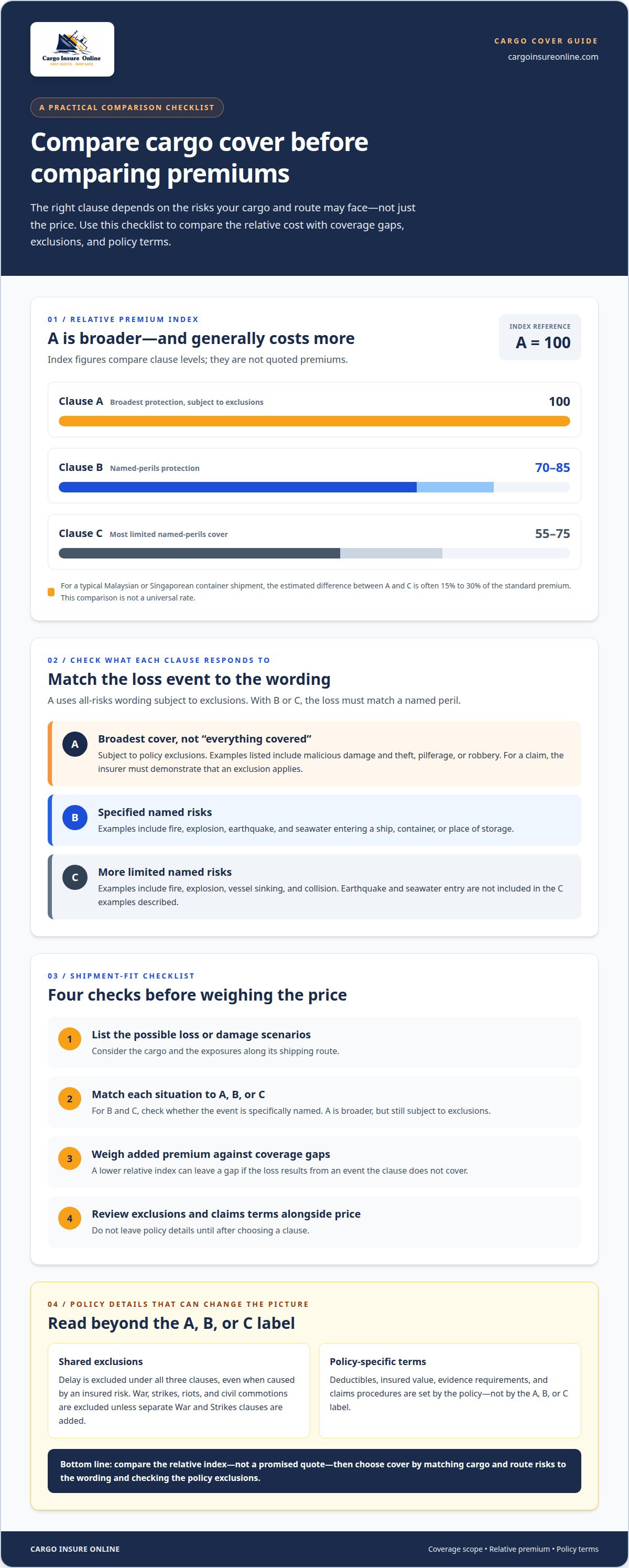
All three clauses exclude delay, even when an insured risk causes it. War, strikes, riots, and civil commotions are also excluded unless separate War and Strikes clauses are added. These exclusions apply regardless of whether the shipment has A, B, or C cover.
Deductibles, insured value, and claims conditions aren’t standard features set by the A, B, or C label. The policy states the deductible, valuation basis, evidence requirements, and claims procedures. Compare those terms alongside the clause.
For duration, the 2009 wording attaches cover when goods are first moved within a warehouse for immediate loading. Cover ends at the final destination warehouse after unloading, at an earlier specified termination event, or no later than 60 days after discharge at the final port.
War and strikes aren’t covered under A, B, or C by default. Separate War and Strikes clauses are required to add those risks.
In the United States, cargo policies may use ICC wording or policy-specific terms. The policy wording and endorsements determine the covered risks, exclusions, valuation, and claims conditions.
Premium differences between coverage levels
Premiums vary with the selected Institute Cargo Clause and its coverage scope. Compare the relative cost with the risks your shipment needs protection against.
Premium Differences by Clause
Clause A is generally the most expensive option because it provides the broadest cover, subject to exclusions. Clause C typically has the lowest premiums and the most restricted cover. Clause B sits between them, offering named-perils protection for a moderate premium. The difference reflects the coverage selected, not a guaranteed amount payable for every shipment.
ICC A, B, and C Premium Comparison
A relative premium index puts Clause A at 100, Clause B at 70-85, and Clause C at 55-75. These figures compare the clauses on a scale; they aren’t quoted premiums. For a typical Malaysian or Singaporean container shipment, the estimated difference between A and C is often 15% to 30% of the standard premium.
Use the index to compare coverage levels, not to predict a specific quote. The premium varies with the selected clause, while cargo and route help determine which risks matter. A shipment exposed to risks not named under B or C may need a different level of cover from cargo with a narrower set of concerns.
Apply a simple comparison process:
- Identify the loss or damage scenarios the shipment could face on its route.
- Match those situations to the risks covered by A, B, or C.
- Compare the added premium for broader cover against the potential gaps in narrower wording.
- Review exclusions and claims conditions alongside the premium, not after choosing a clause.
For example, choosing C for its lowest relative index can leave a gap if the loss results from an event it doesn’t cover. A’s higher index reflects broader cover, but its exclusions still apply. B is an intermediate option, and its value depends on whether its named risks fit the cargo and transit exposure.
Premium estimates vary by market and shipment; the Malaysian and Singaporean comparison shouldn’t be treated as a universal rate. Keep the relative index separate from the final premium, then weigh the clause against the potential loss or damage and the protection the shipment requires. To explore how coverage choices relate to freight movements, review these cargo insurance options.
All-risks versus named-perils coverage
The key difference is how each clause defines a covered loss. Clause A uses all-risks wording, subject to exclusions; Clauses B and C identify specific perils. For an international shipment, that distinction affects how a loss is assessed: under A, the insurer must demonstrate that an exclusion applies, while under B or C, the loss must match a named peril.
“All risks” doesn’t mean every cause of loss is covered. Clause A remains subject to its exclusions, including restrictions that apply across the clauses. A claim turns on the policy wording and the facts of the loss, not simply on the phrase “all risks.” For example, theft is covered under A in this comparison, while B and C don’t cover theft, pilferage, or robbery unless an extension is added.
Named-perils wording works differently. For B or C, identify the event that caused the loss, then compare it with the risks listed in the clause. A fire claim, for example, must be assessed against the fire wording; damage from an unlisted event isn’t covered simply because it occurred during carriage. The list itself is central to assessing a claim.
- Clause A: Broadest of the three, with cover subject to exclusions. The comparison includes malicious damage and theft.
- Clause B: Named-perils cover that includes earthquake and seawater entry. Its listed risks are broader than C’s in those areas.
- Clause C: More limited named-perils cover, including general average, fire or explosion, vessel grounding or capsizing, and collision during carriage.
Clause C shows why named-perils wording needs close reading. A loss caused by a listed event, such as a vessel collision during carriage, may fall within its stated cover. Earthquake and seawater entry are different: this comparison lists them under B, not C. Both the cause of loss and the exact wording matter.
For a practical comparison, outline likely loss scenarios before choosing a clause. First, identify how damage could occur during carriage. Next, match each cause to A’s exclusions or B’s and C’s named perils. Finally, note any gaps, such as theft under B or C without an extension. This makes the difference between broad all-risks wording and a defined list of perils clear, without assuming every marine loss qualifies.
Choosing coverage based on cargo and shipping route
Choose a clause based on both the cargo and its route, not just the transport mode. Container contents, exposure during loading, and the vessel or aircraft journey can affect which listed risks matter.
For containerized general merchandise valued above USD 5,000, the market recommendation is ICC A as the default. Treat that as a starting point, then compare the policy wording with the shipment’s likely loss scenarios. A container route involving sea carriage, for example, makes the difference between cover for seawater entry under A and B and its absence under C relevant.
Cargo characteristics help reveal where narrower clauses may leave gaps. A shipment of valuable items may call for attention to theft or pilferage, which A covers in this comparison, while B and C don’t cover those losses unless an extension is added. If the main concern is a listed event such as fire, compare that exposure with B’s or C’s wording rather than choosing on premium alone.
- Containerized general merchandise: Consider A as the default above USD 5,000, then weigh the route and exclusions.
- Valuable items: Review theft and pilferage protection, since B and C exclude these unless extended.
- Sea shipments: Check whether seawater entry and total loss overboard during loading or discharge are relevant route exposures.
- Air shipments: ICC A is generally the professional standard; B or C is rarely appropriate for airfreight.
Route analysis means mapping the journey, not simply naming its origin and destination. Note where cargo transfers between modes, when it enters or leaves a container, and whether loading or discharge exposes it to a listed peril. On a sea route, vessel collision, grounding, or seawater entry may matter. A transfer point can also be relevant if damage occurs outside the covered transit period.
Use this sequence for each global shipment: identify the cargo’s value and characteristics; map every transport leg; list plausible causes of loss or damage; then compare those causes with the chosen clause and its exclusions. Don’t assume a restrictive clause fits simply because the goods seem robust. Cargo characteristics alone don’t determine the answer; the covered event, policy wording, and route exposure must align.
The right fit addresses the shipment’s meaningful exposures without overlooking exclusions. For high-value containerized goods, start by assessing A; for airfreight, ICC A is generally the professional standard. With B or C, confirm that the named perils match the cargo’s route and handling.
Coverage scope of Institute Cargo Clauses A, B, and C
Coverage depends on the clause wording and the event causing cargo loss or damage. A provides the broadest cover, subject to exclusions; B and C cover named perils, with C the most limited.
The differences become clearer when specific events are compared. A and B cover seawater entering the ship, craft, hold, conveyance, container, liftvan, or place of storage. C does not. A and B also cover earthquake, volcanic eruption, or lightning, while C excludes these events. The clauses may treat losses during vessel loading or discharge differently, so check the policy wording.
Clause C covers specified events during carriage, including general average, fire or explosion, vessel grounding or capsizing, and collision. Under the Institute Cargo Clauses dated 1/1/82, all three clauses include general average and salvage charges, plus proportional liability under a Both to Blame Collision clause. The wording matters: an event occurring during carriage must still match the cover provided.
- A: Broadest of the three, subject to exclusions; covers malicious damage and theft, pilferage, or robbery.
- B: Named-perils cover that includes earthquake and seawater entry; theft and partial non-delivery need an extension.
- C: Limited named-perils cover, including fire or explosion, collision, and vessel grounding or capsizing.
For theft, pilferage, or robbery, A provides cover in this comparison, while B and C do not unless extended. B and C also exclude partial non-delivery unless an extension is added. Assess breakage against the wording and cause of damage rather than assuming it is covered based on the clause label.
A useful claim review starts with the physical event, not the damage description. If cargo arrives wet, establish whether seawater entered a container or place of storage, then compare the clause. A and B include that peril; C doesn’t. If goods are missing, distinguish theft from partial non-delivery, since the stated restrictions under B and C treat them differently.
For a shipment exposed to several risks, list each potential cause and compare it against the wording. A’s broader scope may address losses outside B’s or C’s named perils, but exclusions still apply. The exact policy wording determines how the event and evidence fit the cover. Review cargo insurance coverage options when matching protection to your shipment’s risk profile.
Institute Cargo Clause A generally offers broader coverage than Clause C, while Clause C covers specified events during carriage.
Clause C lists general average sacrifice as a main aspect of cover. It may cover loss or damage caused by fire, explosion, collision, or sinking during carriage.
Cargo Insure Online: Air Freight Insurance
Cargo Insure Online offers Air Freight Insurance for businesses moving goods by air. If your shipment includes an air leg, consider how its transit risks fit the cover you select. ICC A is generally the professional standard for airfreight, while B or C is rarely appropriate for air shipments. Comparing the clause wording with your cargo and journey helps clarify the protection you’re arranging.
For shipments using several transport modes, the air leg is only part of the picture. Cargo Insure Online also offers Sea Freight Insurance, Trucking Insurance, and GAP Insurance for different freight movements and financial risks.
Contact Cargo Insure Online to discuss your cargo insurance needs, or visit cargoinsureonline.com.
Turn your clause choice into a cargo plan
Make your next step practical: document the goods, route, transport handoffs, and financial exposure before arranging cover. An Institute Cargo Clauses A vs B vs C coverage comparison is most useful when it reflects the shipment you’re actually moving, rather than a general preference for broader or lower-cost protection.
Bring those shipment details together with the policy wording and applicable exclusions. This gives you a clearer basis for aligning cargo protection with your logistics plans and identifying which transport legs need attention.
Cargo Insure Online offers Air Freight Insurance, Sea Freight Insurance, and Trucking Insurance for freight moving across these modes. If you’re planning a shipment and want to discuss cargo insurance options, contact Cargo Insure Online. Take the next step with a clearer view of your shipment and its insurance needs.
Frequently Asked Questions
Which Clause Should You Choose?
Choose the clause whose wording matches your cargo’s likely loss scenarios and route. For example, a shipment vulnerable to theft may point toward A, while B or C may fit when their listed perils match the exposure. An Institute Cargo Clauses A-versus-B-versus-C coverage comparison can help organize the decision. Before selecting cover, review the policy’s exclusions, valuation basis, deductible, and claims requirements.
What risks are covered by Institute Cargo Clauses (A), (B), and (C)?
Clause A covers a broad range of transit risks, subject to exclusions. B and C cover named perils: B includes events such as earthquake and seawater entry, while C includes specified events such as fire, explosion, and vessel collision during carriage. Consider a container damaged by seawater: the event may fit A or B, but not C under this comparison. The policy wording determines how a claim is assessed.
What perils are excluded under Institute Cargo Clauses A, B, and C?
All three clauses exclude delay, even if an insured event caused it. War, strikes, riots, and civil commotions are also excluded unless separate War and Strikes clauses are added. Other exclusions depend on the applicable wording. For instance, a shipment delayed after a covered vessel incident may still have no cover for the delay-related loss. Read exclusions alongside the insured risks rather than treating the clause name as a complete summary.
What are the standard Institute Cargo Clauses 1/1/09 policy wordings?
The current Institute Cargo Clauses took effect on 1 January 2009 and are identified as CL382 for A, CL383 for B, and CL384 for C. The date identifies the edition, while each clause sets different coverage terms. Check the schedule and wording attached to the policy to identify the edition and any amendments or endorsements. This helps distinguish the standard clauses from policy-specific changes that may affect a shipment.
How do cargo type, transport mode, and route affect the choice of ICC A, B, or C?
Cargo characteristics and route exposures help identify which insured events matter. A high-value shipment vulnerable to theft raises a different coverage concern from goods mainly exposed to a named peril. Transport mode matters too: ICC A is generally the professional standard for airfreight, while B or C is rarely appropriate for air shipments. Map the shipment’s handling and transport legs, then compare those exposures with the clause wording.
What is the typical premium difference between ICC A, B, and C cargo insurance?
Clause A is generally the costliest, B falls between the options, and C usually has the lowest premium. The difference reflects coverage scope, but an actual premium depends on shipment details and selected terms. For a useful comparison, assess the same cargo, route, insured value, and policy conditions across the clauses. Then weigh the premium against risks left outside narrower cover, rather than choosing on price alone.


