
The airline didn't just lose your freight. They lost your profit margin, your customer's trust, and three months of your time. If you are relying on standard Montreal Convention limits, you aren't protected; you are exposed. Understanding the real differences between air cargo insurance vs carrier liability is the only thing standing between a full reimbursement and receiving pennies on the dollar. Most shippers realize this too late. They assume "covered" means "compensated," but in the world of global logistics, those two words are worlds apart.
It's exhausting to battle through months of paperwork only to have a claim denied because of an "Act of God" clause or a weight-based payout that doesn't even cover the cost of the packaging. You deserve a frictionless recovery process that respects your bottom line. This 2026 guide breaks down the hidden gaps in carrier contracts and explains why all-risk coverage is your only path to total financial safety. We'll explore the strict SDR limits, the myth of carrier negligence, and how to automate your protection so you never get burned by the fine print again.
Key Takeaways
- Stop assuming carrier liability is insurance; it is a legal minimum that requires you to prove the airline was at fault before seeing a cent.
- Learn why the Montreal Convention weight-based limits often mean receiving pennies on the dollar for high-value electronics or light-weight freight.
- Master the air cargo insurance vs carrier liability comparison to see how all-risk coverage provides a no-fault safety net for your bottom line.
- Identify the "Acts of God" and packaging loopholes that allow carriers to legally deny your claim even when your cargo is destroyed.
- Ditch the 48-hour broker wait times and secure instant, digital-first protection that matches the high-speed demands of 2026 global trade.
The Dangerous Myth of "Full Carrier Coverage"
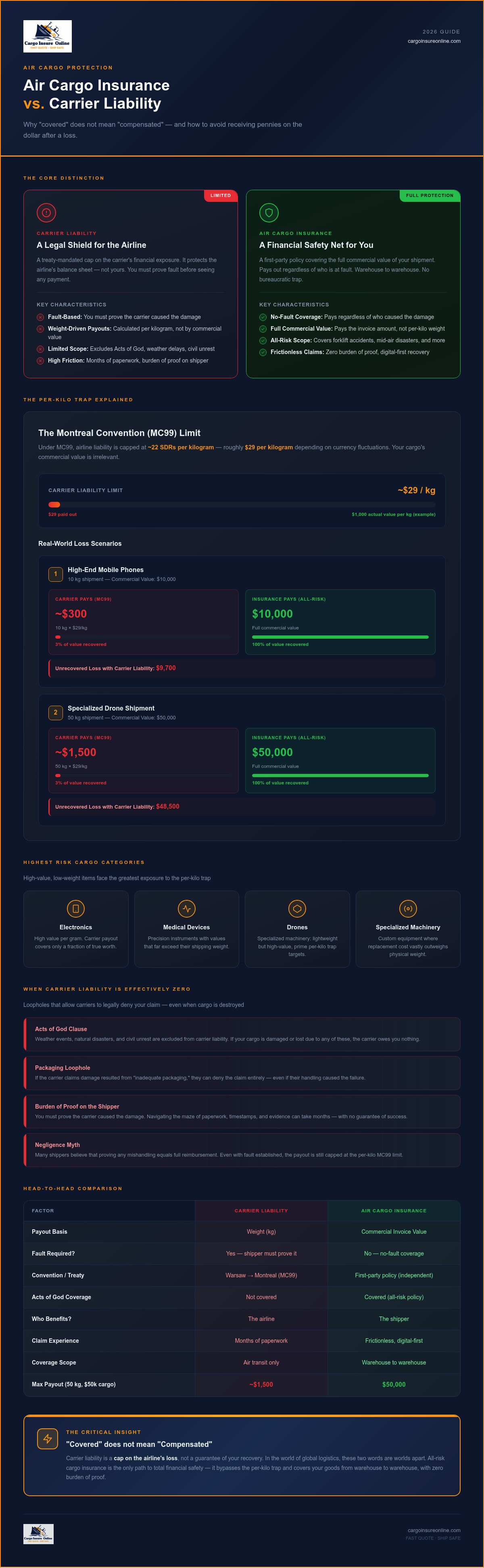
Stop assuming your freight is safe just because it is in the air. It isn't. Many shippers believe that if an airline loses their pallet, the airline simply writes a check for the value. That is a dangerous, expensive myth. In reality, carrier liability is a legal shield designed to protect the airline, not your balance sheet. It is a cap on their financial exposure, not a guarantee of your recovery. If your cargo is worth $50,000 but weighs only 100kg, you are about to discover the painful reality of the air cargo insurance vs carrier liability gap. You aren't being protected; you're being capped.
The carrier only pays if you can prove they were at fault. This burden of proof falls squarely on your shoulders. You must navigate a maze of paperwork, timestamps, and evidence while your capital remains locked away. Even if you win, the payout is almost always calculated by weight, not by the commercial value of the goods. For high-value electronics or specialized machinery, this means receiving pennies on the dollar. It is a system built for logistics giants, not for modern businesses that need speed and certainty.
What is Carrier Liability?
Think of carrier liability as the bare minimum. It is the maximum legal amount a carrier must pay if they damage or lose your goods. This isn't a customer service gesture. It is a treaty-mandated limit. These regulations started with the Warsaw Convention carrier liability limits and evolved into the modern Montreal Convention. These treaties exist to ensure airlines don't go bankrupt every time a plane goes down, which means they are fundamentally biased against the shipper.
- Fault-Based: You must prove the carrier caused the damage.
- Limited Scope: It does not cover "Acts of God," weather delays, or civil unrest.
- Weight-Driven: Payouts are tied to kilograms, regardless of the item's true worth.
The key takeaway is simple. Carrier liability is a limit on their loss, not a guarantee of your safety. It is a legal obligation they fulfill with as much friction as possible.
What is Air Cargo Insurance?
This is where you take control. Unlike liability, air cargo insurance is a first-party policy that covers the full commercial value of your shipment. It is a modern, digital-first solution to an ancient problem. It pays out regardless of who is at fault for the damage. Whether it is a forklift accident in a warehouse or a mid-air disaster, your investment is secured. Air cargo insurance is the only path to total financial recovery because it bypasses the "per-kilo" trap and covers your goods from warehouse to warehouse.
When you weigh the benefits of air cargo insurance vs carrier liability, the choice becomes clear. One is a bureaucratic hurdle; the other is a financial safety net. You get frictionless claims, zero burden of proof, and the peace of mind that comes with knowing your profit margins are actually protected.
Decoding the "Per-Kilo" Trap: Why Weight Matters
Weight is the enemy of your bottom line. If you ship high-value goods, the airline doesn't care about your invoice. They care about the scales. Air freight liability is calculated using Special Drawing Rights (SDRs) per kilogram. An SDR is a basket of international currencies used by the IMF. It's a bureaucratic unit that turns your $10,000 shipment into a few hundred dollars of compensation. It's a system built for bulk commodities, not for modern, high-tech freight.
Under the Montreal Convention 1999 (MC99), the liability limit is currently set at roughly 22 SDRs per kilo. Depending on currency fluctuations, that's about $29 per kilogram. Imagine shipping 10kg of high-end mobile phones worth $10,000. If the airline loses that box, they legally owe you roughly $300. That isn't a safety net; it's a financial disaster. This is the core conflict in the air cargo insurance vs carrier liability debate. One covers what you lost; the other covers only what you weighed.
The Math of a Logistics Disaster
Let's look at a real-world scenario. You are shipping a specialized drone shipment weighing 50kg with a commercial value of $50,000. If that shipment vanishes, a carrier payout based on MC99 limits would net you approximately $1,500. You are left with a $48,500 hole in your budget. If you choose Air Freight Insurance, the weight doesn't matter. You get reimbursed for the full invoice value, including freight costs and a percentage for lost profit.
High-value, low-weight items are the highest risk category in air cargo. Electronics, medical devices, and drones are prime targets for this per-kilo trap. You can protect your margins instantly without the broker delays. You can secure an instant quote in seconds and bypass the scales entirely. Cargo insurance ignores the weight and covers the true value of your business assets.
International Conventions You Need to Know
These treaties aren't designed for your benefit. The Montreal Convention is the global standard, but some regions still operate under the older Warsaw Convention. Warsaw limits are even more restrictive, often capping liability at a fraction of modern rates. These international agreements exist to protect the aviation industry from massive financial claims. They ensure airlines stay profitable while shippers take the hit. When evaluating air cargo insurance vs carrier liability, remember that these treaties are legal shields for the carrier. Insurance is the only tool that prioritizes your financial recovery over airline industry stability.
Liability vs. All-Risk Insurance: The Ultimate Showdown
Carrier liability is a marathon through a bureaucratic minefield. All-risk insurance is a high-speed sprint to a settlement. When you analyze the reality of air cargo insurance vs carrier liability, you aren't just comparing payout amounts. You are comparing the level of friction you are willing to tolerate during a crisis. One system is designed to protect the airline's profit margin; the other is designed to protect yours.
The differences between these two options are stark and immediate:
- Burden of Proof: Liability requires you to be a detective. Insurance only requires you to be a witness.
- Exclusions: Liability is riddled with "Force Majeure" exits. All-risk is built to stay closed.
- Speed: Liability claims often rot in a desk drawer for six months. Digital-first insurance settles in days.
- Value: Liability weighs your cargo on a scale. Insurance reads the commercial invoice.
The Burden of Proof: Your Biggest Hurdle
Under standard liability rules, the airline is not guilty until you prove it. You must provide undeniable evidence that the carrier was specifically negligent. This is notoriously difficult. Did the forklift driver drop the crate in Dubai or London? Was the cargo hold temperature wrong over the Atlantic? Unless you have a camera inside the fuselage, you are guessing. With all-risk insurance, you only need to prove the loss happened during transit. If it left the warehouse intact and arrived broken, the claim is valid. Don’t play detective; get insured.
Acts of God and Other Legal Loopholes
Carriers have a long list of reasons to say "no." They are not liable for "Acts of God." This includes lightning, extreme turbulence, or hurricanes. If a storm grounds a flight and your perishables rot, the carrier legally owes you nothing. Theft and "Force Majeure" events often leave shippers with zero compensation under liability because the carrier can argue the event was beyond their control. This is where Electronics Shipping Insurance becomes essential. It closes these specific loopholes. It ensures that whether the cause is a lightning strike or a warehouse heist, your financial safety remains intact and your claim is processed without the legal gymnastics.
Choosing the right path in the air cargo insurance vs carrier liability debate determines whether you spend your year growing your business or fighting for a fraction of what you are owed. Stop gambling on carrier negligence and start relying on digital certainty.
When Carrier Liability is Effectively Zero
Sometimes the airline doesn't just pay less. They pay nothing. While weight-based limits are frustrating, legal exclusions are devastating. In the battle of air cargo insurance vs carrier liability, the fine print is where profit margins go to die. Carriers have spent decades refining their contracts to ensure that in dozens of common scenarios, they owe you exactly zero dollars. They aren't your partner; they are a service provider with a very thick legal shield.
- Natural Disasters: Extreme weather, lightning, or seismic events grounding flights.
- Cyber-Attacks: Digital shutdowns or ransomware that freeze global logistics.
- Insufficient Packaging: A subjective excuse used to void claims instantly.
- Concealed Damage: Issues discovered after the shipment is moved into your warehouse.
The air cargo insurance vs carrier liability gap becomes a canyon when you look at these "zero-payout" triggers. You are left holding the bill while the carrier cites a Force Majeure clause. It is an outdated way to do business in a high-speed world.
The Packaging Blame Game
Carriers reject a massive percentage of claims by pointing at the box. They'll claim "improper crating" or "insufficient padding" to avoid a payout. It is a subjective judgment call where the carrier acts as both judge and jury. If they can argue your packaging wasn't perfect, they are legally off the hook. All-risk cargo insurance provides a buffer against these packaging disputes. It shifts the focus from blame to reimbursement. You can see similar patterns in road freight; check our Trucking Cargo Insurance guide for how these risks translate to the highway.
Concealed Damage: The Silent Profit Killer
The 48-hour rule is a trap. If you discover damage after your team has signed the Bill of Lading, the carrier will claim it happened in your facility. You have a tiny window to report concealed damage before the airline's liability evaporates entirely. Waiting to inspect your air cargo is a fatal mistake. Always "sign under protest" if the crate shows even a minor scuff. Digital-first claims processes make reporting these issues effortless. You don't need a legal team; you just need a smartphone and a policy that actually works. Choosing between air cargo insurance vs carrier liability is the difference between a total loss and a minor inconvenience. Don't let a bureaucratic loophole bankrupt your shipment. You can get an instant quote and secure your cargo today in under two minutes.
Upgrade to Digital Certainty with Cargo Insure Online
Stop gambling with your profit margins. The air cargo insurance vs carrier liability debate ends when you choose speed over bureaucracy. Traditional brokers make you wait 48 hours for a quote; we give it to you in seconds. No paperwork. No friction. Just total financial safety for the 2026 supply chain. You don't have to accept weight-based limits that leave your business exposed. You can upgrade to all-risk protection that covers the full invoice value of your freight instantly. It's time to move beyond the limitations of outdated treaties and embrace a digital-first approach to global trade.
Frictionless Protection for High-Value Goods
Modern e-commerce moves at the speed of light. If you are shipping drones, smartphones, or high-value devices, you cannot afford a carrier’s empty promise of "coverage." One lost pallet of electronics could sink your quarterly earnings if you rely on per-kilo liability. We provide specialized protection designed for high-value tech and temperature-sensitive shipments. For those managing complex cold chains, our Reefer Cargo Insurance offers the same high-speed, digital-first protection for perishables. It is about removing the risk of loss and the administrative headache of the claims process simultaneously.
The Future is API-Driven
Logistics is evolving rapidly. The most successful providers aren't just moving boxes; they are embedding certainty into every shipment. Our white-label and API-ready solutions allow logistics partners to integrate insurance directly into their existing platforms. This means instant certificate issuance. You protect your freight in seconds, not days. Whether you are a small business with a one-off shipment or an enterprise looking for deep integration, our platform scales with you. We've mastered the complexities of global trade and simplified them into a few clicks.
The choice is yours. You can stay trapped in the "per-kilo" math of the Montreal Convention, or you can take control of your financial future. Experience the relief of a frictionless, automated insurance journey that respects your time and your bottom line. Get your instant air cargo insurance quote now and stop letting carrier liability burn your business.
Secure Your 2026 Profit Margins Now
The era of "fingers crossed" logistics is over. You now know that carrier liability is a legal shield for the airline, not a safety net for your cargo. The "per-kilo" trap is real. It turns $50,000 shipments into $1,500 payouts. When you compare air cargo insurance vs carrier liability, the choice is between a bureaucratic nightmare and total financial certainty. One leaves you exposed; the other keeps you moving. You don't have to settle for pennies on the dollar or wait months for a claim to be processed.
We've built a digital-first platform for the 2026 supply chain. It delivers specialized high-value electronics coverage and instant digital certificate issuance. You stay globally compliant while bypassing the friction and delays of traditional brokers. Don't wait for a disaster to discover the gaps in your protection. You deserve a partner that values your time as much as your freight. It's time to trade uncertainty for automation and legal loopholes for actual, full-value reimbursement.
Stop the per-kilo gamble-get an instant air cargo insurance quote today!
Your business moves fast. Your insurance should move even faster. Take the guesswork out of your global trade and ship with the confidence of a market leader.
Frequently Asked Questions
Is carrier liability the same as cargo insurance?
No, carrier liability is a legal obligation for the airline, while cargo insurance is a private policy you own. Liability only pays if you prove the carrier was at fault. It is almost always capped by weight. Cargo insurance covers the full commercial invoice value regardless of who caused the damage. When comparing air cargo insurance vs carrier liability, remember that liability protects the airline's bank account, not your inventory.
What is the Montreal Convention limit for air cargo in 2026?
The Montreal Convention (MC99) currently limits carrier liability to approximately 22 Special Drawing Rights (SDRs) per kilogram. This value fluctuates based on a basket of global currencies. By 2026, these limits remain the standard for international air freight. If your cargo is light but expensive, this weight-based payout will cover only a tiny fraction of your actual financial loss. It is a legal ceiling designed for the carrier's benefit.
Does carrier liability cover theft or hijacking?
Carrier liability rarely covers theft or hijacking because airlines often argue these events were beyond their control. You must prove they failed to provide adequate security, which is a massive legal hurdle. All-risk insurance removes this friction entirely. It treats theft as a covered peril. You get reimbursed for the loss without having to play detective or spend months in court fighting a "Force Majeure" defense.
How much does air cargo insurance typically cost?
Premiums are typically calculated as a small percentage of the total insured value of your goods. While specific pricing depends on the route and type of cargo, the cost is usually negligible compared to the risk of a total loss. Digital platforms like ours remove broker fees and administrative bloat. You get a frictionless, instant quote that reflects the real-time risk of your 2026 global trade operations without hidden surcharges.
Can I buy cargo insurance if the carrier already has liability?
Absolutely, and you should. Cargo insurance is your primary source of recovery. It bypasses the airline's "per-kilo" limits and pays you directly based on the invoice value. Once your claim is settled, your insurer handles the recovery process from the carrier. This keeps your cash flow healthy. It ensures you aren't waiting for the airline's legal team to approve a payout that might never arrive.
What is "All-Risk" cargo insurance exactly?
All-risk insurance provides the broadest possible protection for your freight. It covers any physical loss or damage from external causes, such as rough handling, moisture, or accidents. Unlike carrier liability, it doesn't require you to prove negligence. It is a "no-fault" solution. Unless an event is specifically excluded, like inherent vice or war, your shipment is covered. It is the gold standard for high-value electronics and specialized cargo.
How long do I have to file a claim under carrier liability?
The windows are incredibly tight. Under the Montreal Convention, you usually have only 14 days to file a written complaint for damaged goods and 21 days for delayed cargo. If you miss these deadlines, your right to any compensation evaporates. In contrast, digital insurance platforms streamline this process. They allow you to report issues instantly via a smartphone, ensuring you never lose your right to a claim because of a calendar error.
What happens if my cargo is damaged by an "Act of God"?
If a hurricane or lightning strike destroys your shipment, the carrier pays nothing. They use "Act of God" clauses to legally void their liability. You are left with a total loss and zero recourse. All-risk cargo insurance is designed for these exact scenarios. It covers weather-related damage and natural disasters. It ensures that a storm in the Atlantic doesn't become a storm in your company's financial statements.


