
Carrier liability isn't a safety net. It's a trap door that leaves your margins rotting on a stalled reefer truck. In the 2026 logistics market, relying on outdated paperwork for perishable goods shipping insurance is a gamble you'll eventually lose. You already know that every minute of a cooling failure is a countdown to a total loss. It's frustrating to watch inventory spoil while waiting weeks for a claim payout that barely covers the freight costs.
Stop settling for slow brokers and limited coverage. We're flipping the script by replacing bureaucratic friction with high-speed digital intelligence. This article reveals how to eliminate spoilage risks and secure your margins with full-value reimbursement and instant quotes. You'll discover the modern standards for cold chain protection, from FSMA Rule 204 compliance to the rise of all-risk Reefer Product solutions that move as fast as your business does.
Key Takeaways
- Stop falling for the "per-kilo" trap. Learn why carrier liability covers pennies on the dollar and how to secure full-value protection for your cargo.
- Master the 2026 freshness checklist. Discover the critical documentation you need to make your perishable goods shipping insurance claims frictionless and fast.
- Identify the hidden killers of cold chain freight. We break down why transit delays are the most common unlisted exclusion in cheap, traditional policies.
- Experience the digital shift. See how instant quotes and tech-driven Reefer Products are replacing the slow, manual brokers of the past.
The Perishable Paradox: Why High-Speed Cargo Needs High-Speed Protection
Cold chain logistics is a high-stakes sprint where time is the ultimate enemy. You aren't just moving products; you're managing a biological deadline. This creates a paradox. While your cargo moves at lightning speed across global networks, traditional insurance often crawls through manual spreadsheets and slow-moving brokers. Specialized perishable goods shipping insurance solves this by providing all-risk coverage designed specifically for the volatility of temperature-controlled freight. It's the difference between a total loss and a protected margin.
Traditional brokers operate on office hours. Your reefer unit doesn't. If a compressor fails at 2 AM on a Sunday, you don't need a voicemail; you need digital-first protection. Modern platforms replace bureaucratic delays with instant connectivity. They align with foundational Marine insurance principles while adding the speed required for 2026 trade. Even a two-degree temperature excursion can trigger a total loss for sensitive cargo. Without specialized perishable goods shipping insurance, you're left fighting carrier liability limits that pay pennies on the dollar. The "ticking clock" isn't just about the product's physical state. It's about the financial window you have to recover and replace that inventory before your supply chain breaks.
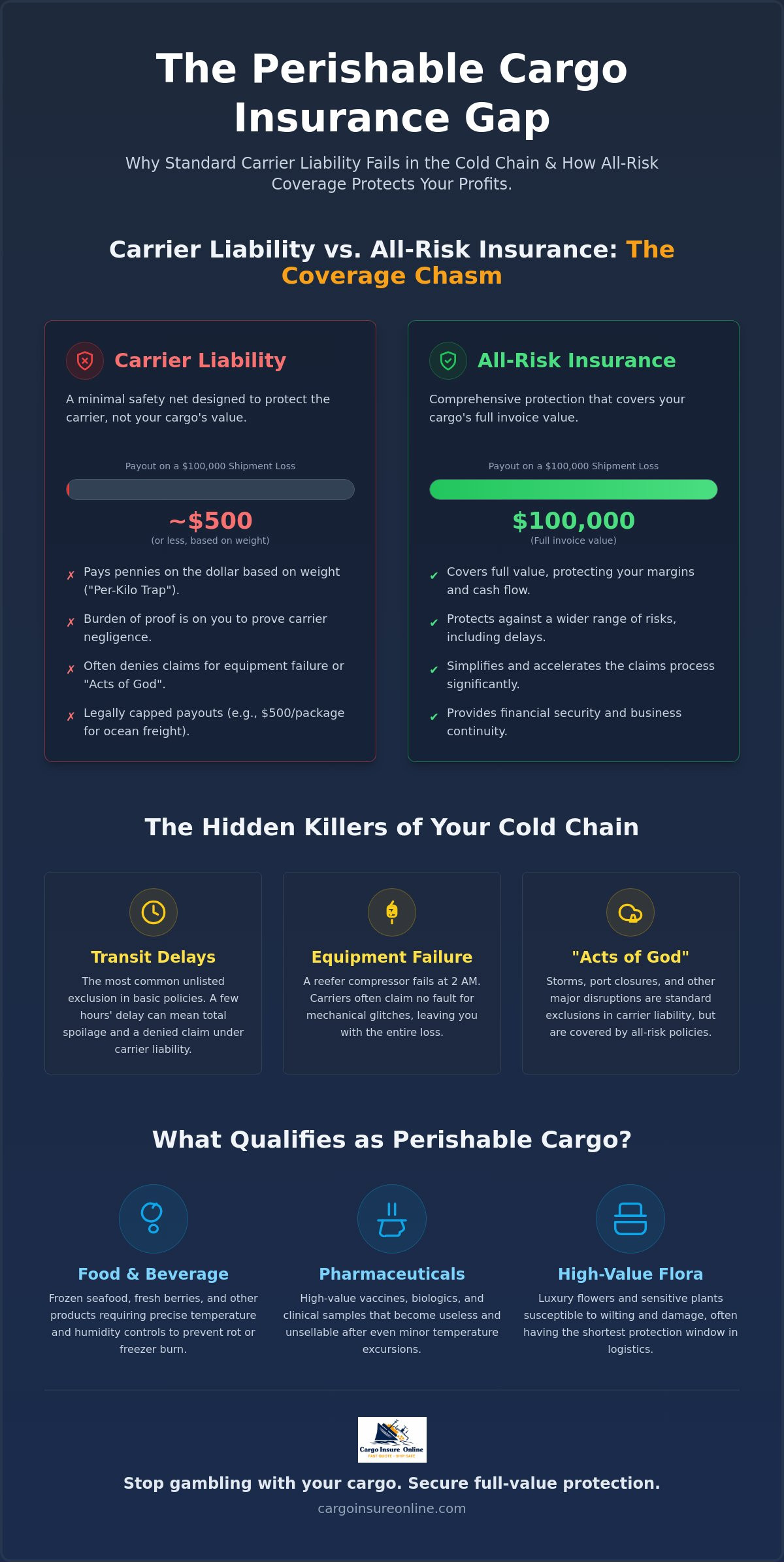
What Qualifies as Perishable Cargo?
Perishability isn't limited to the grocery aisle. It encompasses anything with a shelf life dictated by environmental stability. It's about protecting anything that can't survive a delay.
- Food and Beverage: This includes everything from deep-frozen seafood to fresh-picked berries. Each requires specific thermal thresholds and humidity controls to prevent freezer burn or rot.
- Pharmaceuticals and Life Sciences: Vaccines, clinical samples, and biologics are highly sensitive. A minor delay or a power failure can render these life-saving products useless and legally unsellable.
- High-Value Flora: Luxury flowers and sensitive plants are susceptible to wilting and ethylene damage during transit. These items often have the shortest "protection window" in the entire logistics industry.
The Real Cost of Spoilage
The financial damage of a failed shipment goes far deeper than the commercial invoice value. When cargo spoils, the immediate product loss is just the beginning. You face massive disposal costs and must navigate strict environmental regulations for bio-waste. Your reputation takes a hit too. A missed delivery to a major retailer can lead to "on-time, in-full" (OTIF) penalties and a permanent loss of customer trust. Finally, frequent claims on poorly managed or "cheap" policies will drive your future premiums higher. Using a specialized Reefer Product ensures that when things go wrong, the recovery is as fast as the initial shipment. It turns a potential catastrophe into a manageable operational blip. To help manage the health challenges that come with high-pressure logistics and long shifts, you can discover Blue Collar Fit for fitness programs designed specifically for blue-collar professionals.
While ensuring your freight is covered against loss is essential, many in the industry also explore Affiliate Marketing Commissions to diversify their income and build a more resilient business model.
Carrier Liability vs. All-Risk Insurance: The $100,000 Gap
A carrier is not your insurer. They're a transport provider protected by a fortress of international laws designed to limit their financial exposure. When your temperature-sensitive cargo spoils, you'll quickly realize that carrier liability is a safety net with massive holes. Shippers often expect full reimbursement for a lost shipment. Instead, they receive a check for pennies on the dollar based on weight, not market value. This is the "Per-Kilo" trap, and it's the primary reason businesses face devastating financial gaps when the cold chain fails.
Traditional liability is built on proving fault. If a reefer unit fails due to a mechanical glitch or an "Act of God" like a sudden storm, carriers frequently deny claims entirely. They aren't required to pay if the damage resulted from circumstances beyond their immediate control. Even when they are at fault, the payouts are capped at levels that haven't kept pace with modern inflation. To understand the baseline, you can look at the legal definition of cargo insurance to see how first-party protection differs from carrier negligence. Relying on a carrier's promise is a strategy for loss. Choosing perishable goods shipping insurance is a strategy for growth.
The Limits of Ocean and Air Carrier Liability
Ocean freight is governed by COGSA, which typically limits a carrier's liability to just $500 per "package." For a container full of high-end pharmaceuticals or premium seafood, that $500 is an insult. Air freight isn't much better. The Montreal Convention sets limits based on weight, currently around $25 per kilogram. If you're shipping lightweight, high-value vaccines, you'll lose a fortune before the claim is even processed. The burden of proof rests entirely on you. You must prove the carrier was negligent, which is nearly impossible once the container has been moved or the logs have been cleared.
All-Risk: Total Protection for Perishables
All-risk coverage flips the script. You don't have to prove the carrier was "bad." You only have to prove the cargo was damaged. This modern approach covers spoilage, theft, and mechanical breakdown from the moment the goods leave your warehouse until they reach the final destination. It includes loading and unloading, two of the highest-risk periods for temperature excursions. If you're moving goods over the water, our specialized Sea Freight Insurance provides the robust protection required for long-haul voyages. Don't leave your margins to chance. You can get an instant quote today to see how affordable full-value protection can be.
The 3 Killers of Perishable Freight (And How to Insure Them)
Shipping perishables is a race against biology. Temperature excursion, transit delay, and physical damage are the three horsemen of the cold chain apocalypse. Most logistics managers focus on the obvious mechanical failures, but the real danger lies in the fine print of your policy. Standard, low-cost perishable goods shipping insurance often carries a "silent" exclusion: delay. If your cargo sits in a port for five days and the shelf-life evaporates, a cheap policy might leave you with zero recovery. You need protection that recognizes time as a physical risk.
Data is your strongest ally in 2026. The industry saw a 47% rise in the adoption of smart temperature monitoring devices in 2024, and for good reason. Real-time IoT sensors provide the "black box" evidence needed to settle claims in days rather than months. When sensors show a spike in heat during an intermodal transfer, the debate ends. Modern insurance platforms integrate this data to trigger frictionless payouts. Beyond technology, risk mitigation starts at the warehouse. Proper packaging and rigorous pre-cooling logs are essential to ensure your claim isn't denied due to "inherent vice" or poor preparation.
Temperature Excursion and Reefer Failure
Mechanical breakdown is the most common culprit. Whether it's a compressor failure on a long-haul truck or a power loss during a ship's engine room malfunction, the result is the same: total loss. Intermodal transfers are particularly dangerous. Cargo often sits on a tarmac or a dock waiting for a connection, exposed to ambient temperatures. Our specialized Reefer Cargo Insurance specifically targets these "gap" moments, ensuring that mechanical failure at any point in the journey is fully covered.
Transit Delay: The Silent Spoilage Risk
Port congestion and customs bottlenecks are the quiet killers of profit. With the FSMA Rule 204 compliance date of January 20, 2026, now in effect, enhanced traceability is mandatory. Administrative errors or missing records can lead to extended customs holds. If your insurance doesn't include a specific "Delay" clause, you're on the hook for the lost value as the product's freshness fades. Modern perishable goods shipping insurance must account for these administrative hurdles. It's not just about the cooling unit staying on; it's about the cargo moving fast enough to reach the consumer while it's still viable.
The Freshness Checklist: Securing Your Cold Chain in 2026
A successful shipment starts hours before the truck arrives. You can't rely on luck when shipping temperature-sensitive cargo. In 2026, the industry standard is proactive monitoring and bulletproof documentation. This checklist is your blueprint for minimizing risk and ensuring your perishable goods shipping insurance remains a powerful tool rather than a last resort. Every step you take before the container is sealed dictates the speed of your recovery if things go wrong.
Start with pre-cooling. Loading warm products into a refrigerated container causes the reefer unit to work overtime, leading to uneven cooling and potential mechanical failure. Always verify and archive pre-cooling logs before the doors are shut. Next, focus on the Bill of Lading. A "Clean on Board" notation is your legal proof that the cargo was in prime condition when the carrier took possession. Without this, carriers will claim the damage happened before they ever touched the freight. Finally, embrace real-time visibility. IoT trackers are no longer a luxury. They provide the granular data needed to identify exactly when a temperature excursion occurred, turning a three-month claim dispute into a three-day resolution.
Best Practices for Packing Perishables
Packaging is your first line of defense. Use high-performance insulated containers and calculate dry ice requirements based on transit times plus a 24-hour buffer. Airflow is the most overlooked factor in spoilage. Don't stack pallets to the ceiling; leave room for cold air to circulate through the entire load. Standardized labeling for "Temperature Sensitive" goods is essential. It ensures ground crews prioritize your cargo at intermodal hubs where exposure risks are highest.
Choosing the Right Insurance Partner
Traditional insurance is broken. You don't have time for manual paper trails and 30-day claim cycles while your inventory rots. Look for a partner that offers frictionless digital claims and instant quoting. If you're moving high-value vaccines or fresh produce by plane, ensure your provider has robust Air Freight Insurance capabilities. You need a specialist that understands the unique pressures of the cold chain and can handle high-value cargo with ease. Protect your next shipment in seconds. Get your instant reefer quote now and secure your margins.
Cargo Insure Online: Frictionless Protection for Sensitive Cargo
Old-school insurance is a relic. It's slow, manual, and disconnected from the reality of a moving reefer container. While traditional brokers are still shuffling paper, your margins are at risk. Cargo Insure Online (CIO) is the disruptive alternative. We've built a digital-first engine that understands the cold chain isn't just about transport. It's about time. Our perishable goods shipping insurance is designed to move at the same high speed as the global logistics industry. Stop waiting for callbacks. Start securing your cargo in real time.
Speed is our primary feature. We've replaced the week-long quoting process with a streamlined interface that delivers results in seconds. You enter your data, and we provide instant coverage. This efficiency extends to our claims process. Because we leverage digital documentation and IoT sensor data mentioned earlier, we eliminate the friction that usually stalls payouts. When your inventory is at risk, every hour matters. We ensure that capital returns to your business fast, allowing you to replace stock and maintain your supply chain without missing a beat.
Embedded Solutions for Logistics Providers
For freight forwarders and 3PLs, insurance shouldn't be an afterthought. It should be a revenue driver. We offer sophisticated API integrations that allow you to bake protection directly into your existing Transport Management System (TMS). You can even launch your own branded cargo insurance platform using our white-label solutions. This isn't just about convenience. It's about automating risk management for every shipment you handle. By integrating our Reefer Product into your workflow, you increase your service value and protect your clients' interests simultaneously.
Get Started with Perishable Coverage Today
The era of bureaucratic insurance is over. You don't need a broker who only works nine-to-five. You need a tech-savvy ally that operates 24/7 in the digital space. Our pricing is transparent. There are no hidden fees or "gotcha" clauses buried in fine print. We provide the clarity you need to make fast, confident decisions for your business. Whether you're moving fresh produce or high-value biologics, our perishable goods shipping insurance offers the modern protection you deserve. Don't let another shipment leave the dock unprotected. Get your instant quote now and experience the future of cargo protection.
Future-Proof Your Cold Chain Margins
Traditional carrier liability isn't a safety net; it's a financial liability that leaves your business exposed. You've seen how the "Per-Kilo" trap and silent killers like transit delay can rot your profits before the cargo even arrives. Modern perishable goods shipping insurance is no longer a luxury for 2026 logistics. It's a fundamental requirement for anyone serious about protecting high-value, temperature-sensitive inventory.
Cargo Insure Online replaces the slow, bureaucratic mess of the past with a frictionless, digital-first experience. We offer global reefer protection that scales with your business through API-ready solutions and an automated claims process that respects your time. Don't let a single cooling failure or customs bottleneck derail your growth. You can eliminate the friction and secure your freshness in seconds.
Get Your Instant Perishable Insurance Quote and experience the relief of total cargo confidence. Your cold chain is moving fast. Your insurance should finally keep up.
Frequently Asked Questions
Does perishable goods insurance cover spoilage due to shipping delays?
Yes, high-quality perishable goods shipping insurance covers spoilage from transit delays, provided your policy includes a specific delay clause. Traditional carrier liability almost never pays for lost shelf life, but our all-risk solutions do. This is critical in the 2026 logistics market where port congestion and administrative bottlenecks are constant threats to your margins.
What is the difference between reefer insurance and perishable cargo insurance?
Reefer insurance focuses on the mechanical integrity of the refrigerated container, while perishable cargo insurance covers the actual goods inside. Our specialized Reefer Product combines both. It protects you against equipment failure and the resulting damage to your temperature-sensitive stock. It's a comprehensive shield that replaces the need for multiple, disconnected policies.
How do I prove a temperature excursion claim?
Prove your claim using IoT sensor data and pre-cooling logs. With the 47% rise in smart monitoring device adoption in 2024, digital evidence is now the industry standard. You need a clear timeline showing exactly when the temperature deviated from the required set point. Combine this with a "Clean on Board" Bill of Lading to establish the cargo's condition at origin.
Are pharmaceuticals covered under perishable goods insurance?
Yes, pharmaceuticals and life sciences are fully covered. Vaccines, clinical samples, and biologics are among the most sensitive perishables we protect. These items require strict compliance with FSMA Rule 204 traceability standards as of January 20, 2026. Our digital-first approach ensures these high-value shipments have the precise documentation needed for fast, frictionless claims.
Does this insurance cover "Acts of God" like extreme weather?
Yes, all-risk insurance covers "Acts of God" that carriers typically use to deny liability. Extreme weather, floods, and natural disasters are standard exclusions for transport providers, but they are core components of our coverage. We stop the finger-pointing. If a storm knocks out port power and your reefer fails, you get paid regardless of carrier excuses.
Can I get a quote for international perishable shipping online?
You can get an instant quote for international shipments in seconds. Our platform is built for speed. Just enter your cargo details, route, and value to see transparent pricing immediately. No more waiting days for a broker to call you back while your shipping window closes. It's the fastest way to secure perishable goods shipping insurance globally.
What documents are needed to file a perishable cargo claim?
You need the commercial invoice, the Bill of Lading, temperature logs, and photos of the spoiled goods. Accurate records are vital for the frictionless digital claims we provide. Since the FSMA Rule 204 compliance date of January 20, 2026, enhanced traceability is mandatory. Having these digital records ready ensures your payout happens in days, not months.
Is there a minimum shipment value for perishable insurance?
There is no rigid minimum value that blocks you from professional protection. We cater to everything from small e-commerce batches to full container loads. Our goal is to make cargo insurance accessible for all high-speed logistics. Whether you're shipping a single pallet of premium flora or a massive pharmaceutical load, you can secure coverage that fits your specific scale.


