
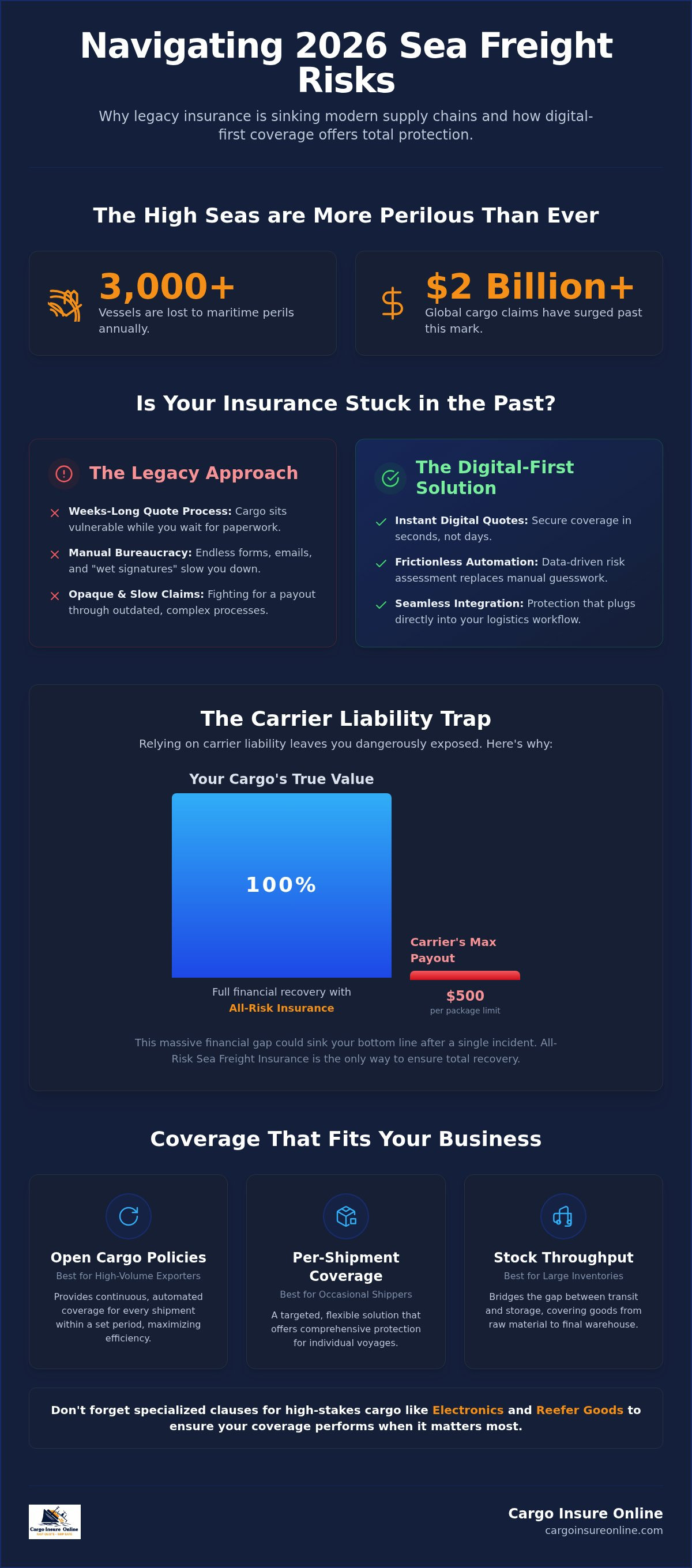
Did you know that over 3,000 vessels are lost to maritime perils every single year? As we move through 2026, global cargo claims have surged past $2 billion, proving the high seas are as unpredictable as ever. Relying on outdated sea freight insurance or basic carrier liability leaves you exposed to massive financial gaps that could sink your bottom line before your goods even leave the port.
You've probably felt the frustration of waiting days for a single quote or battling complex claims processes for international losses. It's an outdated, bureaucratic chore that doesn't fit the speed of modern trade. We believe protecting your investment shouldn't be the slowest part of your supply chain. It's time to ditch the paperwork and embrace a system built for the digital age. You deserve a partner that moves as fast as you do.
This article shows you how to secure your shipments with instant, all-risk coverage that replaces red tape with digital-first speed. We'll dive into the reality of 2026 maritime risks, explain why traditional liability limits often fail, and show you how to integrate seamless, transparent protection directly into your existing logistics workflow. It's time to trade uncertainty for total confidence and keep your business moving forward.
Key Takeaways
- Stop letting legacy insurance slow down your 2026 supply chain. Discover how digital-first speed eliminates the weeks-long wait for traditional quotes.
- Avoid the carrier liability trap where payouts are often capped at just $500 per package. Learn why all-risk sea freight insurance is the only way to ensure total financial recovery.
- Tailor your protection for high-stakes cargo like electronics and reefer products. We reveal why specialized clauses are the key to coverage that actually performs when you need it.
- Master the strategic choice between Open Cargo policies and per-shipment coverage. Find the perfect balance for your specific shipping frequency and volume to maximize efficiency.
- Get your shipments protected in seconds, not days. See how seamless digital integration allows you to secure comprehensive coverage without the administrative friction.
Why Traditional Sea Freight Insurance Fails Modern Logistics
Stop settling for 19th-century bureaucracy in a 21st-century economy. The global market never sleeps. Your logistics team works at light speed. Yet, when you need sea freight insurance, the entire process often grinds to a painful halt. You're forced into a world of manual forms, static spreadsheets, and endless follow-up emails. It's not just annoying; it's a liability. Legacy carriers still prioritize paper trails over your shipment speed. They operate on schedules that simply don't match the high-velocity reality of modern trade. If your insurance partner is still using "wet signatures" and fax machines, they aren't protecting your business; they're slowing it down.
Modern logistics demands instant, automated sea freight protection. You don't have days to wait for a committee to decide if your cargo is worth the risk. You need a tech-savvy ally that understands the digital landscape of 2026. This isn't just about getting a policy; it's about empowering your entire supply chain with speed and clarity. We've moved past the era of "wait and see." Today, protection must be as agile as the vessels carrying your goods.
The High Cost of Waiting for a Quote
Delayed coverage is a silent killer for your supply chain. Every hour you spend waiting for an underwriter to sign off is an hour your cargo sits in a state of vulnerability. Many shippers find themselves shipping "naked," sending goods across the ocean without active protection because the paperwork didn't clear the port in time. This is a massive gamble that no professional should take. By the time you receive a manual quote, the window for securing the best terms might have already closed.
In 2026, instant digital quotes are the new industry standard. They provide the certainty you need to book shipments with confidence. Real-time pricing allows you to factor costs into your margins immediately, rather than guessing and hoping for the best. Fast protection ensures your goods are covered the moment they leave the warehouse, not three days into their journey across the Atlantic.
Bureaucracy vs. Intelligence: The CIO Difference
We don't do manual. We do intelligence. Traditional insurance relies on human guesswork and slow-moving committees that haven't changed much since the early days of trade. You can explore a historical Marine Insurance Overview to see how deep these roots go, but history shouldn't dictate your current efficiency. We've replaced manual bottlenecks with automated risk assessment. By using data-driven insights, we remove the friction that has plagued global marine cargo for decades.
Technology allows us to analyze risks in seconds, providing you with a level of precision that legacy carriers can't match. Frictionless insurance is the future of sea freight; it's a seamless, invisible layer of protection that moves at the speed of your data. It turns a perceived administrative chore into a positive, high-speed experience. When you remove the paperwork, you're left with pure, unadulterated protection that keeps your business moving forward without the drag of old-school bureaucracy.
Defining Sea Freight Insurance: Total Coverage for the High Seas
Think of sea freight insurance as your financial life jacket. It's a specialized policy designed to cover physical loss or damage to ocean cargo while it’s in transit. Whether your goods are crossing the Atlantic or the Pacific, this protection ensures that a single storm or shipping error doesn't derail your entire business model. It's about turning the "what-ifs" of global trade into manageable certainties.
You have choices in how you protect your assets. High-volume exporters typically lean toward Open Cargo policies, which provide continuous, automated coverage for every shipment within a set period. If you only ship occasionally, per-shipment coverage offers a targeted solution for individual voyages. For businesses with massive inventory, Stock Throughput is the secret weapon. It bridges the gap between transit and storage, covering goods from raw material stages all the way to the final warehouse shelf.
The high seas are volatile. In 2026, maritime risks range from heavy weather and improper stowage to the complex legalities of General Average. Having the right sea freight insurance in place means you aren't just reacting to disasters; you're moving ahead of them with confidence.
All-Risk vs. Named Perils
In the world of maritime protection, All-Risk is the undisputed gold standard. Currently, an estimated 59% of insured shipments utilize this coverage because it protects against all external causes of loss unless specifically excluded. It's the ultimate relief for modern logistics managers. In contrast, Named Perils only covers specific events listed in the policy, like fire or sinking. While All-Risk is comprehensive, you must still watch for common exclusions like inherent vice, which is damage due to the product's nature, or losses caused by improper packaging. Getting it right means total peace of mind regardless of what the ocean throws your way.
Understanding General Average in 2026
General Average is a maritime principle that can feel like a relic, but it’s a very real threat in 2026. If a vessel is in peril and the captain sacrifices cargo or incurs expenses to save the ship, all cargo owners share the loss proportionally. Without insurance, you could be legally required to pay for someone else’s jettisoned goods just to get your own container released from the port. It’s a massive financial shock that can reach six figures instantly. Our digital-first platform ensures you’re protected from these claims, handling the bonds and guarantees so your supply chain doesn't skip a beat.
Carrier Liability vs. All-Risk Insurance: Why the 'Per-Kilo' Rule is a Trap
The dangerous myth: "The shipping line is responsible for my goods." It sounds logical, but it's a financial trap. In the world of global logistics, relying on carrier liability is like using a paper umbrella in a hurricane. Carriers aren't your partners in risk. They are businesses protected by century-old international laws designed to limit their exposure, not yours. Stop gambling with your cargo. Own your own protection with comprehensive sea freight insurance.
Under the Carriage of Goods by Sea Act (COGSA), a carrier's liability is often capped at a staggering $500 per package. If your container holds high-value electronics or specialized machinery, that $500 is a drop in the ocean. To make matters worse, recovering even that small amount requires you to prove the carrier was negligent. This is a legal nightmare. You'll face a wall of 17 "excepted perils," including acts of God or even errors in the navigation of the ship, which legally absolve the carrier of any blame. Proving they were at fault while your goods were thousands of miles away is nearly impossible. Don't settle for limited liability. Choose total coverage.
The Payout Gap: Real World Examples
Imagine a shipment of high-end tablets worth $100,000 is crushed during a storm. If you rely on the carrier, your payout might be limited to just $500 for that entire pallet. The "per package" or "per kilo" rules aren't there to help you recover your losses. They exist to ensure the carrier stays profitable even when they lose your cargo. These rules prioritize the vessel owner's bottom line over your inventory's value. You can learn more about these dangerous gaps in our guide on Carrier Liability vs Cargo Insurance.
Claims Speed: Months vs. Days
Carrier claims are notorious for their glacial pace. You fill out manual forms, wait for months, and usually receive a denial letter hidden behind complex legal jargon. It's a system built on friction and delay. We've flipped the script. The CIO approach uses digital claims designed for the high-speed logistics era of 2026. We prioritize your recovery over paper trails. By removing the middleman, we accelerate the entire process from filing to payout. All-risk insurance is an investment in your business's continuity, not a cost to be minimized. It transforms a potential total loss into a temporary setback, keeping your cash flow steady and your customers happy while your competitors are still stuck in the carrier's waiting room.
Tailoring Your Protection: From High-Value Electronics to Reefer Goods
Stop settling for generic coverage. If you're shipping high-end smartphones with the same policy used for scrap metal, you're exposing your business to massive financial risk. In 2026, one size fits none. Specialized cargo requires specialized clauses that actually understand the product inside the box. Modern sea freight insurance shouldn't be a blanket; it should be a tailored shield that fits your specific industry needs.
E-commerce on the ocean has changed the game. Amazon FBA and Shopify sellers can't afford the "payout gap" of legacy insurance. Your business depends on inventory arriving on time and in perfect condition. We provide the digital-first protection that fits the pace of online retail. We've replaced the slow, manual adjustments of the past with automated, product-specific logic that identifies your risk profile in seconds.
Electronics & Mobile Device Protection
High-value tech is a magnet for theft and a victim of fragile handling. Standard marine policies often fall short because they don't account for the unique vulnerabilities of sophisticated hardware. Whether you're moving the latest mobile devices or high-spec UAVs, you need Electronics shipping insurance built for the 2026 market. This isn't just about physical damage; it's about protecting the full market value of your innovation. Drones in international transit are particularly sensitive to handling errors. We ensure your tech arrives ready to deploy, not ready for the scrap heap.
Reefer Cargo: Preventing the Big Melt
The cold chain challenge is a high-stakes race against time. A single power failure or equipment breakdown can turn a shipment of pharmaceuticals or fresh produce into hazardous waste. You need precise coverage that triggers the moment the temperature deviates. Our Reefer Cargo Insurance provides the specific protection required for perishables. We handle the risks of mechanical derangement and power outages that traditional carriers often exclude. If the reefer stops humming, your coverage starts working. Don't let the "big melt" sink your margins. Protect your high-stakes inventory with a partner that understands the ocean is the new digital highway. Secure your specialized cargo now with a digital quote that moves as fast as your business.
Cargo Insure Online: Get Your Sea Freight Quote in Seconds
Stop waiting. Start shipping. The era of the "three-day turnaround" for a sea freight insurance quote is officially over. We've replaced the slow-motion dance of legacy brokers with a 30-second digital promise. You enter your shipment details, and our engine delivers a precise, all-risk quote instantly. It's not just faster; it's smarter. We've built a platform that respects your time and your bottom line.
Zero paperwork. 100% confidence. That is the digital-first CIO experience. We understand that global trade in 2026 doesn't happen in a vacuum. You need worldwide coverage for every major sea route, from the busy lanes of the South China Sea to the trans-Atlantic corridors. Our local expertise is baked into our global reach. We've mastered the complexities of maritime law and General Average so you don't have to. Integration is effortless. You can plug CIO into your existing logistics workflow today and watch the friction disappear.
Digital-First Integration
Our platform empowers logistics providers and e-commerce sellers to move at the speed of the internet. We've simplified the most painful part of the process: the claims. Our digital claims engine is built for the high-velocity logistics era. It removes the hurdles that traditional insurers use to delay payouts. For partners looking to scale, we offer White Label Cargo Insurance. This allows you to launch your own branded insurance engine, providing your clients with the same seamless experience while keeping your brand front and center.
Ready to Ship? Secure Your Cargo Now
The final step is the easiest. You don't need a degree in maritime law to protect your assets. Just enter your shipment details and get protected in seconds. Why settle for legacy carriers that prioritize their own paper trails over your shipment speed? 2026 is the year to ditch the bureaucracy and embrace a tech-savvy ally. You've worked hard to build your inventory and manage your supply chain. Don't let an outdated insurance process be the weak link.
Sea freight insurance should be a high-speed digital asset, not an administrative burden. It transforms your risk management from a headache into a competitive advantage. Click below to get your instant quote and experience the future of cargo protection today.
The Future of Maritime Trade is Digital and Frictionless
The high seas aren't getting any safer, but your protection can get a lot smarter. We've exposed why relying on carrier liability is a financial trap that leaves your business vulnerable. You need a partner that moves at the same velocity as your supply chain. With sea freight insurance from Cargo Insure Online, you replace bureaucratic delays with instant digital quotes and zero paperwork.
We provide specialized protection for high-value tech and reefer goods, ensuring your most sensitive inventory is shielded from the unexpected. Our global all-risk coverage, powered by CIO Sphere Inc., is designed for the modern logistics era. Don't let 19th-century red tape sink your 2026 growth. It's time to trade uncertainty for total confidence and keep your goods moving without the friction of legacy carriers.
Stop Waiting and Start Shipping—Get Your Instant Sea Freight Quote Now! Your business deserves a tech-savvy ally that values your time as much as you do. Let's make every shipment a success.
Frequently Asked Questions
Is sea freight insurance mandatory for international shipping?
No, it's not legally required like vehicle insurance, but it's a commercial necessity for any serious business. Most Incoterms, such as CIF or CIP, require the seller to provide coverage. Shipping without it means you're assuming 100% of the risk. Since carrier liability is often capped at just $500 per package, skipping sea freight insurance is a gamble that could sink your bottom line if a vessel is lost.
How much does sea freight insurance cost in 2026?
Cost depends on your cargo value, the specific route, and the risk profile of your goods. In 2026, we also factor in dynamic war-risk surcharges for high-risk maritime zones. Instead of guessing, we use an automated system to calculate your premium instantly. We typically base the insured value on your invoice price plus freight costs, adding a standard markup to cover profit. This ensures your coverage matches your actual exposure.
What does "All-Risk" sea freight insurance actually cover?
All-Risk is the gold standard for 2026 logistics, protecting against almost all physical loss or damage from external causes. This includes theft, water damage, sinking, and fire. It's built to cover the unexpected, giving you total peace of mind. However, it doesn't cover everything. You'll still see exclusions for "inherent vice," which refers to damage from the product's own nature, or losses caused by improper packaging. It's comprehensive but requires proper documentation.
Can I get insurance for high-value electronics or reefer goods?
Yes, we specialize in these high-stakes categories. High-value electronics require specific clauses to address theft and fragile handling risks that standard policies often miss. For reefer products, our coverage includes protection against mechanical derangement and power failure. This ensures that if your cold chain breaks, your finances don't. We've replaced the slow, manual underwriting of the past with automated, product-specific logic for these specialized goods, ensuring you get protected in seconds.
What is General Average and why does it matter to me?
General Average is a maritime principle where all cargo owners share the cost if a ship's captain sacrifices cargo to save the vessel. If your container is safe but others were jettisoned, you're legally required to pay a share of the loss. Without sea freight insurance, your goods won't be released from the port until you pay a bond. Our policies cover these claims, preventing massive financial shocks and keeping your supply chain moving.
How long does it take to get a cargo insurance quote online?
It takes roughly 30 seconds. We've eliminated the weeks of emails and manual forms that define legacy carriers. Our digital-first platform uses automated risk assessment to give you an instant quote. You enter your shipment details, and the system generates a price immediately. This speed allows you to factor insurance costs into your margins right away, keeping your supply chain moving at the speed of modern trade without any administrative friction.
What documents do I need to file a sea freight insurance claim?
You'll need the commercial invoice, the bill of lading, and a packing list. A survey report or photos of the damage are also essential for verifying the loss. While traditional claims take months, our digital claims engine accelerates the process. We prioritize transparency and speed, removing the hurdles that usually follow a loss. Having digital copies of these documents ready helps ensure your payout happens in days, not weeks, protecting your cash flow.
Does sea freight insurance cover door-to-door or just port-to-port?
Most modern policies, including ours, provide door-to-door coverage. This is often called "warehouse to warehouse" protection. It covers your goods from the moment they leave the supplier until they arrive at the final destination. This includes the trucking legs at both ends of the ocean voyage. It's the only way to ensure there are no gaps in your sea freight insurance as your cargo moves through various hands, warehouses, and transit modes.


