
Your carrier's $100 liability limit isn't a safety net. It's a trap. When you're moving thousands of dollars in electronics or drones, relying on standard protection is a high-stakes gamble you've already lost. Most brands realize this only after a claim is denied on a technicality or a payout covers barely 5% of the total loss. Securing reliable e-commerce shipping insurance for high-value goods shouldn't feel like a bureaucratic nightmare. It's time to stop settling for laughably low limits and start protecting your bottom line with speed and precision.
We know the frustration of slow, paper-heavy processes that stall your global scaling. You need a digital-first solution that moves as fast as your sales. This 2026 guide reveals how to bypass carrier traps and secure instant, tech-driven all-risk coverage. You'll learn the critical difference between "declared value" and true insurance, how to achieve full invoice value recovery, and the secrets to a frictionless claims process that doesn't require a law degree. We are going to break down the specific carrier limits for 2026 and show you how to swap administrative headaches for total peace of mind.
Key Takeaways
- Carrier liability is a trap. Learn why the standard $100 default is a gamble that puts your high-tech inventory at risk.
- Secure full invoice value recovery. Discover how e-commerce shipping insurance for high-value goods outclasses "declared value" with instant, all-risk protection.
- Beat the porch pirates. Implement the "No-Label" rule and strategic packaging to eliminate theft triggers during transit.
- Ditch the paperwork. Experience a frictionless, tech-driven claims process designed for modern global scaling.
- Protect what matters most. Access specialized coverage built specifically for drones, mobile phones, and sophisticated electronics.
The High-Value E-Commerce Boom: Why Legacy Protection is Breaking
High-value goods aren't a niche side-hustle anymore. They are the high-octane fuel powering modern retail. By 2026, shipping high-ticket items like premium drones and specialized electronics has become the standard operating procedure for growing brands. But there's a problem. Legacy insurance models are cracking under the pressure of digital-first commerce. These old systems are slow, clunky, and manual. They rely on "maybe" protection instead of guaranteed financial recovery. To survive this shift, brands need e-commerce shipping insurance for high-value goods that operates at the same speed as their sales. With global cargo claims exceeding $2 billion annually, the era of "hoping for the best" is officially over.
The Rise of Tech and Luxury Shipments
Electronics and high-end tech aren't just expensive; they're high-stakes. A $5,000 drone requires more than just extra bubble wrap. It requires a financial safety net that understands the specific risks of the 2026 logistics landscape. Consumers now expect instant replacements if a shipment goes dark. Industry data shows that loss and damage rates for e-commerce typically fall between 1% and 3% of shipments. That might sound small until it's your most expensive SKU that disappears. If your logistics plan doesn't include a guarantee of full invoice value recovery, you're essentially self-insuring your most expensive assets. Without a tech-forward insurance partner, you're forced to choose between losing a customer or eating the cost of the loss yourself.
Friction: The Silent Margin Killer
Administrative friction is a direct drain on your bottom line. Traditional processes often involve waiting days for a quote or navigating complex legal jargon. This is a relic of a slower time. While the foundational concepts of protecting cargo in transit over land evolved from Inland marine insurance, the 2026 market demands a much faster, automated approach. Automation is the answer. Moving from paperwork to digital integration means your insurance keeps pace with your global scaling. It’s about removing the administrative chore and replacing it with a seamless workflow. You shouldn't have to pause your global expansion because your insurer is still using spreadsheets. When you're scaling into new international markets, you can't afford the friction of bureaucratic insurance. You need an ally that provides near-instantaneous solutions.
The 2026 landscape demands a disruptive approach to risk management. It isn't just about covering a loss. It's about protecting your brand's reputation and your customer's trust. Sophisticated sellers are moving away from reactive models and embracing proactive, digital-first allies. This shift ensures that every shipment, no matter the value, is backed by a system that values your time as much as your inventory. By integrating e-commerce shipping insurance for high-value goods directly into your workflow, you transform a perceived administrative chore into a competitive advantage. You gain the confidence to ship anywhere, knowing your margins are shielded by modern, tech-driven protection.
The Carrier Liability Trap: Why $100 Coverage Won't Save Your Tech
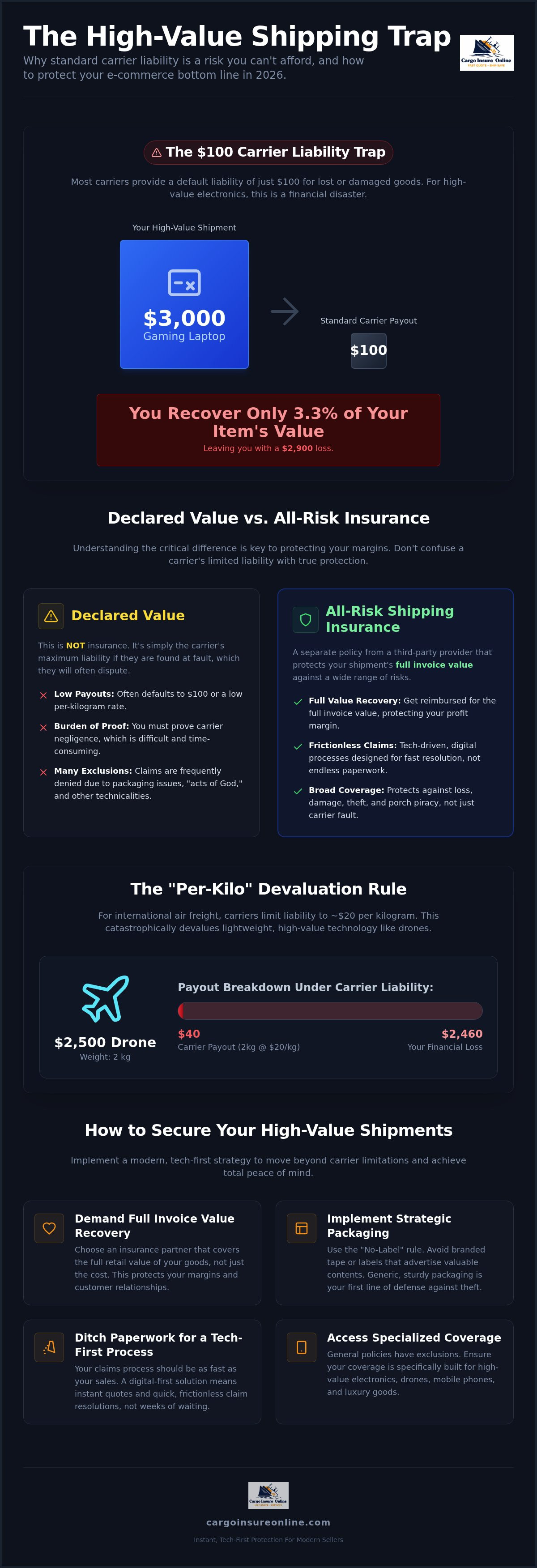
Carrier liability isn't a safety net. It's a statutory limit that often covers less than 5% of a high-value item's cost. Most shippers mistakenly believe the "Declared Value" box on a shipping label is a comprehensive insurance policy. It's not. Major carriers like UPS, FedEx, and USPS provide a standard $100 of coverage for most services. For a $3,000 gaming laptop or a specialized drone, that's a rounding error. It's the bare legal minimum carriers provide to satisfy regulations while keeping their own financial exposure at zero. Relying on this default is the fastest way to drain your margins when a shipment goes missing.
The "Per-Kilo" rule is where tech sellers truly lose. For international air freight, the Montreal Convention limits payouts to approximately $20 per kilogram. If you're shipping a lightweight, high-value drone, you might receive a check for $40 on a $2,500 total loss. This rule effectively devalues your inventory before it even leaves the warehouse. You aren't just losing the hardware; you're losing the shipping costs, the customer's trust, and the time spent managing the disaster. This is why e-commerce shipping insurance for high-value goods is no longer optional; it's a fundamental requirement for business survival in 2026.
The $1,000 Ceiling and Other Merchant Pitfalls
Declared value is often an expensive illusion. It doesn't actually change the terms of the shipping contract. It simply raises the maximum amount a carrier *might* pay if you can prove they were entirely at fault. The burden of proof is high. You must provide evidence that your packaging was flawless and that the damage occurred solely due to carrier negligence. Carriers frequently default to a "denied" status because their legacy systems aren't built for the speed of modern retail. To see how these gaps affect your specific inventory, read our deep dive on Carrier Liability vs Cargo Insurance: Don't Get Burned.
Hidden Exclusions in the Fine Print
The fine print is designed to protect the carrier, not your bottom line. "Mechanical derangement" is the industry's most common excuse for denying tech claims. If a high-end camera arrives and fails to power on, but the external box is pristine, the carrier will claim the failure was internal and deny the payout. They also hide behind "Force Majeure" or Acts of God. If a storm delays a vessel and your electronics suffer from humidity or heat damage, standard carrier protection won't cover a cent. These legacy models ignore the unique transit risks associated with drones and sophisticated mobile devices. You need a sophisticated ally that offers E-Commerce Cargo Insurance to shield your revenue from these hidden traps.
Third-Party Insurance vs. Declared Value: The ROI of All-Risk Coverage
Stop settling for "maybe." When you ship high-ticket inventory, "declared value" is a gamble disguised as a service. It's time to talk ROI. Carriers don't sell insurance; they sell limited liability. If they lose your package, they investigate themselves. That's a conflict of interest that costs you money. In contrast, e-commerce shipping insurance for high-value goods provides a dedicated financial shield. You move from a position of begging for a payout to having a contractual right to recovery. The return on investment isn't just about the payout; it's about the certainty that your business won't take a devastating hit from a single lost pallet.
The math is simple. To protect a $5,000 shipment in 2026, major carriers charge approximately $50 to $95. Third-party specialty providers offer broader coverage for significantly less, often between $25 and $38. You're paying up to 50% less for a product that actually works. Third-party insurance is an asset; carrier liability is a liability. You shouldn't pay a premium for the privilege of a difficult claims process. Switch to a model that prioritizes your margins and eliminates the guesswork from your logistics strategy.
All-Risk: Total Peace of Mind
All-Risk coverage is the definitive "yes" to your worst "what-if" questions. Unlike carrier liability, which only covers what you can prove the carrier broke, All-Risk covers everything unless it's specifically excluded. It protects the full invoice value plus freight costs. This is vital for electronics. If a device arrives with "concealed damage", meaning the box is fine but the internal sensors are fried, All-Risk has your back. To understand how this fits into your broader strategy, check out What is Cargo Insurance? The Modern Guide to Shipping. It's the difference between a total loss and a minor speed bump.
The Claims Equation: Time is Money
Slow claims kill cash flow. Carriers often take 30 days or more to process a single claim. For a small business, that's a month of tied-up capital that could have been used for inventory or marketing. Digital-first resolution changes the game. You upload proof of loss, submit the digital form, and get paid. Third-party providers are incentivized to settle quickly to keep your business. They don't hide behind bureaucracy. They use technology to verify and pay out, often in a fraction of the time. You gain a sophisticated ally that values your time. Don't let a bureaucratic insurance process slow down your global scaling. Choose e-commerce shipping insurance for high-value goods for a frictionless path to recovery.
Best Practices for Shipping High-Value Electronics and Luxury Goods
Stop turning your shipping boxes into billboards for thieves. If your packaging screams "expensive electronics," you're inviting trouble before the carrier even arrives. Strategic packaging isn't just about padding; it's about operational security. While bubble wrap protects against drops, it does nothing against porch piracy or warehouse theft. High-performing sellers know that e-commerce shipping insurance for high-value goods works best when combined with a "No-Label" policy. This means using plain, discreet boxes that give no hint of the $2,000 drone or premium smartphone inside. Discretion is your first line of defense.
Maintaining a digital log of IMEI numbers and serial numbers for every unit shipped is critical, as insurers require this specific data to verify the identity of lost or stolen devices before approving a claim. Without this tracking, you're left with a generic loss that's easily disputed. You must prove exactly what was in the box to get paid. Documentation is the bridge between a denied claim and a full recovery.
Operational Security for Tech Sellers
Don't just tape the box. Seal the deal. Use dual-layered, heavy-duty corrugated boxes to prevent crushing, but focus heavily on tamper-evident seals. Standard clear tape is an invitation for "fishing" inventory out of a box; reinforced water-activated tape makes it impossible to open without leaving visible evidence. For shipments exceeding $10,000, consider GPS tracking inserts. These devices provide real-time location data that can be the smoking gun in a theft investigation. If you're moving inventory across international lines, check out our Cross-Border E-Commerce Insurance: The 2026 Guide to ensure your security protocols meet global standards. High-value tech demands a high-tech approach to safety.
The Fulfillment Center Hand-off
The journey from your warehouse to a fulfillment center like Amazon FBA is a high-risk gap. You must bridge this with clear documentation. Photograph the "Condition of Goods" and the sealed pallet before the truck pulls away. This creates a timestamped audit trail that prevents carriers from claiming the damage happened in your warehouse. 2026 Amazon FBA requirements are stricter than ever regarding cargo insurance compliance. You need to ensure your policy explicitly covers the transit to these hubs. Handling high-value returns is equally risky. Always provide customers with a pre-paid, insured label that requires a signature. Never let a $1,000 return float through the mail system unprotected. Protect your high-value inventory with Cargo Insure Online and eliminate the risk of the fulfillment hand-off.
Cargo Insure Online: Instant, Tech-First Protection for Modern Sellers
Stop waiting for an underwriter to wake up. In the fast-moving world of global trade, a manual quote is a dead end. Cargo Insure Online (CIO) replaces the traditionally dry, bureaucratic insurance process with a high-speed digital engine. We've eliminated the "carrier liability trap" by building a platform that prioritizes speed and clarity over fine print. It's time to move from administrative chores to seamless growth. CIO acts as your sophisticated ally, transforming e-commerce shipping insurance for high-value goods from a complex hurdle into a near-instantaneous solution. We don't just cover your shipments; we empower your entire logistics workflow.
The legacy model of insurance was built for a slower era. Today, your business scales globally in clicks, not months. You need a partner that operates at the same frequency as your sales. CIO provides that momentum. Our platform offers a frictionless journey from the moment you identify a risk to the moment you secure all-risk protection. No more spreadsheets. No more vague promises. Just transparent, tech-driven coverage that respects your time and your bottom line.
Electronics & High-Value Device Specialization
Generic insurance doesn't understand the specific vulnerabilities of a carbon-fiber drone or a temperature-sensitive smartphone battery. We do. CIO offers niche protection specifically designed for high-end electronics. Whether you are moving inventory via air, sea, or road, you can secure specialized coverage in a single click. This isn't just about covering a box; it's about safeguarding the future of your brand. To see how we handle the unique risks of the tech sector, explore our guide on Electronics Shipping Insurance: Safeguarding High-Value Tech. We bridge the gap between standard logistics and high-stakes asset protection.
White-Label and API: Insurance at the Speed of Software
The biggest gap in the market today is the lack of integration. Most providers give you a login; we give you an API. You can now embed e-commerce shipping insurance for high-value goods directly into your own platform or checkout process. This allows high-volume sellers to automate their risk management entirely. If you're a logistics provider or a large-scale merchant, you can even launch your own branded insurance engine using our white-label solutions. Check out White Label Cargo Insurance: Launch Your Branded Engine to see how to monetize and streamline your protection. This is insurance reimagined as software, moving as fast as your code and your customers.
CIO is more than a service provider. We are a forward-thinking partner committed to removing every ounce of friction from your global scaling. By combining technological sophistication with an approachable, high-energy style, we make complex global logistics feel effortless. You focus on building your empire. We'll make sure every high-value shipment arrives with the certainty it deserves.
Secure Your Global Ambitions with Tech-First Protection
The 2026 e-commerce landscape moves too fast for legacy insurance models. You've seen the risks of the carrier liability trap and the laughably low $100 limits that leave your tech inventory exposed. Relying on outdated protection is a high-stakes gamble that stalls your growth. By choosing e-commerce shipping insurance for high-value goods, you swap administrative chores for a sophisticated financial shield. You gain the power to scale globally with total confidence and zero friction.
Cargo Insure Online is your sophisticated ally. We provide specialized drone and electronics coverage alongside a 100% digital claims process that actually respects your time. With global all-risk protection, you aren't just shipping boxes; you're securing your brand's future. Don't let bureaucratic insurance processes hold your business back. It's time to embrace a disruptive, digital-first approach to logistics risk management.
Stop waiting and start shipping; get your instant high-value cargo quote now!
Your bottom line deserves the best. We're ready to help you win.
Frequently Asked Questions
Is e-commerce shipping insurance necessary if I have carrier liability?
Carrier liability is a legal minimum, not a business safety net. It usually caps at $100; a fraction of the cost for high-end tech. Standard liability requires you to prove the carrier was at fault, which is a high hurdle. Real insurance covers the full invoice value regardless of who is to blame. It's the difference between a total loss and a minor speed bump.
Can I get all-risk insurance for refurbished electronics or drones?
Yes, you can secure all-risk coverage for refurbished drones and electronics. Many standard carriers exclude non-new items from their protection plans, but specialized providers don't. We focus on the certified value of the asset rather than just the retail status. This ensures your refurbished inventory is protected against the same transit risks as brand-new units.
How much does third-party shipping insurance cost for high-value items?
Third-party rates typically range from 0.5% to 1% of the declared value. For a $1,000 shipment, this costs roughly $5 to $10. Major carriers often charge $12 to $20 for the same amount of "declared value," which isn't even true insurance. You're paying less for a superior product that actually pays out when things go wrong.
What happens if my high-value shipment is stolen during transit?
All-risk insurance triggers a full recovery process the moment theft is confirmed. Unlike carrier liability, which forces you to prove carrier negligence, all-risk covers theft even if the carrier isn't at fault. This includes protection against porch piracy, a common e-commerce pain point that standard carrier protection typically ignores. You get your money back without the legal drama.
Does Cargo Insure Online cover Amazon FBA and Shopify shipments?
Yes, we provide comprehensive coverage for both Amazon FBA and Shopify workflows. Our platform is built to meet the specific 2026 Amazon FBA cargo insurance requirements. This bridges the high-risk gap between your warehouse and the fulfillment center. It ensures your e-commerce shipping insurance for high-value goods stays active through every hand-off in your supply chain.
How fast is the claims process for high-value tech items?
Our digital-first process is built for speed, not bureaucracy. While carriers often take 30 days or more to investigate themselves, a tech-driven resolution happens in a fraction of that time. You upload proof of loss digitally and move through a streamlined workflow. We prioritize your cash flow, ensuring you get paid fast so you can restock and keep selling.
What documentation do I need to file a high-value cargo claim?
You'll need the commercial invoice, proof of delivery or loss, and tracking data. For high-value electronics, IMEI and serial numbers are non-negotiable requirements. This data proves exactly what was in the box and serves as the key to a frictionless payout. Keeping these records digital and accessible is the fastest way to guarantee a successful claim.
Can I integrate Cargo Insure Online directly into my e-commerce checkout?
You can integrate our insurance engine directly into your e-commerce checkout via a robust API. This allows you to offer e-commerce shipping insurance for high-value goods to your customers in real-time. It's insurance reimagined as software, moving at the speed of your sales. You gain a branded, professional protection engine that builds customer trust and automates your risk management.


