
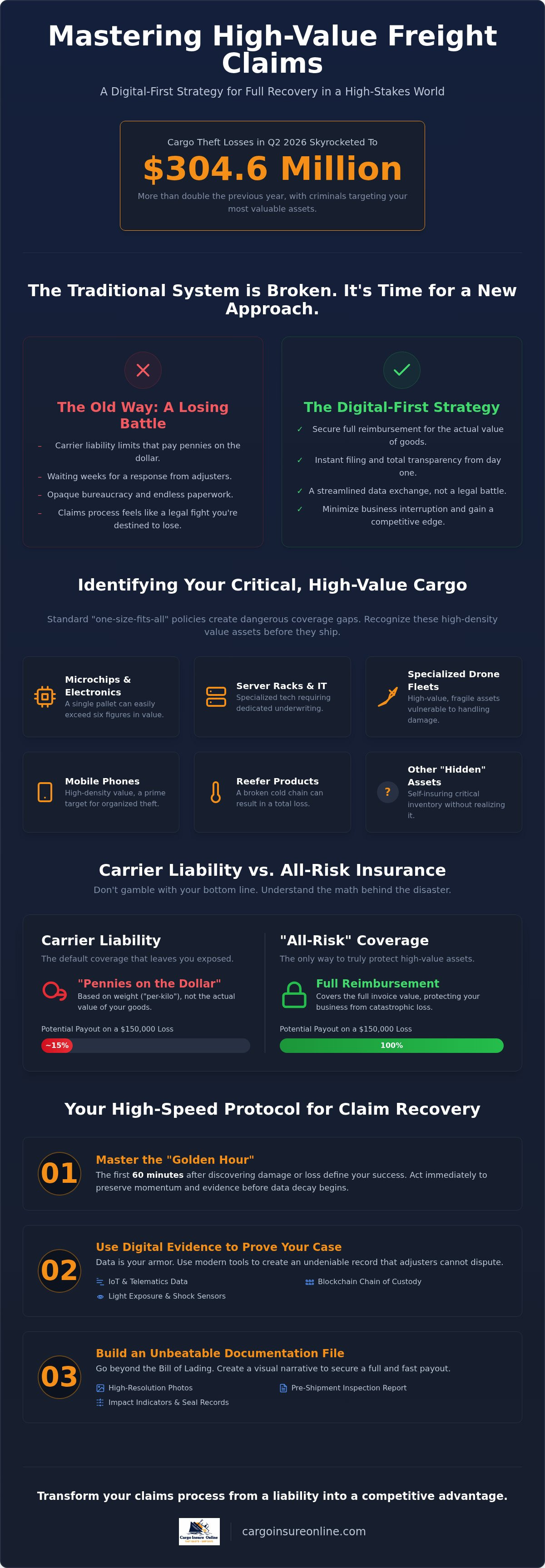
Did you know that in the second quarter of 2026, cargo theft losses skyrocketed to $304.6 million? That is more than double the losses from the previous year, even though the number of actual incidents dropped. Criminals are getting surgical; they are bypassing basic loads to hunt for your most expensive assets. If you are currently managing high-value freight insurance claims, you know the traditional system is broken. You are tired of carrier liability limits that pay pennies on the dollar. You are done waiting weeks for a response from an adjuster who doesn't understand your urgency.
It's time to stop being pushed around by opaque bureaucracy. You deserve a recovery process that moves as fast as your supply chain. This guide empowers you to master the high-stakes world of expensive cargo with a digital-first strategy that ensures you get paid what you're actually owed. We're dismissing the old "wait and see" approach in favor of instant filing and total transparency. You'll learn how to secure full reimbursement for the actual value of your goods and eliminate business interruption for good.
Key Takeaways
- Stop settling for "per-kilo" payouts. Learn how to secure full reimbursement for the actual value of your high-stakes cargo.
- Master the "Golden Hour." Use digital evidence and real-time data to bulletproof your claim within sixty minutes of discovery.
- Don't gamble with carrier liability. Discover why "all-risk" coverage is the only way to protect assets over $100,000.
- Forget the wait. Execute a high-speed recovery protocol that simplifies high-value freight insurance claims through digital-first documentation.
- Gain an edge. Transform your claims process from an administrative chore into a streamlined advantage that minimizes business interruption.
The High-Value Freight Crisis: Why Standard Claims Fail You
High-value freight isn't just a shipment; it's a target. In 2026, "expensive" takes on a whole new meaning. We're talking about microchips, server racks, and specialized drone fleets. Standard insurance is a relic of the past. It's built for cardboard boxes and bulk lumber. If you're managing complex logistics, a "one-size-fits-all" policy is a liability. These policies often leave $100,000 gaps in coverage. When a claim is denied, the fallout isn't just financial. It's a psychological blow to your logistics team. They spent weeks coordinating the move, only to be pushed around by an adjuster who doesn't understand the tech. Filing a freight claim shouldn't feel like a legal battle you're destined to lose.
The $100,000 Heartbeat: Recognizing Critical Cargo
Electronics and mobile phones aren't just gadgets. They are high-density value. A single pallet can easily exceed six figures. This requires dedicated underwriting. You can't rely on generic trucking insurance for specialized tech. Temperature-sensitive reefer products add another layer of risk. If the cold chain breaks for even ten minutes, the entire shipment could be a total loss. You must identify these "hidden" high-value assets before they leave the warehouse. Without specialized coverage, you're essentially self-insuring your most critical inventory.
Common Triggers: Theft, Damage, and Cyber-Risks
Cargo theft is evolving rapidly. Criminals are moving away from simple trailer heists toward sophisticated cyber-enabled fraud. They use shipment misdirection and business email compromise to steal high-value loads. They don't even need to break a lock. Air freight handling also remains a frequent culprit for physical damage. One wrong move with a forklift can turn a precision drone into scrap metal. Modern high-value freight insurance claims must account for these digital and physical vulnerabilities to ensure rapid recovery. Speed is your only defense in a race against data decay.
Successful recovery starts with recognizing that your cargo is unique. You wouldn't protect a diamond with a paper bag. Don't protect your 2026 logistics with a 1990s insurance policy. By understanding these triggers, you can build a high-value freight insurance claims process that actually works when you need it most.
Anatomy of a High-Value Claim: Speed, Data, and Documentation
A high-value claim isn't just paperwork. It's a high-stakes race against data decay. Forget dusty clipboards and fax machines; in 2026, data is your armor. Every second matters when you're dealing with six-figure losses. We call it the "Golden Hour." The first 60 minutes after you discover damage define your success. If you wait for a traditional adjuster to call you back, you've already lost the momentum. Digital logs provide the precise timestamps you need to win. Effective High-Value Shipping strategies rely on this level of granular detail to survive the claims process.
At Cargo Insure Online, we prioritize a frictionless, high-speed journey from loss to settlement. We know that administrative friction is the enemy of recovery. By moving beyond paper, you transform a legal battle into a streamlined data exchange. This digital-first mindset ensures that high-value freight insurance claims are resolved in days, not months. It's about empowering your team with the tools to prove their case instantly.
Digital Evidence: Using IoT and Telematics to Prove Your Case
IoT is the ultimate game changer for modern logistics. Real-time tracking data pinpoints the exact millisecond damage occurred. Was it a hard brake in Nebraska or a rough landing in Singapore? Shock sensors record the specific G-force of a dropped crate, providing undeniable proof of carrier negligence. Light exposure logs can even prove if a container was opened illegally during transit. Furthermore, blockchain technology now verifies the entire chain of custody for high-value tech, creating an immutable record that adjusters cannot dispute. This level of transparency makes high-value freight insurance claims nearly impossible to deny.
The Documentation Powerhouse: Building an Unbeatable File
The Bill of Lading is only the beginning of your evidence file. You need a visual narrative to secure a full payout. High-resolution photos are mandatory. Capture the cargo from every angle before it leaves the warehouse and the moment it arrives. Focus on seals, pallet corners, and impact indicators. A Pre-Shipment Inspection Report acts as a claim-saver by documenting the pristine condition of goods before they enter the carrier's possession. If you want to ensure your recovery is handled by experts who value your time, consider how a digital-first insurance partner can accelerate your internal protocols.
Carrier Liability vs. All-Risk: The Math Behind the Disaster
Carriers aren't in the business of replacing your high-tech inventory. They are in the business of moving boxes. If those boxes disappear, they pay for the weight, not the contents. This is the "Per-Kilo" trap. Imagine shipping a crate of high-end microchips worth $200,000. If that crate weighs 50 kilograms and goes missing, a standard air carrier might only owe you $1,000. That's a 99.5% loss you have to eat. Relying on a trucking company's standard policy isn't just risky; it's a gamble you're statistically likely to lose.
The Per-Kilo Trap: Why Carriers Won't Pay Full Value
International law protects carriers, not shippers. The Montreal Convention limits air freight liability to roughly $20 per kilogram. For sea freight, the Carriage of Goods by Sea Act (COGSA) is even more restrictive, often capping payouts at $500 per package. It doesn't matter if that package contains a drone fleet or a bag of gravel. Without a dedicated policy, your high-value freight insurance claims will hit a legal ceiling long before you're made whole. Understanding the difference between Carrier Liability vs Cargo Insurance is the first step toward real financial security.
All-Risk Protection: The Only Shield for Tech & Luxury
All-Risk Cargo Insurance flips the script. Instead of proving the carrier was negligent, you only need to prove the loss happened. In 2026, this coverage is the gold standard for global trade. It covers everything from theft and physical damage to "General Average" sacrifices at sea. However, even the best shield has limits. You must watch for exclusions like improper packaging or inherent vice. For manufacturers, electronics shipping insurance is non-negotiable. It bridges the gap between a carrier's "pennies on the dollar" payout and the actual replacement cost of your tech.
The ROI of premium protection is clear. In Q2 2026, the average value of a reported cargo theft reached $564,009. A standard carrier policy covers less than 20% of that in most scenarios. Investing in comprehensive coverage ensures that high-value freight insurance claims result in a full recovery rather than a business-ending disaster. You aren't just buying insurance; you're buying the certainty that your balance sheet remains intact regardless of what happens on the road or in the air.
Your High-Speed Protocol for Successful Claim Recovery
Stop waiting for the adjuster to call you back. In the high-stakes environment of 2026 logistics, waiting is losing. You need to stop being a passive observer and start executing your internal claim protocol the second a loss is detected. Traditional adjusters move at the speed of paper; you need to move at the speed of light. Successful high-value freight insurance claims aren't won by being patient. They're won by overwhelming the system with immediate, accurate data that leaves no room for carrier excuses. Action creates momentum. Momentum creates settlements.
Communicating with carriers requires a surgical touch. You must notify them immediately without admitting a shred of fault or waiving your legal rights. Use neutral, factual language. Instead of saying "the driver dropped the crate," state that "damage was observed upon delivery." This protects your position while satisfying the carrier’s notification requirements. Modern tech platforms now automate this process, notifying all stakeholders, from underwriters to warehouse managers, in a single click. This isn't just efficiency; it's defensive logistics at its finest.
Step-by-Step: From Discovery to Settlement
Your recovery journey follows a precise five-step checklist. First, issue an immediate "Notice of Intent to Claim" to the carrier to stop the legal clock. Second, segregate all damaged goods in a secure area to prevent further loss or tampering. Third, conduct a rapid internal value audit to determine the exact replacement cost based on current market data. Fourth, finalize your evidence packet by merging IoT sensor logs with high-resolution visual proof. Finally, move to digital filing through your branded cargo insurance platform to bypass the traditional administrative bottleneck. This protocol transforms high-value freight insurance claims from a months-long headache into a streamlined financial recovery.
The Documentation Checklist: Don’t Leave Money on the Table
Your evidence file is your currency. You need the commercial invoice, the detailed packing list, and the original Bill of Lading. However, the most critical document is the Delivery Receipt. If your team signs that receipt without noting damage, you've just handed the carrier a "get out of jail free" card. 'Clean Receipts' are the #1 enemy of high-value claims because they provide carriers with a signed legal admission that the cargo was delivered without exception. Ensure your warehouse team understands the specific Trucking Cargo Insurance documentation requirements before the truck even hits the dock. One missed notation can cost you six figures.
Don't let bureaucracy drain your bottom line. Switch to a digital-first claims engine today and experience recovery without the friction.
Cargo Insure Online: Transforming Claims into Competitive Advantages
We don't just sell policies. We build high-speed recovery engines. Traditional insurance is a slow-motion disaster. It's a maze of paper, fax machines, and "we'll get back to you" promises. We've deleted that entire model. Our digital-first approach eliminates 80% of traditional claim friction. This isn't just about getting paid; it's about business continuity. When your high-value freight insurance claims are handled with surgical precision, you can focus on your next move. Innovative tech brands trust us because we speak their language. We move as fast as the global market. We've replaced administrative chores with technological empowerment.
Digital-First Recovery: No Paperwork, No Bureaucracy
Forget the dusty file folders. Our mobile-responsive portal allows for instant filing from the warehouse floor. You can upload photos, sensor data, and invoices in seconds. CIO Sphere Inc. technology powers our automated document verification. It cross-references data points instantly. This eliminates the back-and-forth emails that stall traditional settlements. You'll never have to ask "Where is my money?" again. Real-time status updates keep you in the loop until the funds hit your account. It's insurance that feels like a software upgrade. We've optimized every click to respect your time and peace of mind. Transparent management of high-value freight insurance claims is now the new standard.
Global Reach, Instant Protection: Secure Your Next Shipment
Whether you're shipping across the Pacific or managing last-mile drone delivery, we've got you covered. From sea freight insurance to specialized protection for high-value electronics, our reach is truly global. We protect assets from the manufacturing hubs of Asia to the distribution centers in the Americas. Our platform scales with your business. It doesn't matter if you're a startup or a global enterprise. Ready to move? Get an instant quote and ship with total confidence. Join the logistics revolution and get your high-value cargo quote now. Don't let your next shipment become another statistic in the $304.6 million theft landscape of 2026. Experience the relief of a partner that values speed as much as you do.
Take Control of Your Cargo Recovery
The era of waiting six months for a carrier to pay pennies on the dollar is officially over. You've seen the data; high-value freight insurance claims require a surgical, digital-first approach that prioritizes speed, documentation, and undeniable evidence. By shifting from weak carrier liability to comprehensive All-Risk coverage and leveraging real-time IoT data, you transform a potential financial disaster into a managed, predictable event. You don't have to be at the mercy of slow adjusters or outdated maritime laws anymore.
Cargo Insure Online acts as your tech-savvy ally in this high-stakes landscape. We provide specialized high-value tech underwriting and a frictionless digital-first claims portal that ensures global coverage for air, sea, and land. Don't let your next shipment be vulnerable to the archaic rules of the past. It's time to empower your logistics team with the recovery tools they actually need to win. Stop risking your high-value assets; get an instant All-Risk quote today! Your bottom line deserves the protection of the future. Let's make your recovery process as fast and efficient as your business growth.
Frequently Asked Questions
What qualifies as a high-value freight claim?
High-value claims involve cargo where the market value exceeds standard carrier liability limits, often hitting the $100,000 threshold. It's not just about the price tag; it's about the density of risk. Think microchips, specialized drone fleets, or high-end medical devices. If the potential loss could disrupt your quarterly balance sheet, it's high-value. Don't rely on generic definitions when your specific inventory requires specialized underwriting and precise data management to ensure a full recovery.
How long does the cargo insurance claim process typically take in 2026?
Forget the months-long wait times of the past. In 2026, a digital-first platform can process high-value freight insurance claims in a fraction of the traditional time. While legacy adjusters still move at a glacial pace, modern automated systems aim for settlements within days. Speed depends on your documentation. If you provide real-time IoT data and high-res photos immediately, you've already won the race against administrative friction. It's recovery at the speed of your business.
Can I file a claim if the damage is only discovered after delivery?
Yes, you can file for concealed damage, but you must act fast. You typically have a window of three to five days after delivery to report issues that weren't visible upon arrival. Don't wait. The longer you delay, the harder it becomes to prove the damage happened during transit rather than in your warehouse. Use digital timestamps to verify exactly when the package was opened. This creates an undeniable timeline that adjusters simply cannot ignore.
Is carrier liability enough to cover a high-value electronics shipment?
Absolutely not. Carrier liability is designed to protect the carrier, not your bottom line. It's calculated by weight or package count, paying pennies on the dollar for high-tech goods. An electronics shipment worth $500,000 might only net you $1,000 under the Montreal Convention. You need All-Risk insurance to cover the actual replacement value. Don't gamble with weight-based payouts when you're shipping high-density tech. It's a risk your balance sheet simply cannot afford to take.
What are the most common reasons high-value freight claims are denied?
Denial usually stems from simple human error or poor preparation. Improper packaging is a leading culprit; retail boxes aren't enough for international transit. Another major trap is the "clean receipt," where your team signs for a delivery without noting visible damage. Finally, missing the strict notification deadlines can kill a claim instantly. Avoid these pitfalls by training your warehouse team on rigorous inspection protocols. It's about being proactive rather than hoping for the best during a crisis.
Do I need a third-party surveyor for every high-value loss?
You don't always need a physical surveyor, but it's common for losses exceeding $20,000. For smaller high-value incidents, digital evidence often suffices. High-resolution video and IoT sensor logs can replace the need for an on-site inspection. However, for massive losses, a surveyor provides the professional authority needed to bulletproof your file. It's about having the right evidence for the right scale of loss. Use technology to streamline the process whenever the insurance policy allows it.
How does All-Risk insurance differ from standard freight insurance?
Standard freight insurance often refers to carrier liability, which requires you to prove the carrier was negligent. All-Risk insurance flips that script. It covers any physical loss or damage from an external cause unless specifically excluded in the policy. You only need to prove the loss occurred while the goods were in transit. It's the difference between a lengthy legal battle and a straightforward financial recovery. Choose the path that offers total peace of mind and faster settlements.
What documentation is absolutely critical for a high-value claim?
You need four pillars of proof to secure a payout. These are the commercial invoice, the packing list, the Bill of Lading, and the Delivery Receipt. For high-value freight insurance claims, you should also include IoT sensor logs and pre-shipment inspection reports. Don't settle for the bare minimum. The more data you provide, the less room an adjuster has to push back on your settlement. Comprehensive documentation is the only way to ensure a full and rapid recovery.


