
If your $50,000 ocean shipment vanishes today, the carrier might only owe you $1.35 per kilogram. That isn't a safety net; it's a financial trap. You've likely felt that pit in your stomach when a tracking number stops updating. You know the traditional claims process is a black hole of paperwork, months of silence, and "no" answers. It's frustrating to realize that carrier liability limits pay pennies on the dollar while your business absorbs the hit. Relying on outdated protection in a high-speed world is a risk you can no longer afford to take.
It's time to stop treating missing shipments like a business-ending disaster. Modern freight insurance for lost cargo turns these logistics nightmares into minor speed bumps. You deserve instant peace of mind and a digital-first experience that actually respects your time. In this guide, we'll explore how all-risk coverage bypasses outdated regulations like the Hague-Visby rules. We'll also dive into why high-speed automation is the only way to achieve full financial recovery in an era of digital theft and global disruption. You don't need more fine print; you need a sophisticated ally that moves as fast as your supply chain.
Key Takeaways
- Stop relying on carrier liability. It's a legal shield for transporters that often pays out only a fraction of your cargo's actual value.
- Secure full financial recovery with modern freight insurance for lost cargo. These all-risk policies eliminate the "mysterious disappearance" loopholes that often sink traditional claims.
- Navigate the 2026 threat landscape where AI and digital deception have replaced traditional piracy. Learn to protect your shipments from high-tech theft and double-brokering schemes.
- Act fast with a proven 24-hour protocol. Discover the essential digital documents you need to turn a lost shipment into a successful claim without the administrative headache.
- Transform insurance from a chore into a competitive advantage. Learn how frictionless, digital-first solutions provide instant protection for your high-value electronics and e-commerce goods.
The High Cost of Lost Cargo: Why Traditional Protection Fails in 2026
2026 is the year of high-velocity trade. Your supply chain is faster than ever. But speed creates massive blind spots. Traditional freight insurance for lost cargo often fails because it was built for a different era. When a shipment goes missing today, it's rarely just a fallen crate or a simple clerical error. It's often a sophisticated digital breach or a systemic logistics failure. The financial hit isn't just the sticker price of your goods. It's the catastrophic ripple effect of a broken customer promise. One missing container can trigger stockouts, canceled contracts, and a permanent loss of consumer trust. You can't afford to rely on reactive hope when your brand's reputation is on the line.
The 'Vanishing Act' Problem in Modern Logistics
Cargo "just disappearing" is the ultimate nightmare for modern logistics managers. Most standard, low-cost Cargo insurance policies actually exclude these events entirely. These legacy providers want physical proof of a break-in or a crashed truck before they'll even consider a claim. If the freight simply never arrives at the distribution center and there's no "event" to point to, you're often left holding the bill. For e-commerce brands, mysterious disappearance represents a critical coverage gap where goods vanish from the supply chain without evidence of a specific peril or theft.
There's a massive difference between physical theft, carrier negligence, and administrative loss. Physical theft is obvious. Administrative loss is a paperwork headache. But carrier negligence often lives in a grey area that traditional adjusters love to exploit. You need a digital-first solution that understands how modern cargo moves. If your inventory vanishes into thin air, your insurance shouldn't vanish with it. You need a policy that treats your assets like the high-value investments they are, not just another line item on a manifest.
Why Your Freight Forwarder's Coverage Isn't Enough
Many shippers assume their forwarder has them covered. That's a dangerous myth that ends in financial disaster. Forwarders typically provide the bare minimum required by international law. This "Limit of Liability" is a legal shield designed to protect the carrier, not to reimburse the shipper for their full loss. If your high-value electronics vanish during transit, you might receive a tiny payout based on the weight of the boxes rather than the value of the tech inside. It's the "pennies on the dollar" trap that ruins margins.
Don't let a third party dictate your financial recovery. It's time to move toward a modern air freight insurance model that puts you in total control of the process. This proactive approach ensures you're covered for the actual invoice value of your goods, not some arbitrary weight-based limit. High-speed global trade requires an equally agile approach to freight insurance for lost cargo. You need a sophisticated ally that eliminates friction and guarantees full financial recovery when the unthinkable happens.
Carrier Liability vs. All-Risk Insurance: Decoding the 'Per-Kilo' Trap
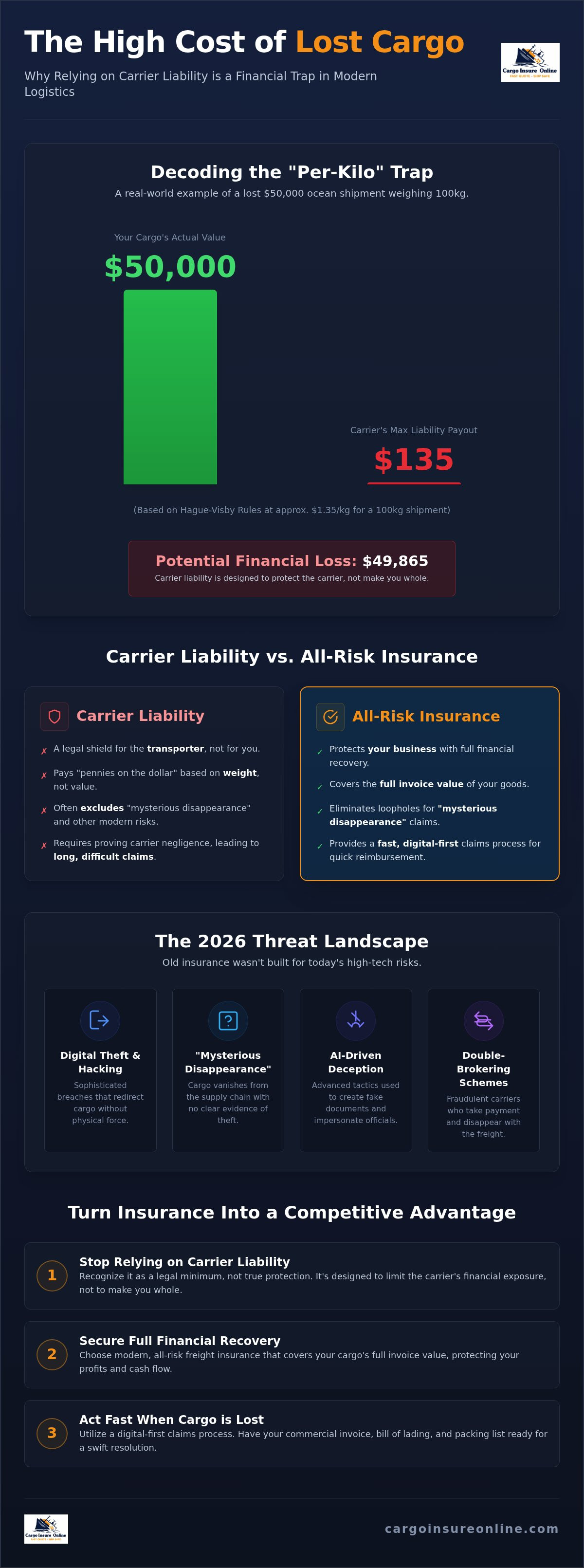
Carrier liability isn't a safety net. It's a legal shield. Transporters use international conventions to cap their payouts at levels that haven't kept pace with modern commerce. If you rely solely on these limits, you aren't truly covered. You're exposed. Freight insurance for lost cargo is the only way to bridge the gap between "pennies per kilo" and your actual invoice value. While carriers focus on protecting their bottom line, all-risk insurance focuses on protecting yours. It's the difference between a total financial loss and a seamless recovery.
The Math of a Loss: A Reality Check
Let's look at the cold, hard numbers. Imagine a $50,000 shipment of high-end tablets weighing 100 kilograms. If that cargo vanishes at sea, the Hague-Visby Rules limit the carrier's liability to approximately $1.35 per kilogram. Your total payout? A pathetic $135. Even under the Montreal Convention for air freight, you'd likely only see about $3,000. You're still out $47,000. This is why electronics shipping insurance is a non-negotiable requirement for tech hardware in 2026.
The nightmare doesn't stop at the loss itself. Without all-risk protection, you're on the hook for hidden costs that most shippers never see coming. Survey fees to investigate a loss can cost thousands. Then there's "General Average" in sea freight. This ancient rule can force you to pay for other people's lost cargo just because your shipment was on the same vessel. All-risk coverage absorbs these shocks. It turns a potential business-ending disaster into a minor accounting entry.
Bypassing the Bureaucracy of Proof
Standard carrier liability requires you to prove the carrier was negligent. That's a high bar to clear. Carriers have a long list of legal excuses to deny your claim. They'll blame the weather. They'll blame the packaging. They'll even blame the warehouse. This "blame game" between trucking companies and port authorities can stall your recovery for months. It's a bureaucratic maze designed to wear you down until you give up.
All-risk freight insurance for lost cargo changes the rules entirely. You don't have to prove fault; you only have to prove the loss occurred. This distinction speeds up your claims process by weeks or even months. It removes the friction of legal debates and puts cash back in your business faster. Don't waste time arguing with a trucking company's legal department. You can protect your margins instantly with a digital-first policy that prioritizes your recovery over their bureaucracy.
Modern Piracy: When Cargo Vanishes into Thin Air
Piracy has gone digital. Forget eye patches and boarding planks. Today's pirates use AI and forged credentials to hijack shipments from the comfort of a remote office. Strategic theft is the new frontline of logistics risk. Industry data highlights a staggering 1,455 percent increase in strategic theft between 2022 and 2024. This isn't just a trend; it's a crisis. If your current freight insurance for lost cargo doesn't account for digital deception, you're essentially uninsured against the most common threat of 2026. You need protection that recognizes a hacker is just as dangerous as a highway robber.
Then there's the rise of double brokering. It's a logistical shell game that makes finding lost cargo nearly impossible. Your shipment gets passed from broker to broker until the trail goes cold and the accountability disappears. By the time you realize something is wrong, the goods are long gone. This is why traditional trucking cargo insurance must evolve. It needs to cover sophisticated fraud, not just physical accidents. Most losses now happen in the "Last Mile" of e-commerce, where visibility is lowest and the risk of a "vanishing act" is highest.
Fictitious Pickups and Digital Hijacking
Thieves now use deepfake technology and stolen digital IDs to walk right into warehouses. They present perfectly forged credentials, load up a container, and vanish into the night. Here's the kicker: many "standard" policies won't pay out for this. They claim you "voluntarily" handed over the cargo to a fraudster. We think that's bureaucratic nonsense. Cargo Insure Online treats strategic theft as a core part of a modern policy. We remove the friction of the "voluntary parting" exclusion, ensuring you're protected against high-tech hijacking without the legal excuses.
High-Value Targets: Electronics and Drones
Tech is the ultimate prize for modern thieves. High resale value and compact sizes make electronics and drones easy to flip on the secondary market. Protecting these sensitive assets requires more than a basic, one-size-fits-all policy. You need specialized safeguards that understand the tech landscape. Creating a "hardened" supply chain starts with cross-border e-commerce insurance designed for the digital age. Don't let your high-value inventory become a statistic. Secure a sophisticated ally that understands the difference between a physical accident and a digital heist.
The 2026 Claim Protocol: What to Do When Freight Goes Missing
When a tracking number goes dark, the clock starts. You don't have weeks to wait for a traditional adjuster to call you back. In 2026, the first 24 hours determine whether you recover your funds or swallow the loss. Speed isn't just a preference; it's your primary weapon. While legacy brokers are still checking their voicemail, you need to be securing your data. A rapid response stops a missing shipment from becoming a permanent financial hole.
A successful claim for freight insurance for lost cargo depends on your digital paper trail. You need your files organized and ready before the shipment even leaves the dock. This includes your Bill of Lading, commercial invoice, and digital tracking logs. If you wait until the cargo is missing to start looking for paperwork, you've already lost the race. You need a system that captures every data point in real time, turning documentation from a chore into an automated asset.
Step-by-Step: From Discovery to Payout
- Immediate notification: Send the 'Notice of Intent to Claim' to the carrier instantly. Don't wait for their internal investigation to conclude.
- Gathering evidence: Capture every digital breadcrumb. This includes screenshots of tracking status, communication logs with drivers, and any proof of "last seen" location.
- Filing: Skip the endless email threads. Upload your freight insurance for lost cargo claim directly to the Cargo Insure Online portal for high-speed processing.
Once your claim is in the system, focus on mitigating the damage. Alert your customers immediately. Re-route backup inventory to keep your sales funnel moving. A lost shipment is a speed bump, not a dead end for your business. Use our platform to turn a logistics crisis into a managed, predictable event.
Avoiding Common Claim Denials
Legacy insurers love the "insufficient packaging" trap. They'll claim your boxes weren't strong enough to justify a payout, even if the cargo was stolen. We don't play those games. However, you still need to ensure your supply chain follows professional standards. High-quality digital photos of the cargo before it was sealed can instantly shut down this excuse and keep your claim on track.
Then there's the "Time Bar" deadline. This is the legal window for filing your claim before your rights expire. Under the Hague-Visby rules, the time bar for sea freight claims is generally nine months from the date the cargo was delivered or should have been delivered. Don't let a technicality kill your recovery. You can start your high-speed claim right now and bypass the bureaucratic wait times that plague the traditional insurance industry.
Frictionless Protection: Why Cargo Insure Online is the Sophisticated Choice
Insurance shouldn't be a chore. It's a superpower. We've stripped away the layers of red tape that make traditional brokers slow. You don't need a stack of paper. You need an intelligent system that moves at the speed of your business. Our digital-first approach transforms freight insurance for lost cargo from a complex legal burden into a seamless, automated process. We've replaced the "dry and bureaucratic" with the "instant and intelligent." It's about empowering you with speed and total clarity.
Whether you're navigating the complexities of sea freight insurance or managing a trucking fleet, we cover every lane. Our all-risk policies treat your cargo like the high-value asset it is. We don't just insure boxes; we protect your margins. For tech-driven companies, our API is the ultimate tool. It integrates protection directly into your existing logistics workflow. No manual entries. No missed shipments. Just pure, frictionless intelligence.
Zero Stress, Maximum Speed
Waiting for an "underwriter review" is a relic of the past. Your business doesn't pause for office hours. Your insurance shouldn't either. We provide instant quotes that respect your time and your intelligence. Our claims process is built for the digital age: transparent, fast, and fair. This is why leading online sellers trust our reefer cargo insurance to safeguard temperature-sensitive tech and high-value electronics. We've removed the friction so you can focus on growth.
Ready to Ship with Confidence?
Stop treating insurance as a last-minute afterthought. Start using it as a strategic competitive advantage. When you can guarantee full financial recovery for every shipment, you can scale with confidence. Join the 10,000+ brands that have already moved toward a frictionless shipping future. Secure your supply chain with freight insurance for lost cargo that actually works when you need it. Don't leave your recovery to chance or carrier liability limits. Get your instant cargo insurance quote now! and see how simple total protection can be.
Take Command of Your Supply Chain
The logistics landscape of 2026 doesn't wait for slow brokers or outdated policies. You've seen the math. Relying on carrier liability is a gamble that pays out pennies while your business takes the full hit. Whether it's a mysterious disappearance or a high-tech digital heist, you need a sophisticated ally that eliminates the friction of traditional claims. High-speed global trade demands a digital-first approach to freight insurance for lost cargo that prioritizes your recovery over bureaucratic red tape.
Stop treating cargo loss like an inevitable disaster. All-risk protection turns those logistical nightmares into manageable speed bumps. With instant digital quotes and specialized protection for high-value tech, you can bypass carrier limits and secure your margins in seconds. It's time to move toward a future where shipping is frictionless and your peace of mind is guaranteed. Don't let your next shipment become a statistic. Secure your cargo with an instant All-Risk quote today! You've built a great brand. Now, give it the elite protection it deserves.
Expert Insights: Your Cargo Protection Questions Answered
What is the difference between lost and stolen cargo insurance?
Lost cargo is a broad category for any shipment that fails to arrive, while stolen cargo specifically involves criminal theft. Stolen goods usually require a police report and evidence of a crime to trigger a payout. Lost cargo could be an administrative error or a container lost at sea. Choosing freight insurance for lost cargo ensures you're protected regardless of the cause, covering both criminal acts and unexplained vanishing acts.
Does freight insurance cover 'Mysterious Disappearance'?
Yes, all-risk policies are specifically designed to cover mysterious disappearance where other policies fail. Traditional, named-peril insurance often excludes cargo that simply vanishes without proof of a specific accident. All-risk protection flips this logic. Instead of proving how it happened, you only need to prove the loss occurred. It's the only way to eliminate the "mysterious disappearance" loophole that traditional insurers love to use to deny claims.
How long do I have to file a claim for lost cargo in 2026?
Deadlines vary by transport mode, but you should always act within 24 hours. For sea freight under Hague-Visby rules, you generally have nine months from the delivery date. Air freight claims under the Montreal Convention allow up to two years. Don't wait for the legal limit. Notifying the carrier immediately is essential to preserving your rights and speeding up your financial recovery through a digital-first claims platform.
Why is carrier liability usually not enough for high-value electronics?
Carrier liability is based on weight, not the actual value of your tech. For sea freight, the limit is approximately $1.35 per kilogram. If you ship a pallet of smartphones worth $100,000 that only weighs 200kg, the carrier might only owe you $270. This "per-kilo trap" makes carrier liability useless for modern tech. All-risk freight insurance for lost cargo covers the full invoice value, ensuring you recover every dollar you actually lost.
What is 'Strategic Theft' and is it covered by my policy?
Strategic theft involves using AI, deepfakes, or forged digital credentials to trick you into handing over cargo. It's a growing threat in 2026 that traditional policies often exclude as "voluntary parting." A modern all-risk policy recognizes this digital hijacking as a covered loss. We don't hide behind fine print. If a fraudster steals your shipment through deception, our intelligent protection ensures you aren't left holding the bill for their crime.
Can I buy insurance for a single shipment that is already in transit?
No, insurance must be secured and bound before the shipment begins its journey. Once the cargo is in transit, the risk has already commenced, and insurers cannot provide retrospective coverage. This is why automated API integration is so valuable for modern shippers. It ensures every shipment is protected the moment the label is created. Don't wait until a tracking number goes dark to think about your coverage options.
What documents are required to prove a cargo loss claim?
You need four essential digital documents: the Bill of Lading, the Commercial Invoice, the Packing List, and the Notice of Intent to Claim. These files prove the value of the goods, the condition they were in when shipped, and that you notified the carrier of the loss. Keeping these documents in a central digital repository allows you to file a claim instantly, bypassing the weeks of paperwork required by legacy brokers.
Does all-risk insurance cover loss due to shipping delays?
No, all-risk insurance typically covers physical loss or damage, not pure economic losses caused by delays. If your shipment arrives late and you lose a contract, that isn't a covered physical loss. However, if the delay results in the cargo being lost or stolen, your policy kicks in for the full value. For temperature-sensitive goods, specialized reefer protection can cover spoilage, but pure schedule delays remain a separate business risk.


