
Would you trade a $5,000 pallet of high-end electronics for a $400 payout? That's the brutal reality of air freight carrier liability vs cargo insurance when things go wrong at 30,000 feet. You've spent months perfecting your supply chain. You trust the airline to handle your tech with precision. It's a shock when a "per-kilo" rule turns a damaged shipment into a massive financial loss. Most shippers believe they're legally protected by the carrier's fine print. They aren't.
We know you want total financial safety and zero friction. It's exhausting to deal with slow claims and bureaucratic jargon that protects the airline's balance sheet instead of yours. This guide reveals why relying on carrier liability is a dangerous gamble for your 2026 bottom line. You'll discover how all-risk cargo insurance secures your business in seconds. We're breaking down the hidden limits of the Montreal Convention, the reality of "per-kilo" payouts, and the digital-first path to total protection for your high-value shipments.
Key Takeaways
- Stop treating carrier liability as a safety net. It's a legal minimum that leaves your high-value tech exposed to massive financial gaps.
- Master the math of air freight carrier liability vs cargo insurance to avoid the "per-kilo" trap where a smartphone is valued like scrap metal.
- Shift the burden of proof off your shoulders. All-risk insurance pays out even when the carrier isn't at fault or "Acts of God" strike.
- Accelerate your 2026 logistics with digital-first tools that deliver instant quotes and mobile-ready claims in seconds.
The Great Logistics Myth: Is Your Air Freight Actually Covered?
Many shippers believe their freight is safe because it's in the hands of a global airline. It's a myth. Relying on carrier liability is like using a cardboard umbrella in a hurricane. It might be a legal requirement, but it isn't a safety net for your business. When you analyze air freight carrier liability vs cargo insurance, you're looking at the difference between a legal minimum and total financial certainty.
Stop viewing insurance as an optional add-on. It's actually critical financial GAP protection. The airline's responsibility is limited. Your business's exposure is not. Understanding where one ends and the other begins is the only way to protect your bottom line in 2026.
What is Carrier Liability?
Airlines are required by law to provide a baseline level of protection. This is governed by international treaties like the Montreal Convention. However, this coverage exists to protect the carrier's balance sheet, not your profit margins. It's a fault-based system that focuses on the carrier's negligence rather than your financial recovery.
This creates the "Care, Custody, and Control" trap. To get a cent from an airline, you often have to prove they were negligent. If a storm damages your electronics or a freak accident occurs, the carrier can simply walk away. They didn't cause the weather, so they aren't liable. You're left holding the bill for thousands of dollars in lost inventory because the gap between air freight carrier liability vs cargo insurance is where your profit goes to die.
What is All-Risk Cargo Insurance?
This is where the narrative shifts from "legal minimum" to "total protection." All-risk cargo insurance is "Shipper’s Interest" coverage. It belongs to you. It doesn't care whose fault the damage was. If your cargo is damaged, lost, or stolen, you get paid. It's a modern solution for a high-speed industry that doesn't have time for the blame game.
Standard policies cover the full invoice value of your goods plus the cost of freight and an extra 10% (CIF+10). This extra padding accounts for the administrative headaches and lost time that follow a shipping disaster. While carrier liability pays out based on weight, cargo insurance pays out based on value. For anyone shipping high-value tech, drones, or mobile phones, this isn't just a preference. It's a survival strategy.
The Math of Loss: Why 'Per-Kilo' Payouts Fail Shippers
The math of logistics is often brutal. Shippers frequently discover too late that airlines don't care about the value of what's inside the box. They care about how much the box weighs. This is the fundamental conflict in the debate of air freight carrier liability vs cargo insurance. One protects the weight; the other protects the wealth.
For tech exporters, this "weight trap" is a financial landmine. A single kilogram of high-end circuit boards or smartphones is worth thousands. Yet, under carrier liability, that same kilogram is valued exactly the same as a kilogram of rusted scrap metal. If you're shipping lightweight, high-value goods, carrier payouts often cover less than 5% of your total shipment value. This is why high-value electronics shipping insurance is a non-negotiable requirement for modern tech exporters.
The Montreal Convention Explained
The Montreal Convention is the international treaty that sets the rules for air carrier liability. It uses a specialized currency called Special Drawing Rights (SDRs) to limit what airlines owe you. In 2026, the standard payout remains capped at approximately 22 SDRs per kilogram for most international routes.
This system is intentionally rigid. To calculate your recovery, you multiply the weight of the lost or damaged goods by 22 and then convert that SDR total into your local currency based on daily exchange rates. It's a formula designed for the carrier's convenience, not your financial recovery.
Scenario: Shipping 100 Drones
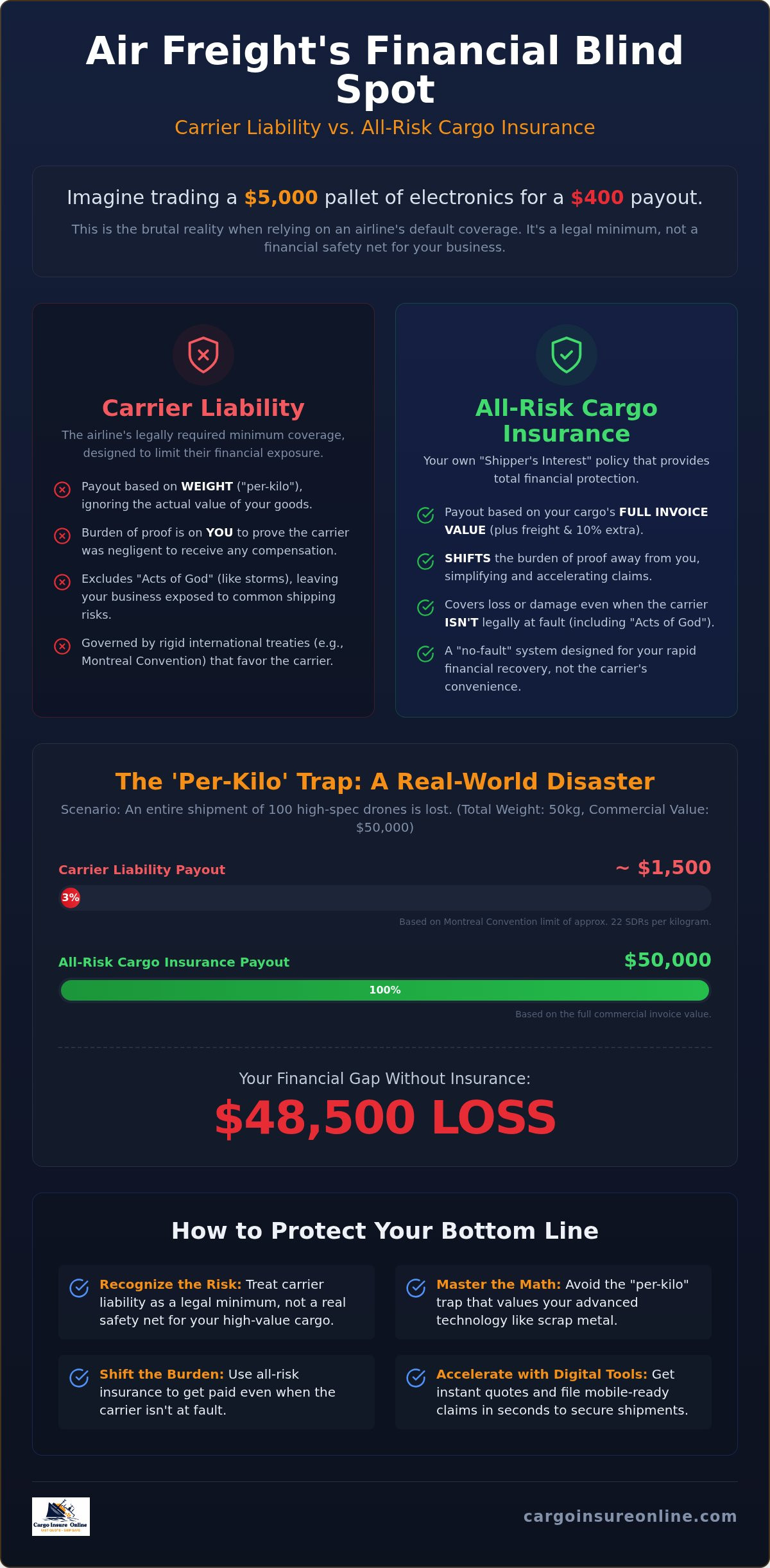
Let's look at a real-world disaster. Imagine you are shipping 100 high-spec drones. The total weight is 50kg, and the commercial value is $50,000. If the airline loses the entire shipment, their liability is capped at 50kg multiplied by 22 SDRs.
At current rates, that's roughly $1,500.
Without electronics shipping insurance, you just lost $48,500 in a single afternoon. That's a massive financial hole that can sink a small business or derail a quarterly budget. In the battle of air freight carrier liability vs cargo insurance, the insurance policy is the only tool that covers the full $50,000 replacement cost.
The gap is shocking. Relying on carrier liability for high-tech freight isn't just risky; it's a mathematical certainty of loss in the event of a claim. You don't have to settle for "per-kilo" crumbs. You can get a precise quote for your cargo's true value in seconds and close the gap before your next flight departs.
Carrier Liability vs. Cargo Insurance: The Gap Analysis
If you think the airline has your back during a logistics crisis, think again. The gap between air freight carrier liability vs cargo insurance is wider than a trans-Atlantic flight path. It isn't just about how much you get paid; it's about whether you get paid at all. The airline's legal framework is built to protect their interests, not your profit margins.
The biggest hurdle is the burden of proof. Under carrier liability, you are essentially a private investigator. You must prove the airline was negligent. If you can't point to a specific moment where they failed, they don't pay. Cargo insurance flips this script. It's "no-fault" protection. You only need to prove that the damage happened while the goods were in transit. No investigations. No finger-pointing. Just results.
Time is another critical factor. Carrier claims are notoriously slow, often dragging on for six months or more while they investigate themselves. A digital-first cargo policy settles in days. While the carrier is still filing paperwork, you've already replaced your inventory and kept your customers happy. Even "General Average" risks, usually associated with sea freight, can haunt intermodal air-sea journeys, making insurance a vital shield against shared salvage costs.
When Carriers Don't Have to Pay
Airlines have a long list of "get out of jail free" cards. If they can find a reason to deny your claim, they will. Common exclusions include:
- Insufficient packaging: This is the #1 reason claims are rejected. If the carrier decides your box wasn't "standard," they're off the hook.
- Inherent vice: If your product spoils or breaks due to its own nature, the carrier isn't responsible.
- Acts of God: Lightning, storms, or freak weather events are beyond the carrier's control. If a typhoon delays your flight and ruins temperature-sensitive cargo, the airline owes you nothing.
- Acts of War or Terrorism: These are standard exclusions in almost every carrier contract.
The All-Risk Advantage
All-risk insurance doesn't just fill the gaps; it creates a fortress around your shipment. It provides door-to-door coverage, protecting your goods during the "last mile" trucking phase that airlines never touch. Some specialized policies even cover consequential loss, protecting your business from the ripple effects of a missing shipment.
For a deeper dive into these perks, check out our guide on Air Freight Insurance. It's time to stop gambling on the airline's fine print and start securing your balance sheet with a modern, digital solution.
Strategic Shipping: When to Rely on Which?
Strategy isn't just about picking the fastest route. It's about protecting your capital. Choosing between air freight carrier liability vs cargo insurance depends entirely on your cargo's DNA. If you're shipping low-value, heavy bulk like raw timber, carrier liability might feel like enough. But for 99% of modern businesses, that's a dangerous assumption. One pallet of damaged tech can wipe out a month's profit.
Don't fall for the airline's "insurance" upsell at the booking stage. These add-ons are often overpriced and offer limited support when things go south. Independent cargo insurance is your secret weapon. It provides a dedicated partner who prioritizes your recovery, not the carrier's bottom line. You get better rates, faster digital workflows, and a team that speaks your language. It's the difference between being a number in a queue and having a professional ally.
The Electronics & Tech Checklist
Tech firms face a unique set of risks that standard airline rules simply can't handle. Fragility is the obvious one. A slight drop can shatter a pallet of tablets, but the carrier only sees the weight of the glass. Theft is the second, more invisible threat. High-demand items like smartphones often suffer from "mysterious disappearance" during airport handling. This is why electronics shipping insurance is the gold standard for tech firms. It covers the full commercial value, including the risk of theft and handling damage that carriers routinely deny. You need a policy that recognizes the value of your innovation, not just the weight of your hardware.
E-Commerce & Global Trade
Selling on Amazon or Shopify in 2026 requires a frictionless supply chain. For Amazon FBA sellers, cross-border e-commerce insurance is more than a safety net; it's a requirement for staying in the game. You're likely managing high-volume, low-weight shipments where carrier liability payouts are practically non-existent. Integrating insurance directly into your B2B checkout flow or your logistics stack removes the administrative burden of manual booking. GAP insurance acts as your final shield, covering the financial distance between a carrier's "per-kilo" pittance and your actual loss. This ensures your balance sheet stays healthy even when the airline's fine print tries to cut your payout. Ready to upgrade your strategy? You can secure your next shipment in seconds on our digital platform and get back to growing your brand.
Cargo Insure Online: Fast-Track Your Freight Protection
Logistics moves at the speed of light. Your protection should too. Traditional insurance is a slow, paper-heavy grind that drains your resources and tests your patience. We've replaced that friction with a high-velocity digital platform designed for the modern era. When you weigh the benefits of air freight carrier liability vs cargo insurance, the choice becomes clear once you see how fast you can secure your bottom line. Stop waiting. Start winning.
Forget waiting 48 hours for a broker to call you back. Get instant quotes in seconds. Our digital-first claims process lets you submit evidence via mobile and track progress in real-time. We specialize in the high-stakes niches that traditional providers often avoid. We provide expert protection for drones, mobile phones, and temperature-sensitive reefer products. From the tarmac to the highway, we offer comprehensive trucking cargo insurance to keep your entire journey safe across every border.
Automation Meets Authority
We aren't just another insurance provider. We're a tech-driven ally. Our AI-driven platform strips away the bureaucratic layers of 20th-century insurance. It's built for speed and intelligence. Our system analyzes risk in real-time, providing a level of connectivity that legacy systems can't match. This isn't just about a policy; it's about an automated workflow that respects your time. We've mastered the complexities of global trade so you can focus on scaling your business.
For logistics providers, our white-label solutions offer a seamless way to provide branded protection to your own clients. You can integrate our technology directly into your stack, turning insurance from a chore into a value-add service. Experience the relief of a system where tech experts manage your risk. No more faceless bureaucrats. No more endless phone loops. Just clarity and high-speed results.
Secure Your 2026 Supply Chain Now
Doing nothing is a choice. It's a choice to accept a pittance for a high-value loss. Peace of mind is more than a feeling; it's a strategic advantage that empowers you to take bigger risks and enter new markets with confidence. Whether it's a fleet of drones or a shipment of high-end electronics, we protect the innovation that drives your brand. Securing your 2026 supply chain is a three-step sprint:
- Enter: Input your shipment details into our intuitive interface.
- Quote: Receive a precise, all-risk quote in seconds.
- Secure: Activate your coverage with a single click and fly with confidence.
It's that simple. Don't let your next flight take off without a shield. Protect your air freight instantly with Cargo Insure Online.
Secure Your Profit Margins in 2026
The 2026 logistics landscape doesn't reward those who leave their cargo to chance. You've seen how the rigid "per-kilo" rule can turn a high-value electronics shipment into a total financial write-off. Relying on carriers means fighting an uphill battle with the burden of proof while your capital remains locked in a months-long claims process. It's a risk your business simply doesn't need to take when modern alternatives are a click away.
By mastering the difference between air freight carrier liability vs cargo insurance, you're choosing a path of total financial certainty. You gain specialized high-value tech protection, a digital-first claims process that respects your time, and global coverage designed for the speed of modern trade. Don't let bureaucratic fine print or international treaties dictate your success. It's time to trade administrative friction for streamlined, all-risk safety that empowers your growth.
Get an Instant Air Freight Insurance Quote today and fly with the confidence of a fully protected supply chain. You've built an incredible brand; we're here to make sure every shipment arrives with your profit margins intact. Your future is in the air, so let's keep it secure.
Frequently Asked Questions
Is carrier liability the same as cargo insurance?
No, carrier liability and cargo insurance are fundamentally different. Liability is a fault-based legal minimum provided by the airline, often paying cents on the dollar. Cargo insurance is a contract you own that covers the full invoice value regardless of fault. When comparing air freight carrier liability vs cargo insurance, remember that liability protects the carrier's wallet while insurance protects your specific shipment's commercial value and your business's cash flow.
What is the maximum payout for air freight carrier liability?
The maximum payout is strictly capped by international treaties like the Montreal Convention. In 2026, the standard limit is approximately 22 Special Drawing Rights (SDR) per kilogram. This means a lost pallet of lightweight drones weighing 10kg might only net you a few hundred dollars, even if the tech is worth thousands. It's a weight-based calculation that ignores the actual market value of your goods.
Does carrier liability cover 'Acts of God' like hurricanes?
Carrier liability rarely covers "Acts of God" such as hurricanes, lightning, or freak floods. Airlines are only responsible for damage caused by their own negligence. If a natural disaster destroys your freight at the airport, the carrier can legally deny your claim because the event was beyond their control. All-risk cargo insurance is essential here because it covers these external perils that leave carrier-reliant shippers empty-handed.
Why is cargo insurance better for high-value electronics?
Cargo insurance is the only way to bridge the massive gap between weight and value for tech exporters. A smartphone weighs very little but costs a lot. Because air freight carrier liability vs cargo insurance payouts are calculated differently, an airline might offer you $20 for a stolen $1,000 device. Specialized electronics insurance ensures you recover the full replacement cost plus freight charges, protecting your margins from "per-kilo" pittance.
How long does a carrier liability claim typically take?
A typical carrier liability claim can drag on for three to six months while the airline conducts internal investigations. They often prioritize their own legal defense over your recovery. Digital-first insurance providers like Cargo Insure Online settle claims in a fraction of that time, sometimes in just a few days. You shouldn't have to wait a fiscal quarter to replace inventory that was lost in a single afternoon.
Can I buy cargo insurance if I am not the freight forwarder?
You absolutely can buy insurance directly even if you aren't the freight forwarder. Many modern shippers prefer this because it gives them direct control over the claims process and better transparency on pricing. You don't have to rely on a middleman's markup or their choice of provider. Our platform allows you to secure all-risk protection for your cargo in seconds, regardless of who is handling the physical transport.
What documents do I need for a cargo insurance claim in 2026?
You'll need a digital trail to fast-track your 2026 claim. Standard requirements include the commercial invoice showing the value of the goods, the packing list, and the Air Waybill (AWB). High-quality photos or video evidence of the damage are also crucial. Since we use a digital-first process, you can upload these documents via mobile immediately after discovering a loss to trigger an instant review by our tech-driven team.
Does air freight insurance cover the last-mile delivery?
Yes, all-risk air freight insurance typically provides "door-to-door" coverage. This means your goods are protected from the moment they leave your warehouse until they reach the final customer's doorstep. Carrier liability usually only covers the time the goods are in the airline's "care, custody, and control." Insurance fills the gap for the trucking legs and warehouse transfers that make up the critical last mile of your journey.


