
If you're still relying on standard carrier liability to protect your freight in 2026, you're essentially self-insuring against a global logistics storm you cannot control. The "per-kilo" rule was never designed to protect your profit margins; it was built to protect the carrier. In a year defined by the new IATA Direct Air Waybill framework and stricter FMCSA enforcement, all-risk cargo insurance is no longer an optional add-on. It's the only way to close massive financial gaps and move past the era of opaque, manual claim processes that stall your momentum.
We know the frustration of watching high-value electronics or reefer products sit in a liability limbo while you wait days for a slow quoting system to respond. It's exhausting and unnecessary. This guide will show you how to eliminate shipping anxiety and protect your bottom line from global volatility. We'll explore how fast digital claims and comprehensive coverage provide the resilience you need to ship with total confidence in 2026. Get ready to transform insurance from a slow administrative chore into a high-speed competitive advantage that matches the pace of modern trade.
Key Takeaways
- Break free from the carrier liability trap and secure full-value protection with all-risk cargo insurance.
- Master the "Institute Cargo Clauses (A)" to ensure your shipments meet the global gold standard for comprehensive coverage.
- Safeguard high-stakes freight like electronics and reefer goods with specialized strategies that go beyond basic policies.
- Replace slow, manual quoting with digital-first tools that provide instant coverage to match the speed of 2026 logistics.
- Move from reactive shipping anxiety to proactive resilience by integrating frictionless insurance directly into your supply chain.
Beyond Carrier Liability: The High Cost of the Per-Kilo Rule
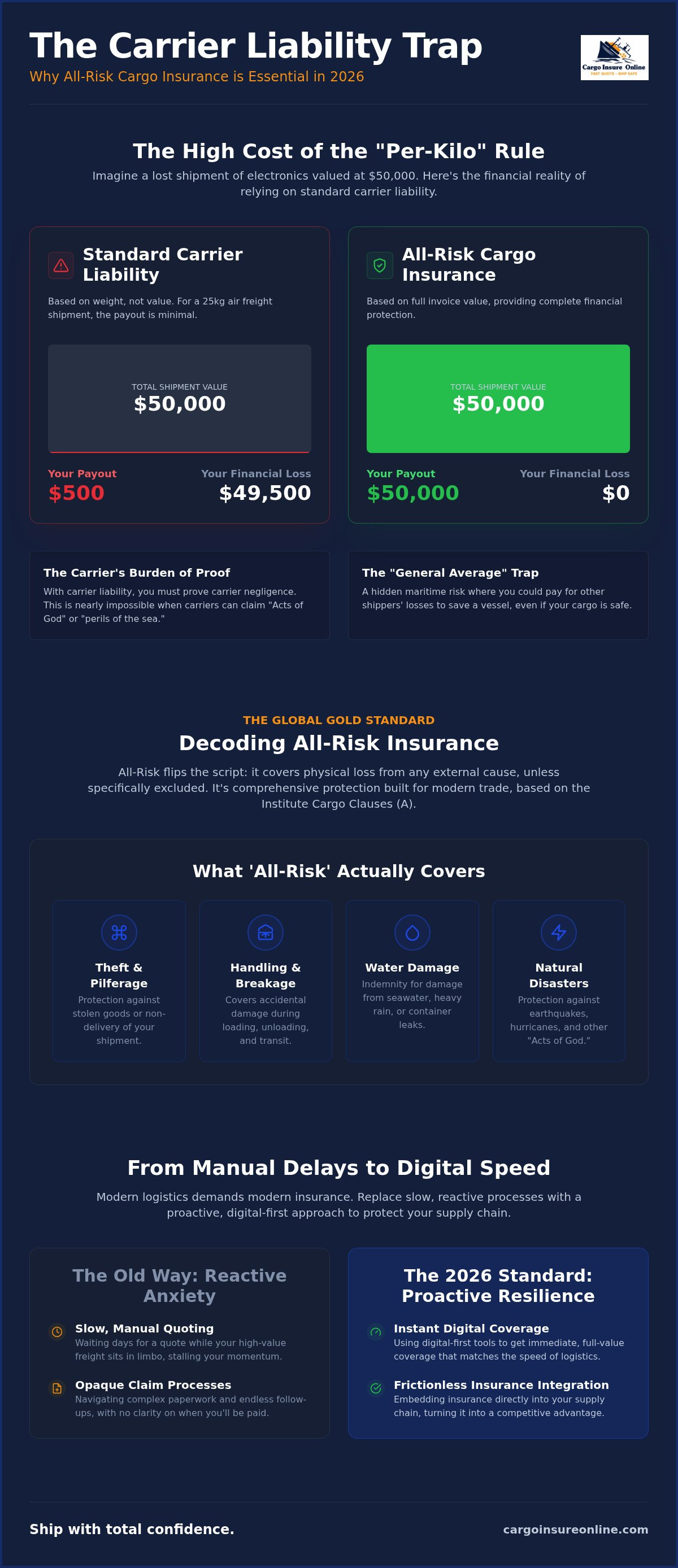
Stop crossing your fingers and hoping the carrier has your back. They don't. Most shippers mistakenly believe the carrier’s Bill of Lading is a comprehensive safety net. It isn't. It's a legal shield designed to protect the carrier's interests, not your profit margins. If your cargo is damaged or stolen, the carrier doesn't care about your commercial invoice. They care about the scale. This is the "per-kilo" trap. In 2026, with the revised IATA Direct Air Waybill framework shifting liability and new FMCSA regulations tightening the screws, all-risk cargo insurance is the only way to escape the fine print.
Relying on carrier liability means you're playing a high-stakes game of "General Average." This ancient maritime principle means if a ship faces a crisis and cargo is jettisoned to save the vessel, every shipper on board shares the cost. You could end up owing thousands of dollars for a ship you don't own, even if your specific goods arrived safely. It's a hidden risk that can bankrupt a small business overnight. Don't leave your resilience to "good luck" and carrier excuses.
Weight-Based Limits vs. Full Invoice Value
Imagine shipping $50,000 worth of high-end electronics. If those goods are lost in transit via air freight, standard carrier liability might only pay out roughly $20 per kilogram. If your shipment weighs 25 kilos, your recovery is a measly $500. You're left with a $49,500 hole in your balance sheet. Carrier liability is a legal minimum, not a safety net. It ignores the value-density of modern trade. All-risk cargo insurance covers the full invoice value, ensuring you aren't penalized just because your high-value tech is lightweight.
The Burden of Proof: Why Carriers Rarely Pay
Getting a carrier to pay a claim is like pulling teeth. They have an arsenal of "get out of jail free" cards, including Acts of God, strikes, and "perils of the sea." To get paid, you usually have to prove the carrier was specifically negligent. That's a massive hurdle when your cargo is at the bottom of the ocean or in a locked warehouse halfway across the world.
Modern coverage changes the game. By utilizing Marine Insurance principles through an all-risk policy, the burden of proof shifts. You don't have to prove the carrier messed up; you only need to show the loss occurred during transit. This is especially critical for maritime shipments where risks are amplified. For a deeper look at protecting your ocean freight, check out our guide on Sea Freight Insurance: Total Protection for the High Seas in 2026. It's time to stop chasing carriers and start protecting your assets with digital-first clarity.
Decoding All-Risk Cargo Insurance: Comprehensive Protection Made Simple
Forget the laundry list of what might be covered. All-risk cargo insurance flips the script. Instead of listing specific "perils" like fire or sinking, all-risk covers everything unless it is specifically excluded. It's the difference between a "maybe" and a "yes." In the fast-moving world of 2026 logistics, you don't have time to parse through old-school "Named Perils" policies that leave gaps big enough to sink a freighter. You need the global gold standard: the Institute Cargo Clauses (A).
This framework is the backbone of modern trade. It provides the broadest level of indemnity available. It's designed for businesses that value speed and clarity over bureaucratic hurdles. When you switch to all-risk cargo insurance, you're choosing total peace of mind. You're ensuring that your bottom line is protected against the unpredictable volatility of global supply chains. Stop wasting time with restrictive policies. Switch to modern protection that covers what standard contracts miss.
What 'All-Risk' Actually Covers
All-risk protection isn't just a safety net; it's a proactive business asset. It handles the logistics nightmares that keep supply chain managers awake at night. If it's a physical loss from an external cause, you're covered. This includes:
- Theft, pilferage, and non-delivery: critical for high-value mobile phones and drones.
- Rough handling and accidental breakage during loading or unloading.
- Water damage from heavy rain or seawater ingress.
- Natural disasters like earthquakes or hurricanes that leave carriers legally immune.
The Essential Exclusions You Need to Know
Even the best protection has boundaries. Transparency is key to a frictionless experience. The most common exclusion is "inherent vice." This refers to damage caused by the nature of the goods themselves, such as natural decay or internal chemical reactions. It also covers damage resulting from poor packaging. If you don't secure your electronics properly, the insurer won't pay for the rattle.
Additionally, standard policies usually exclude willful misconduct by the insured. You can't intentionally cut corners and expect a payout. Finally, be aware of geopolitical risks. While standard all-risk is comprehensive, it typically excludes War Risk Cargo Insurance and terrorism. These often require specialized add-ons depending on your shipping lanes. Understanding these boundaries helps you build a more resilient strategy. If you're ready to simplify your protection, you can get an instant quote today and see how easy modern coverage can be.
High-Value Assets: Why Electronics and Reefer Goods Demand All-Risk
Shipping a pallet of bricks is easy. Shipping a pallet of iPhones is a high-stakes mission. In 2026, the value-density of global trade has reached a tipping point. Modern electronics are smaller, more expensive, and easier to steal than ever before. This makes them a primary target for organized cargo crime. If you're moving high-tech assets, generic coverage isn't just risky; it's a liability. You need all-risk cargo insurance that understands the specific vulnerabilities of your freight.
Traditional carrier liability won't save you when a shipment of drones vanishes from a tarmac or a reefer container loses power in a heatwave. These scenarios require specialized protection that mirrors the sophistication of the goods being moved. By choosing all-risk cargo insurance, you're securing a policy that accounts for modern piracy and the evolving tactics of cargo thieves. It's about building a resilient supply chain that can withstand the unique pressures of the high-value market.
Safeguarding the Tech Supply Chain
Mobile phones and microchips move fast. They represent high-velocity capital that can't afford to sit in a claims queue. When you're shipping these items, you're often dealing with complex financing arrangements where Electronics Shipping Insurance becomes a requirement, not a suggestion. If your cargo is financed, GAP insurance is critical to cover the difference between the depreciated value and what you actually owe. Don't let a transit loss turn into a long-term debt. For those utilizing the fastest lanes, Air Freight Insurance provides the rapid protection needed to match the speed of global tech trade.
Cold Chain Resilience for Reefer Products
Temperature excursions are the invisible killers of perishable profits. A single degree of deviation can ruin an entire shipment of pharmaceuticals or high-end produce. Equipment failure and power loss are constant threats that standard "named perils" often ignore. You need protection that triggers the moment the cold chain breaks. Our Reefer Cargo Insurance is built for this exact challenge. It covers the gap left by carriers who claim "mechanical breakdown" as an excuse to deny your claim. All-risk protection ensures that if the temperature drops or spikes, your investment stays frozen in place, financially speaking. It’s about turning a potential disaster into a manageable, insured event.
Digital-First Logistics: Integrating Insurance into Your Supply Chain
Stop waiting days for a quote that’s already outdated by the time it hits your inbox. Traditional insurance is a bottleneck. It’s a mountain of paper certificates and manual back-and-forth that kills your momentum. In 2026, logistics is purely digital. Your protection should be, too. All-risk cargo insurance isn't just about the coverage; it's about the delivery mechanism. It needs to move at the speed of your business. If your insurance partner is still using spreadsheets and slow manual emails, they're holding you back from your full potential.
We've replaced the bureaucratic chore with a seamless, positive experience. Protection now feels like software, not paperwork. By integrating all-risk cargo insurance directly into your workflow, you eliminate the friction that causes shipping anxiety. It’s about empowerment through speed and clarity. Modern platforms allow you to bind a policy in seconds, not hours. This level of automation ensures you never miss a shipping window due to a missing certificate of insurance or a slow underwriter response.
E-Commerce and Cross-Border Speed
Selling on Amazon FBA or Shopify requires extreme agility. You can't afford to let a manual insurance process stall a global shipment. Online sellers need instant, scalable coverage that grows with their orders. This is where automated compliance becomes a competitive advantage. Reducing friction in global trade starts with removing the administrative hurdles of old-school policies. If you're scaling fast, you need a partner that can keep up with your transaction volume without breaking a sweat.
For a deep dive into navigating these digital waters, see our Cross-Border E-Commerce Insurance: The 2026 Guide to Frictionless Global Selling. It’s the essential roadmap for the modern merchant who values time as much as profit. By automating your insurance, you free up your team to focus on growth rather than logistics headaches. You get the protection you need without the delay you've come to expect from legacy providers.
White-Label Solutions for Logistics Partners
Freight forwarders are no longer just movers; they are tech partners. By using our API and White Label Cargo Insurance: Launch Your Branded Insurance Engine in 2026, forwarders can offer branded insurance instantly. This is the future of embedded insurance. Protection becomes a standard feature of the booking process, not a separate, painful step. It allows logistics providers to add value while keeping their customers inside their own digital ecosystem. Ready to upgrade your operations? You can get an instant quote and see the digital difference for yourself.
Cargo Insure Online: Frictionless Protection for Global Trade
Insurance isn't a bureaucratic barrier; it's a digital catalyst. At Cargo Insure Online (CIO), we've spent years dismantling the traditional, dry nature of the industry to build something better. Our mission is clear: we transform administrative chores into seamless, high-energy experiences. We don't just provide all-risk cargo insurance; we provide the technological sophistication you need to move at the speed of 2026 logistics. It's time to stop overthinking your coverage and start shipping with total confidence.
We bring vibrant, high-energy support to every shipment, whether it’s traveling by air, sea, or land. Our platform is built for the modern shipper who values time and transparency above all else. By mastering the complexities of global trade, we've simplified the journey for you. From high-value electronics to temperature-sensitive reefer products, we ensure your freight is protected by specialists who actually understand your niche. This is protection designed for the future, delivered today.
Why Shippers Choose CIO in 2026
Modern shippers choose CIO because we offer more than just a policy; we offer a partnership. We act as your sophisticated ally, mastering global trade complexity so you don't have to. Our claims process is entirely digital and transparent. It respects your time and your intelligence. We've removed the opaque, manual hurdles that define legacy insurers. Instead, we offer a streamlined path to resolution that keeps your business moving forward.
Our expertise extends across all modes of transport. Whether you are navigating the high seas or managing complex road networks, we have you covered. For those focused on domestic or cross-border land freight, our Trucking Cargo Insurance: The 2026 Guide to Frictionless Road Protection provides the specific insights you need for the road ahead. We simplify the rules so you can focus on the results.
The CIO Advantage: Speed, Clarity, Relief
The CIO advantage is built on three pillars: speed, clarity, and relief. We remove the friction from global logistics with a single click. Our platform empowers your business through automation and intelligence. We've replaced the anxiety of "what if" with the confidence of "I'm covered." This is all-risk cargo insurance reimagined as a frictionless user journey.
You deserve a partner that operates at the same high speed as your industry. Don't let slow paperwork and legacy systems hold your growth hostage. It is time to experience the relief of a digital-first partner that values your peace of mind as much as your freight. Your next shipment deserves the best protection available in 2026. Get your instant all-risk cargo insurance quote now and see how easy global trade can be.
Secure Your Supply Chain for the Future of Trade
Stop letting legacy paperwork and weight-based liability limits hold your business back. You've seen the risks of the "per-kilo" trap and the invisible dangers of General Average. In 2026, all-risk cargo insurance isn't a luxury; it's a strategic necessity for anyone moving high-value tech or temperature-sensitive goods. You need protection that matches the speed of global commerce. It's about empowering your growth through clarity and automation.
Cargo Insure Online delivers that speed through our instant digital quoting engine. We provide specialized high-value tech protection and global coverage across all freight modes, ensuring your drones, electronics, and reefer products are safe from tarmac to doorstep. It's time to replace shipping anxiety with total peace of mind. We've mastered the complexities of global trade so you can focus on scale.
Don't wait for a logistics storm to realize your coverage is lacking. Experience the relief of a digital-first partner that understands your specific needs. Get Your Instant All-Risk Quote today and move your business forward with total confidence. You've built the vision; we'll protect the journey.
Frequently Asked Questions
What does all-risk cargo insurance actually cover?
All-risk cargo insurance provides the broadest indemnity available by covering every external cause of physical loss or damage unless specifically named in the exclusions. Unlike restricted policies, it assumes coverage for common transit nightmares like accidental breakage, loading damage, or natural disasters. It's the gold standard for shippers who value total peace of mind over the uncertainty of named-perils contracts that leave massive gaps in your protection.
Is all-risk insurance better than carrier liability?
Yes, because carrier liability is a legal minimum rather than a safety net. Liability often limits recovery to a specific dollar amount per kilogram, which fails to protect high-value electronics or drones. All-risk protection covers the full invoice value of your goods. Additionally, it shifts the burden of proof; you don't have to prove the carrier was negligent to receive a payout for your loss.
Does all-risk cargo insurance cover theft and pilferage?
Yes, theft and pilferage are standard inclusions in an all-risk cargo insurance policy. This is critical for high-velocity goods like mobile phones and microchips that are frequent targets for cargo crime. While carriers often use fine print to avoid theft claims, all-risk protection ensures your bottom line stays resilient even if your freight vanishes. It provides the security needed to navigate high-risk shipping lanes with total confidence.
What are the common exclusions in an all-risk policy?
Even the most comprehensive policies have boundaries to ensure transparency. Common exclusions include "inherent vice," which covers natural decay or internal chemical reactions, and damage caused by inadequate packaging. Willful misconduct by the insured is also excluded. While geopolitical risks like war and terrorism are typically left out of standard all-risk forms, specialized add-ons are available for businesses shipping through high-risk global regions in 2026.
How long does it take to get a cargo insurance quote?
You can get a quote instantly through our digital engine. We've replaced slow, manual paperwork with a high-speed quoting system that respects your time. There's no need to wait days for a broker to email you back. By leveraging our automated platform, you can bind coverage in seconds. This allows your logistics operations to move at the same speed as global e-commerce and modern trade.
Can I get all-risk insurance for temperature-sensitive reefer goods?
Yes, we specialize in reefer products and provide comprehensive protection for temperature-sensitive goods. Our all-risk coverage addresses the invisible risks of the cold chain, such as mechanical breakdown or power loss. If a temperature excursion ruins your perishable shipment, your policy triggers to protect your investment. This ensures that equipment failure doesn't turn into a total financial loss for your food or pharmaceutical business.
Is all-risk insurance required for Amazon FBA shipments?
While Amazon has specific insurance requirements for professional sellers, all-risk protection is the most effective way to safeguard your FBA inventory. Standard carrier liability won't cover the full value of your goods if they are lost during cross-border transit. Using a digital-first policy ensures you meet Amazon's compliance standards while protecting your profit margins from the volatility of global logistics and rough warehouse handling.
How do I file a claim for damaged cargo under an all-risk policy?
Filing a claim is a streamlined, digital-first experience through our platform. You simply submit your documentation, including photos of the damage and your Bill of Lading, directly through the portal. We've eliminated the opaque, manual processes that typically stall claim resolutions. Our goal is to transform a traditionally painful administrative chore into a fast, transparent journey that gets you back to business without unnecessary delays.


