
What if your insurance desk wasn't a cost center, but a high-octane revenue engine that closed deals while you slept? For too many, cargo insurance remains a slow, manual grind that kills momentum. You're stuck waiting hours for quotes while shipments sit idle and clients grow restless. It's time to stop the clock. Implementing automated cargo insurance for freight forwarders isn't just a tech upgrade; it's a fundamental shift in how you scale. You need speed that matches your global logistics flow, not bureaucratic paperwork that creates unnecessary bottlenecks.
We understand the burnout that comes from chasing certificates and the constant anxiety of carrier liability gaps that leave your firm exposed to massive losses. It's an administrative weight you shouldn't have to carry. This guide will show you how to eliminate that friction and transform insurance into a seamless, high-speed profit center through modern automation. We'll explore how instant certificates, API integrations, and branded white-label solutions can redefine your service offering and protect your margins in 2026. Get ready to move faster than the industry ever thought possible.
Key Takeaways
- Stop waiting for brokers and start closing shipments in seconds with instant digital quoting that keeps your freight moving.
- Automated cargo insurance for freight forwarders isn't just a tool; it's a 24/7 revenue engine that scales your business without increasing your workload.
- Carrier liability isn't a safety net; it's a ceiling that leaves you exposed. All-Risk digital policies provide the total protection modern global trade demands.
- Eliminate administrative burnout by integrating insurance directly into your workflow via API, generating instant certificates the moment a deal is struck.
- Move beyond being a middleman by using white-label software to offer your own branded insurance solutions and build deeper client loyalty.
The Manual Bottleneck: Why Traditional Cargo Insurance Fails Modern Forwarders
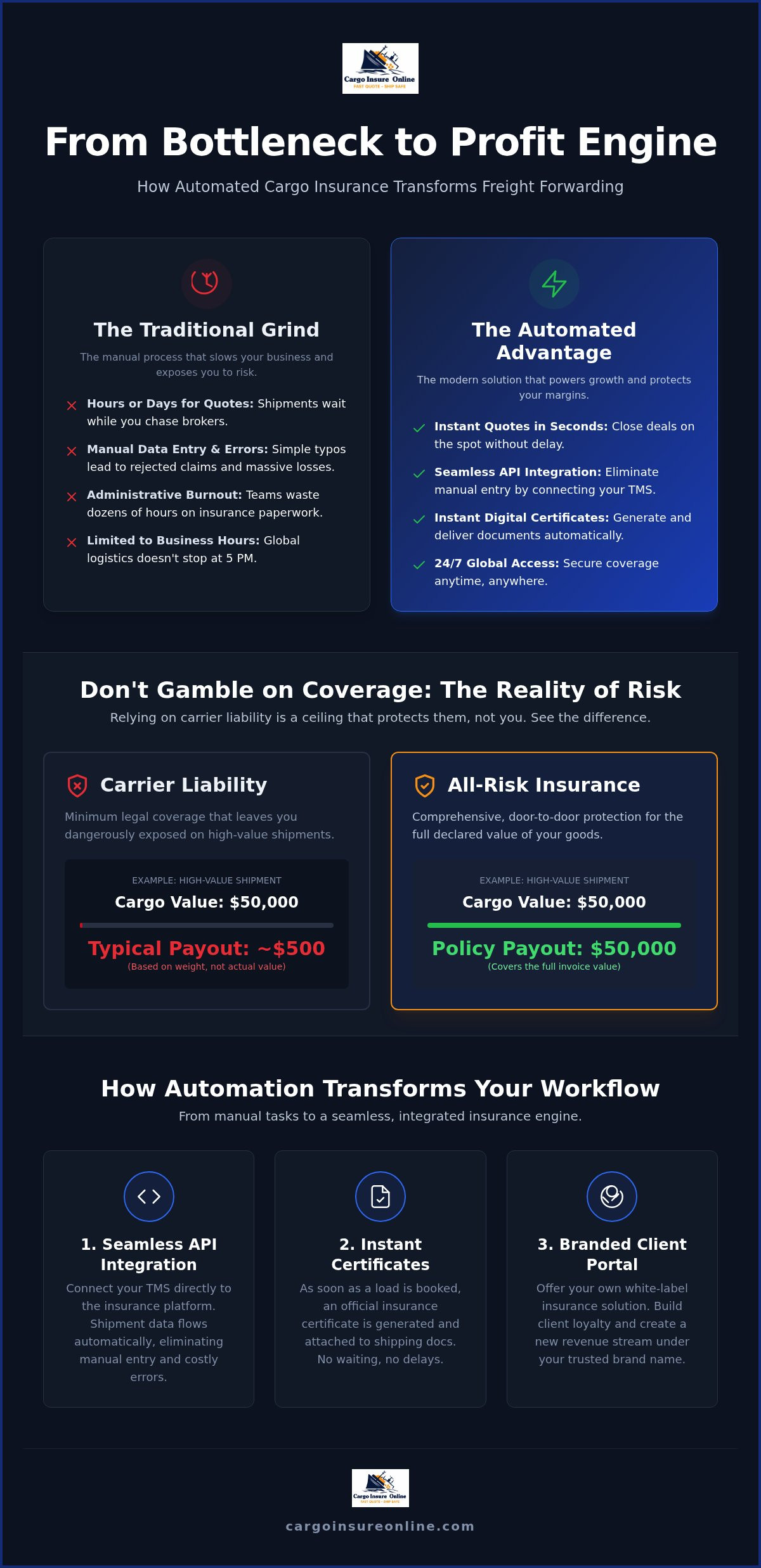
Manual processes are the friction slowing down your growth. When you wait four hours for a broker to reply with a quote, your shipment is already behind. In the high-speed market of 2026, deal velocity is everything. If you can't provide an insurance rate the moment a client asks, they'll find someone who can. Traditional cargo insurance isn't just slow; it's a liability.
Stop chasing brokers through endless email chains. Start clicking buttons and getting results. The shift to automated cargo insurance for freight forwarders removes the human bottleneck that creates administrative drag. Manual data entry is a ticking time bomb. A simple typo on a certificate of insurance can lead to a rejected claim, leaving your firm to foot the bill for high-value losses. Traditional policies often take a one-size-fits-all approach that fails to account for the specific risks of electronics or reefer products. You need precision, not a generic safety net.
The Administrative Drain on Logistics Teams
Logistics teams often lose dozens of hours every month to insurance paperwork. It's a soul-crushing cycle of data entry, follow-ups, and filing. This friction doesn't just hurt your internal efficiency; it erodes client trust. When insurance feels like a hurdle, clients look for smoother alternatives. Moving to a digital-first workflow provides immediate psychological relief. Your team stops being paperwork chasers and starts being growth drivers. Efficiency breeds confidence, and confidence wins more business.
Identifying the Gaps in Standard Carrier Liability
Relying on standard carrier liability is a dangerous gamble. The per-kilo or per-package rules found in the Carmack Amendment or COGSA are traps for anyone moving high-value goods like drones or mobile phones. If a shipment worth $50,000 is lost, a carrier might only be liable for a few hundred dollars based on weight. Understanding the difference between All-Risk vs. Carrier Liability is critical for protecting your margins. Traditional carriers offer the illusion of safety, but their coverage is often a ceiling that protects them, not you. In 2026, freight forwarders act as strategic risk architects who leverage technology to protect global supply chains from every angle.
How Automation Works: From API Integrations to Instant Certificates
Automated cargo insurance for freight forwarders isn't just a digital version of a paper form. It's an intelligent, integrated ecosystem that lives within your existing workflow. Forget the days of filling out static PDFs and waiting for a callback. Modern automation is about live data streams and instant connectivity. You aren't just buying coverage; you're embedding protection into the very fabric of your logistics operation. It's fast. It's precise. It's the new industry standard.
The 24/7 quote engine is your secret weapon in a global market that never sleeps. While your competitors are stuck waiting for a broker to wake up on Monday morning, you've already secured All-Risk coverage for a midnight trucking haul or an urgent air freight shipment. This isn't just a convenience. It's a strategic advantage that ensures your cargo never sits idle at a terminal because of a missing certificate. You move at the speed of 2026, not 1996.
Embedded insurance turns a complex legal requirement into a single-click experience. Algorithms now assess risk in milliseconds, evaluating routes, cargo types, and historical data faster than any human underwriter ever could. This data-driven approach means more accurate pricing and fewer "gray area" exclusions. You get the right coverage for the right price, every single time, without the back-and-forth negotiation that kills deal velocity.
The Power of Cargo Insurance API for Logistics
Connecting your Transport Management System (TMS) to an insurance API is the ultimate friction-killer. This seamless link eliminates redundant data entry by pulling shipment details directly into the insurance platform. When you book a load in your TMS, the insurance certificate is generated automatically and attached to your shipping documents. This reduces administrative overhead and virtually eliminates the risk of clerical errors that lead to denied claims. If you're ready to stop the paperwork grind, exploring a modern cargo insurance platform is the first step toward a truly frictionless office.
Instant Quotes: The Competitive Advantage
Real-time pricing for air, sea, and trucking modes allows for more aggressive freight bidding. You no longer have to pad your quotes with "estimated" insurance costs that might lose you the deal. You get the exact rate, instantly. In 2026, digital underwriting moves at the speed of light, transforming hours of deliberation into a millisecond of calculation. This speed allows you to respond to RFPs with surgical precision, knowing your margins are protected and your cargo is fully covered before the ink is dry on the contract.
All-Risk vs. Carrier Liability: Why Automation Demands Better Coverage
Carrier liability isn't a safety net. It's a ceiling. Many forwarders mistakenly believe that because a carrier is "insured," the cargo is fully protected. This is a dangerous myth. Carrier liability is designed to protect the carrier's interests, not your client's balance sheet. Under the Carmack Amendment, a domestic shipment might only be covered for as little as $0.50 per pound. If you're moving a pallet of high-end tablets, that legal minimum won't even cover the cost of the packaging. It's a 20th-century rule that has no place in a 21st-century supply chain.
All-Risk coverage is the only viable path for electronics shipping insurance and other high-value commodities. Unlike limited liability, All-Risk covers the full value of the goods from door to door, regardless of who is at fault. Automated cargo insurance for freight forwarders makes this superior level of protection the default setting. It removes the guesswork and ensures you aren't leaving your clients exposed to massive financial gaps when a shipment goes sideways. GAP insurance further bridges these divides, providing the necessary financial padding in complex, multi-modal supply chains where liability often gets blurred between hands.
Decoding the Fine Print of Liability
Standard motor cargo policies are riddled with exclusions that can sink a claim before it even starts. "Act of God" clauses are the ultimate exit strategy for traditional insurers, leaving you empty-handed after a natural disaster. Temperature-sensitive shipments face even steeper hurdles. Standard policies rarely cover spoilage without specialized digital riders. This is why reefer cargo insurance is essential for cold chain integrity. Automation identifies these specific cargo needs instantly, applying the correct riders so you don't have to hunt through the fine print of a 50-page policy document.
The All-Risk Advantage for High-Value Goods
Protecting drones, mobile phones, and sophisticated tech requires a proactive approach. Automation ensures every high-value shipment is flagged and covered the second it enters your system. There is no waiting for a manual underwriter to approve a high-limit request. While carrier liability limits often hover around pennies on the dollar, the total asset value of a modern high-tech shipment can easily reach into the hundreds of thousands. You need a system that recognizes this disparity and scales protection accordingly. With automated cargo insurance for freight forwarders, you provide a premium service that treats every shipment like the critical asset it is.
Scaling Your Business: Implementing Automation into Your Freight Workflow
Scaling your business in 2026 requires a departure from the manual status quo. You can't grow if your team is tethered to a desk, manually quoting every load. Start with a friction audit. Where are the bottlenecks hiding in your current process? If your team spends more than ten minutes on insurance per shipment, you're losing money. Automated cargo insurance for freight forwarders turns that lost time into high-velocity growth, allowing your staff to focus on moving freight rather than filling forms.
Forget the traditional brokers who promise "custom programs" but deliver slow, manual service. You need a tech-first partner that treats insurance like software, not a stack of paper. The integration phase is where the magic happens. Whether you're plugging in an API or launching a white-label portal, the goal is total connectivity. Your team's role shifts from insurance purchasers to digital platform managers. It's a promotion in efficiency that builds confidence across your entire operation.
Step-by-Step Integration Guide
The first step is connecting your existing logistics software to a modern insurance engine. This isn't a months-long IT project; it's a streamlined handshake between systems. Configure automatic triggers for high-risk or high-value shipments like drones and electronics. This ensures no shipment leaves the warehouse without All-Risk protection. Set up user permissions for your global logistics teams so they can manage their own certificates within a unified, digital framework. If you're ready to modernize, you can get started with our digital insurance platform today and eliminate administrative drag for good.
Optimizing for Different Freight Modes
Automation isn't a one-size-fits-all solution. Each mode has unique risks that require tailored rules. For high-velocity logistics, air freight insurance needs to be instantaneous to match tight flight windows. When dealing with the high-volume complexities of ocean transit, sea freight insurance automation manages the heavy lifting of multi-container bookings. Even domestic road hauls benefit from the speed of trucking cargo insurance, where inland marine risks are covered the moment the truck hits the gate. Your portal should handle all three, giving you a 360-degree view of your risk portfolio in real time.
Cargo Insure Online: Your High-Speed, White-Label Insurance Engine
Stop being a customer and start being a provider. For decades, insurance has been a drain on your margins and a constant headache for your operations team. Cargo Insure Online (CIO) flips that script. We provide the technical foundation that turns automated cargo insurance for freight forwarders into a massive competitive advantage. You don't just buy coverage; you deploy a sophisticated insurance engine that integrates directly into your existing business model. It's time to view insurance as a digital asset rather than an administrative chore.
The white label cargo insurance revolution is here to redefine the forwarder-client relationship. By using our platform, you offer a branded, seamless experience that keeps your logo in front of your customers. This isn't a complex software rollout; it's a near-instantaneous upgrade to your digital capabilities. Total transparency is part of the package. We've replaced the old "black box" claims process with digital tracking and real-time status updates. You and your clients can see exactly where a claim stands at any moment, providing the relief and clarity that modern global trade demands.
Launching Your Branded Insurance Platform
White-labeling isn't just about aesthetics; it's a strategic revenue play. The implementation of automated cargo insurance for freight forwarders via a white-label portal allows you to generate secondary income by offering digital policies directly to your shippers. It builds immense trust when a client can secure a quote and a certificate within your own branded ecosystem. The CIO setup process is designed for speed, allowing you to go from a manual desk to a digital insurance provider in record time. You provide the client relationship; we provide the tech-driven All-Risk policies that protect high-value assets like drones, electronics, and reefer products.
Future-Proofing with Digital Logistics
The logistics landscape is shifting toward smaller, more frequent global shipments that move at breakneck speeds. This is why cross-border e-commerce insurance is the next massive growth frontier for forwarders. Our tech stack evolves alongside global trade regulations, ensuring that your automated cargo insurance remains a seamless, compliant part of your global offering as rules change. Don't let your business get left behind in the manual era. Transform your logistics desk today and turn cargo insurance into a high-speed revenue engine that drives your business into the future.
Accelerate Your Logistics Strategy for 2026
The era of manual quoting and broker-chasing is over. You've seen how automated cargo insurance for freight forwarders transforms a slow administrative chore into a high-speed revenue driver. By bridging the gap between carrier liability and the true value of your shipments, you protect your margins and your reputation. Whether you're integrating via API or launching your own branded portal, the shift to digital protection is the ultimate competitive edge. It's time to stop reacting to risks and start proactive scaling.
With instant white-label licensing and specialized drone and electronics coverage, you're equipped for the most demanding global markets. Our global multi-modal API integration ensures that every shipment, whether by air, sea, or land, is protected in seconds. You're no longer just moving freight; you're architecting a more secure and efficient supply chain for your clients. Every click saved is a second gained toward your next big deal.
Ready to reclaim your team's time and turn insurance into your secret weapon? Launch Your Automated Insurance Engine with Cargo Insure Online today. The future of logistics is frictionless, and it's waiting for you to take the lead.
Frequently Asked Questions
How quickly can I integrate an automated cargo insurance API?
Integration is designed for rapid deployment, often taking as little as a few days depending on your technical resources. We provide a streamlined handshake between systems that avoids months of IT development. Our API is built for the modern logistics desk, prioritizing speed and ease of use. You can move from manual processes to a fully digital workflow with minimal disruption to your daily operations.
What is the difference between automated insurance and traditional brokerage?
Traditional brokerage relies on manual emails, phone calls, and human underwriters which creates massive bottlenecks. Automated cargo insurance for freight forwarders replaces this friction with instant, data-driven quoting and certificate generation. Instead of waiting hours for a response, you get coverage in milliseconds. It transforms insurance from a slow administrative chore into a high-speed revenue engine that operates 24/7 without human intervention.
Can automated cargo insurance handle high-value electronics and drones?
Yes, our platform specializes in niche protection for high-value assets including drones, mobile phones, and sophisticated electronics. Unlike generic policies that often exclude these items or offer insufficient limits, our automated system applies specific digital riders for high-tech cargo. It ensures every high-value shipment is flagged and covered the second it enters your system. This level of precision protects your margins and your clients' most valuable assets.
Is white-label insurance legal for freight forwarders to offer?
Offering white-label insurance solutions is a fully compliant and legal way for forwarders to provide branded services. You act as the interface for your clients while the underlying risk is managed by a licensed digital intermediary like Cargo Insure Online. This setup allows you to generate secondary revenue without needing to become a licensed insurance carrier yourself. It builds deeper client trust through a seamless, professional experience under your own brand.
Does automation work for all freight modes including air, sea, and land?
Automation covers global multi-modal logistics including air, sea, and land transport. Whether you are securing air freight insurance for urgent flight windows or trucking insurance for domestic hauls, the system adapts to each mode's specific risks. It manages the complexities of sea freight bookings just as easily as inland marine risks. You get a 360-degree view of your entire risk portfolio through a single, unified digital portal.
How are claims handled in an automated cargo insurance system?
Claims are handled through a transparent, digital-first system that replaces the traditional "black box" approach. You can submit documents and track the status of a claim in real time through your dashboard. This visibility provides immediate relief and clarity during stressful loss events. Settlements in 2026 are significantly faster than old manual methods, often completing in 48 to 72 hours rather than months.
What happens if my TMS doesn't support direct API integration?
If your Transport Management System doesn't support direct API integration, you can use our white-label portal as a standalone solution. You don't need a complex IT setup to start benefiting from automation. The web-based interface allows your team to generate quotes and certificates manually but at digital speeds. It's a flexible alternative that ensures every forwarder can eliminate administrative drag regardless of their current tech stack.
Is automated cargo insurance more expensive than manual policies?
Automated cargo insurance for freight forwarders is often more cost-effective because it eliminates the high overhead of manual processing. Algorithms assess risk with surgical precision, which can lead to more accurate and competitive pricing than generic manual policies. You also save money by reducing the labor hours your team spends on paperwork. It's an investment in efficiency that pays for itself through increased deal velocity and protected margins.


