
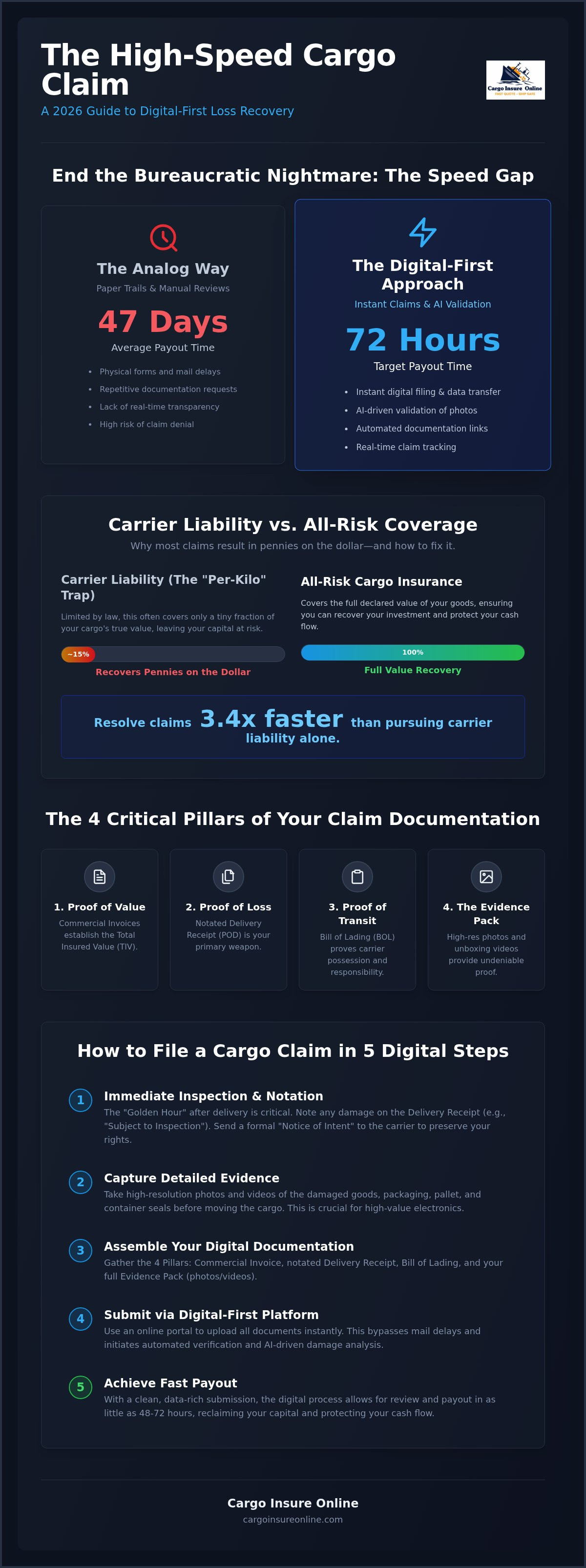
Why settle for a 60-day payout window when your cash flow is on the line today? Traditional manual processing takes an average of 47 days to reach a final disposition. That's a lifetime in global trade. You've likely felt the suffocating weight of the standard cargo insurance claim process. It's a system built on "per-kilo" liability traps and repetitive documentation requests that seem designed to trigger a denial. You deserve a recovery partner that moves as fast as your supply chain.
We're here to end the bureaucratic nightmare. This 2026 guide promises to help you master a high-speed, digital-first approach to recovering your cargo losses. You'll learn how to leverage all-risk coverage to resolve claims 3.4 times faster than pursuing carrier liability alone. We're providing a clear roadmap from the moment of damage to a successful payout. We'll cover instant digital filing, full value recovery strategies, and the technical tools that turn a six-month battle into a 72-hour win. It's time to stop chasing adjusters and start reclaiming your capital.
Key Takeaways
- Identify the four essential documents needed to prove value and loss without the traditional back-and-forth documentation requests.
- Discover why the "per-kilo" liability trap often results in pennies on the dollar and how all-risk coverage ensures full value recovery.
- Master a streamlined 5-step cargo insurance claim process that uses digital-first workflows to bypass old-school carrier delays.
- Learn how specialized protection for high-value electronics and drones ensures complex losses are handled with surgical precision and speed.
- Understand the "duty to mitigate" and why immediate delivery receipt notation is your strongest weapon against claim denials.
What is the Cargo Insurance Claim Process? (Stop the Paperwork)
The cargo insurance claim process is the digital workflow used to prove loss and secure financial recovery after a transit incident. It's a specialized sub-branch of Marine Insurance that has finally shed its bureaucratic skin. In 2026, the goal is simple. You need to move from a "Notice of Loss" to "Cash in Bank" with zero friction. Speed isn't just a bonus; it's your #1 asset in a global supply chain where every hour of downtime drains your margins. Capital tied up in damaged inventory is dead weight that your business can't afford.
The shift is here. We've moved from "Paper Trails" to "Instant Claims." The old way involved mailing physical forms and waiting for manual reviews that could stretch into months. The modern approach treats a claim like a data transfer. It's about getting the right information to the right system immediately. When you prioritize speed, you don't just recover your money; you protect your customer relationships and maintain your momentum.
Analog vs. Digital: The Speed Gap
Waiting for "official forms" to arrive by mail is a relic of the past. It's inefficient, slow, and entirely unnecessary. Modern digital-first platforms like CIO bypass traditional bottlenecks by automating the verification of documents. While manual processing can take 47 days, digital workflows aim for 48 to 72 hours. This gap represents the difference between a minor operational hiccup and a full-blown financial crisis.
- AI-Driven Validation: Algorithms can analyze damage photos instantly, confirming losses without waiting for a human adjuster to board a plane.
- Automated Documentation: Digital systems link directly to your commercial invoices and packing lists, eliminating repetitive data entry.
- Real-Time Transparency: You see exactly where your claim sits in the pipeline, removing the "black hole" effect of traditional insurance.
The Stakeholders in Your Claim
Three key players drive the recovery path. The Insured is you, the party with the financial interest in the goods. The Underwriter is the insurance provider that evaluates the risk and pays the claim. The Surveyor acts as an independent fact-finder who inspects the cargo to determine the exact cause and extent of the damage.
Don't forget the "Notice of Intent." This is a formal letter you send to the carrier immediately upon discovering damage. It doesn't replace the formal cargo insurance claim process, but it puts the carrier on notice and preserves your legal rights for future subrogation. Keeping these stakeholders aligned through a digital platform ensures that nobody becomes a bottleneck in your recovery journey.
The 4 Critical Pillars of Your Claim Documentation
Data is the fuel for a high-speed cargo insurance claim process. Without clean documentation, even the most sophisticated digital platform stalls. You need to build an airtight evidence vault before you hit submit. Don't rely on memory or vague descriptions; rely on hard data that proves exactly what happened and what it cost you.
- Proof of Value: Your commercial invoices are non-negotiable. They establish the Total Insured Value (TIV) and ensure you aren't fighting over the replacement cost.
- Proof of Loss: The Delivery Receipt (POD) is your primary weapon. A "clean" POD suggests no damage occurred. Always mark it "Subject to Inspection" if the packaging is even slightly scuffed.
- Proof of Transit: The Bill of Lading (BOL), or its modern digital e-BOL equivalent, proves the carrier had possession and responsibility during the incident.
- The Evidence Pack: High-resolution photos and unboxing videos are the ultimate proof. They turn a "he-said, she-said" argument into an undeniable fact.
Capturing Evidence at the Loading Dock
The first 60 minutes after the truck arrives is the "Golden Hour" of claims. If you miss this window, your chances of full recovery drop significantly. This is especially critical for electronics shipping insurance, where internal damage isn't always visible on the box. Photograph the pallet from four angles before it moves. Capture the seal number and any serial numbers on the hardware. Use bright, direct lighting to reveal hairline cracks or moisture stains. If you're unsure about the next steps, you can speak with a digital claims specialist to ensure your evidence is audit-ready.
The Notice of Intent to Claim
Don't wait for your insurer to pick up the phone. You must notify the carrier immediately to preserve your rights. This isn't the formal claim; it's a "Notice of Intent" that freezes the clock. Deadlines are brutal. For international air cargo under the Montreal Convention, you have 14 days for damage. For an ocean cargo claims process, the COGSA window for visible damage is just 3 days. Road freight often requires notification within 5 business days for concealed damage. Draft a punchy, one-page notice stating the BOL number, the date, and a brief description of the loss. Send it via email with a read receipt. It's a small step that prevents the "Time Bar" trap from killing your recovery.
Carrier Liability vs. All-Risk: Why Most Claims Fail
Reliance on carrier liability is the fastest way to lose money in global trade. Most shippers assume their goods are protected because the carrier has a policy. They're wrong. Under standard Carrier's Liability, you enter the Negligence Trap. To get paid, you must prove the carrier was specifically at fault. This is an uphill battle against a legal team designed to say "no." Even if you win, the "Per-Kilo" rule slashes your payout to a fraction of the cargo's value.
Then there's the General Average nightmare. If a ship catches fire or runs aground, maritime law requires all cargo owners to share the cost of the loss. You could end up paying for someone else's damaged containers just to release your own perfectly fine goods. It's a relic of the past that still haunts the modern cargo insurance claim process. It's not just about your loss; it's about the entire vessel's survival.
The Math of a Failed Claim
The numbers don't lie. Imagine you lose a shipment of high-end tablets worth $50,000. The total weight is only 100kg. Under international air conventions, the carrier's liability is capped at roughly $20 per kilo. Your total recovery? A measly $2,000. You just ate a $48,000 loss because you didn't have a private policy. This is why air freight insurance is essential for high-value, low-weight items that need full protection.
Carriers also hide behind "Act of God" exclusions. A hurricane or a freak flood isn't considered their fault, so they don't pay. You're left holding the bill for a total loss. Uninsured shippers find out too late that being "covered" by a carrier doesn't mean being reimbursed for the actual value of their inventory.
All-Risk: The Frictionless Shield
All-Risk coverage flips the script. Instead of you proving the carrier failed, the burden of proof shifts to the insurer. If the loss isn't specifically excluded, it's covered. It's that simple. This is especially vital for the sensitive cargo insurance claim process involving temperature-controlled goods. Compare this to the specialized needs of reefer cargo insurance to see how high-stakes this becomes when the cold chain breaks.
You aren't fighting for $20 per kilo. You're recovering the full invoice value plus freight costs and often a 10% buffer for anticipated profit. You get peace of mind and protected cash flow. Stop gambling with carrier limits. Start shielding your bottom line with a digital-first All-Risk policy that values your cargo as much as you do.
How to File a Cargo Claim in 5 Digital Steps
Forget the multi-page PDF guides and the "contact your local agent" runaround. In 2026, the cargo insurance claim process is a high-speed sprint, not a marathon. When your shipment arrives compromised, you need to act with surgical precision to protect your $142,000 average claim value. Follow these five steps to move from disaster to deposit without the traditional 47-day wait.
- Step 1: Immediate Inspection and POD Notation. Check your goods the second they hit the dock. For ocean freight, you have just 3 days under COGSA to report visible damage. If the damage is concealed, you must notify the carrier within 5 business days of discovery.
- Step 2: Segregate and Protect. Move the damaged units to a secure area. This fulfills your legal duty to mitigate loss and prevents further issues.
- Step 3: Notify Digitally. Send your "Notice of Intent" to the carrier and alert your insurer simultaneously through a digital portal.
- Step 4: Upload Your Evidence. Drop your photos, videos, and invoices into the system. High-speed platforms use AI to validate these files in seconds.
- Step 5: Settlement and Subrogation. Once approved, you receive your payout. Your insurer then handles the subrogation, chasing the carrier for recovery so you don't have to.
Step 2: The Duty to Mitigate Loss
You can't just throw away damaged goods and expect a full check. You have a "Duty to Mitigate," which means you must take reasonable steps to minimize the financial hit. Start by separating sound cargo from damaged cargo immediately. This stops "Cross-Contamination," which is a major risk in food or chemical shipments. Document the "Salvage Value" by getting quotes from secondary buyers or repair shops. Proving that you tried to save every possible dollar makes your claim nearly impossible for an adjuster to decline.
Step 4: The Digital Upload
The days of mailing physical folders are dead. Using the CIO portal allows for instant document submission that feeds directly into API-driven review systems. These smart systems flag missing data points in real-time, so you don't wait three weeks just to be told a signature is missing. This is a game-changer for trucking cargo insurance where drivers and warehouse managers need to report incidents on the go. While manual claims drag on for over a month, digital processing can settle your loss in as little as 48 to 72 hours. If you're ready to bypass the bottlenecks, you can start your digital claim here and get your capital back into your business today.
Frictionless Claims with Cargo Insure Online
Insurance shouldn't feel like a punishment for a bad day. At Cargo Insure Online (CIO), we've flipped the script on the traditionally dry and bureaucratic insurance model. Our philosophy is simple. We value your time as much as your cargo. While the average cargo insurance claim process in the industry drags on for 47 days, we've built a system that prioritizes speed, clarity, and relief. We're not just a service provider; we're a tech-savvy ally that removes the friction from global trade.
Our infrastructure operates at the same high speed as the industries we serve. We don't sleep because your supply chain doesn't. With a global reach that spans air, sea, and land, CIO provides a digital-first shield that moves as fast as a click. For logistics professionals, we offer more than just coverage. Our white-label API solutions allow you to integrate "Claim-as-a-Service" directly into your own platforms. You can transform a potential administrative nightmare into a branded, high-performance competitive advantage for your clients.
Specialized Protection for Tech & E-Commerce
Standard policies often fail when it comes to the complexities of modern hardware. Drones, high-value electronics, and mobile phones require more than a generic "one-size-fits-all" approach. Drones aren't just freight; they're sophisticated sensors. Mobile phones aren't just inventory; they're high-liquidity assets. We've developed specialized workflows that understand these nuances, ensuring that the cargo insurance claim process for high-tech goods is surgically precise.
E-commerce sellers face unique pressures that traditional insurers ignore. You need instant quotes and even faster payouts to keep your store's reputation intact. Check out our guide on cross-border e-commerce insurance to see how we handle global selling risks. If you're a logistics partner, you can even launch your own branded cargo insurance platforms using our engine. We provide the technology; you provide the peace of mind.
Get Started: Zero Waiting, Total Protection
Your next shipment shouldn't be a gamble. It deserves a digital-first shield that protects its full invoice value without the "per-kilo" liability traps. Moving your insurance to a digital platform isn't just an upgrade. It's a fundamental shift from an administrative chore to a strategic asset. You'll spend less time chasing documentation and more time growing your business. The future of freight recovery isn't found in a filing cabinet; it's found in an API-driven, frictionless ecosystem. It's time to experience the relief of a claim process that actually works. Stop waiting and start shipping with Cargo Insure Online today.
Master the Future of Freight Recovery
The era of waiting 47 days for a manual adjuster is over. You've seen how the modern cargo insurance claim process transforms from a bureaucratic burden into a high-speed digital asset. By switching from restrictive carrier liability to comprehensive All-Risk coverage, you protect the full value of your inventory rather than settling for pennies on the pound. Documentation isn't a hurdle anymore; it's the digital fuel that powers your recovery.
Stop treating insurance like an administrative chore. It's a competitive advantage that protects your cash flow and customer trust. We provide instant digital filing via API and specialized high-value tech recovery designed for the 2026 market. With global 24/7 claims support, we act as the tech-savvy ally your logistics operation deserves. You don't have to navigate these complexities alone when you have a partner built for speed.
Secure your next shipment with a frictionless claim process at Cargo Insure Online. Take control of your transit risks today and keep your business moving forward with total confidence.
Frequently Asked Questions
How long does the cargo insurance claim process typically take?
Traditional manual claims drag on for an average of 47 days. However; a digital-first cargo insurance claim process can settle in as little as 48 to 72 hours. This massive speed gap exists because API-driven platforms validate data instantly. You don't have to wait for physical mail or manual reviews. By providing clean digital evidence up front, you bypass the standard industry bottlenecks and get your capital back into your business much faster.
What happens if the carrier denies my cargo claim?
If a carrier denies your claim, you're often left with a total loss unless you have a private All-Risk policy. Carriers frequently use "Acts of God" or lack of proven negligence to avoid payouts. With a digital insurance partner, the insurer pays your claim first based on the terms of your policy. They then handle the legal battle with the carrier themselves through subrogation, protecting your cash flow from their red tape.
Can I file a claim if the damage was discovered after delivery (hidden damage)?
Yes, you can file for concealed damage, but the clock moves fast. In the US, you must notify the carrier within 5 business days of discovery to request an inspection. For international air cargo, the window is often 14 days. You'll need to prove the damage happened during transit rather than in your warehouse. High-resolution photos of the packaging and the "Subject to Inspection" note on your POD are critical for these cases.
Is a surveyor always required for a cargo insurance claim?
A professional surveyor isn't always mandatory for every incident. For smaller losses or clear-cut damage, digital evidence like unboxing videos and high-resolution photos often suffice for AI-driven validation. However; for high-value electronics or complex maritime incidents, an independent surveyor provides the authoritative fact-finding report required for a large settlement. They act as a neutral party to confirm the cause and extent of the loss, ensuring the adjuster has indisputable data during the cargo insurance claim process.
What is the 'duty to mitigate' in a cargo insurance claim?
The duty to mitigate is your legal obligation to prevent further loss after an incident occurs. You can't simply abandon the shipment. You must separate damaged items from sound ones to stop issues like cross-contamination. This also involves protecting the cargo from weather or theft while the claim is underway. Documenting your efforts to preserve the remaining value actually strengthens your standing with the insurer and speeds up your eventual payout.
How do I calculate the 'Total Insured Value' for a claim?
Calculating Total Insured Value (TIV) typically involves the commercial invoice price of the goods plus the cost of freight. It's also industry standard to add a 10% buffer to cover anticipated profit or administrative costs associated with the loss. Ensuring this number is accurate at the start of your policy prevents disputes during the recovery phase. This comprehensive valuation ensures you aren't just getting the cost of the goods back, but your entire investment.
What is subrogation in the cargo claim process?
Subrogation is the process where your insurer steps into your shoes after paying your claim. Once you receive your settlement, the insurer takes over the legal right to pursue the carrier for the loss. This is a major benefit of digital insurance. You get paid immediately, and the insurer deals with the carrier's legal team and "per-kilo" liability limits. It removes the burden of litigation from your shoulders while keeping your balance sheet healthy.
Can I file a claim for temperature-sensitive cargo like reefer products?
You can absolutely file claims for temperature-sensitive goods if you have a specialized Reefer Product policy. These claims usually center on "cold chain" failures, such as reefer unit breakdowns or power interruptions. You'll need to provide data logger records or temperature charts as proof of the deviation. Digital platforms make this easier by allowing you to upload sensor data directly, proving the breach occurred while the cargo was in the carrier's possession.


