

What if your insurance premium wasn't just a safety net, but a high-speed lever for clearing customs faster? Most shippers treat cargo insurance for customs valuation as a tedious administrative chore. It isn't. It's actually the secret to frictionless global trade. We know the stress. Customs audits are terrifying. Bureaucratic jargon is exhausting. Apportioning annual premiums across individual shipments feels like a math puzzle nobody asked for.
You want accuracy without the headache. You need lower risk without the delays. You've likely felt the sting of a shipment held up over a minor valuation error. This 2026 digital guide wipes away that confusion. We'll master the critical link between your premiums and your declared customs value to ensure your supply chain moves at the speed of software. No more guesswork. No more friction. We are breaking down the latest digital reporting standards, smart apportionment strategies, and audit-proofing techniques. Get ready to transform your compliance from a bottleneck into a competitive advantage. It's time to trade smarter, faster, and with total confidence.
Key Takeaways
- Understand why insurance premiums are mandatory additions to your transaction value. Learn to calculate composite customs values that pass every audit.
- Master the precision framework for cargo insurance for customs valuation, including how the 110% rule impacts your final duty payments.
- Stop confusing carrier liability with real protection. Learn why All-Risk insurance is the only asset customs brokers truly trust for seamless declarations.
- Navigate high-scrutiny reporting for electronics, drones, and reefer shipments. Ensure your high-value tech doesn't get stuck at the border.
- Ditch the paperwork for digital-first speed. Use instant quotes and compliant certificates to turn compliance into a competitive logistics advantage.
Why Cargo Insurance is the Secret Key to Customs Valuation
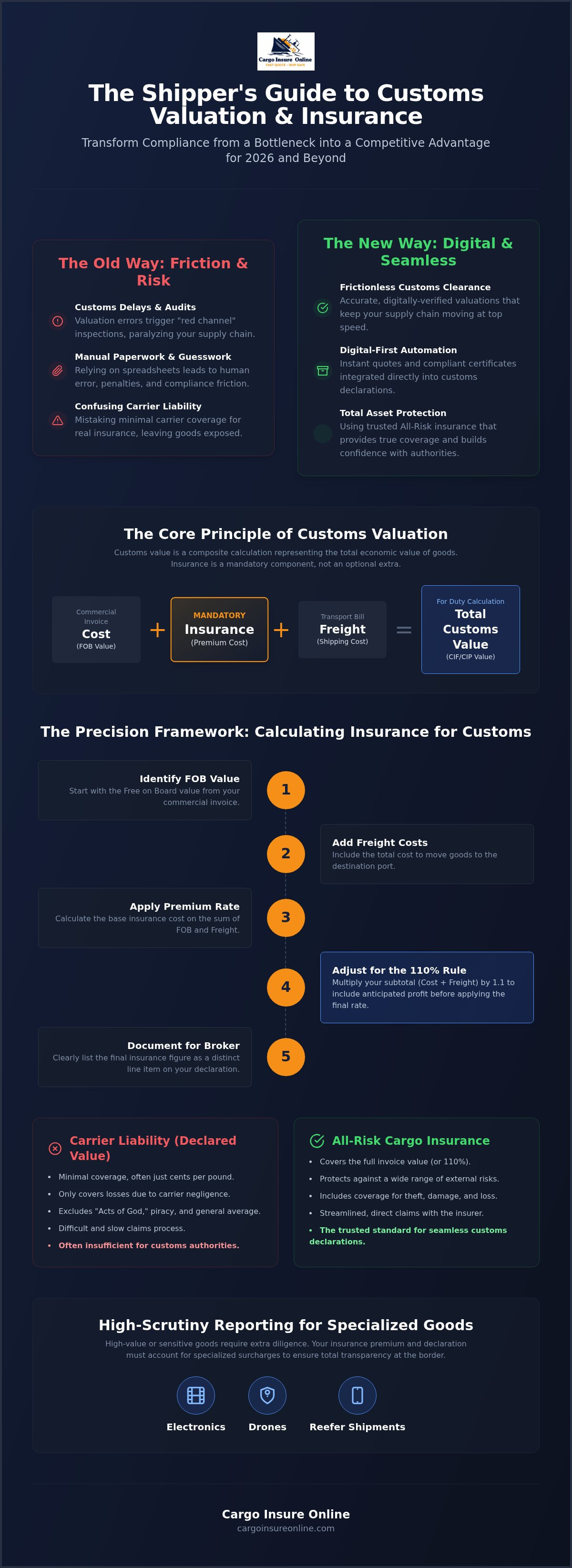
Customs value isn't just the price tag on your invoice. It's a composite calculation that represents the total economic value of goods at the point of entry. Customs valuation is the specific method used to determine the monetary value of imported goods for duty purposes, fundamentally built on the Cost, Insurance, and Freight (CIF) components. If you think insurance is an optional line item, you're risking your entire supply chain. In the eyes of a customs officer, insurance premiums are mandatory additions to the "Transaction Value."
Leaving these costs out doesn't just look sloppy. It signals a red flag. Accurate cargo insurance for customs valuation prevents the dreaded "red channel" delays that can paralyze your operations for weeks. When your data is precise, your goods move. When it's not, you're looking at audits, penalties, and a damaged reputation with authorities. It's about more than just numbers; it's about maintaining a frictionless flow in a high-speed global market.
The CIF and CIP Connection
Incoterms define the rules of the game. For CIF and CIP shipments, providing proof of insurance isn't just a best practice; it's a requirement. Customs authorities use this insurance data as a cross-reference tool to verify shipment integrity. They're looking for consistency between your commercial invoice and your insurance certificate. Under-reporting your insurance costs might seem like a clever way to lower your duty bill, but the reality is far uglier. Discrepancies often lead to fines that far outweigh any perceived savings. In 2026, transparency is your only real protection against regulatory friction.
Digital-First Valuation in 2026
The era of manual spreadsheets is over. Today, software does the heavy lifting. Automation simplifies premium reporting by pulling data directly from your insurance provider into your customs declarations. This real-time data exchange between digital insurance platforms and customs brokers eliminates the human error that triggers audits. Speed is the new compliance standard. You shouldn't have to wait days for a valuation report. Modern systems provide these insights instantly, allowing your shipments to clear the border while your competitors are still digging through paperwork. It's not just about being compliant; it's about being faster than the system itself.
Calculating Insurance Costs for Customs: The Precision Framework
Stop guessing your way through a customs entry. Precision isn't a burden; it's your superpower. To get your cargo insurance for customs valuation right, you must start with the primary premium. This is the base cost of your cargo coverage. It's the foundation of your CIF calculation. But the foundation is only the beginning. You need to account for the 110% rule. Most global trade standards expect you to insure for 110% of the CIF value. That extra 10% isn't random; it represents your anticipated profit. Customs authorities want to see this reflected because it validates the true economic weight of the shipment.
Don't forget the specialized riders. If you're shipping high-value electronics or drones, your premium likely includes a surcharge. These specific costs must be captured in your reporting to ensure total transparency. Getting this right is easy when you access instant, specialized quotes that break down these costs for you. Here is the exact step-by-step framework for calculating the insurance component of a CIF value:
- Step 1: Identify the FOB (Free on Board) value from your commercial invoice.
- Step 2: Add the total freight costs required to move the goods to the destination port.
- Step 3: Apply your insurance premium rate to the sum of FOB and freight.
- Step 4: Adjust for the 110% rule by multiplying your subtotal by 1.1 before applying the rate.
- Step 5: Document the final insurance figure as a distinct line item for your customs broker.
The Math of Apportionment
Managing an annual policy? You can't just dump a yearly premium onto one shipment. You need to divide that cost across every individual move. While some attempt to use weight, customs authorities almost always prefer value-based apportionment. It's more logical. If a container holds a mix of low-value textiles and high-value electronics, the insurance cost should follow the value. Allocate your premium proportionally to each tariff code to keep your audit trail clean and your duty payments optimized.
Deductions and Exclusions
You don't have to pay duty on every cent. You can legally exclude post-importation insurance. This is the coverage that protects your goods from the port to your final warehouse. Since this risk occurs after the goods enter the country, it's not part of the dutiable value. Also, distinguish between third-party premiums and internal "self-insurance." If you aren't paying an actual premium to an external provider, you generally cannot include that "cost" in your customs declaration. Stick to verifiable, third-party expenses to stay compliant.
Declared Value vs. All-Risk Insurance: Impact on Duties
Don't confuse a carrier's legal shield with your financial asset. Declared value is a liability limit for the transporter. All-Risk insurance is a high-speed asset for the shipper. Shippers often try to use "declared value" notes on a bill of lading to satisfy cargo insurance for customs valuation requirements. It doesn't work. Customs officials are trained to spot the difference instantly. They won't accept a carrier's default limit as a valid insurance component for a CIF calculation because it doesn't reflect the full economic value of the cargo.
This creates a "Hidden Tax" for the unprepared. When carrier limits are low, customs may suspect you are under-reporting the total transaction value. This leads to valuation disputes that can freeze your inventory at the port. Your insurance certificate must match your commercial invoice exactly. Discrepancies are an open invitation for an audit. You need a digital-first solution that ensures every line item aligns before the goods even hit the water. Consistency is your best defense against unnecessary friction.
Carrier Liability Pitfalls
The "Per-Kilo" rule is a relic of the past. It fails miserably for modern high-value electronics and drones. If your shipment weighs 10kg but is worth $10,000, a carrier's liability might only cover a fraction of that cost. Customs officials know this math doesn't add up. They look for specific insurance certificates, not just vague "declared value" notes. These certificates provide the precise data needed for accurate duty calculations. Beyond the paperwork, there is the reality of recovery. All-Risk insurance pays out in days. Carriers often take months to process claims; leaving your capital locked in a bureaucratic black hole while you wait for a resolution.
Optimizing Duty Payments
All-Risk insurance provides the cleanest audit trail possible. It simplifies the job for your customs broker and reduces "rejection risk" at the border. When your premium documentation is clear and accessible, officials have no reason to pull your shipment for a manual inspection. You are effectively buying a fast-pass through the regulatory landscape. To understand how these two protection levels differ in a real-world scenario, read our breakdown of Carrier Liability vs Cargo Insurance. Don't let a carrier's fine print dictate your duty strategy. Take control of your valuation with precise, digital documentation that respects your time and your bottom line.
Specialized Goods: Valuation for Electronics and Drones
High-value tech isn't just expensive to buy. It's expensive to clear. When you ship smartphones, tablets, or drones, you aren't just moving hardware; you're moving high-risk assets that trigger immediate customs scrutiny. For these items, cargo insurance for customs valuation becomes a balancing act of precision and speed. Customs officers know that tech premiums are higher. They expect to see those costs perfectly reflected in your declarations. Any mismatch between the insured value and the reported premium suggests a valuation error. This is where the "red channel" delays we discussed earlier become a very expensive reality.
Drone shipping insurance requires its own set of specific valuation line items. You can't just group these under general electronics. Authorities often look for distinct entries that account for the specialized nature of autonomous flight tech. Similarly, you must document GAP insurance in your customs filing if it's part of your coverage package. While GAP insurance covers the difference between the actual value and the replacement cost, it still influences the total transaction value. Transparent reporting here prevents officials from questioning your numbers during a post-entry audit.
Electronics and Mobile Tech
Valuing high-frequency shipments of smartphones and tablets requires a streamlined approach. For bulk tech moves, insurance is often calculated as a percentage of the total value. This makes Electronics Shipping Insurance essential for maintaining valuation accuracy across every SKU. You don't have time to manually calculate premiums for ten thousand mobile devices. You need a digital system that automates the math and generates the certificates customs brokers love. This ensures your high-speed tech moves at the speed of your e-commerce demand.
The Reefer and Perishables Nuance
Temperature-sensitive goods introduce a different kind of complexity. Customs officials care about the physical value of the goods, but they also monitor the risks involved in transport. Reporting Reefer insurance involves handling spoilage versus physical damage. While spoilage coverage protects your bottom line, it must be accurately valued to ensure your VAT and duties are calculated correctly at the border. For a deeper look at cold chain protection, consult our guide on Reefer Cargo Insurance. Don't let a temperature spike melt your profits or your compliance record. You can get an instant quote for specialized goods today and keep your cold chain moving without friction.
Frictionless Customs Compliance with Cargo Insure Online
Stop the paperwork. Start the shipping. Cargo Insure Online (CIO) is built for the pace of 2026 global trade. Traditional insurance is a bottleneck; we are the bypass. By offering instant quotes, we provide the accurate valuation math you need before the ship even sails. This isn't just about protection. It’s about total precision. Our platform delivers All-Risk coverage that satisfies global customs standards, covering the critical gaps that carrier liability leaves wide open. We turn a perceived administrative chore into a high-speed strategic advantage.
Customs brokers love our digital certificates. They are clear, concise, and fully compliant with international reporting requirements. No more digging through blurry scans or deciphering dense legalise. When your broker has a CIO certificate in hand, the cargo insurance for customs valuation process becomes a non-event. It’s a seamless, digital handoff that keeps your goods moving through the port while your competitors are still stuck in the red channel. We empower you to declare with confidence and clear with speed.
The Digital Advantage
We offer global coverage across air, sea, and trucking from a single, high-energy platform. For logistics providers, our White Label Solutions allow you to automate valuation reporting under your own brand. E-commerce businesses can scale without limits by integrating our insurance engine directly into their existing API. This removes the manual touchpoints that cause errors. It eliminates the friction that causes delays. You get real-time data exchange that ensures your insurance premiums and customs values are always in perfect sync.
Next Steps for Importers
Your supply chain strategy needs an upgrade. Start by reviewing your current Incoterms and insurance certificates for any discrepancies. If you are still relying on carrier liability, you are leaving your customs valuation to chance. It is time to move beyond the spreadsheet era. Talk to a CIO expert about automating your premium reporting and turning your compliance into a competitive edge. Don't let bureaucratic friction slow your growth or trigger unnecessary audits. Your frictionless future is one click away. Get an instant quote and fix your customs valuation today!
Master Your Global Trade Velocity
Accurate customs declarations don't have to be a bottleneck. By mastering cargo insurance for customs valuation, you transform a regulatory chore into a high-speed growth strategy. You've seen the difference. Carrier liability is a trap; All-Risk protection is your financial asset. Precise CIF calculations and the 110% rule ensure your shipments bypass the red channel and move straight to their destination without the fear of audits or delays.
Stop fighting bureaucratic friction. Ditch the manual spreadsheets and embrace the digital-first era of global logistics. With instant digital certificates and specialized protection for high-value tech and drones, you can scale your e-commerce or logistics business with total confidence. The future of trade is fast, transparent, and completely under your control. You've got the knowledge to turn compliance into a competitive advantage.
Ready to clear customs without the headache? Get a Frictionless Cargo Insurance Quote Now and let's get your goods moving at the speed of software. It's time to experience insurance that works as hard as you do.
Frequently Asked Questions
Does cargo insurance increase the amount of duty I pay?
Yes, it generally does because duties are calculated on the CIF value. Adding the insurance premium increases the total dutiable value of your shipment. However, the cost of the premium is usually small compared to the protection it provides. Accurate reporting ensures you pay exactly what is owed and avoids the heavy penalties associated with under-valuation. It's a minor cost for major peace of mind.
Can I exclude insurance costs if my shipping terms are FOB?
No, you cannot exclude insurance costs from the final customs value even under FOB terms. While the seller doesn't pay for insurance in an FOB agreement, the buyer usually does. Customs authorities require the total value of the goods at the point of entry. This means you must add the cost of your own insurance premium to the FOB price to reach the correct dutiable value.
What happens if I don’t report the insurance premium to customs?
Omitting the premium triggers audits, delays, and financial penalties. Customs officers use automated systems to flag shipments where insurance costs appear to be missing from the calculation. If you're caught under-reporting cargo insurance for customs valuation, your shipment might be moved to the "red channel" for physical inspection. This results in storage fees and a tarnished compliance record that affects every future shipment you make.
How do I calculate insurance for a multi-product shipment?
You should apportion the total insurance cost based on the value of each individual item. Customs authorities prefer value-based allocation over weight-based methods because insurance risk follows the dollar amount. If your container has electronics and textiles, calculate the percentage of total value each category represents. Apply that same percentage to your total insurance premium. This ensures each tariff code carries its fair share of the cost for accurate duty reporting.
Is carrier "declared value" the same as insurance for customs purposes?
No, carrier "declared value" is a liability limit and not a valid insurance premium for customs. Carriers often limit their responsibility to small amounts per kilogram. Customs officials look for a specific insurance certificate from a third-party provider. Using a carrier's limit as your insurance figure is a common error that leads to valuation disputes. Real All-Risk insurance provides a clear, documented premium that satisfies every global customs standard.
What is the "110% rule" in marine cargo insurance valuation?
The "110% rule" is an industry standard where goods are insured for their full CIF value plus an additional 10%. This extra margin covers anticipated profit and administrative costs if a loss occurs. When reporting cargo insurance for customs valuation, you must ensure your premium calculation reflects this total insured amount. Customs authorities accept this as the standard economic value of the goods, making it a critical component of your declaration.
How do I handle annual insurance premiums on a per-shipment basis?
You must divide your total annual premium by your projected annual shipping volume or value. Most importers use an "estimated turnover" method to find a per-dollar rate. You then apply this rate to the value of each specific shipment. Digital platforms like CIO make this effortless by automating the math for you. This ensures your reporting stays consistent throughout the year and provides a clean audit trail for customs brokers.
Do I need insurance for customs valuation on domestic shipments?
No, customs valuation rules generally only apply to international imports. Domestic shipments don't cross national borders, so they don't require a formal customs declaration or duty calculation. While you definitely still need trucking insurance to protect your cargo from theft or damage, you don't need to report those premiums to a customs authority. It's strictly a matter of private contract and risk management for your internal supply chain.


