
Carrier liability isn't insurance. It's a legal minimum designed to protect the carrier, not your balance sheet. If you're relying on standard limits to cover a loss in 2026, you're likely staring at a 90% recovery gap. Understanding the specific insurance requirements for air and sea freight is no longer just a compliance task; it's a survival strategy for global trade. You know the drill. You ship high-value goods, something goes wrong, and you're met with a wall of fine print and protracted claim processes.
It's exhausting to battle outdated conventions like Hague-Visby or the Montreal Convention while your capital is tied up in damaged inventory. We promise to help you master these complex global mandates and protect your bottom line from the hidden traps of carrier liability. This 2026 guide breaks down the latest SDR rates, explains the All-Risk advantage, and provides a clear roadmap to frictionless shipping protection. Stop fighting the old-school brokers and start securing your cargo with the speed and clarity your business deserves.
Key Takeaways
- Master the updated 2026 insurance requirements for air and sea freight to ensure your high-value cargo stays protected across every border.
- Decode the commercial mandates of Incoterms 2020, including CIF and CIP, to pinpoint exactly when you’re legally responsible for securing coverage.
- Stop relying on carrier liability and learn how All-Risk insurance bridges the massive financial gap left by Montreal Convention and Hague-Visby limits.
- Protect your revenue by identifying "Acts of God" and other hidden exclusions that carriers use to deny claims and drain your bottom line.
- Streamline your logistics with a digital-first approach that swaps protracted legal battles for instant quotes and rapid, frictionless claim resolutions.
What Are the Legal Insurance Requirements for Global Freight?
You might think international law forces you to buy cargo insurance. It doesn't. Most global treaties focus on the carrier's protection, not yours. This creates a dangerous misconception about the actual insurance requirements for air and sea freight. While a government might not throw you in jail for skipping a policy, your commercial partners and the reality of 2026 supply chain volatility certainly will. Insurance isn't always legally mandatory in a criminal sense, but it is commercially essential for business survival.
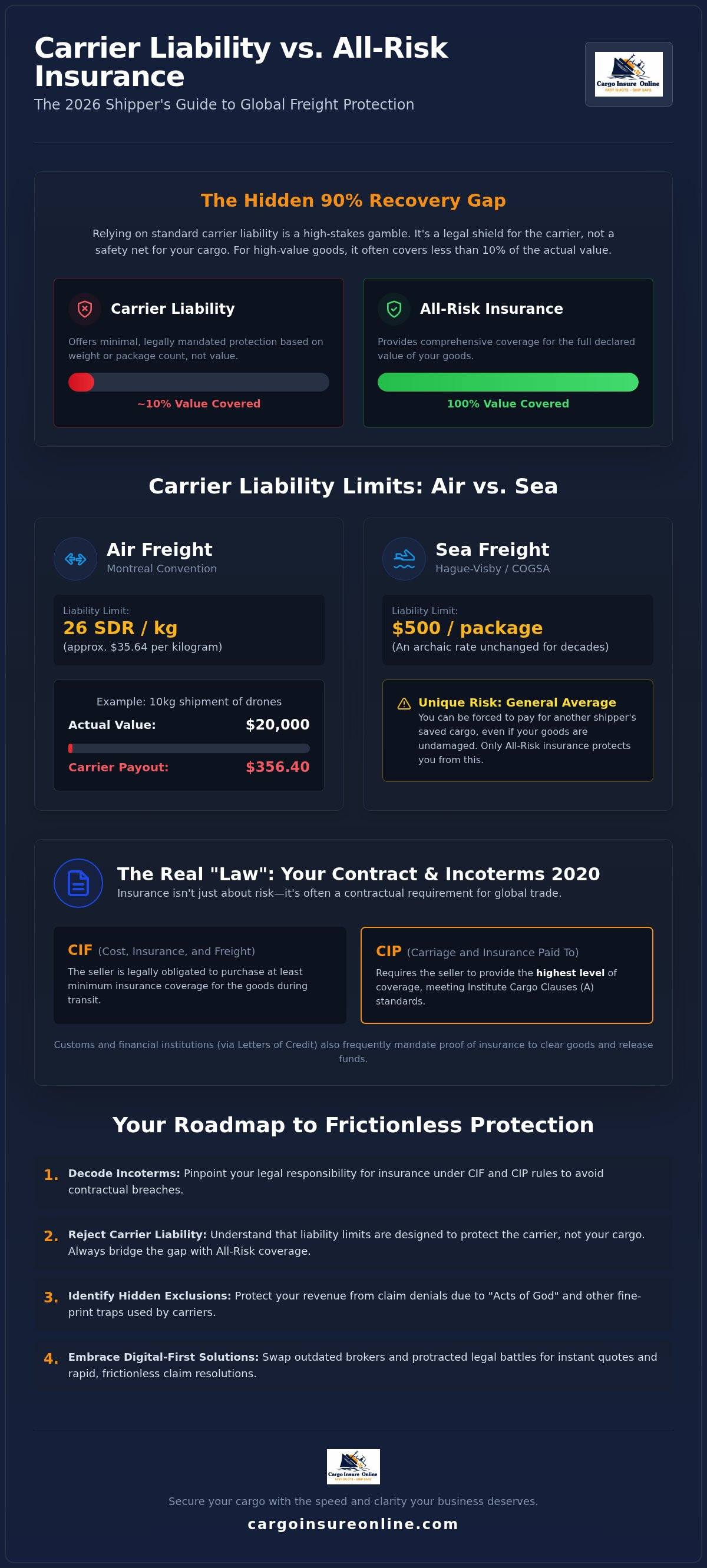
Don't confuse carrier liability with cargo insurance. One is a limited legal promise; the other is a comprehensive financial asset. Carriers operate under conventions that cap their payouts at a fraction of your cargo's value. Relying on this is a high-stakes gamble. You're essentially self-insuring 90% of your shipment's value without even knowing it. Liability isn't a safety net. It's a legal shield for the shipping line. All-Risk insurance is your actual rescue plan.
Incoterms: The Contractual Requirement
The real "law" in global trade is the contract. Under Incoterms 2020, specifically CIF (Cost, Insurance, and Freight) and CIP (Carriage and Insurance Paid To), the seller is legally obligated to provide insurance. For CIP, the seller must provide coverage that meets Institute Cargo Clauses (A), which is the highest level of protection. Marine insurance principles underpin these requirements, ensuring the risk transfer between buyer and seller is backed by financial security. Minimum coverage often fails high-value electronics or reefer goods because it doesn't account for the specific vulnerabilities of sensitive tech or temperature-controlled products. If you're shipping drones or mobile phones, "minimum" is just another word for "unprotected."
Government and Customs Mandates
Customs officials in many jurisdictions require proof of insurance to clear goods, especially for high-risk categories. If you can't show a certificate, your cargo sits. It rots. It incurs demurrage. Financial institutions also drive this mandate. If you're using a Letter of Credit, the bank won't release funds without a valid insurance policy. They want to ensure their collateral is safe from "General Average" traps. This is a maritime law where you're legally forced to pay for a ship's saved cargo even if yours was fine. Without insurance, a single incident at sea could bankrupt your operation through these shared loss mandates. Stop treating insurance as a checkbox and start seeing it as the fuel for your global growth.
Air vs. Sea Freight: Convention Requirements and Limits
Air and sea freight operate in two different legal universes. If you ship via sky, the Montreal Convention dictates your fate. If you ship via ocean, you're likely bound by Hague-Visby or COGSA. Understanding the specific insurance requirements for air and sea freight means knowing exactly how much money you stand to lose when things go south. These conventions aren't designed to make you whole. They're designed to limit what the carrier has to pay out. Don't mistake a carrier's legal minimum for a safety net.
The Montreal Convention (Air Freight)
The Montreal Convention provides the global legal framework for international air carrier liability, establishing weight-based compensation limits for cargo loss or damage. It uses Special Drawing Rights (SDR) to calculate payouts. As of August 2026, the limit is 26 SDR per kilogram, or roughly $35.64 per kilo. It sounds decent until you do the math on high-value electronics. A 10kg box of high-end drones might be worth $20,000, but the carrier only owes you about $356. This massive gap is why specialized electronics shipping insurance is a non-negotiable requirement for tech exporters.
COGSA and Hague-Visby (Sea Freight)
Sea freight liability is even more archaic. Under the U.S. Carriage of Goods by Sea Act (COGSA), the statutory limit of liability for sea carriers is often just $500 per package. This rate hasn't changed in decades. Sea freight also carries the unique risk of General Average. If a captain sacrifices cargo to save the ship, you pay a portion of that loss even if your goods are untouched. Air freight doesn't have this shared-loss mandate. Robust sea freight insurance is your only shield against these ship-wide losses. Don't let a 19th-century legal relic sink your 21st-century business. You can get instant, frictionless protection that bypasses these carrier traps entirely.
Carrier Liability vs. All-Risk Insurance: The Hidden Gap
Carrier liability is not a safety net; it's a legal disclaimer. Many shippers assume that if a carrier loses their cargo, the carrier pays the bill. That's a dangerous myth. In reality, the gap between your actual loss and a carrier's payout is often a financial chasm. Meeting the commercial insurance requirements for air and sea freight means recognizing that liability only covers a fraction of your goods' value, and even then, only under perfect conditions. If you want full-value reimbursement, air freight insurance is the only logical path forward. It's the difference between recovering pennies on the dollar and protecting your entire investment.
The "Per-Kilo" trap is where most businesses lose their footing. Carriers pay based on weight, not value. If you're shipping lightweight, high-value components, a total loss could bankrupt a small operation. Liability also excludes "Acts of God." If a hurricane hits a port or a plane encounters extreme turbulence that damages cargo, the carrier is legally off the hook. They didn't cause the storm, so they don't pay for the damage. All-Risk insurance flips this script, covering external causes of loss without forcing you to play the blame game.
The Burden of Proof Problem
To get a dime from a carrier liability claim, you must prove the carrier was negligent. It's a legal nightmare. Carriers are experts at rejecting claims, and in 2026, they are aggressively auditing every incident. They systematically deny 60-80% of claims by citing "inadequate packaging" or "unforeseeable events." Even if you win, the timeline is brutal. Liability claims frequently drag on for 12 months or more. Compare that to the digital advantage of All-Risk policies. Modern platforms provide frictionless claims that settle in days, not years, keeping your cash flow alive while others are stuck in legal limbo.
Specialized Protection for Tech and Reefer
Standard liability is particularly useless for sensitive cargo. If you're shipping drones or high-end mobile phones, the fragility of the tech means even minor mishandling causes total failure. Carriers will argue the vibration was "normal transit stress." For cold chain logistics, the risks are even higher. A single temperature excursion can spoil an entire shipment of pharmaceuticals or perishables. Liability won't cover "inherent vice" or power failures beyond the carrier's control. You need reefer cargo insurance to bridge this gap. Don't let a "limited liability" clause turn a minor shipping hiccup into a permanent financial scar.
How to Meet Requirements and Secure Your Cargo
Securing your supply chain doesn't have to be a bureaucratic slog. You can meet all insurance requirements for air and sea freight in minutes by following a digital-first roadmap. First, identify your Incoterm responsibility. If you're shipping under CIF or CIP, you're contractually bound to provide coverage. Don't just guess the value. Use your actual commercial invoice as the baseline. Next, compare the carrier’s liability limits against that invoice. You’ll quickly see the chasm that needs to be filled.
Once you’ve identified the gap, secure an instant All-Risk quote. Forget the back-and-forth emails with old-school brokers. Use a digital platform to get a price that reflects current 2026 market rates. Ensure your documentation is digital-ready. A digital Bill of Lading isn't just a trend; it's a speed requirement for modern claims. Finally, integrate these steps into your daily workflow. Use API or white-label tools to automate the process so you never ship a single box unprotected again.
Digital Documentation for 2026
Paper is the enemy of speed. Moving to digital Bills of Lading accelerates every part of the logistics chain, especially the claim payout. In 2026, smart contracts are increasingly used to automate cargo insurance requirements. These contracts trigger actions based on verified data, reducing the need for manual intervention. Logistics providers are now using branded cargo insurance platforms to embed these protections directly into their customer portals. This eliminates friction and ensures every shipment is compliant from the moment it’s booked.
Risk Mitigation Beyond Insurance
Insurance is your safety net, but risk mitigation is your first line of defense. You must meet strict packing standards to satisfy the "Insurer's Requirement" for safe transit. Underwriters are auditing packaging more than ever before. If your electronics aren't properly cushioned or your reefer goods aren't pre-cooled, you're giving the insurer a reason to say no. Use GPS tracking and IoT sensors for high-value tech to provide real-time visibility and proof of condition. Adhering to rigorous packing standards is the absolute foundation for ensuring your cargo insurance claim is validated and paid without delay.
Ready to automate your protection? You can get an instant digital quote and secure your next shipment in seconds.
Cargo Insure Online: Frictionless Protection for Global Trade
Stop fighting with carriers. Start protecting your revenue. Traditional insurance is a slow, paper-heavy nightmare that doesn't fit the speed of 2026 logistics. Cargo Insure Online (CIO) changes that. We provide a digital-first solution that turns a complex administrative chore into a seamless, positive experience. Meeting the insurance requirements for air and sea freight shouldn't take days of back-and-forth emails. It should take seconds. We've mastered the complexities of global trade so you don't have to.
We specialize in the high-stakes world of modern tech. From drones to mobile phones, we understand that your cargo's value isn't tied to its weight. Standard carrier liability is a relic of the past that leaves you exposed. Our platform offers instant quotes for air, sea, and trucking cargo insurance, ensuring every leg of your journey is covered. We operate with a global reach and a high-speed approach that matches your business ambition. No more friction. No more uncertainty. Just pure, automated protection.
Why Shippers Choose CIO
Old-school brokers rely on endless forms and opaque processes. CIO delivers zero paperwork, zero bureaucracy, and total transparency. We help you bridge the massive "liability gap" with tailored GAP insurance. This ensures you aren't left holding the bill when a carrier hides behind a per-kilo limit. We also provide expert support for cross-border e-commerce insurance. If you're selling on global platforms, we ensure your inventory is protected from the factory floor to the final warehouse. We are the digital-first partner that values your time as much as your cargo.
Get Started in Seconds
The CIO promise is simple: relief, speed, and absolute peace of mind. Our instant quote engine is built for the modern logistics professional. You don't need a legal degree to understand your policy. You just need a few shipment details. Enter your data, review your All-Risk coverage options, and secure your cargo. It's that simple. Don't let your bottom line stay vulnerable to the hidden traps of international shipping conventions. Whether you are fulfilling the insurance requirements for air and sea freight or securing a high-value electronics shipment, we make it effortless. You can secure your shipment now with a 60-second quote and experience the future of freight protection today.
Secure Your Global Growth Today
You've seen the math. Carrier liability is a legal shield for them, not a safety net for you. Relying on outdated conventions like Hague-Visby or the Montreal Convention in 2026 is a gamble you don't need to take. Master the insurance requirements for air and sea freight by moving beyond the per-kilo trap and embracing All-Risk protection. The gap between a carrier's limited payout and your actual commercial loss is a financial chasm that only comprehensive, digital-first coverage can bridge.
Stop fighting the bureaucracy. Start leveraging technology. With instant digital coverage and specialized protection for high-value electronics and drones, you can bridge the liability gap in seconds. Our global 2026-ready API solutions mean your logistics flow never has to stop for manual paperwork or endless emails. The world of global trade moves fast; your insurance should be faster. It's time to trade uncertainty for total clarity and absolute peace of mind.
Stop Gambling with Your Cargo—Get an Instant Quote Now. Take control of your supply chain, protect your bottom line, and ship with absolute confidence. Your next shipment is far too valuable to leave to chance. Let's get it protected today.
Frequently Asked Questions
Is cargo insurance legally required for international shipping?
Cargo insurance isn't a legal mandate under international law, but it's a commercial necessity for most global trade. While no government will fine you for skipping it, your buyers, sellers, and banks definitely will. Most Letters of Credit require proof of insurance before funds release. Additionally, specific insurance requirements for air and sea freight often appear in Incoterms contracts, making it a binding obligation between you and your business partners.
What is the difference between carrier liability and cargo insurance?
Carrier liability is a limited legal promise that pays based on weight, not the actual value of your goods. If a carrier damages your shipment, they only owe you a fraction of its worth. Cargo insurance is a private policy that covers the full commercial invoice value. While liability requires you to prove the carrier was negligent, All-Risk insurance covers external losses like "Acts of God" or accidents without the lengthy legal battle.
How much does air freight insurance typically cost?
The cost of air freight insurance depends on your cargo's value, destination, and risk profile. Generally, premiums are calculated as a small percentage of the total insured value. High-value electronics or fragile tech might see different rates than bulk commodities. Instead of a flat fee, you'll find that digital platforms offer instant quotes based on real-time data. This allows you to factor protection costs directly into your shipping margins without any surprise expenses.
What is General Average in sea freight, and why does it matter?
General Average is a maritime legal principle where all parties in a sea venture share the losses resulting from a voluntary sacrifice to save the ship. If the captain throws containers overboard to prevent a sinking, every shipper on that vessel pays a portion of the loss. It matters because your cargo could be held at the port until you pay your share. Insurance is the only way to protect your capital from these shared maritime debts.
Does air cargo insurance cover delays in delivery?
Standard air cargo insurance typically excludes losses caused solely by delays in delivery. Most policies focus on physical loss or damage to the goods themselves. If your electronics arrive late but intact, a standard All-Risk policy won't reimburse you for the lost time or market fluctuations. However, some specialized riders exist for time-sensitive freight. You should always check your specific policy wording to understand exactly where your protection starts and stops during transit.
What are the Incoterms that require the seller to provide insurance?
CIF (Cost, Insurance, and Freight) and CIP (Carriage and Insurance Paid To) are the two primary Incoterms that legally obligate the seller to provide insurance. Under CIP, the seller must secure a high level of coverage, specifically Institute Cargo Clauses (A). These rules ensure that the buyer is protected the moment the risk transfers. Understanding these insurance requirements for air and sea freight helps you avoid costly contractual breaches and ensures your global shipments remain compliant.
How do I calculate the insured value of my freight?
The industry standard for calculating insured value is the "CIF + 10%" formula. This includes the Cost of the goods, the Insurance premium, and the Freight charges, plus an additional 10% to cover unforeseen expenses and lost profits. By including this extra margin, you ensure that a total loss doesn't leave you out of pocket for the logistical costs already spent. It's a simple way to protect your entire investment rather than just the raw inventory cost.
Can I buy insurance for high-value electronics like drones or mobile phones?
You can absolutely buy specialized insurance for high-value electronics like drones and mobile phones. Standard carrier liability is notoriously insufficient for these items because they are lightweight but extremely expensive. Digital-first providers offer tailored policies that account for the fragility and theft risk associated with modern tech. These policies provide the All-Risk protection necessary to ensure that a single damaged pallet of smartphones doesn't result in a massive financial hit to your business.


