
What if your biggest delivery contract vanished because your insurance quote took three days to arrive? In the high-speed world of 2026 logistics, waiting on a traditional broker isn't just annoying; it's expensive. You already know that standard carrier liability is a trap. Those hidden per-kilo limits often turn a stolen pallet of high-value iPhones into a business-ending loss. It's time to stop gambling with your bottom line. Specialized courier cargo insurance isn't just a safety net anymore. It's a high-performance digital asset that gives you the edge.
We agree that the old way of securing coverage is broken. It's slow, bureaucratic, and dangerously inadequate for modern electronics and e-commerce demands. This guide shows you how to flip the script. You'll discover how to secure instant digital proof of insurance and slash premiums through intelligent risk management. We're moving past the paperwork and into a world of frictionless protection. From comprehensive tech coverage to 2026-ready digital infrastructure, here is how you turn last-mile protection into your brand's secret weapon.
Key Takeaways
- Stop relying on basic carrier liability that pays pennies per kilo. Protecting the goods, not just the vehicle, is the only way to safeguard your actual revenue.
- Shift to All-Risk coverage to ensure your shipments are protected unless specifically excluded. It's the simplest way to avoid the "at-fault" proof trap.
- Unlock specialized protection for high-value electronics and drones. These high-risk categories require modern, tech-focused coverage to remain profitable.
- Secure courier cargo insurance via instant digital quote engines rather than waiting days for traditional brokers. Speed is your new competitive advantage for winning delivery contracts.
- Learn the three data points needed to evaluate any insurance quote in 60 seconds. Focus on cargo type, route, and max value to keep your operations moving.
Courier Cargo Insurance: Why Basic Liability is a Business Killer
Stop assuming your van insurance has your back. It doesn't. Commercial auto policies protect the vehicle, the "metal," but they leave the cargo, your "revenue," completely exposed. In 2026, the last-mile delivery market is shifting toward high-frequency, high-value tech shipments. Relying on basic vehicle coverage is a gamble you'll eventually lose. True courier cargo insurance is a specialized shield designed specifically for the goods you're carrying. It ensures that if a package disappears or breaks, your business doesn't go down with it.
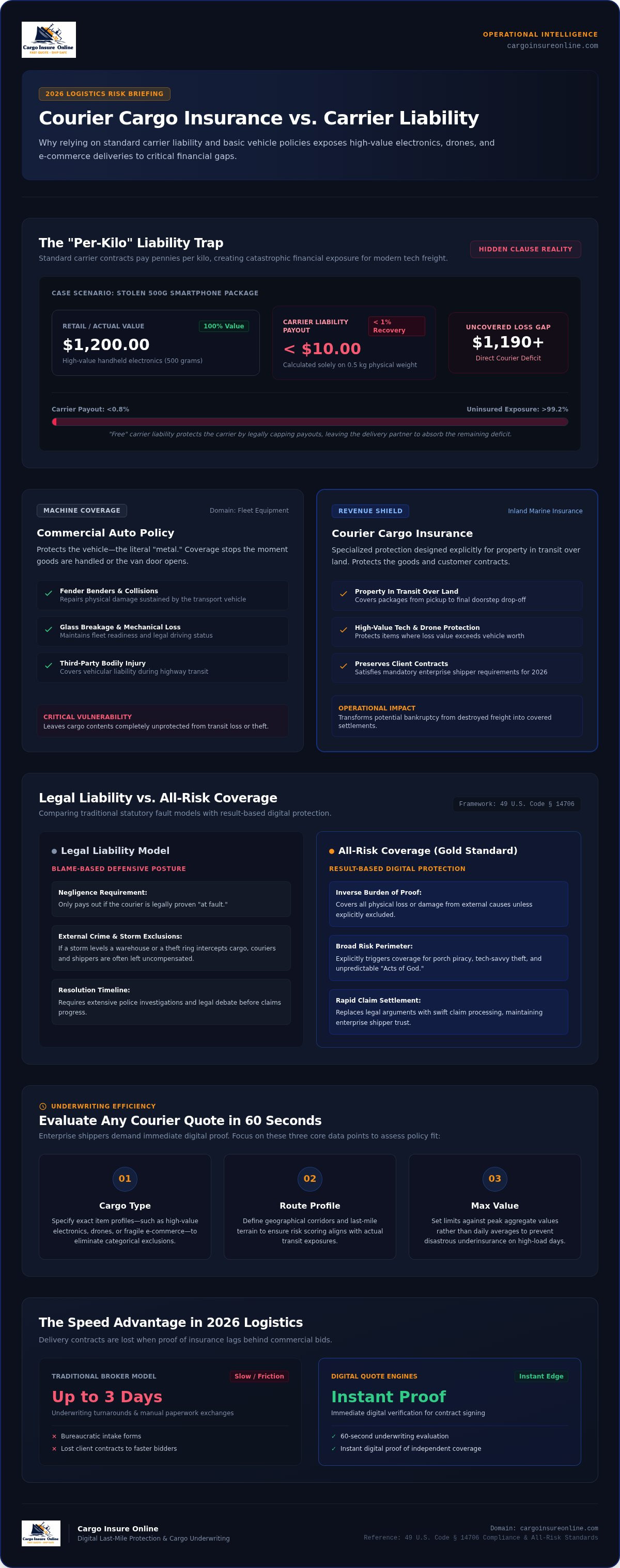
Most couriers rely on "standard carrier liability" provided by the platform or a legacy partner. It sounds safe until you read the fine print. These contracts often limit payouts to a few dollars per kilo. If you're delivering a 500g smartphone worth $1,200, a per-kilo limit might pay out less than $10. That's not protection; it's a financial catastrophe. You aren't just moving boxes; you're moving your client's most valuable assets. You need a policy that reflects that reality.
Cargo Insurance vs. Commercial Auto: Know the Difference
Think of your commercial auto policy as protection for the machine. It covers fender benders, glass breakage, and third-party injury. However, the moment that van door opens, that policy usually stops. Courier cargo insurance falls under the broader category of inland marine insurance, which specifically covers property in transit over land. Without it, a single accident could leave you with a repaired van but a six-figure debt for destroyed electronics. One protects your tools; the other protects your bank account. A fender bender is a nuisance, but a lost shipment without cargo coverage is a bankruptcy filing waiting to happen.
The Hidden Cost of 'Free' Carrier Liability
"Free" liability is a myth that kills growth. Most courier contracts contain "limited liability" clauses that protect the shipper, not you. These clauses are designed to minimize the payout from the carrier's side, often leaving you to bridge a massive financial gap. It's vital to understand the distinction between coverage types: Legal Liability only covers what you're proven "at fault" for, while All-Risk protection covers any physical loss or damage from an external cause unless it's specifically excluded. By 2026, sophisticated shippers aren't just asking for insurance; they're demanding digital proof of independent cargo coverage before they'll even sign a contract. They want to know their high-value tech is safe, and they want to see it in writing instantly.
All-Risk vs. Legal Liability: Decoding Your Protection Options
Stop playing the blame game. Traditional insurance models love to ask "who is at fault?" while your client is asking "where is my money?" Standard legal liability is a defensive posture. It only pays out if you're proven negligent. If a storm levels your warehouse or a sophisticated theft ring intercepts a shipment, legal liability often leaves you and your client in the cold. This framework is largely dictated by statutory carrier liability under 49 U.S. Code § 14706, which was designed for a different era of logistics.
All-Risk courier cargo insurance flips the script. It operates on a simple principle: if it isn’t specifically excluded, it's covered. You don't need to prove you weren't at fault. You don't need to wait for a police investigation to conclude. You simply file the claim and get back to business. This shift from "blame-based" to "result-based" protection is what defines a modern logistics partner. It replaces the friction of legal arguments with the speed of digital resolution.
Why All-Risk is the Gold Standard for 2026
Speed is the only currency that matters in 2026. When high-value electronics go missing due to porch piracy or tech-savvy theft, an All-Risk policy triggers a payout without the need for a legal battle. It covers "Acts of God" and external crimes that traditional liability policies might fight you on for months. This transparency builds massive trust with your shippers. They know that no matter what happens on the road, their investment is secure. It turns a potential logistical nightmare into a demonstration of your professional reliability.
Understanding Deductibles and Coverage Limits
Don't settle for "average" coverage. Many couriers make the mistake of setting limits based on their typical daily load. This is a mistake. You must match your limits to your most expensive single-vanload. If you usually carry household goods but occasionally deliver a crate of specialized drones, your policy must reflect that peak value. Choosing your deductible is your primary lever for controlling costs. A higher deductible slashes your monthly premium but requires you to be self-insured for minor scratches or dings. You can optimize your risk profile by using digital quote engines that show you exactly how these variables affect your bottom line in real-time.
High-Value Delivery: Protecting Electronics, Drones, and Tech
Electronics aren't just another category on your manifest. They are the primary target for cargo theft in 2026. High value, small form factors, and instant resale potential make smartphones and tablets a massive liability for unprepared couriers. Standard courier cargo insurance often treats a box of circuit boards the same as a box of office supplies. That is a mistake that leads to massive out-of-pocket losses. You need "first-dollar" coverage. This specialized protection ensures that for high-theft tech items, your insurance kicks in immediately without the complex hurdles found in legacy policies.
If you're relying on a basic commercial property policy, you're likely flying blind. Most standard policies exclude goods once they leave your physical premises. You can review the Insurance Information Institute's guide to transit coverage to see why these gaps exist and how inland marine endorsements fill them. We've built our expertise in electronics shipping insurance to address these exact 2026 vulnerabilities, from porch piracy to sophisticated warehouse interceptions.
The Electronics Surge: Why Standard Policies Fail
Tech cargo moves fast, but it depreciates even faster. A claim for a flagship phone filed six months after its release can lead to valuation disputes if your policy isn't clear on replacement cost versus actual cash value. You must specify whether you're hauling "new-in-box" retail tech or refurbished units. Mixing these up during a claim is a recipe for a rejected payout. Then there's the drone boom. As last-mile delivery takes to the sky, you aren't just insuring a package. You're insuring a high-value flight asset. Standard policies aren't built for this level of technological sophistication.
Theft Prevention and Recovery for Tech Couriers
Modern protection is about intelligence, not just paperwork. Integrating digital tracking and smart packaging into your workflow doesn't just secure the goods. It signals to insurers that you're a low-risk partner, which can lead to lower premiums. We prioritize "mysterious disappearance" clauses in our tech-focused courier cargo insurance. If a crate of GPUs vanishes without signs of forced entry, traditional insurers often use that ambiguity to deny the claim. We close those loopholes. For couriers scaling up to larger vehicles or longer routes, see our guide on Trucking Cargo Insurance for more on road safety and fleet-wide security.
How to Evaluate a Courier Insurance Quote in 60 Seconds
Stop wasting time on hold. Traditional brokers love the phone tag game. Your business moves too fast for that. In 2026, the best way to secure courier cargo insurance is through instant digital quote engines. No more phone tag. No more waiting. Just results. You don't need a three-page application. You need a platform that values your time. A modern quote should be transparent and immediate. If you can't get a price in under a minute, you're using the wrong partner.
Evaluation isn't just about the bottom-line number. It's about clarity. To get an accurate quote, you only need three critical data points: your cargo type, your primary routes, and your maximum load value. If a broker asks for more than that just to give you a ballpark, they're stuck in the past. Identify "Red Flags" in cheap policies early. Look for vague exclusions like "theft from unattended vehicles" or suspiciously low sub-limits on mobile devices. Don't fall for the lowest price if it leaves you holding the bill for a stolen pallet. Digital transparency wins because it forces these details into the light. Not all quotes are equal; modern platforms prove their value through speed and precision.
The Digital Quote Checklist
- Is it All-Risk? If the quote specifies "Named Perils" or "Legal Liability" only, walk away. You need protection that covers everything not explicitly excluded to survive 2026 risks.
- Tech-Ready Coverage: Ensure the policy handles high-value electronics and drones without a massive surcharge. Many legacy policies bury these costs in the fine print.
- Instant COI: You should be able to generate a Certificate of Insurance (COI) the second you buy. Shippers won't wait for your broker to email a PDF tomorrow.
Calculating Your Real ROI on Insurance
Think of insurance as a revenue generator, not a cost center. A robust policy is your ticket to bidding on higher-paying "white glove" contracts. Shippers of sensitive medical devices or high-end tech won't even talk to you without proof of premium courier cargo insurance. They need to see that you've mastered the risks of modern logistics. The math is simple. The cost of one lost shipment can wipe out a year's worth of profit. One comprehensive policy protects that entire year. For those managing hybrid delivery models, check our guide on Air Freight Insurance to see how high-speed coverage scales across global trade lanes. Ready to upgrade your protection? You can get your instant digital quote here and start winning better contracts today.
Cargo Insure Online: The Frictionless Edge for Modern Couriers
Legacy insurance is a drag. It's slow. It's bureaucratic. It's a relic of a time before instant deliveries and global e-commerce. Cargo Insure Online (CIO) is the disruptive alternative. We've built a tech-first platform that treats courier cargo insurance like the high-speed asset it should be. You don't need a broker who only works nine-to-five. You need an "Instant Quote" engine that moves at the speed of your business. Enter your data. Get covered. Move on. We've compressed the entire process into minutes.
We're also empowering the platforms that power the world. Our White Label Cargo Insurance allows courier networks to launch their own branded insurance engines. It's about total integration. Our 2026 vision is simple. Insurance should be automated, invisible, and actually exciting for your bottom line. We aren't just selling policies; we're selling the confidence to bid on the world's most valuable delivery contracts.
API-Driven Protection for Logistics Platforms
Modern couriers can now integrate insurance directly into their existing booking software. This isn't just for massive fleets. We've pioneered "per-shipment" micro-insurance designed specifically for gig workers and independent contractors. You only pay for what you carry. It's flexible. It's fair. We're reducing administrative friction by automating the digital claims process. If something goes wrong, you don't fill out a ten-page form. You tap a button. Our system handles the rest, ensuring your cash flow stays healthy and your reputation stays intact.
Join the Digital Logistics Revolution
CIO is the preferred partner for high-value e-commerce couriers. We understand the specific risks of mobile phones, drones, and specialized tech because we live in the same tech-driven world you do. We're committed to transparent, high-energy customer empowerment. No hidden fees. No legal jargon. Just the protection you need to scale your business in a competitive market. Stop waiting on the old guard to catch up to the 21st century. Get your instant courier cargo insurance quote now and experience how frictionless protection transforms your operation.
Master the Last Mile with Frictionless Protection
Stop letting legacy insurance slow you down. The 2026 logistics landscape rewards speed and certainty. You've seen why basic liability is a business killer and how All-Risk protection turns risks into revenue. Modern courier cargo insurance isn't just about covering losses. It’s about building the trust needed to win high-value contracts for electronics and drones. You don't need a broker who operates at 1990s speeds. You need a digital partner that matches your momentum.
It's time to trade administrative friction for total clarity. With specialized tech coverage and 2026-ready API integrations, you can protect your cargo and your reputation in seconds. Generate your instant digital COI and show your clients you're ready for the most demanding shipments. Don't wait for a crisis to find out your coverage is inadequate. Get Your Instant Courier Cargo Quote right now and take control of your professional future. The road ahead is wide open. Let's get moving.
Frequently Asked Questions
What exactly does courier cargo insurance cover?
Courier cargo insurance protects the physical goods you are transporting from origin to destination. It covers financial losses resulting from theft, accidental damage, or total loss of the freight itself. While your vehicle insurance handles the van, this policy safeguards your revenue. It specifically addresses high-risk items like mobile phones and drones that standard policies often ignore. This ensures that if a pallet is damaged during transit, your business isn't liable for the replacement costs.
Is courier cargo insurance required by law?
Federal law generally mandates motor carrier liability, but it doesn't always require comprehensive cargo insurance for every small courier. However, the market has changed. By 2026, almost every major shipper and e-commerce platform requires proof of independent courier cargo insurance before you can bid on a contract. You might not be breaking a law without it, but you are definitely losing business. It's a professional requirement for growth.
How is cargo insurance different from public liability?
Public liability insurance covers you if you accidentally cause injury to a person or damage someone else's property while working. It doesn't touch the packages in your van. Cargo insurance is the opposite. It is dedicated solely to the items inside your vehicle. If you drop a crate of electronics, public liability won't pay a cent. You need a dedicated cargo policy to protect the value of the goods you've been hired to deliver.
Does my policy cover theft from an unattended vehicle?
Many traditional policies contain "unattended vehicle" exclusions that leave you exposed during lunch breaks or overnight stops. Modern All-Risk policies from tech-first providers are designed to close these loopholes. They recognize that last-mile delivery involves frequent stops. If your vehicle is locked and secured, a high-quality policy should cover the theft. Always check your specific wording to ensure your courier cargo insurance doesn't leave you stranded after a smash-and-grab incident.
Can I get insurance for a single high-value delivery?
Yes. You don't always need a massive annual policy to protect a one-off shipment. Digital platforms now offer per-shipment micro-insurance for high-value tech or specialized drones. This allows independent couriers and gig workers to secure professional-grade protection for a single route. It’s a flexible, cost-effective way to bid on "white glove" deliveries without committing to high monthly overheads. You get the coverage you need, exactly when you need it.
What happens if I ship electronics without specialized coverage?
Shipping electronics without specialized tech coverage is a massive financial risk. Standard carrier liability often pays out based on weight, which means a stolen $1,200 smartphone might only net you a $10 reimbursement. Specialized coverage accounts for rapid depreciation and high theft risks. Without it, you face "mysterious disappearance" exclusions and valuation disputes. You risk losing the entire value of the shipment and potentially your relationship with the shipper.
How fast can I get a certificate of insurance (COI)?
You can generate a COI instantly. The days of waiting for a broker to email a PDF are over. Modern digital platforms allow you to purchase coverage and download your proof of insurance in minutes. This speed is a competitive advantage. When a high-paying contract opens up, you can provide the required documentation immediately. It removes the administrative friction that used to kill new business opportunities for small and mid-sized couriers.
Does courier insurance cover international shipments?
Yes, our coverage extends globally across all major logistics lanes. Whether your cargo is moving via air freight, sea freight, or trucking across borders, the protection remains seamless. We specialize in e-commerce cargo that travels through complex international supply chains. This ensures your high-value devices are protected from the moment they leave the factory until they reach the customer's doorstep. Global trade moves fast, and your insurance should move with it.


