

Did you know that when your $3,500 server arrives in pieces, most carriers only owe you pennies on the dollar? It's a gut-punching reality for tech sellers who realize too late that "carrier liability" is a trap designed to protect the transporter, not your bottom line. Filing a damaged electronics shipping claim usually feels like a second job; you're often buried under weeks of bureaucratic paperwork and archaic "per-pound" payout rules that ignore the true value of your tech.
You're right to be frustrated with a system that treats a high-end drone like a box of scrap metal. This 2026 guide is your roadmap to stopping the bleed and securing 100% financial recovery on every shipment. We'll show you how to navigate the latest CPSC eFiling mandates and IATA's 30% state-of-charge rules for lithium batteries while upgrading to a digital-first claims process. From bypassing carrier negligence hurdles to mastering the documentation that makes claims undeniable, you're about to transform shipping losses into a seamless, automated win for your business.
Key Takeaways
- Stop settling for "per-kilo" payouts that ignore the true value of your tech. Carrier liability is a legal limit, not a safety net; learn how to bypass these archaic rules for 100% recovery.
- Speed is your ultimate weapon. Discover why the 48-hour evidence rule and a strict "unboxing protocol" are mandatory for any successful damaged electronics shipping claim in 2026.
- Ditch the 15-page carrier forms for good. Move from a 90-day bureaucratic nightmare to a 7-day digital resolution by choosing all-risk protection over standard carrier options.
- Navigate the 2026 regulatory landscape with confidence. Master the latest lithium battery shipping mandates and CPSC eFiling requirements to keep your high-value shipments compliant and protected.
- Transform claims from an administrative headache into a competitive edge. Use digital-first insurance platforms to provide instant relief to your customers while securing your business's financial future.
The $50,000 Shatter: Why Electronics Shipping Claims Are Different
Shipping a stack of high-end GPUs isn't like shipping a pallet of gravel. In the world of tech, weight is irrelevant but value is everything. Electronics represent the most extreme value-to-weight ratio in modern logistics. You might be moving $50,000 worth of server equipment in a box that weighs less than a carry-on bag. This density creates a massive vulnerability during a damaged electronics shipping claim. Standard carriers treat every box the same. They don't care if it's a bag of dog food or a precision-engineered drone. If the box arrives with no visible holes, the carrier assumes their job is done. But tech is different.
Impact damage often hides beneath a pristine cardboard surface. If you're forced to ship a replacement on your own dime while waiting months for a carrier to "investigate," your margins evaporate instantly. Many sellers believe a "delivered" status on a tracking page ends their chances of recovery. That's a myth. Internal components can fail even when the outer packaging looks untouched. Relying on carrier goodwill for these complex losses is a recipe for financial disaster.
The Fragility Factor in 2026 Logistics
Modern sorting hubs are miracles of automation. They're also brutal on delicate sensors. High-speed belts and robotic sorters subject packages to constant vibration and rapid deceleration. These forces cause micro-fractures in circuit boards that carriers frequently dismiss as "manufacturing defects" to avoid payouts. In high-end drone logistics, latent damage is defined as internal structural or electronic failure caused by transit shocks that leave no external evidence on the packaging. It's the silent killer of tech ROI. Without specialized protection, proving this damage happened in transit is nearly impossible.
Why Traditional 'Per-Kilo' Liability Fails Tech
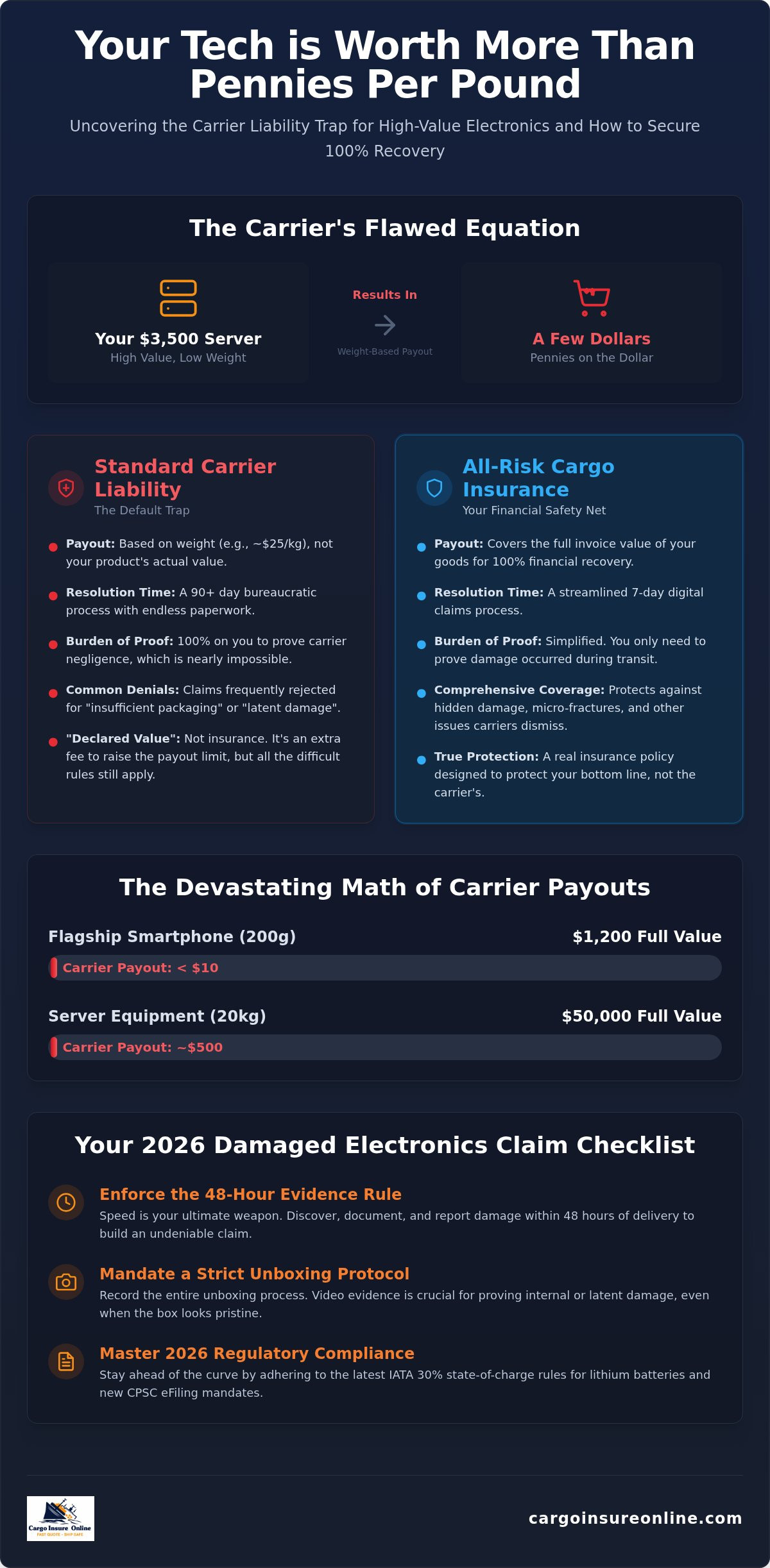
Carriers rely on the Montreal Convention to protect their profits. This international treaty limits their financial responsibility based on weight, not value. The math is devastating for electronics. Imagine a shattered flagship smartphone. At roughly 200 grams, a carrier paying out by weight might offer you less than $10 for a $1,200 device. That isn't a recovery; it's an insult. This is the core difference between carrier liability vs cargo insurance. One protects the carrier's balance sheet, while the other protects yours. Relying on weight-based limits for a damaged electronics shipping claim is a gamble you'll lose every time.
The Carrier Liability Trap: Why You Won't Get Your Money Back
Carrier liability isn't a safety net. It's a legal ceiling designed to protect the carrier's balance sheet, not your inventory. When you file a damaged electronics shipping claim, you're not asking for the value of your item. You're operating within a framework that treats a high-end MacBook and a box of bricks exactly the same. In 2026, the industry still leans on the Montreal Convention for international air freight, which caps payouts at roughly $20 to $25 per kilogram. If your tech is light and expensive, you're already losing.
Stop thinking of carrier liability as insurance. It’s a limited promise to pay a fraction of the cost, and only if you can navigate a maze of fine print. While carriers have raised their "Declared Value" fees, their actual protection hasn't kept pace with the soaring costs of modern components. Relying on this system means accepting that a total loss on a high-value shipment will result in a payout that barely covers the shipping label itself.
The 'Declared Value' Myth
Carriers love selling "Declared Value" because it sounds like protection. It isn't. When you pay for declared value, you're simply paying to raise the carrier's liability limit. You aren't buying a policy. The burden of proof remains entirely on your shoulders. To see a single cent, you must prove the carrier was negligent. That's a nearly impossible task when 38% of claims are denied for "insufficient packaging." They take your money upfront but use every bureaucratic loophole to keep it when things go wrong. If you want real certainty, you need digital-first cargo protection that prioritizes your recovery over carrier excuses.
Calculating Your Potential Loss
The math of carrier liability is a tech seller's nightmare. Payouts follow a brutal formula: Weight of Item x Carrier Rate = Your Payout. This weight-based logic is fundamentally broken for electronics. Consider a professional cinematic drone:
- Market Value: $2,500
- Shipping Weight: 2.0 kg
- Carrier Payout (@ $22.50/kg): $45.00
- Your Total Loss: $2,455.00
That $45 check won't even cover the taxes on a replacement unit. This massive financial void is the "gap" that electronics shipping insurance fills by covering the actual replacement cost rather than just the physical weight. Don't let a damaged electronics shipping claim turn into a 98% loss because you trusted a system built to fail you.
Winning the Evidence War: The Electronics Claim Checklist
Filing a damaged electronics shipping claim is a battle of data. Carriers don't want to pay you; they want to find a reason to say no. Don't give it to them. In 2026, speed is your primary weapon. The "48-hour rule" is now the industry standard for reporting transit damage. If you wait longer, carriers will argue the damage happened in your warehouse or after delivery. You must treat every high-value delivery like a forensic site from the moment it hits the dock.
Don't just rip the tape off. Implement a strict unboxing protocol for all high-end tech. This means recording a continuous video of the package being opened, showing the shipping label and the internal state of the items. For B2B shipments, leverage digital breadcrumbs. Modern IoT tags and shock sensors provide the "black box" data needed to prove exactly when an impact occurred. Even if the retail seal is intact, you can document concealed damage by photographing the impact indicators on the outer carton before the box is ever opened.
The Photographic Proof Framework
Basic snapshots won't cut it anymore. You need to follow the 6-sided box rule. Photograph the top, bottom, and all four sides of the exterior before opening. These shots prove the condition of the "corrugated evidence" upon arrival. Next, take internal packaging shots. You must demonstrate that you met the "double-wall" cushioning standards required for delicate circuitry. Finally, perform serial number verification. Capturing the serial number on the damaged unit alongside the shipping label prevents carriers from claiming a "fraudulent swap" occurred, a common tactic used to deny a damaged electronics shipping claim.
Technical Documentation Requirements
Carriers love to push for "repair estimates" because they're cheaper than replacements. For precision sensors or high-end drones, a repair often compromises the unit's integrity. You must push for a total loss payout by providing technical data on why the damage is non-repairable. For B2B shipments valued over $10,000, consider an independent survey. A third-party inspection adds an undeniable layer of authority to your file. Most importantly, never throw away the box. The carrier has a legal right to inspect the original packaging, and disposing of it is the fastest way to get your claim rejected instantly. Keep the crime scene intact until the check clears.
All-Risk vs. Carrier Claims: A Frictionless Comparison
A damaged electronics shipping claim filed through a carrier is a slow-motion disaster. It is a legacy system built on friction. You are met with a mountain of 15-page PDF forms and weeks of radio silence. All-risk protection flips the script. It replaces old-school bureaucracy with a 2-minute digital portal. You don't need a legal team to get paid. You just need a smartphone and 120 seconds. Carriers offer excuses. All-risk offers results.
The resolution gap is staggering. Carriers typically take up to 90 days to "investigate" a claim, a process designed to outlast your patience. All-risk settlements are finalized in 7 to 10 days. The payout difference is even more jarring. Carriers pay a depreciated "market value" based on weight, meaning they pay you less for a used item. All-risk pays the full invoice value. You get exactly what you charged your customer. No weight-based math. No depreciation games. No automated bots. You deal with logistics insurance experts who actually understand high-value tech.
The Financial Impact of Speed
Speed isn't a luxury. It is a survival mechanism. For e-commerce brands, a 90-day wait for a claim payout kills cash flow and drains working capital. It also kills customer loyalty. If you can't replace a damaged item instantly, your customer goes to a competitor. Using cross-border e-commerce insurance allows you to refund or reship immediately. You stay liquid while the claim processes in the background. This turns a shipping failure into a customer service win.
Why All-Risk is the Only Choice for Tech
Carriers have a long list of exclusions. They don't pay for "Acts of God" like storms or lightning. They rarely pay for theft after delivery. All-risk covers these gaps. For tech shippers, specialized air freight insurance is essential. It protects against pressurized cabin damage, like delaminated screens or popped capacitors, which standard carrier liability ignores. You can even choose zero-deductible options to keep your high-frequency shipping profitable. Stop the paperwork nightmare and secure 100% recovery for your tech today.
Switching to Frictionless Tech Protection with Cargo Insure Online
Cargo Insure Online (CIO) is here to burn the old insurance playbook. We don't do slow. We don't do "maybe." Our mission is to transform the dreaded damaged electronics shipping claim from a financial drain into a seamless operational win. Most insurance providers act like gatekeepers. We act like partners. We've built a digital-first ecosystem that removes the friction of global trade. This allows you to focus on scaling your business while we handle the risk. We believe that protecting your tech should be as fast and intuitive as the devices you sell.
Our platform was designed specifically for the high-velocity world of modern logistics. Whether you're shipping precision drones, the latest mobile phones, or specialized high-value hardware, we provide the all-risk coverage that carriers refuse to offer. You shouldn't have to wait 90 days to find out if your business is taking a hit. With CIO, you get a decision in days, not months. You can secure an instant quote in under 60 seconds. This gives you immediate protection before your shipment even leaves the dock.
Digital Integration for Modern Logistics
We know you're busy. That's why we've automated the boring, time-consuming parts of the insurance lifecycle. For logistics providers and high-volume shippers, our API integrations allow you to embed protection directly into your existing workflow. We also offer white label cargo insurance solutions. This allows you to launch your own branded insurance engine, providing your clients with the same high-speed recovery we're known for. It's about intelligence, connectivity, and removing the insurance headache once and for all.
Your Next Step: Stop Risking Your Bottom Line
Every day you rely on carrier liability is a day you're gambling with your company's future. You've seen the math. You know the weight-based limits are a trap. It's time to demand better. Switching to all-risk protection means you never have to settle for pennies on the dollar again. You get 100% value protection and the peace of mind that comes with a partner who operates at your speed. Don't wait for the next shattered screen to realize you're under-protected. Get your instant electronics insurance quote now and secure your recovery before the next damaged electronics shipping claim hits your desk.
Secure Your Tech ROI and Master Your Recovery
The days of accepting pennies for a shattered server are over. You've seen how carrier liability traps use weight-based math to strip away your profits. By mastering the 48-hour evidence rule and ditching archaic paper forms for a digital-first approach, you're now equipped to protect your bottom line. A successful damaged electronics shipping claim shouldn't be a 90-day bureaucratic nightmare; it should be a fast, automated win for your business.
It's time to stop gambling with your inventory and start using a platform built for the speed of 2026. Whether you need specialized protection for drones or instant coverage for mobile phones, we offer 100% invoice value protection without the carrier headaches. Get your instant digital quotes in seconds and experience the relief of all-risk coverage that actually pays out. Secure Your High-Value Tech with Cargo Insure Online and ship with total confidence. You've built an incredible business; now give it the high-speed protection it deserves.
Frequently Asked Questions
How long do I have to file a claim for damaged electronics?
Most major carriers like UPS and USPS allow up to 60 days from the delivery date to report damage. Don't wait that long. In the fast-paced 2026 logistics environment, the industry standard for reporting transit damage is 48 hours. Reporting immediately prevents carriers from arguing that the damage happened in your warehouse or after the customer took possession.
What happens if the carrier denies my claim for 'insufficient packaging'?
A denial for "insufficient packaging" is the carrier's favorite loophole to avoid a damaged electronics shipping claim payout. If this happens, you must provide photographic evidence proving you met "double-wall" cushioning standards. While carriers use this to block claims, all-risk insurance bypasses these bureaucratic hurdles by focusing on the actual loss rather than technical packaging excuses.
Can I file a claim if the external box shows no signs of damage?
Yes, this is known as "concealed damage." Electronics are uniquely sensitive to high-frequency vibrations and rapid deceleration in automated sorting centers that leave no marks on the cardboard. Use unboxing videos or shock-sensor data to prove internal failure occurred during transit. A pristine box does not mean your claim is dead; it just means you need better internal evidence.
Does carrier insurance cover the full retail value of my electronics?
Almost never. Carriers typically provide "Declared Value," which is a weight-based liability limit, not true insurance. Under treaties like the Montreal Convention, they may only owe you roughly $20 to $25 per kilogram. For a lightweight, high-value drone, this results in a payout that covers less than 5% of your replacement cost. You need all-risk protection for 100% recovery.
What is the difference between 'declared value' and 'all-risk' insurance?
Declared value is a limit on the carrier's own liability; you still have to prove they were negligent to get paid. It is a legal ceiling designed to protect the carrier. All-risk insurance is a dedicated policy that covers your cargo against almost any external cause, including theft and "Acts of God," without requiring you to prove the carrier was at fault.
Do I need to keep the original packaging to win a damage claim?
Absolutely. Carriers have a legal right to inspect the original shipping carton and all internal cushioning. If you or your customer disposes of the box before the inspection, your damaged electronics shipping claim will be rejected instantly. Instruct your recipients to keep the "crime scene" intact until the claim is officially finalized and the check clears.
How do I prove the value of a damaged electronic item?
The most powerful evidence is the final sales invoice or a commercial receipt showing what the customer actually paid. Carriers ignore MSRP or "expected value." For B2B shipments, you may also need a certified repair estimate or a technical report stating the unit is a total loss. Digital records from your e-commerce platform are usually sufficient to establish the financial loss.
What is the Montreal Convention and how does it affect my tech claim?
The Montreal Convention is an international treaty that governs carrier liability for air freight. It uses Special Drawing Rights (SDRs) to calculate payouts based on weight rather than the item's actual worth. For tech sellers, this is a financial trap. It ensures that carriers pay the same low rate for a kilogram of gold as they do for a kilogram of scrap metal.


