
In 2026, a slow claim is a dead claim. Stop waiting for the mail to deliver your reimbursement check while your cash flow bleeds out. You know the drill: your high-value electronics arrive smashed, and the carrier offers you a "per-kilo" settlement that doesn't even cover the packaging. It's frustrating, it's outdated, and it's killing your margins. We agree that the traditional cargo insurance claim process is a bureaucratic maze designed to make you give up. It's time to stop the paperwork nightmare and start winning the digital speed test.
We promise to show you how to bypass the friction, leverage digital filing for instant results, and secure the full value of your losses without the endless back-and-forth documentation requests. This guide provides a clear, high-speed roadmap from the moment you discover damage to the second the payout hits your account. You'll learn how to navigate the modern, digital-first landscape with confidence and recover your capital faster than ever before. Let's transform your recovery experience from a headache into a high-octane competitive advantage.
Key Takeaways
- Ditch the paper trail and embrace the 2026 shift toward near-instant digital recovery.
- Master the modern cargo insurance claim process by securing the right digital evidence from the very first inspection.
- Avoid the negligence trap of carrier liability that slashes payouts to pennies per kilo.
- Follow a 5-step digital roadmap to protect your cash flow and fulfill your duty to mitigate cargo damage.
- Access specialized recovery workflows designed specifically for high-value electronics, drones, and reefer products.
What is the Cargo Insurance Claim Process? (Stop the Paperwork)
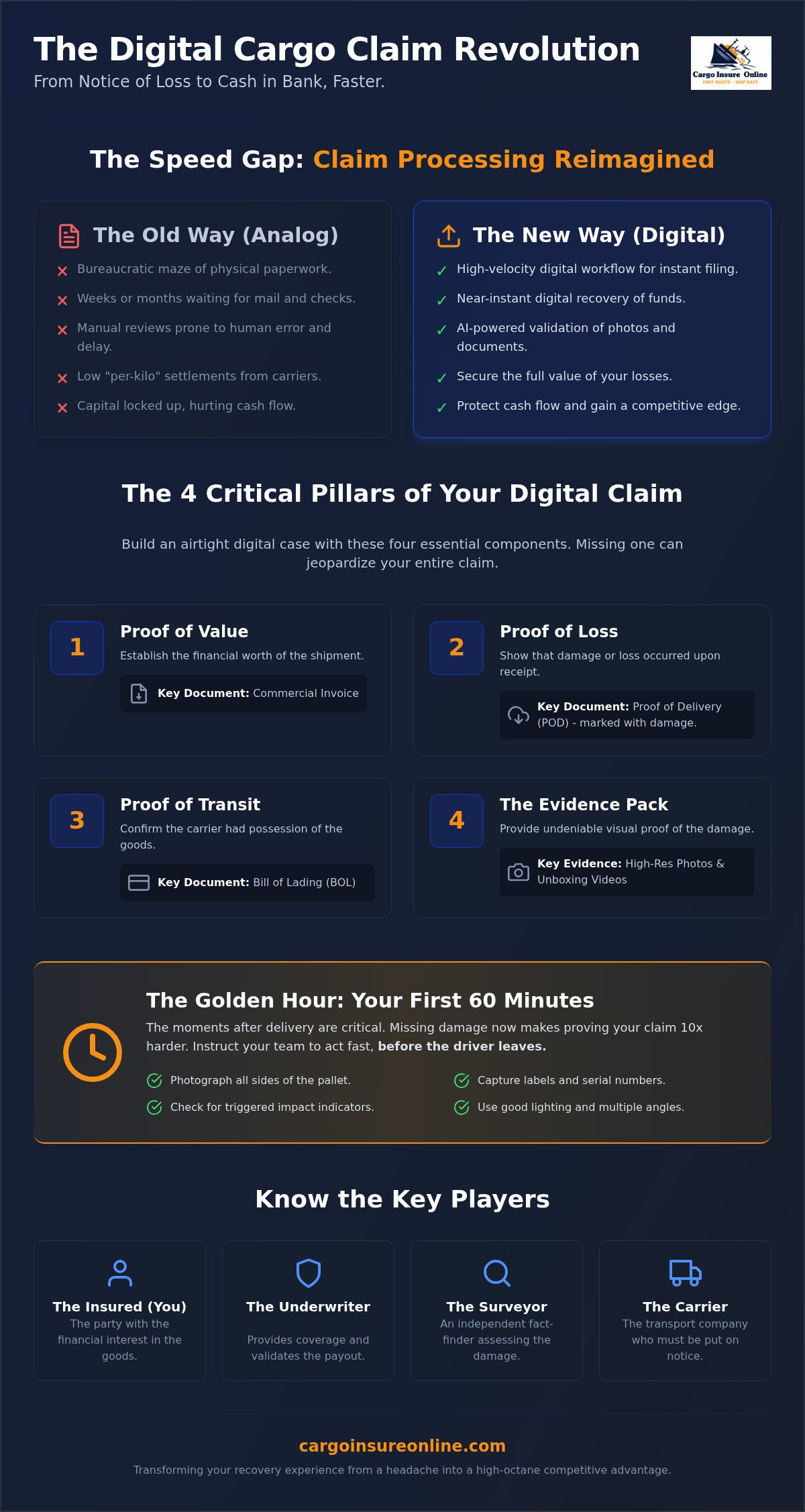
Forget the dusty filing cabinets and the "lost in the mail" excuses. The cargo insurance claim process is now a high-velocity digital workflow. It's the technical sequence used to prove a loss and secure financial recovery before your cash flow takes a hit. While Marine and cargo insurance has existed for centuries, the way we handle claims has fundamentally changed. In 2026, we've replaced the paper trail with the 'Instant Claim'.
The objective is clear. You want to move from a 'Notice of Loss' to 'Cash in Bank' with zero friction. Speed isn't just a luxury; it's your #1 asset. In a global supply chain, a delayed payout is a compounding loss. Every hour your capital is locked in a dispute is an hour you aren't reinvesting in new inventory. We've moved past the era of waiting. We're in the era of winning.
Analog vs. Digital: The Speed Gap
Traditional insurers thrive on delay. They ask for "official forms" that haven't changed since the 90s. This is a relic of the past. Digital-first platforms like CIO bypass these bottlenecks by integrating directly with your logistics data. We don't wait for a physical packet to arrive. We use AI to validate damage photos instantly, confirming the severity and type of loss in real-time.
This shift removes the human error that plagues manual reviews. If your high-value electronics arrive with a punctured box, you shouldn't wait three weeks for an adjuster to look at a JPEG. You need a system that recognizes the damage, cross-references it with your policy, and triggers the next step immediately. That's the digital difference.
The Stakeholders in Your Claim
Success requires knowing the players on the field. You are the Insured, the party with the financial interest in the goods. The Underwriter is the entity providing the coverage and validating the payout. Then there is the Surveyor. The Surveyor acts as an independent fact-finder who assesses the extent and cause of the damage without bias. This independence protects the integrity of the cargo insurance claim process for everyone involved.
You also have the carrier to consider. Issuing a 'Notice of Intent' to the carrier is a non-negotiable first step. It puts them on notice that a claim is coming and protects your right to recover funds later. Understanding these relationships transforms a bureaucratic nightmare into a manageable, transparent project. It's about moving forward, not looking back.
The 4 Critical Pillars of Your Claim Documentation
Documentation isn't about filling drawers with paper. It's about building an airtight digital case. In the modern cargo insurance claim process, your evidence pack is the difference between a full payout and a total loss. You need four specific pillars to hold up your claim. Without them, even the most valid loss can be rejected on a technicality.
- Proof of Value: This starts with your commercial invoice. It must clearly show the transaction price and the 'Total Insured Value'. If your policy includes freight costs and a 10% buffer, ensure these are reflected in your initial filing.
- Proof of Loss: The Proof of Delivery (POD) is your primary weapon. Never sign a 'Clean' receipt if you see a crushed corner or a broken seal. The debate between 'Clean' and 'Subject to Inspection' is often where claims live or die.
- Proof of Transit: You must prove the goods were in the carrier's possession. The Bill of Lading (BOL) or its digital equivalent acts as the contract of carriage. It tracks the chain of custody from origin to destination.
- The Evidence Pack: Digital-first recovery requires visual proof. High-resolution photos and unboxing videos provide the undeniable 'Before and After' narrative that adjusters need to approve a payout.
Building this pack manually is a chore. Using a platform that automates data collection makes it effortless. You can explore how modern cargo protection simplifies this data gathering to keep your business moving.
Capturing Evidence at the Loading Dock
The first 60 minutes after delivery are the 'Golden Hour' of claims. If you miss the damage now, proving it happened during transit becomes ten times harder. Instruct your warehouse team to photograph every side of the pallet before the driver leaves. Capture clear shots of the shipping labels, serial numbers, and any impact indicators like Tilt-Watch sensors. This level of detail is especially vital for electronics shipping insurance, where internal damage often hide behind a pristine exterior. Good lighting and multiple angles remove any room for carrier denial.
The Notice of Intent to Claim
Speed is your shield against the 'Time Bar' trap. You must notify the carrier of your intent to file a claim immediately, often before you even contact your insurer. Deadlines vary wildly: air freight often requires notice within 7 to 14 days, while sea freight may only give you 3 days for latent damage. A punchy, digital Notice of Intent should be sent via email or carrier portal the moment damage is suspected. It doesn't need to be a legal dissertation. It just needs to identify the shipment, state that damage occurred, and hold the carrier responsible for the full value. This simple step preserves your legal rights and keeps the cargo insurance claim process on track.
Carrier Liability vs. All-Risk: Why Most Claims Fail
Relying on carrier liability is a gamble you'll likely lose. Most shippers believe that if a carrier breaks it, the carrier pays for it. This is a dangerous myth. In reality, the standard cargo insurance claim process through a carrier is rigged in their favor. They hide behind international conventions designed to protect their bottom line, not yours.
First, there's the Negligence Trap. To get a cent from a carrier, you usually have to prove they were at fault. Unless you have a video of the forklift driver dropping your pallet, proving negligence is nearly impossible. Then comes the 'Per-Kilo' Rule. International treaties like the Montreal Convention for air or Hague-Visby for sea limit a carrier's financial exposure to a fixed amount per kilogram. If you're shipping high-value items, these limits slash your payout to a fraction of the actual loss.
Sea freight introduces an even scarier concept: General Average. If a ship faces a crisis and cargo is jettisoned to save the vessel, every shipper on that boat shares the cost. You could lose your cargo and still owe money to save someone else's. All-Risk coverage eliminates these nightmares entirely. It's not just a safety net; it's a total shield against the unpredictability of global trade.
The Math of a Failed Claim
Let's look at the numbers. Imagine you ship $50,000 worth of high-end sensors weighing 100kg. If they're crushed in transit, a carrier under the Montreal Convention might only be liable for roughly $20 per kilo. Your $50,000 loss results in a measly $2,000 payout. You're out $48,000 because you didn't have the right protection. Air freight insurance is essential for high-value/low-weight items because it covers the full invoice value, not just the weight.
Uninsured shippers also fall victim to 'Act of God' exclusions. If a hurricane sinks a ship or a freak storm flips a truck, the carrier isn't liable. They'll point to the weather and walk away. You're left with a total loss and zero recourse. Don't let a cloud formation dictate your company's solvency. All-Risk policies cover these events, ensuring you stay in business regardless of the forecast.
All-Risk: The Frictionless Shield
All-Risk isn't just a policy; it's a strategic advantage. It shifts the burden of proof from your shoulders to the insurer. You don't have to prove the carrier was negligent. You only have to prove the loss happened during the covered transit. This simplifies the cargo insurance claim process and accelerates your path to a payout. It's the difference between a six-month legal battle and a digital approval.
This level of protection is non-negotiable for sensitive shipments. For example, reefer cargo insurance provides specialized shields against temperature excursions that carrier liability simply won't touch. Knowing your full invoice value is protected gives you the confidence to scale. You focus on growth while the insurance handles the risk.
How to File a Cargo Claim in 5 Digital Steps
The 2026 cargo insurance claim process isn't about mailing forms or playing phone tag with adjusters. It's about data velocity. When your shipment arrives compromised, you need a system that moves as fast as your supply chain. Stop waiting for instructions and start taking control of your recovery. Follow these five digital steps to turn a logistics disaster into a settled payout.
First, perform an immediate inspection. Never wave the driver away before checking the seals and the exterior. If you see a punctured box or a broken pallet, note the specific damage on the Proof of Delivery (POD). A "Clean" POD is a claim killer. Digital notation is your best friend here; a timestamped photo of the driver's handheld device with your comments provides undeniable proof of the condition at the time of arrival.
Step 2: The Duty to Mitigate Loss
You can't just toss damaged goods in the trash and expect a check. You have a legal obligation to act as if you were uninsured. This means protecting the remaining cargo from further harm. Separate the "sound" cargo from the "damaged" cargo immediately to prevent 'Cross-Contamination'. This is vital for food or chemical shipments where one leaking container can ruin an entire pallet. Document the 'Salvage Value' of the affected goods. Even if they can't be sold as new, showing that you attempted to minimize the loss maximizes your eventual recovery.
Third, notify the carrier and the insurer digitally. Send a Notice of Intent via the carrier's web portal or email. Then, trigger your insurer's digital workflow. No paper. No delays. Just a clear digital trail that preserves your rights under international shipping conventions.
Step 4: The Digital Upload
This is where speed wins the game. Use the CIO portal for instant document submission. Our API-driven systems ingest your evidence pack and photos, speeding up the adjuster's review from weeks to hours. This high-speed approach is perfect for trucking cargo insurance, where drivers need to report damage on the go directly from the loading dock. When the data is uploaded instantly, the settlement clock starts ticking immediately.
Finally, move to settlement and subrogation. Once the evidence is verified, your payout is calculated and released. You're already back to business with your cash flow intact while the insurer handles the subrogation. This is the legal process of chasing the carrier for reimbursement on the backend. You don't need to be involved in the legal battle; you just need to be paid.
Start your digital claim now to experience a friction-free recovery that respects your time.
Frictionless Claims with Cargo Insure Online
At Cargo Insure Online (CIO), we value your time as much as your cargo. We don't believe in waiting weeks for a response. Our philosophy is simple: eliminate friction at every touchpoint. Traditional insurance is a slow-motion wreck. CIO is a high-speed recovery engine. We've built a cargo insurance claim process that prioritizes your cash flow, ensuring that a damaged pallet doesn't become a damaged business. We focus on results, not red tape.
Our reach is truly global. We operate at the speed of international trade, providing support that never sleeps. Whether your shipment is crossing the Atlantic or being delivered by a local courier, our digital-first approach remains the same. For logistics professionals, our white-label API solutions are a game-changer. You can now offer 'Claim-as-a-Service' directly to your clients, turning a potential point of friction into a powerful value-add. This isn't just about protection; it's about empowerment through technology.
Specialized Protection for Tech & E-Commerce
Standard insurance policies often fail when it comes to sophisticated hardware. They treat a crate of drones like a crate of scrap metal. At CIO, we've developed specialized workflows for high-value electronics, drones, and mobile phones. We understand the specific risks of these items, from internal calibration shifts to software-sensitive components. Standard "per-kilo" limits don't work for tech. You need a partner that understands the actual value of your inventory. We provide the precision you deserve.
Our system provides instant quotes and frictionless claims, making it the perfect engine for modern sellers. You can explore how we handle these complexities in our guide on cross-border e-commerce insurance. If you're a partner looking to scale, check out how to launch branded cargo insurance platforms in minutes. We provide the tech; you provide the growth. It's a seamless integration designed for the 2026 marketplace.
Get Started: Zero Waiting, Total Protection
Your next shipment deserves more than a "best effort" policy. It deserves a digital-first shield that actually pays out. Don't let the cargo insurance claim process remain an administrative chore that haunts your finance department. Transform it into a competitive advantage. With CIO, you're not just buying a policy; you're gaining a tech-savvy ally that fights for your capital. We remove the obstacles so you can focus on the horizon.
The era of the bureaucratic nightmare is over. The era of high-speed, painless recovery is here. We've simplified the roadmap so you can get back to what you do best: shipping and selling. Stop waiting and start shipping with Cargo Insure Online today. Your peace of mind is just a few clicks away.
Master the Future of Cargo Recovery
The days of waiting months for a carrier to deny your claim are over. You've seen the roadmap. You know the pillars. By shifting from carrier liability to All-Risk protection, you're choosing capital security over empty promises. The modern cargo insurance claim process is no longer a bureaucratic hurdle; it's a digital speed test that you are now equipped to win. Don't let a "clean" POD or a "per-kilo" limit dictate your profitability.
It's time to empower your supply chain with a partner that operates at the speed of 2026. Experience instant digital filing via API and specialized high-value tech recovery that respects the true value of your inventory. With global 24/7 claims support, you're never navigating a loss alone. It's fast. It's digital. It's entirely painless. Stop the paperwork nightmare and start shipping with total confidence today.
Secure your next shipment with a frictionless claim process at Cargo Insure Online. Your recovery journey just got a high-speed upgrade. Let's get moving.
Frequently Asked Questions
How long does the cargo insurance claim process typically take?
Digital-first models aim for settlement in days rather than the months typical of traditional insurers. The cargo insurance claim process is accelerated by instant document uploads and automated verification. While industry averages once hovered around 30 to 60 days, modern API-driven platforms can trigger payouts almost immediately after evidence validation. Speed is the new standard for global trade.
What happens if the carrier denies my cargo claim?
Carrier denials are common because their liability is limited by strict international conventions. If a carrier rejects your claim, you are often left with zero recourse unless you have All-Risk insurance. Your insurer pays you first and then handles the dispute with the carrier on the backend. This keeps your cash flow moving while the legal teams fight for reimbursement.
Can I file a claim if the damage was discovered after delivery (hidden damage)?
Yes, you can file for concealed damage, but you must act fast. Most carriers require notification within 3 days for hidden losses discovered after a "clean" delivery. Documentation is critical here. You must prove the damage occurred during transit and not in your warehouse. Use timestamped photos of the unboxing to build a winning case for recovery.
Is a surveyor always required for a cargo insurance claim?
No, a physical surveyor is not always necessary in a digital-first environment. For smaller losses or clear-cut damage, high-resolution photos and videos often suffice for validation. Surveyors are typically reserved for high-value incidents or complex "General Average" cases. Digital evidence packs have largely replaced the need for on-site inspections for routine claims, saving you valuable time.
What is the 'duty to mitigate' in a cargo insurance claim?
The duty to mitigate requires you to take reasonable steps to minimize the financial loss after damage is discovered. You cannot simply abandon the cargo. This involves separating damaged goods from sound ones and seeking salvage value where possible. Acting as if you were uninsured protects the integrity of your claim and ensures a smoother, faster payout process.
How do I calculate the 'Total Insured Value' for a claim?
Total Insured Value usually equals the commercial invoice value plus freight costs and an additional 10% buffer. This 10% covers unanticipated expenses and administrative costs during the cargo insurance claim process. Always ensure your policy reflects this full amount to avoid being under-insured. Accuracy here ensures you aren't paying out of pocket for transit fees or hidden costs.
What is subrogation in the cargo claim process?
Subrogation is the legal process where your insurer steps into your shoes to recover paid losses from the responsible carrier. Once you receive your payout, the insurer takes over the right to sue the shipping line or airline. This is a massive benefit for your business. You get your money immediately, and the insurer handles the long-term legal battle.
Can I file a claim for temperature-sensitive cargo like reefer products?
Yes, but you need specialized reefer protection to cover temperature excursions effectively. Standard carrier liability rarely pays for "thaw" damage unless you prove mechanical negligence. A digital-first reefer policy uses data logs from sensors to prove the cold chain was broken. This evidence allows for a fast, frictionless payout for sensitive food, chemical, or pharmaceutical shipments.


