
Your current insurance workflow isn't just slow; it's a quiet profit killer. For too long, freight forwarders have treated cargo protection as a necessary evil, a mountain of manual paperwork that drags down every booking. You've likely felt the sting of losing a loyal client to a "full-service" competitor who offers everything with a single click. It's frustrating to watch revenue slip away because of outdated, bureaucratic systems that leave you and your shippers exposed when carrier liability falls short.
It doesn't have to be this way. In fact, it shouldn't. This guide shows you exactly how freight forwarders can offer cargo insurance as a frictionless, high-speed revenue stream using modern digital integration. We're stripping away the complexity and replacing it with pure efficiency. You'll discover the 2026 playbook for transforming insurance from a liability headache into a powerful tool for brand trust and new commission growth. We'll explore how white-label solutions and instant digital quotes for air, sea, and land can turn your logistics operation into a digital-first powerhouse that stops waiting and starts shipping.
Key Takeaways
- Stop relying on limited carrier liability. Learn why Shipper’s Interest is the only way to offer true All-Risk protection in 2026.
- Discover how freight forwarders can offer cargo insurance through seamless digital integration rather than slow, manual paperwork.
- Audit your TMS for API connectivity to replace traditional referral friction with instant, branded quoting.
- Pivot your sales strategy to focus on "Shipment Certainty" to effortlessly overcome common client objections.
- Build a new revenue stream with white-label solutions that put your brand at the center of every insurance transaction.
Why Forwarders Must Pivot from Liability to Shipper’s Interest
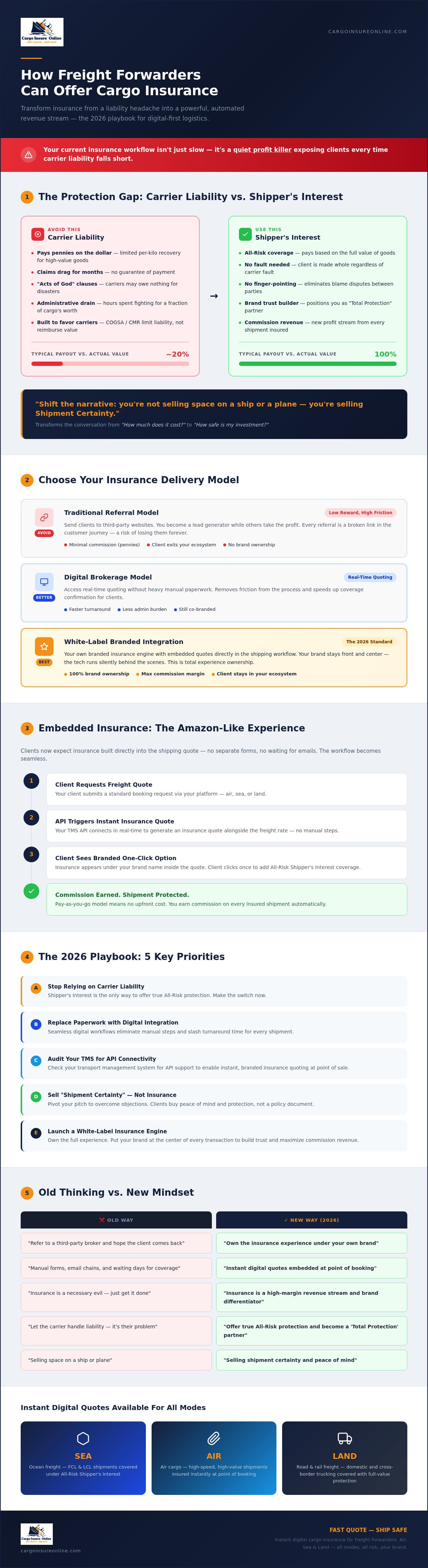
Carrier liability is a financial trap disguised as protection. It's built on old bureaucratic rules that favor the carrier, not your client. If you're still relying on per-kilo limits, you're leaving your customers' balance sheets exposed. This creates a massive revenue gap. You're likely referring clients to outside brokers, losing both the commission and the chance to be a "Total Protection" partner. It's time to stop being a middleman. Start being the solution.
By shifting your focus, you move from a transactional service to an essential ally. Understanding how freight forwarders can offer cargo insurance starts with identifying the massive gap between what carriers owe and what shippers actually lose. You shouldn't leave money on the table while your clients carry all the risk.
The Carrier Liability Myth
Most shippers assume they're covered. They aren't. Conventions like COGSA or CMR are designed to limit liability, not reimburse full value. In 2026, global trade moves too fast for these archaic per-kilo rules. If a container goes overboard during a storm, "Acts of God" clauses often leave the carrier paying nothing. Your client loses everything, and you're left holding the bag for the relationship.
- Limited recovery: Carriers often pay pennies on the dollar for high-value electronics or reefer products.
- Lengthy disputes: Claims can drag on for months without a guarantee of payment.
- Administrative drain: Your team spends hours fighting for a fraction of the cargo's worth.
When you don't provide a real solution, you're stuck managing the fallout of an uninsured loss. That's a brand-killer. It’s an administrative chore that eats your time without adding a cent to your bottom line.
Shipper’s Interest: Your Secret Growth Weapon
Shipper’s Interest is different. It's "All-Risk" coverage that pays out based on the full value of the goods, regardless of carrier fault. This is the foundation of how freight forwarders can offer cargo insurance effectively. It protects your freight forwarder’s bill of lading by ensuring the client is made whole quickly. No more finger-pointing. No more waiting for a carrier to admit fault.
Shift the narrative. You aren't just selling space on a ship or a plane. You're selling shipment certainty. When you integrate insurance into your workflow, you provide peace of mind that builds deep brand trust. It transforms the conversation from "how much does it cost?" to "how safe is my investment?" This isn't just about protection; it's about speed and revenue. It makes complex global logistics feel manageable and even effortless for your end-user.
Choosing Your Insurance Model: Referral vs. Branded Integration
You've decided to stop leaving money on the table. Now you face a critical choice: how do you actually deliver the service? Most traditional agents will tell you to just refer the business away. They want you to be a lead generator while they take the lion's share of the profit. That's a relic of the past. In 2026, the question of how freight forwarders can offer cargo insurance has moved from "who can I call?" to "how can I automate?"
The referral model is a low-effort trap. It offers minimal rewards and creates high friction for your customers. On the flip side, the digital brokerage model provides real-time quoting without the manual paperwork. But the real game-changer is the white-label revolution. Launching your own branded insurance engine is the most powerful way to address how freight forwarders can offer cargo insurance while maintaining total control over the user experience. You keep your brand front and center while we handle the technical heavy lifting behind the scenes. It's about ownership, not just participation.
The High Cost of Traditional Referrals
Sending your clients to third-party websites is a branding disaster. Every time a customer leaves your ecosystem to buy insurance elsewhere, you risk losing them forever. It's a "broken link" in what should be a seamless journey. Why hand off your hard-earned relationship to a third party? Referral fees are pennies compared to the integrated margin opportunities available when you own the process. If you want to scale, you need to own the experience from booking to delivery. Stop being a middleman for someone else's growth.
Embedded Insurance: The 2026 Standard
Embedded insurance is the future of logistics. It integrates the protection directly into the shipping quote. No separate forms. No waiting for emails. It's the "Amazon-like" experience your clients now expect as a default. With "pay-as-you-go" models, you eliminate upfront financial risk. You only pay for what you use. It’s an effortless addition to your service list that prioritizes speed and clarity. To see this in action, you can explore White-Label solutions that put your logo on a high-speed insurance engine.
Evaluating the right fit depends on your volume. If you're moving hundreds of shipments a month, manual entries are your enemy. You need a tech stack that talks to your TMS via API. This isn't just about adding a feature; it's about evolving into a digital-first partner. Choose a model that scales with your ambition. Don't settle for a system that holds you back with paperwork and slow response times.
The Tech Stack: Implementing APIs and White-Label Platforms
Manual paperwork is the enemy of scale. If your team is still copy-pasting shipment details into a broker's portal, you're moving too slow. The 2026 revenue playbook requires a tech stack that works at the speed of digital trade. This isn't just about adding a feature; it's about building an automated engine that generates profit while you sleep. Understanding how freight forwarders can offer cargo insurance efficiently starts with a shift from manual tasks to intelligent, connected systems.
Step 1 begins with a hard look at your current Transport Management System (TMS). Does it support external integrations? If your TMS is a closed box, it's holding you back. Step 2 is selecting an insurance partner that provides a robust branded cargo insurance platform. You need a partner that speaks the language of APIs, not just policy numbers.
API Integration: Speed is the New Currency
In global logistics, a delay of five minutes can mean a lost booking. Cargo insurance APIs eliminate the friction of manual data entry by pulling shipment details directly from your TMS. When your system talks to ours, quotes appear instantly at the point of booking. This creates a powerful conversion booster. Clients see the total cost, including protection, in one view. It's transparent, it's fast, and it builds immediate trust. Security isn't an afterthought, either. Modern APIs ensure data compliance across global borders, keeping your client information encrypted and safe from end to end.
White-Label Solutions: Your Brand, Our Engine
Don't send your customers away to a third-party site. A white-label solution keeps your brand in the driver's seat. Your clients interact with a custom-branded insurance portal that looks and feels like your own. This maintains a frictionless user experience from the initial quote to the final claim. This specialized digital approach is especially critical for high-stakes cargo. For example, electronics shipping insurance requires precise data and instant coverage confirmation to safeguard high-value tech. A generic, manual process simply can't keep up with the demands of the electronics sector.
Finalizing your stack means connecting via API for that high-speed generation and training your team to use a centralized digital dashboard. This dashboard gives your staff a single source of truth. No more hunting through emails for policy documents. Everything is visible, manageable, and ready for action. You're no longer just moving boxes; you're operating a sophisticated, tech-enabled logistics powerhouse.
Mastering the Sales Pitch: How to Position Insurance to Clients
Stop selling "Insurance." It sounds like a cost. It sounds like a chore. Start selling "Shipment Certainty." It sounds like an investment. This simple shift is the secret to how freight forwarders can offer cargo insurance without sounding like a pushy vendor. You aren't adding a fee; you're removing a risk. You're transforming from a logistics provider into a strategic partner who protects their bottom line.
The biggest hurdle is the myth of carrier coverage. When a client says, "My carrier already covers this," show them the gap. Carrier liability isn't protection; it's a legal minimum. It covers weight, not worth. It pays out pennies on the dollar and only if you can prove the carrier was at fault. Positioning your service as "Total Protection" changes the narrative. You're offering a safety net that works when the carrier's fine print fails.
Use your claims speed as your loudest marketing tool. In a world of bureaucratic delays, being the partner that facilitates claims in days instead of months is a massive differentiator. It builds brand trust that keeps clients coming back. Don't just move boxes. Deliver peace of mind.
The "Certainty" Framework for Modern Shippers
Position insurance as a business continuity tool. If a shipment vanishes, your client's business shouldn't stop. Use "All-Risk" terms to simplify the decision. Don't make them choose between complex clauses or legal jargon. Give them a "one-click" opt-in during your digital checkout process. It makes the decision effortless. It’s about creating a frictionless path to safety. When the process is this smooth, the value becomes obvious.
Niche Strategies for High-Value Cargo
Specific cargo demands specific stories. For high-speed global trade, air freight insurance is an easy upsell because the cargo is often high-value and the timelines are incredibly tight. You aren't just shipping a box; you're protecting a vital deadline. The risk of theft or damage in transit is too high to ignore.
When moving containers across oceans, use sea freight insurance to highlight risks like General Average, which can force an uninsured shipper to pay for someone else's loss. For cold chain logistics, lead with reefer cargo insurance to safeguard temperature-sensitive investments. Finally, leverage trucking cargo insurance to provide total confidence during that critical final-mile road journey.
Ready to transform your sales process and build a new revenue stream? Launch your digital insurance engine today.
Launch Your Branded Insurance Engine with Cargo Insure Online
Cargo Insure Online isn't just an insurance provider. We're a tech-enabled growth engine for the modern logistics world. We've mastered the technical side of how freight forwarders can offer cargo insurance so you don't have to. Our ecosystem is built for speed. It's built for 2026. Forget the dry, bureaucratic legacy systems that slow your team down. We offer a vibrant alternative that turns a perceived administrative chore into a high-speed revenue stream.
Our white-label solutions put your brand in the driver’s seat. You aren't just selling a third-party product; you're selling your own expertise under your own logo. This isn't just about basic air or sea freight coverage. We give you access to specialized markets that competitors often avoid. From high-value electronics and mobile phones to drones and reefer products, your portfolio becomes instantly more sophisticated. Think of us as your 24/7 digital underwriter. There's zero waiting. There's total protection.
The CIO Advantage for Forwarders
We bring vibrant, high-energy support to an industry that's traditionally been stuck in the past. Our digital-first claims processing is designed to keep your clients happy and your brand reputation intact. When a claim happens, the speed of resolution becomes your biggest selling point. We've removed the friction from the entire journey. Our solutions are fully scalable, making them a perfect fit for small boutiques and global giants alike. We don't just provide a policy; we provide a sophisticated ally that values your time.
Next Steps: From Inquiry to Integration
Ready to see the future of logistics insurance? Requesting a demo of our white-label insurance engine is the first step toward a frictionless revenue stream. Our onboarding process is fast. We can have your team trained and ready to go in hours, not weeks. We've eliminated the long, complex explanatory clauses of the past and replaced them with clear, action-oriented digital tools. Stop waiting for manual quotes and start winning more business with a platform built for the speed of global trade. Launch your branded insurance engine today!
Own Your Revenue Future in 2026
The era of manual paperwork and lost commissions is over. You've seen the roadmap. You know that carrier liability is a trap and that your clients expect a digital-first experience. By integrating Shipper’s Interest insurance directly into your booking flow, you transform from a middleman into a total protection partner. This is the definitive answer to how freight forwarders can offer cargo insurance while building a high-speed revenue stream.
Stop referring business away. Start owning the customer journey. With Cargo Insure Online, you get instant API-driven quotes and branded white-label portals that keep your logo front and center. Whether you're moving high-value electronics or temperature-sensitive reefer goods, our platform provides the specialized coverage your shippers demand. Your business deserves a solution that moves as fast as you do. It's about removing friction and empowering your team with speed and clarity.
Don't let another booking go unprotected. Supercharge your revenue with our White-Label Cargo Insurance Engine and lead the logistics industry into a frictionless future. The technology is ready. Your brand is ready. Let's start shipping with certainty.
Frequently Asked Questions
Do I need an insurance license to offer cargo insurance as a forwarder?
You typically don't need an individual insurance license when you use a digital-first partner's master policy framework. Our platform allows you to offer protection through a white-label arrangement that handles the regulatory heavy lifting behind the scenes. It's about simplifying the legal maze for your team. This is a key part of how freight forwarders can offer cargo insurance while staying compliant in their specific local jurisdictions.
How does offering cargo insurance increase my company’s revenue?
You unlock new revenue through markups or commissions on every policy sold. Beyond direct profit, it's a massive retention tool. Clients who get "Total Protection" from you are far less likely to shop around for other quotes. It transforms a low-margin shipping job into a high-value service package. You stop leaving money on the table for third-party brokers to collect on your hard work and relationships.
What is the difference between freight forwarder liability and cargo insurance?
Forwarder liability only pays if you're proven negligent and usually has very low weight-based limits. Cargo insurance, or Shipper’s Interest, covers the full value of the goods regardless of who's at fault. It's the difference between pennies on the dollar and a full payout. This distinction is the core of how freight forwarders can offer cargo insurance that actually protects their shippers from financial ruin.
Can I integrate cargo insurance into my existing TMS or website?
Yes, integration is seamless through modern APIs. You can connect our insurance engine directly to your current TMS or customer-facing website. This allows for instant quotes at the point of booking. No more jumping between different browser windows or manual data entry. It creates a vertical, fast-moving experience that respects your team's time and your client's patience. High-speed connectivity is the new industry standard.
How are cargo insurance claims handled in a digital-first model?
Claims are managed through a centralized digital dashboard that prioritizes speed and clarity. Your clients upload photos and documents directly to the portal. The system uses intelligent workflows to process information without the traditional bureaucratic delays. It's a transparent process that offers relief rather than administrative dread. Fast payouts build the kind of brand trust that keeps clients loyal and confident in your "Total Protection" promise.
What types of cargo can I insure through a white-label platform?
You can insure almost anything moving through the global supply chain. Our platform specializes in high-value electronics, reefer products, and even specialized tech like drones or mobile phones. Whether it's air, sea, or land freight, the coverage is comprehensive. You're no longer limited to "safe" or low-value cargo. You can confidently handle complex, high-stakes shipments that your competitors might be too afraid to touch.
Is it possible to offer insurance on a per-shipment basis?
Absolutely, per-shipment insurance is the modern standard for on-demand logistics. You only pay for the protection you actually use. This "pay-as-you-go" model eliminates upfront financial risk and keeps your cash flow healthy. It's perfect for e-commerce or spot-market bookings. You offer the same high-level protection to a one-time shipper as you do to your biggest enterprise accounts without any long-term commitment or overhead.
How long does it take to set up a branded insurance engine?
Setting up your branded insurance engine takes hours, not weeks. Our white-label solutions are designed for rapid deployment and immediate impact. Once you've audited your TMS, the API connection is straightforward and efficient. You can have your team trained and generating quotes by the end of the day. It's a near-instantaneous solution for forwarders who are ready to stop waiting and start shipping with a digital-first edge.


