

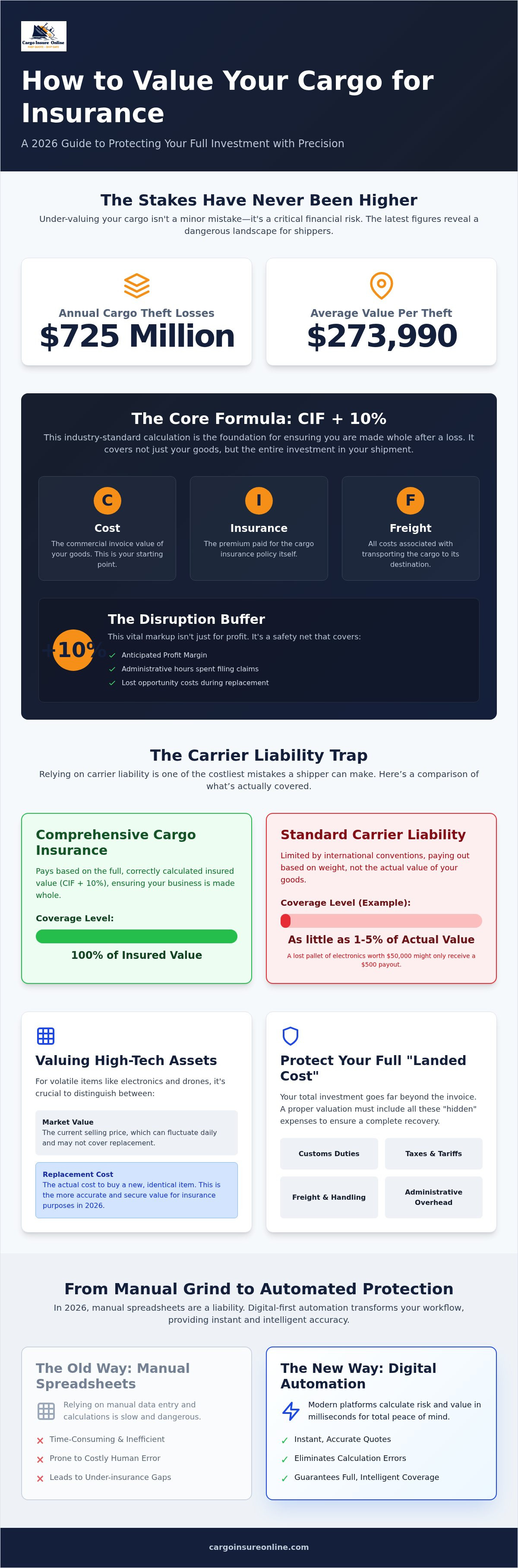
Did you know cargo theft losses surged to a record $725 million last year? With the average value per theft now hitting $273,990, a single rounding error in your paperwork could bankrupt your bottom line. If you're still guessing how to value cargo for insurance, you aren't just risking a minor delay. You're gambling with your company's future.
We get it. Spreadsheets are a nightmare. Incoterms feel like a foreign language. The fear of a total loss payout that barely covers your shipping costs is real. It's time to stop the manual grind and start protecting your margins with precision. You deserve a process that's as fast as your supply chain and twice as smart.
This 2026 guide delivers the exact formulas and expert strategies you need to value your freight correctly. We'll master the CIF + 10% method, secure high-value tech like drones or electronics, and show you how digital tools generate instant quotes. You're about to gain total confidence that every claim will be paid in full without the administrative friction.
Key Takeaways
- Master the industry-standard CIF + 10% formula to protect your invoice value, freight costs, and insurance premiums in one calculation.
- Stop falling for the "per-kilo" carrier liability trap; learn how to value cargo for insurance so you aren't left with pennies after a loss.
- Navigate the volatility of high-tech assets by understanding the critical difference between market value and replacement cost for 2026 electronics.
- Protect your full "landed cost" by factoring in hidden expenses like customs duties, taxes, and administrative overhead.
- Transform your workflow with digital-first automation that calculates risk in milliseconds, replacing manual spreadsheets with instant, intelligent accuracy.
Cargo Valuation Fundamentals: The CIF + 10% Formula
Stop guessing. Start calculating. Many shippers treat valuation like a finger in the wind, but 2026 global trade moves too fast for "good enough." Learning how to value cargo for insurance starts with a single, non-negotiable formula: CIF + 10%. CIF stands for Cost (Invoice), Insurance, and Freight. This isn't just a technicality. It's the logic that ensures your business survives a total loss.
While cargo insurance is technically a branch of Marine insurance, the principles apply whether your freight is touching salt water or flying at 30,000 feet. The goal is simple. You want to be made whole. You don't just want a reimbursement for the cost of goods. The 2026 reality is clear. Manual calculations are slow and prone to human error, but this logic remains the foundation of all-risk coverage.
Breaking Down the CIF Components
The Commercial Invoice is your starting point. It represents the raw value of the goods. But it's not the finish line. If a container goes overboard, you haven't just lost the product. You've lost the money you spent to move it. That is why Freight charges must be included in your calculation. Whether it's air, sea, or land, the cost of transport is a sunk cost that deserves protection.
Finally, include the Insurance premium itself. It might feel circular to insure the cost of the insurance, but it's standard practice. This ensures that in the event of a claim, your premium expense is returned to you. This creates a frictionless recovery process where every dollar spent is accounted for. You aren't just covering the cargo. You are covering the entire investment of the shipment.
The Logic of the 10% Markup
Why add ten percent? Think of it as your disruption buffer. A loss isn't just about the physical items. It's about the administrative hours spent filing claims. It's about the lost opportunity while you wait for replacements. The 10% markup covers these invisible costs and your anticipated profit. It keeps your cash flow healthy during the replacement period.
For ultra-volatile commodities or high-demand electronics, some experts even suggest a 20% markup. In 2026, where supply chains can pivot in hours, that extra margin is your safety net. Manual spreadsheets are a relic of the past. They lead to expensive mistakes. Understanding this logic is the foundation, but using digital tools to automate the calculation is how you stay competitive.
The Carrier Liability Trap: Why Invoice Value Isn't Enough
Carriers aren't insurers. They are transport providers with massive legal shields. Relying on carrier liability is like walking a tightrope without a net. Most shippers assume their freight is covered for its full invoice value. It isn't. Carriers limit their financial responsibility based on weight. They don't care about the actual worth of your goods. This is the "Per-Kilo" Rule. It's the reason a lost pallet of high-end electronics could net you a measly $500 payout. Learning how to value cargo for insurance is the only way to bridge this massive financial gap.
The difference between "Declared Value" and "Insured Value" is where businesses bleed money. Declaring a value to a carrier doesn't guarantee a full payout. It just sets a ceiling for their liability. You still have to prove they were at fault. That's a slow, expensive battle. Cargo insurance bypasses this entirely. It pays based on the formula we discussed earlier. It doesn't matter who was at fault. You get paid, and your business keeps moving.
International Liability Limits (Sea and Air)
The rules are rigged. Sea freight is governed by the Hague-Visby Rules. These use Special Drawing Rights (SDRs) to cap payouts. Air freight follows the Montreal Convention. In 2026, the air liability limit is approximately 22 SDRs per kilogram. These figures have nothing to do with the customs value of imported goods or your actual replacement costs. They are arbitrary benchmarks. They limit the shipping line's exposure, not yours. If your cargo is light but expensive, these limits are a disaster.
The Hidden Costs of a Claim
A loss is more than just missing items. Carrier claims are notoriously slow. They require mountains of paperwork. While you're fighting for a settlement, your cash flow is frozen. Even worse is General Average. In maritime law, if cargo is sacrificed to save a ship, all cargo owners share the cost. You could be hit with a bill for a ship you don't own. Don't leave your balance sheet to chance. We've detailed how to avoid these maritime nightmares in our guide to Sea Freight Insurance: Total Protection for the High Seas.
Don't settle for weight-based crumbs. Don't waste weeks chasing a carrier for a fraction of your loss. Secure comprehensive cargo coverage that pays based on your true value. You can secure protection in minutes and get back to what matters most: growing your business.
Valuing High-Tech Assets: Electronics, Drones, and Mobile Devices
High-tech shipments aren't just boxes of components. They're high-stakes investments. In 2026, the global electronics market is exploding toward a $5.6 trillion valuation. This growth brings a massive target on your back. Cargo theft losses reached $725 million last year, and high-value tech remains the number one prize for sophisticated criminal networks. Mastering how to value cargo for insurance in this sector means accounting for volatility that standard commodities simply don't face.
If a shipment of GPUs or mobile devices vanishes, can you replace them for the same price tomorrow? In a world of snap component shortages and daily price fluctuations, "Market Value" is a moving target. You need a valuation that reflects the "Replacement Cost" at the time of the loss. If you value based on yesterday's invoice but prices spike 15% due to a factory delay, you're under-insured. You're losing money before the claim even starts. Precise valuation isn't just about the hardware. It's about protecting your ability to stay in stock.
Electronics Shipping: Beyond the Price Tag
Valuing electronics requires looking beneath the screen. Are you accounting for pre-installed proprietary software or firmware? In 2026, the "brain" of the device is often as valuable as the chassis. If your valuation only covers the raw hardware, you're leaving thousands on the table. Component shortages can also trigger "surge pricing" for replacements. Ensure your policy accounts for these spikes. For a deeper dive into these risks, check out our guide on Electronics Shipping Insurance: Safeguarding High-Value Tech.
Drones and Specialized UAV Hardware
Drones are unique because they are rarely just a single unit. You're shipping a "kit" that includes controllers, specialized sensors, and high-capacity batteries. Your valuation must cover the entire ecosystem. If a drone is damaged, the cost isn't just the repair. It's the professional recalibration and flight-testing required to make it mission-ready again. These "soft costs" are often ignored by traditional insurers. We recommend using specialized GAP insurance for high-investment tech to ensure these hidden expenses don't eat your margins. It's the difference between getting a check for a drone and getting a drone that actually flies.
Mobile phone logistics present a different challenge: volume. High-density shipments of smartphones are prime targets for GPS spoofing and AI-powered social engineering. Precise, per-unit valuation is the only way to ensure your all-risk coverage holds up under scrutiny. Don't let a criminal's payday become your company's catastrophe.
Accounting for the 'Plus 10%' and Hidden Logistics Costs
Your cargo's value isn't a fixed number on an invoice. It's a living figure that increases every mile it travels. By the time your freight hits the warehouse, it has accumulated layers of costs that many shippers forget to protect. If you want to know how to value cargo for insurance with 2026 precision, you have to look at the "Total Landed Cost." This isn't just about what you paid the supplier. It's about every dollar spent to get that product to its final destination.
Geopolitical shifts are more than just headlines. They are line items on your freight bill. War-risk surcharges are a mandatory reality in 2026. Climate-related disruptions are also driving transport insurance premiums up by 15-20%. These expenses fluctuate based on global stability and weather events. If you omit these surcharges when deciding how to value cargo for insurance, you are leaving a gap in your coverage. The same applies to specialized reefer shipments. Cold-chain protection requires more than just a refrigerated box. It involves high-tech monitoring sensors and specialized packaging. These aren't optional extras. They are part of the cargo's value.
The Total Landed Cost Checklist
Don't let customs duties become a total loss. If your goods are destroyed after clearing the port, you've already paid the government. If you haven't insured the "Duty-Paid" value, that money is gone forever. Your checklist must include:
- Import duties and local taxes.
- Terminal Handling Charges (THC).
- Drayage and last-mile transport fees.
Protecting these margins is critical. Learn more about specialized cold-chain needs in our guide to Reefer Cargo Insurance: The Modern Guide to Cold Chain Protection.
2026 Volatility: Adjusting for Inflation
Lead times are stretching. A shipment ordered today might not arrive for 60 days. In that window, inflation and currency fluctuations can erode your purchasing power. If your valuation is stuck in the past, your payout won't cover the cost of re-ordering the same goods at tomorrow's prices. This is why "Open Policies" are the gold standard for high-volume shippers. They provide a consistent valuation framework that adapts to market shifts. This removes the manual guesswork. It ensures your protection stays current.
Stop letting hidden costs eat your profits. Get an instant digital quote that accounts for your total landed cost in seconds.
Frictionless Valuation: How Cargo Insure Online Automates Protection
Ditch the spreadsheets. Valuation shouldn't be a manual chore that slows down your shipping department. It should be instant, intelligent, and integrated. While legacy providers offer clunky calculators that feel like 2010s software, CIO Sphere Inc. technology calculates your risk in milliseconds. This isn't just a faster way to do math. It's a fundamental shift in how to value cargo for insurance for the 2026 trade environment. We've removed the friction so you can focus on scale.
Manual spreadsheets are the enemy of accuracy. They lead to typos, outdated pricing, and expensive gaps in coverage. Our digital-first approach replaces human error with algorithmic precision. Whether you're moving a single drone or a massive container of reefer goods, our platform applies the correct valuation logic automatically. You don't need to be an expert in Incoterms to get it right. You just need a partner that speaks the language of modern logistics.
The Power of the Cargo Insurance API
Human error is the silent killer of claims. A single mistake in a manual entry can lead to thousands in under-insurance. Our Cargo Insurance API eliminates this risk by pulling data directly from your ERP or logistics management system. This is especially critical for high-volume electronics shipping where SKU values fluctuate daily. By automating the data flow, you ensure that every shipment is covered for its true replacement cost. Logistics partners and brokers can also leverage our White-Label Solutions to empower their own clients. You can launch your branded insurance engine and provide instant valuation tools that keep your customers protected and loyal.
Next Steps: Get Your Instant Quote
For digital-brands, the connection must be direct. We've built e-commerce integrations that link your Shopify store or Amazon FBA account directly to your policy. This ensures your valuation stays accurate because it's based on real-time inventory costs and sales data. No more manual uploads. No more guessing. It's total protection that lives inside your existing workflow.
Waiting for a broker to return a phone call is a 20th-century mistake. In the time it takes to pour a cup of coffee, you can value your next shipment and secure all-risk protection. Our digital platform allows you to move at the speed of global trade. Stop worrying about how to value cargo for insurance and start shipping with total confidence. Your freight is too valuable to leave to a spreadsheet. Protect your margins and your peace of mind with a single click.
Future-Proof Your Freight Protection
You now have the blueprint for 2026 logistics. You've moved beyond the carrier liability trap. You understand why weight-based payouts are a relic of the past. By mastering the CIF + 10% formula and accounting for hidden landed costs, you've secured your margins against the volatility of global trade. This knowledge transforms insurance from a bureaucratic chore into a powerful shield for your bottom line.
Knowing how to value cargo for insurance is no longer a manual headache. It's a strategic advantage. Whether you're shipping high-value drones or reefer goods, specialized protection is just a few clicks away. Our digital-first 2026 technology replaces slow spreadsheets with instant, intelligent risk assessment. You get global all-risk coverage in seconds, not days. This is the relief of knowing your high-value tech and sensitive shipments are fully protected.
Don't let a rounding error cost you your business. Secure your freight with a partner that operates at the speed of your supply chain. It's time to trade with total confidence and zero friction. Stop Guessing—Get an Instant, Accurate Cargo Insurance Quote Now. Your freight is moving. Your protection should be too.
Frequently Asked Questions
What is the standard formula for cargo insurance valuation?
The industry standard is the CIF + 10% formula. This adds the Cost of goods (commercial invoice) to the Insurance premium and the Freight charges, then adds a 10% buffer. This calculation is the most reliable way to determine how to value cargo for insurance because it protects your total investment rather than just the physical product.
Can I just insure my cargo for the commercial invoice value?
You can, but it's a risky move that leaves you under-insured. If your shipment is lost, an invoice-only policy won't reimburse the thousands you spent on shipping fees or the cost of the insurance itself. You'll end up paying out of pocket to replace the stock and move it again. Always include freight and insurance costs to stay whole.
What does the 'plus 10%' in CIF + 10% actually cover?
The 10% markup covers the invisible costs of a supply chain disruption. It accounts for administrative labor, anticipated profit, and small expenses like currency fluctuations or replacement order processing. It ensures your cash flow stays healthy while you wait for new inventory to arrive. Without it, a loss becomes a drain on your operational budget.
How do I value used or refurbished electronics for shipping?
Value used electronics based on their current market replacement cost, not the original purchase price. For 2026 tech shipments, this requires checking real-time market data because component shortages can spike prices overnight. If you're shipping refurbished mobile phones or drones, ensure your valuation reflects what it would cost to buy the exact same model in the same condition today.
Do I need to include customs duties in my cargo valuation?
Yes, you should include customs duties if you want to protect your "Duty-Paid" value. If your goods are destroyed after they clear customs, those taxes are a sunk cost that you won't get back from the government. Including duties in your total valuation ensures your insurance payout covers the full landed cost of the goods at their destination.
What happens if I under-value my cargo on the insurance policy?
Under-valuing triggers the "Principle of Average," which can slash your payout. If you only insure 80% of the true value, the insurer will only pay 80% of your claim, even for a partial loss. It's a common trap that turns a manageable incident into a financial disaster. Accuracy isn't just about compliance; it's about making sure your claims are paid in full.
How do Incoterms like FOB or CIF affect who is responsible for valuation?
Incoterms define the moment the risk transfers. Under CIF (Cost, Insurance, and Freight), the seller is responsible for valuing and insuring the goods to the destination port. Under FOB (Free on Board), the buyer takes over valuation once the goods are loaded. Understanding these terms is critical to knowing how to value cargo for insurance without doubling up or leaving gaps.
Is there a maximum value limit for drone or high-tech shipping insurance?
Limits vary by provider, but specialized electronics and drones insurance often features higher thresholds than general freight policies. In 2026, high-density shipments of mobile devices can easily exceed $1 million in value. If your shipment hits these peaks, you need a digital-first partner that can scale your coverage instantly without the 20th-century paperwork delays.


