
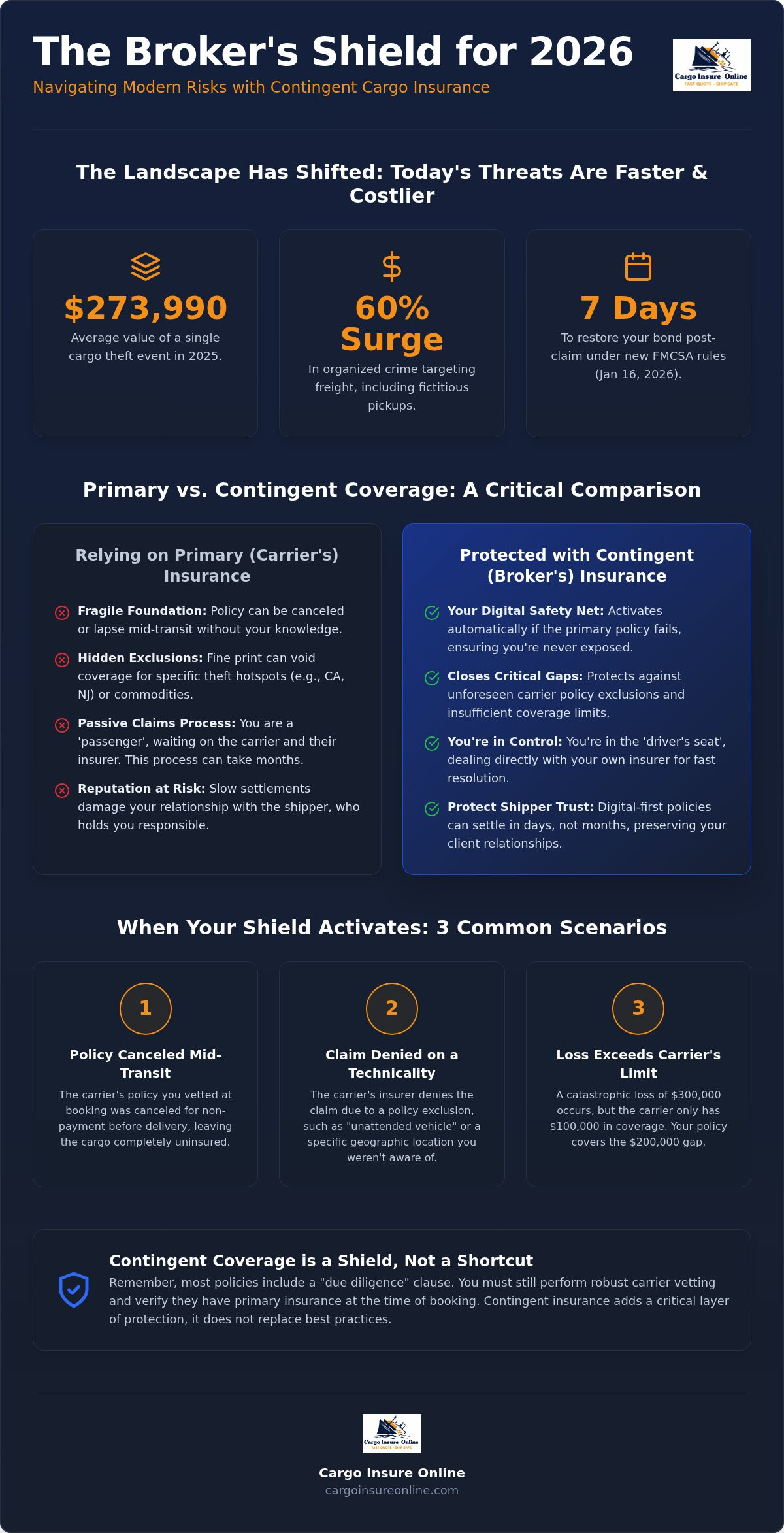
Would your brokerage survive a $273,990 hit if your carrier’s insurance suddenly evaporated? In 2025, that was the average value of a single cargo theft event. When you explore cargo insurance solutions for freight brokers, you aren't just ticking a box. You're building a fortress against a 60% surge in organized crime. Stop settling for slow, manual COI vetting and the constant shadow of double-brokering. It's time to move faster.
You know the stress of wondering if a carrier's policy is actually active when the wheels start turning. We're here to turn that anxiety into a competitive advantage. This guide shows you how to eliminate liability gaps and leverage contingent cargo insurance as a high-speed growth engine for your 3PL. We'll preview the new Jan 16, 2026 FMCSA financial responsibility rules and show you how to automate your risk management for total peace of mind during every transit.
Key Takeaways
- Understand why contingent coverage acts as your essential secondary shield when a carrier's primary policy is voided or denied.
- Navigate the critical differences between primary and contingent insurance to eliminate hidden liability gaps in your 3PL operations.
- Implement modern cargo insurance solutions for freight brokers to defend against the rise of AI-driven fictitious pickups and double-brokering.
- Audit your vetting tech stack and determine if per-load or annual coverage best supports your specific volume and growth targets.
- Transition from manual paperwork to instant digital quotes, allowing your brokerage to book loads faster without sacrificing security.
What is Contingent Cargo Insurance? The 2026 Definition for Brokers
Think of it as your brokerage’s digital safety net. It doesn't replace the carrier's policy. It sits behind it. If the carrier's coverage vanishes, yours stands up. This is the backstop principle. In 2026, this isn't just about legal compliance. It's about balance sheet survival. As an intermediary, you don't touch the freight, but you own the relationship. If a carrier fails, the shipper looks at you. Without a secondary shield, a single major claim could bankrupt your brokerage.
The landscape has shifted. Manual verification is a relic. It's slow. It's prone to error. By Jan 16, 2026, the FMCSA’s new financial responsibility rules will be in full effect. If a claim hits your bond and drops it below $75,000, you have exactly seven days to fix it or lose your authority. You need Cargo insurance solutions for freight brokers that integrate directly with your digital workflow. Relying on a PDF of a COI is like bringing a paper map to a high-speed chase.
The 'Contingent' Trigger: When Does It Actually Kick In?
Your policy stays dormant until it's needed. It's your silent partner. It activates only when the primary carrier’s policy fails to perform. This usually happens in three high-stress scenarios:
- Scenario A: The carrier’s policy was cancelled mid-transit without your knowledge. You checked it at booking, but it was gone by delivery.
- Scenario B: The insurer denies the claim. They might find a technicality in the driver's logs or a specific exclusion for "unattended vehicles" that the carrier ignored.
- Scenario C: The loss is massive. The claim is $300,000, but the carrier only carries $100,000 in coverage. You're on the hook for the remaining $200,000.
Why Standard Carrier Liability Isn’t Enough
Carrier liability is a trap. It's often based on weight, not value. If a shipment of high-end electronics is stolen, a "per-kilo" payout won't even cover the packaging. Modern cargo insurance solutions for freight brokers must account for these exclusions. Many primary policies exclude specific theft hotspots like California or New Jersey, which saw a 119% surge in theft incidents in early 2026. If your carrier’s policy has a "geographic exclusion" you didn't see, you're exposed. Contingent Cargo is the broker’s ultimate fail-safe against carrier insolvency.
Contingent vs. Primary Cargo Insurance: A Critical Comparison
Primary insurance is the carrier’s frontline defense. It’s also inherently fragile. Carriers miss payments. Policies lapse. Exclusions hide in the fine print. When you're moving high-value electronics or reefer products, that fragility is a liability you can't afford. While the FMCSA mandates a $750,000 public liability minimum, cargo coverage remains a contractual market standard rather than a federal requirement for most freight. That $100,000 limit you see on a carrier's COI? It’s a handshake, not a guarantee.
This is where cargo insurance solutions for freight brokers change the game. Contingent insurance is your secondary shield. It doesn’t just wait for the carrier to fail. It empowers you to manage the entire risk profile from your own digital dashboard. In 2026, brokers who rely solely on primary insurance are throttled by manual checks. Those who leverage contingent coverage move faster. They book loads with confidence because they have the ultimate backstop. It turns a bureaucratic bottleneck into a high-speed growth engine.
The Difference in Claims Handling
When a load disappears, the clock starts ticking. With primary insurance, you're a passenger. You wait for the carrier to file the claim. You wait for their insurer to investigate. You hope they don't find a reason to deny it. It’s a slow, manual nightmare that leaves your reputation at the mercy of a third party's responsiveness.
Contingent claims put you in the driver’s seat. You deal with your own insurer. You control the narrative. In 2026, digital-first policies settle in days, not months. This speed protects your relationship with the shipper. They don't care who’s at fault. They just want their cargo replaced or their loss reimbursed. Fast settlements keep your brand intact while others are stuck in legal limbo.
Vetting Carriers: Does Contingent Coverage Replace It?
Short answer: No. Contingent insurance isn't a "get out of jail free" card. Most policies include a due diligence clause. You still need to verify that the carrier has Trucking Cargo Insurance at the time of booking. It’s about layers of protection, not replacing them.
The best cargo insurance solutions for freight brokers actually reward you for using robust vetting technology. If you automate your risk management, your premiums stay lean. You’re proving to the insurer that you aren't booking "blind" loads. It’s a symbiotic relationship between tech and protection. You can even explore instant digital quotes to see how your vetting process impacts your rates in real-time. This synergy allows you to scale without increasing your administrative burden.
Defending Against 2026 Risks: Cargo Theft and Carrier Fraud
Traditional theft prevention is dead. A padlock and a gated yard aren't enough when the thief is using AI to clone your carrier’s identity. In 2025, cargo theft losses skyrocketed to an estimated $725 million. This 60% surge wasn't driven by bolt cutters. It was fueled by strategic impersonation. Fraudsters now use sophisticated digital tools to create fictitious pickups, stealing the load before it even leaves the dock. If your carrier vetting relies on manual checks, you're already behind.
Double-brokering is the next nightmare. You hire a carrier you trust. They pass the load to a carrier you’ve never heard of. When that load vanishes or ends up in a "hostage freight" situation, the legal fallout is brutal. Recent court rulings are shifting the liability. Brokers are increasingly held accountable for carrier negligence. You aren't just an intermediary anymore. You're a target. Implementing advanced cargo insurance solutions for freight brokers is the only way to protect your balance sheet from these evolving criminal tactics.
Electronics and High-Value Tech Protection
Criminals are targeting higher value goods to maximize their score. In 2025, the average value of a single theft event rose to $273,990. Standard contingent forms often exclude the very items being targeted, like mobile phones and drones. Don't leave your brokerage exposed to these massive gaps. Check out our Electronics Shipping Insurance guide to see how to safeguard high-value tech. CIO’s specialized tech coverage closes gaps that generic brokers miss, ensuring your high-margin loads stay protected.
Reefer Risks: Temperature Control and Spoilage
Cold chain logistics add another layer of volatility. A reefer breakdown isn't just a mechanical failure. It’s a total loss of cargo. When the carrier disappears or denies fault for a temperature excursion, you need a policy that triggers immediately. Our Reefer Cargo Insurance guide explains how to maintain cold chain protection even when the carrier’s primary policy fails. You need to be able to prove a reefer claim with telematics data, even if the driver goes silent. This proactive defense turns a potential disaster into a managed event, keeping your shipper's trust intact.
How to Implement Contingent Coverage: A 5-Step Workflow
Scaling your 3PL doesn't have to be a high-wire act. Stop viewing insurance as a static expense and start using it as a dynamic growth tool. Implementing modern cargo insurance solutions for freight brokers requires a shift from manual oversight to digital-first automation. Don't wait for a $273,990 theft event to realize your vetting process is broken. Follow this 5-step workflow to build a resilient, frictionless brokerage.
- Step 1: Audit your tech stack. If your dispatchers are still manually verifying COIs via email, you have a vulnerability. Use automated vetting tools that flag expired policies in real-time.
- Step 2: Balance your volume. Determine if your load volume justifies an annual policy or if per-load transactional coverage is better for your margins. Most brokers require a $100,000 per-occurrence limit as a market standard.
- Step 3: Map your commodities. Identify high-risk items like copper, electronics, or personal care products in your book of business. Ensure your policy doesn't have hidden exclusions for these specific targets.
- Step 4: Integrate at point-of-sale. Connect your insurance provider to your TMS via API. This ensures every load is covered the moment it's booked, removing the risk of human error.
- Step 5: Train for red flags. Educate your team on 2026 fraud tactics. If a carrier’s contact info doesn't match their FMCSA filing, or if they insist on a "quick-pay" for a suspicious lane, stop the booking.
Choosing Between Annual and Per-Load Policies
Annual policies are the powerhouse choice for high-volume brokerages with consistent freight lanes. They offer a predictable cost structure and broad blanket coverage. Transactional, or per-load insurance, is the agile alternative for spot-market heavy operations. It allows you to pay only for the protection you need, load by load. Many scaling 3PLs use a hybrid approach. They maintain a base annual policy and use transactional riders for high-value electronics or specialized reefer loads. This flexibility keeps your overhead low while your protection stays high.
Digital Integration: The API Advantage
Administrative drag is the enemy of scale. Traditional insurers want you to fill out paper applications and wait for manual approvals. We dismiss that. Modern cargo insurance solutions for freight brokers leverage APIs to embed protection directly into your internal load board. This automation creates an "insurance checkmark" that verifies coverage instantly. It eliminates the need for back-and-forth emails and ensures you never move a load "blind." If you want to take it a step further, explore how White Label Cargo Insurance can turn your branded platform into an insurance engine. You can get started with a digital quote in minutes to see how frictionless your workflow can actually be.
Scale Faster with Cargo Insure Online’s Broker Solutions
Growth shouldn't feel like a grind. In a market where cargo theft losses hit $725 million in 2025, your shippers are looking for more than just a low rate. They want security. They want a partner who has already solved the liability puzzle. By integrating cargo insurance solutions for freight brokers from Cargo Insure Online (CIO), you stop being a simple intermediary and start being a tech-forward logistics powerhouse. We don't believe in the bureaucratic delays of the past. We believe in speed.
Onboarding with CIO is built for the pace of modern logistics. You can move from a quote to full coverage in minutes, not days. This rapid response allows you to capture spot market opportunities that leave traditional brokers stuck in a cycle of paperwork. Our high-energy support team and tech-first claims handling ensure that if a carrier fails, your response is immediate. We turn the administrative chore of insurance into a high-speed growth accelerant for your 3PL.
White-Label and API: Your Branded Insurance Engine
Your brand is your most valuable asset. Why send your shippers to a third-party insurer when you can offer protection directly under your own banner? CIO’s White Label Solutions act as a seamless extension of your brand. By embedding insurance into your customer portal via our robust API, you provide instant value at the point of sale. This isn't just about protection. It’s about revenue. Embedded insurance allows you to generate secondary income while providing the frictionless experience your shippers demand in 2026.
This digital-first approach eliminates human error and administrative drag. Your shippers get the coverage they need instantly, and you gain the peace of mind that every load is backed by a sophisticated digital shield. It’s a win-win that positions your brokerage as a modern, transparent leader in a crowded marketplace.
Ready to Shield Your Brokerage?
Imagine the relief of knowing every load you book is double-protected. No more anxiety over hidden carrier exclusions or the seven-day FMCSA replenishment deadline. With CIO as your partner, you’re future-proofing your business against the evolving fraud and theft tactics of 2026. You’ve done the hard work of building your book of business. Now, protect it with the industry’s most disruptive insurance technology. Stop waiting and start shipping with Cargo Insure Online’s broker solutions today. Your scalable future is just a few clicks away.
Drive Your 3PL Into a Frictionless Future
The logistics landscape of 2026 demands speed and absolute security. You've seen how manual vetting fails and how contingent coverage acts as your ultimate backstop against carrier fraud. It isn't just about avoiding a massive theft claim. It's about booking loads with total confidence and zero liability gaps. By leveraging API-first integration and specialized high-value tech riders, you transform your brokerage into a frictionless powerhouse that shippers trust. Stop letting bureaucratic delays and manual COI checks slow your roll.
Start using cargo insurance solutions for freight brokers that operate at the same velocity as your business. Secure your reputation and your balance sheet today. Shield your brokerage and scale faster with Cargo Insure Online through instant digital quotes that put you in control. Your next level of growth is ready for pickup. Let's get moving.
Frequently Asked Questions
Does contingent cargo insurance cover driver negligence?
Yes, it generally covers losses resulting from driver negligence if the carrier’s primary insurer denies the claim. Don't assume a carrier’s policy is bulletproof; it’s not. Many primary policies contain fine-print exclusions that trigger when a driver makes a mistake. Your contingent coverage acts as the essential secondary shield. It ensures your shipper is reimbursed even when the carrier’s insurance refuses to pay for a driver’s error.
What is the difference between Contingent Cargo and Broker Liability?
Contingent cargo covers the actual physical loss or damage to the freight when the carrier's insurance fails. Broker liability is different. It protects your brokerage against lawsuits claiming you were negligent in hiring a specific carrier. Think of contingent cargo as protecting the goods and broker liability as protecting your legal standing. Both are vital, but they solve different problems in your risk management strategy.
Is contingent cargo insurance required by the FMCSA in 2026?
No, the FMCSA does not federally mandate contingent cargo insurance for freight brokers. You are only legally required to maintain a $75,000 financial responsibility bond or trust fund. However, market reality is different. Shippers demand these cargo insurance solutions for freight brokers to mitigate risk. Also, the new Jan 16, 2026 rules mean you must replenish your bond within seven days if a claim hits it. Insurance prevents that bond hit.
How much does contingent cargo insurance cost for a new broker?
Pricing varies based on your projected volume, commodity types, and vetting history. New brokers often find that rates are influenced by the strength of their carrier management tech. Instead of a flat fee, look for digital-first providers that offer flexible structures. This allows you to scale your coverage as your load count increases. You avoid overpaying for protection you haven't used yet while maintaining a professional shield.
Will contingent cargo insurance cover theft if the truck was left unattended?
Yes, provided your specific policy doesn't have an "unattended vehicle" exclusion. This is a common trap in primary carrier policies. If a carrier’s insurer denies a theft claim because the driver left the truck at a rest stop, your contingent policy should activate. It’s designed to close the gaps left by the carrier’s restrictive fine print. Always verify these clauses to ensure your protection is truly gap-free.
What happens if both the carrier and the broker have insurance policies?
The carrier’s policy is always the primary responder. Your contingent policy only triggers if the carrier’s insurance is cancelled, exhausted, or denies the claim for a valid reason. You don't get a double payout. Instead, you get a guarantee that the loss will be covered. This structure ensures the shipper is made whole while keeping your brokerage's balance sheet safe from carrier insurance failures or cancellations.
Can I buy contingent cargo insurance on a per-load basis?
Yes, you can secure cargo insurance solutions for freight brokers on a per-load, transactional basis. This is the ultimate tool for agile 3PLs. You don't need to swallow a massive annual premium if your volume fluctuates. Digital portals make it effortless to add coverage during the booking process. It’s a pay-as-you-go model that protects your margins while ensuring every high-value shipment has a secondary shield during transit.
Does it cover high-value electronics like mobile phones and drones?
Standard policies often exclude high-value tech, but specialized riders can bridge that gap. Items like mobile phones and drones are high-theft targets and require specific language in your policy. CIO provides targeted coverage for these commodities. Don't assume your generic policy covers them. Always verify that your high-margin electronics are explicitly included in your contingent coverage scope to avoid a devastating, uncovered loss.


