
In 2026, waiting three days for an ocean cargo insurance policy quote isn't just an inconvenience. It's a logistical failure. You need your goods on the water. Not stuck in an inbox. Most shippers still struggle with opaque wording and carrier liability limits that cover almost nothing when disaster strikes. You're tired of claims processes that take months. You're done with the administrative friction that slows your growth. It's time to shift from legacy baggage to digital-first speed.
Your coverage should be a digital accelerator, not a bureaucratic anchor. This guide shows you how to master the complexities of 2026 maritime risks with total confidence. We'll show you how to secure instant digital quotes and full All-Risk protection that actually protects your bottom line. You'll gain a clear understanding of General Average risks and the new 2026 SOLAS container reporting requirements. We're moving past the era of paperwork. We're entering the era of frictionless maritime protection.
Key Takeaways
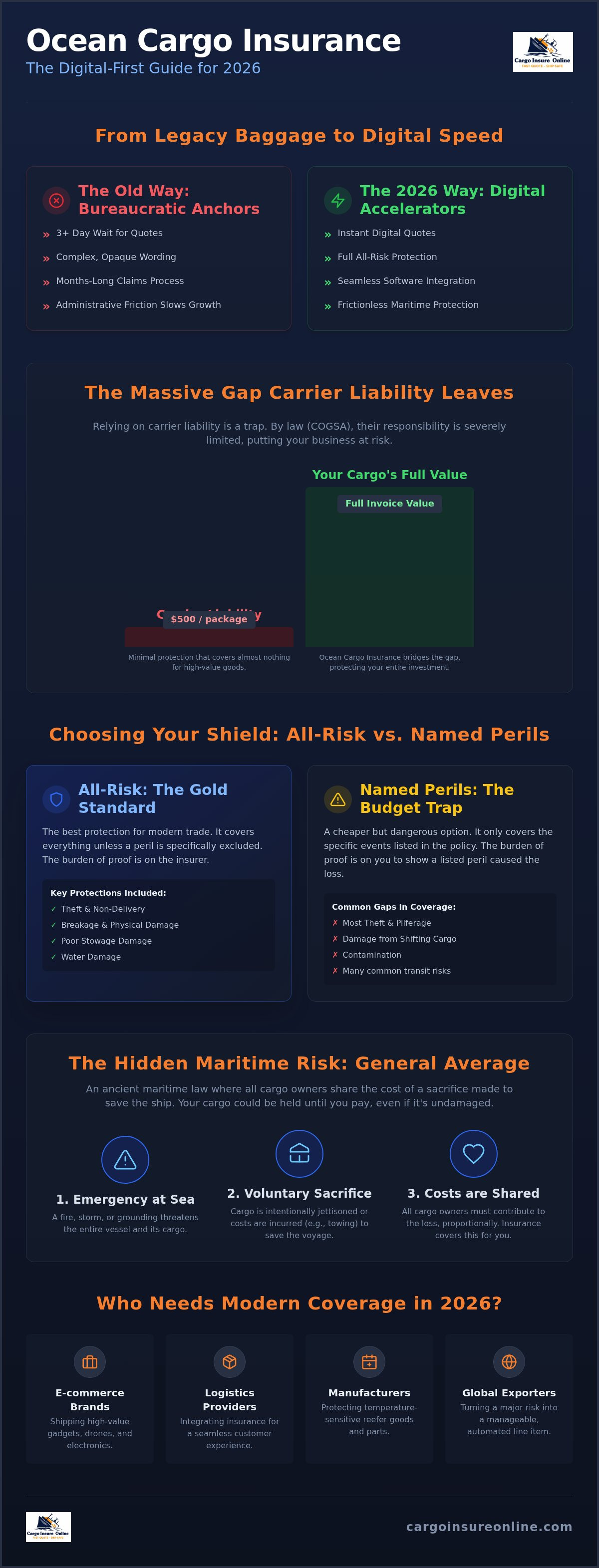
- Stop relying on carrier liability. An ocean cargo insurance policy bridges the massive coverage gap and protects your goods against physical loss.
- Ditch the limitations of Named Perils. All-Risk is the gold standard for 2026, providing the comprehensive shield your supply chain demands.
- Navigate the ancient law of General Average. Learn how to shield your business from sharing the costs of emergency maritime sacrifices.
- Prioritize speed and digital integration. Modern protection moves at the speed of your software, offering instant quotes and zero-friction logistics.
- Access specialized coverage instantly. Secure tailored protection for reefer goods, drones, and high-value electronics in seconds.
What is an Ocean Cargo Insurance Policy?
An ocean cargo insurance policy isn't just a legal checkbox. It's a financial shield for your supply chain. At its core, this policy is a contract that protects your goods against physical loss or damage while they're in transit across international waters. But don't think it's limited to the ocean. Modern policies in 2026 provide "warehouse-to-warehouse" protection. This means your cargo is covered from the factory floor, through the port, across the sea, and right to the customer's doorstep. It's comprehensive. It's seamless. It's exactly what high-speed logistics requires.
The Core Purpose: Beyond the Horizon
Carrier liability is a trap. Many shippers realize too late that the Carriage of Goods by Sea Act (COGSA) limits a carrier's responsibility significantly. Often, you're looking at a cap of just $500 per package. That's nothing when you're shipping high-density cargo. One storm or one "General Average" declaration can wipe out your profit margins instantly. A digital-first ocean cargo insurance policy bridges this massive gap. It protects your balance sheet from catastrophic "Total Loss" events while facilitating bank financing. Diving into the history and practice of marine insurance shows that while the risks have changed, the need for a solid financial backstop remains constant.
Who Needs a Policy in 2026?
The logistics landscape has shifted. It's faster. It's more complex. Everyone in the chain needs a safety net that doesn't slow them down. In 2026, the stakes are higher than ever. Supply chains are leaner. Margins are tighter. E-commerce brands moving high-value gadgets can't afford a single lost container. They rely on specialized electronics shipping insurance to keep their operations scalable. Meanwhile, forward-thinking logistics providers are ditching the old way of doing things. They're adopting branded cargo insurance platforms to provide instant, integrated coverage to their customers. Whether you're a manufacturer shipping temperature-sensitive reefer goods or a global exporter, a modern policy is your most valuable asset. It turns a massive risk into a manageable, automated line item.
All-Risk vs. Named Perils: Choosing Your Shield
Stop looking at insurance as a one size fits all commodity. It isn't. In 2026, the gap between a basic policy and a premium one is the difference between a recovered loss and a bankrupt quarter. Most legacy brokers still push Free from Particular Average (FPA) or With Average (WA) policies. These are relics. They're designed for the shipping speeds of the 1970s, not the digital-first reality of today. You don't need a list of reasons why your claim might be denied. You need a shield that works. Demand All-Risk for total peace of mind.
The All-Risk Advantage
All-Risk is the gold standard for modern global trade. It flips the script on the burden of proof. Under a standard ocean cargo insurance policy, if your goods arrive damaged, the insurer must prove that an exclusion applies. If they can't, you're covered. This shift is vital for e-commerce and high-value logistics. You aren't just worried about the ship sinking. You're worried about theft, breakage, and non-delivery. These are the biggest threats to high-value tech, drones, and mobile devices. All-Risk handles these complexities automatically, ensuring your supply chain stays resilient.
Named Perils: The Budget Trap
Named Perils policies look attractive on a spreadsheet because they're cheaper. They're also a dangerous trap. These policies only cover the specific events listed in the document. Usually, that means Major Perils like fire, sinking, or stranding. If your cargo is crushed due to poor stowage or stolen during a port delay, and it isn't on that specific list, you're on your own. It's a gamble that rarely pays off in the high-stakes world of international shipping.
Restricted policies might make sense for low-value, indestructible bulk goods like scrap metal. For anything else, you're leaving your balance sheet exposed to unnecessary risk. Modern trade requires more than just basic coverage. It requires an automated insurance solution that defaults to the highest standard of protection. Don't let a slightly lower premium blind you to massive exposure. Secure an ocean cargo insurance policy that actually covers the risks you face every day, not just the ones that make the news.
General Average: The Hidden Maritime Risk
Most shippers believe they're only responsible for their own goods. They're wrong. Maritime law includes a concept called General Average (GA) that feels more like a pirate raid than a legal framework. It's an ancient principle that's still very much alive in 2026. If a ship faces a catastrophic emergency and the captain sacrifices part of the ship or cargo to save the whole, everyone pays. General Average can cost you tens of thousands even if your cargo is untouched. Without the right protection, you're on the hook for a percentage of everyone else's losses.
How General Average Works
The process is brutal. When GA is declared, an Average Adjuster is brought in to tally the damages. This includes salvage costs, towing fees, and the value of sacrificed goods. Take the 2021 Ever Given disaster as a prime example. The salvage claim alone was hundreds of millions of dollars. If your goods were on that ship, you couldn't just walk away. You'd be required to post a cash bond or provide a guarantee before the carrier would release your container. Insurance companies handle this "GA Guarantee" automatically. They provide the financial backing so you don't have to drain your bank account to get your products out of port.
Mitigating the 'Hostage Cargo' Scenario
The "hostage cargo" scenario is the biggest threat to lean supply chains. If your cargo is held at the terminal, your entire operation grinds to a halt. Small businesses are often hit the hardest because they lack the liquid capital to pay unexpected maritime bonds. This is why a modern ocean cargo insurance policy is essential. It prevents supply chain halts by letting the insurer assume the risk. All-Risk policies are the best defense because they cover these contributions by default. You aren't just buying protection for your goods; you're buying the right to keep your business running when the unexpected happens on the high seas. It's the difference between a minor administrative update and a total logistical standstill.
How to Evaluate Ocean Cargo Policies in the Digital Age
Efficiency is the new safety. In 2026, a manual underwriting process is a liability. If your broker takes forty-eight hours to return a quote, they're already too slow for your supply chain. You need an ocean cargo insurance policy that generates quotes in under sixty seconds. Speed isn't just about convenience. It's about securing your space on the vessel before the window closes. Digital integration is the next frontier. Does your insurer play nice with your logistics stack? If they don't offer API connectivity, you're looking at a mountain of manual data entry.
The Tech-First Checklist
Legacy systems are crumbling. Modern shippers demand transparency. Look for API-driven platforms that automate the certificate process instantly. You shouldn't be chasing PDFs in an email thread. Verify the 'A' rating of the underlying underwriters to ensure financial stability. This is especially critical for those meeting cross-border e-commerce insurance requirements. High-volume global selling requires a policy that holds up in every port worldwide. If the portal is clunky or the claims process is a black hole, move on. You deserve a clear, digital dashboard, not a busy phone line.
Understanding Exclusions and Deductibles
Clarity kills risk. Most disputes arise from misunderstood exclusions. Improper packing and "inherent vice" are common reasons for claim denial. If your goods are prone to decay or weren't secured for the high seas, you're exposed. Choosing a deductible is a balancing act. A higher deductible lowers your premium but increases your out-of-pocket risk during a loss. Always prioritize "Warehouse-to-Warehouse" clauses. This ensures your ocean cargo insurance policy covers the entire journey, not just the time spent on the ship. Don't leave your cargo unprotected during the first or last mile of transit.
Stop settling for prehistoric insurance processes. You can get an instant digital cargo quote today and see how technology transforms protection. Your supply chain moves fast. Your insurance should move faster.
Get Covered in Seconds: The Cargo Insure Online Advantage
Negotiating with brokers belongs in the history books. The era of waiting days for a manual response is over. You need an ocean cargo insurance policy that matches the high-velocity nature of your business. Cargo Insure Online (CIO) isn't just another service provider. It's a digital-first engine built specifically for the speed of modern global trade. No more back-and-forth email threads. No more opaque policy wording that hides exclusions. Just instant, transparent protection that lets you start shipping with absolute confidence today.
Why Shippers Choose CIO
Traditional insurance is a massive friction point. We've removed it entirely. Savvy shippers choose CIO because we offer a 100% digital journey from the initial quote to the final claim. There's zero paperwork to slow down your operations. We don't just offer generic, one-size-fits-all coverage. We provide specialized expertise for the cargo that matters most in 2026. This includes high-value tech, temperature-sensitive reefer goods, and precision drones. If you're a freight forwarder, our white-label solutions empower you to lead. You can launch your own branded insurance engine in minutes, leveraging our sophisticated technology to serve your customers better. It's about empowering your brand with the tools to dominate your niche.
Your Next Step to Total Protection
Securing your global supply chain shouldn't be a complex project. It should be a simple click. Generating your first ocean cargo quote is intuitive. You simply enter your shipment details on our automated platform. Our engine analyzes the risk and provides an instant quote. You bind the coverage immediately. You'll have your digital certificate in seconds, ready for the carrier. No more waiting. No more uncertainty.
Managing your ocean cargo insurance policy is just as effortless via our centralized digital dashboard. You can track every shipment, review policy documents, and manage certificates without ever leaving your logistics stack. This is the frictionless future of maritime protection. Stop waiting for the old guard to catch up to the digital age. They won't. Get your instant ocean cargo insurance quote now and experience the relief of automated, high-speed protection. Your cargo is moving. Your insurance should be too.
Secure Your Maritime Future Today
The shipping world of 2026 moves too fast for legacy insurance. You've seen how carrier liability leaves you exposed and how General Average can hold your growth hostage. Don't let an outdated ocean cargo insurance policy be the weak link in your supply chain. It's time to choose All-Risk protection that covers the entire journey, from factory floor to final destination. You need a partner that provides instant digital certificates and A-rated global security without the paperwork. Whether you're moving high-value electronics or temperature-sensitive reefer goods, your coverage should be as smart as your logistics stack.
The era of friction is over. The era of automated, frictionless protection has arrived. You can finally stop worrying about maritime risks and focus on scaling your global footprint. Start shipping with the confidence that only tech-first coverage provides. It's fast, it's transparent, and it's built for you. Secure your cargo with an instant digital quote and experience the CIO advantage today. Your goods are ready to move, and now, your insurance is too.
Frequently Asked Questions
What does an ocean cargo insurance policy typically cover?
An ocean cargo insurance policy typically covers physical loss or damage to goods caused by external factors during transit. This includes major perils like fire, vessel sinking, and stranding, but also more common risks like theft, breakage, and water damage. Most modern policies provide warehouse-to-warehouse protection. This means your goods are shielded from the moment they leave the supplier until they reach the final customer, including any truck or rail legs during the journey.
Is ocean cargo insurance mandatory for international shipping?
Ocean cargo insurance is not legally mandatory for most international shipments, but it is often a commercial requirement. Banks financing a trade will almost always demand proof of coverage to protect their collateral. Similarly, Incoterms like CIF (Cost, Insurance, and Freight) require the seller to provide insurance. Even when not contractually required, shipping without it is a massive gamble. One lost container could wipe out your annual profit without a policy in place.
What is the difference between carrier liability and cargo insurance?
Carrier liability is a limited legal responsibility, while cargo insurance is a comprehensive financial shield. Under maritime laws like COGSA, carriers often limit their payout to just $500 per package. You also have to prove the carrier was negligent to get paid. An ocean cargo insurance policy covers the full value of your goods regardless of carrier fault. It pays out directly to you, bypassing the long and difficult process of suing a shipping line.
What is 'All-Risk' ocean cargo insurance?
'All-Risk' insurance is the most comprehensive coverage level available for global trade. Unlike Named Perils policies which only cover specific events, All-Risk covers every possible cause of loss unless it is explicitly excluded in the document. This includes theft, non-delivery, and rough handling. It also shifts the burden of proof to the insurer. If your goods arrive damaged, the insurer must prove an exclusion applies, or they must pay the claim.
How much does an ocean cargo insurance policy cost?
The cost of an ocean cargo insurance policy is generally calculated as a small percentage of the total insured value of the shipment. This value usually includes the cost of the goods, freight charges, and a 10% buffer. Factors like the commodity type, the shipping route, and your previous claims history influence the final rate. High-risk items like electronics might have higher rates than bulk raw materials, but digital platforms ensure you get the most competitive price instantly.
What is General Average and does insurance cover it?
General Average is an ancient maritime principle where all parties in a sea venture share the cost of a voluntary sacrifice made to save the ship. If the captain jettisons cargo to prevent sinking, you are liable for a portion of that loss even if your goods are safe. A quality insurance policy covers these GA contributions and provides the necessary bonds. Without it, the carrier will hold your cargo hostage until you pay your share of the salvage costs.
Can I get a single-shipment ocean cargo policy?
Yes, you can secure a single-shipment policy, often called a spot or facultative policy. These are perfect for businesses that ship irregularly or have a one-off high-value order. Digital platforms allow you to generate a quote and bind coverage for a single journey in under sixty seconds. You get the same All-Risk protection and instant certificates as a high-volume shipper without needing a long-term annual contract or complex reporting requirements.
How do I file a claim for damaged ocean freight?
Filing a claim is now a streamlined digital process rather than a paperwork nightmare. You should notify your insurer immediately upon discovering damage or loss. Take high-quality photos of the cargo and the container seal before unloading. Document the damage on the delivery receipt or Bill of Lading. Finally, upload these documents along with your commercial invoice to our digital claims portal. Automated workflows ensure your claim is reviewed quickly, keeping your supply chain moving.


