
A cargo claim shouldn't be a death sentence for your delivery schedule. Most traditional carriers treat a loss like a legal battle, burying you in endless forms and radio silence. It's frustrating. You’re watching your income stall while a slow adjuster takes their sweet time. You fear a single missed checkbox will lead to a total denial. We get it. The old way of insurance is broken, slow, and stuck in the past. It’s time to stop worrying and start moving.
You deserve a process that moves as fast as your fleet. This guide simplifies exactly how to file a trucking cargo insurance claim without the friction or the bureaucratic headaches. We're stripping away the legacy nonsense to help you master the claim process and recover your losses at high speed. We’ll preview the digital evidence you need, the common technical traps to avoid, and the exact steps to ensure your operations stay in motion. You’ll get clear answers and quick reimbursement so you can focus on the road ahead. Let's get your business back on track.
Key Takeaways
- React within the first sixty minutes. Immediate notification and scene preservation are your best defenses against technical denials and lost revenue.
- Simplify the paperwork. We break down how to file a trucking cargo insurance claim using a high-speed documentation checklist that adjusters can't ignore.
- Move past the bureaucracy. Digital filing portals replace slow phone calls and outdated carrier liability traps with instant, transparent updates.
- Stop denials before they happen. Learn why shipper packaging errors and reefer temperature excursions are the top reasons claims get rejected.
- Focus on total recovery. All-risk coverage ensures you get paid for the full value of your goods instead of settling for pennies per kilo.
The First 60 Minutes: Immediate Actions at the Scene
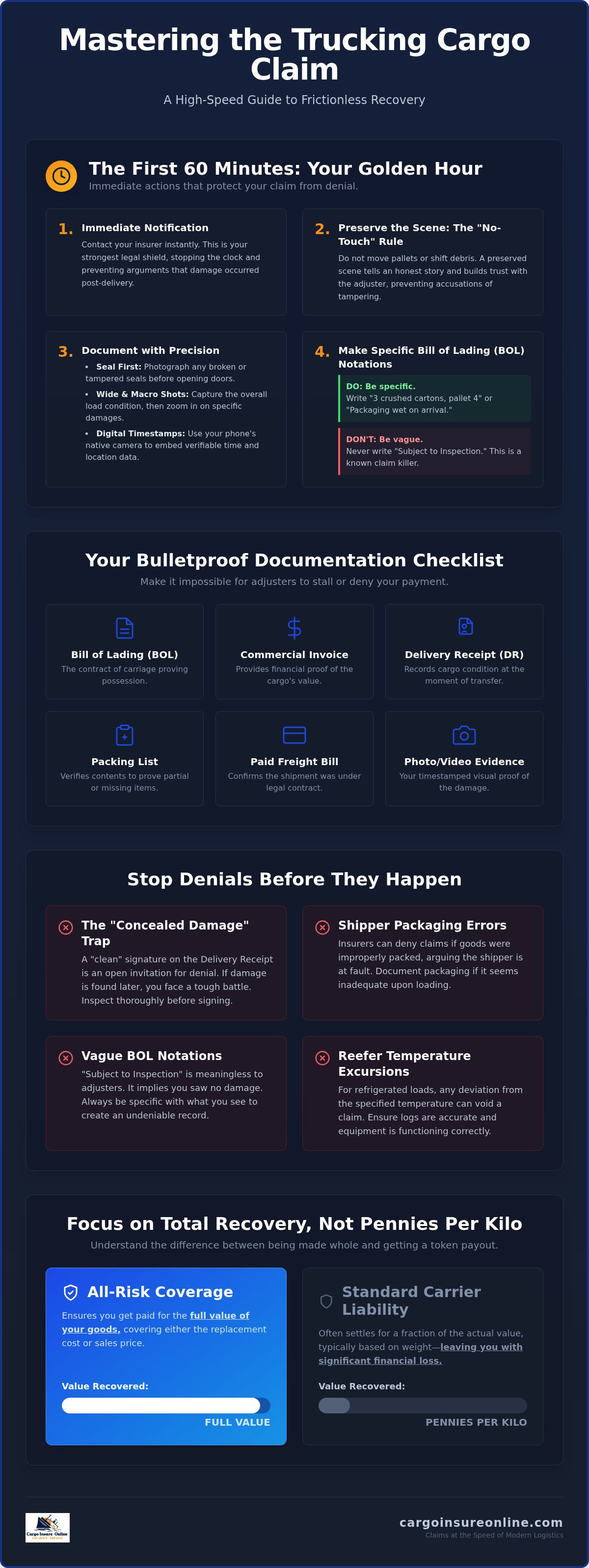
The moment your driver spots damage, the race begins. Forget the old-school "wait and see" approach. In the high-speed world of 2026 logistics, the first 60 minutes determine whether you get paid or get ignored. Immediate notification isn't just a courtesy; it's your strongest legal shield. It stops the clock and puts the insurer on notice. If you wait, you’re essentially inviting the adjuster to argue that the damage happened after delivery. Don't give them that opening. Speed equals transparency, especially when dealing with modern trucking cargo insurance.
Stick to the "No-Touch" Rule. It’s tempting to start digging through the trailer to see how bad the loss is. Stop. Preserving the scene is vital for a successful freight claim. Moving pallets or shifting debris can look like tampering to a skeptical adjuster. Let the scene tell the story exactly as it was found. This level of honesty builds trust and dramatically simplifies the process of how to file a trucking cargo insurance claim.
Documenting Damage Like a Pro
Photos are your digital witnesses. Start with the seal. A tampered or broken seal is a non-negotiable red flag that must be documented before the doors even swing wide. Once open, capture the narrative. Take wide shots to show the overall state of the load, then move in for macro shots of specific damage. Use your phone's native camera features to ensure every file has a digital timestamp. This metadata proves exactly when and where the evidence was captured. It leaves zero room for bureaucratic pushback or questions about the timeline.
The Crucial Bill of Lading Notation
Your pen is as important as your camera. When signing the Bill of Lading (BOL), specificity is everything. Never use the phrase "Subject to Inspection." It’s a total claim killer. Adjusters view it as a vague admission that you didn't actually see damage at the time of delivery. Instead, write down exactly what you see. If there are "3 crushed cartons of electronics" or "wet packaging on pallet 4," state it clearly. Ensure the driver signs next to your notation. This acknowledgment creates an undeniable record of the discrepancy. Mastering this notation is a critical part of knowing how to file a trucking cargo insurance claim without getting denied on a technicality.
The Essential Trucking Claims Documentation Checklist
Documentation isn't just a pile of paperwork; it's your evidence locker. Most adjusters look for a single missing document to stall a payment. Your goal is to make it impossible for them to say no. A complete file removes the friction from the process and ensures you meet the standards set by the federal Principles and Practices for the Investigation and Voluntary Disposition of Loss and Damage Claims. If you’re tired of the manual grind, modern trucking insurance can help automate these data points for you.
- Bill of Lading (BOL): This is the foundation of your claim. It acts as the contract of carriage and proves the carrier took possession of the freight in good condition.
- Commercial Invoice: This provides the financial proof of the cargo's value.
- Delivery Receipt (DR): This document records the condition of the goods at the moment of transfer. A "dirty" receipt with specific damage notes is your best friend.
- Packing List: This verifies exactly what was inside the shipment, helping to prove partial losses or missing items.
- Paid Freight Bill: This confirms the shipment was legally under contract and that all transport fees were settled.
Mastering how to file a trucking cargo insurance claim requires a bulletproof paper trail. Without these five documents, your claim is essentially dead on arrival. Legacy insurers love to hide behind missing forms; don't give them the chance.
Financial Proof: Invoices and Valuations
Insurance isn't a lottery; it’s about being made whole. Most policies pay based on either the replacement cost or the sales price. You need to know which one your policy covers before you file. You can often recover the freight charges for the damaged portion of the haul, but only if you’ve already paid that freight bill. The Commercial Invoice is the primary document for establishing cargo value. It bridges the gap between a physical loss and a financial recovery.
The Delivery Receipt (DR) Trap
A "clean" signature on a Delivery Receipt is a trap that many drivers fall into. If damage is found after the driver leaves, you’re dealing with "concealed damage." The 15-day rule is the standard industry window for reporting these hidden losses. Don't wait until day 14 to speak up. Digital PODs are quickly replacing paper, allowing for instant photo uploads and real-time notations. This digital-first approach eliminates the "he-said, she-said" arguments that plague traditional claims and speeds up the process of how to file a trucking cargo insurance claim.
Step-by-Step: From Filing to Settlement
Stop wasting time on hold. Legacy insurers love phone tag. It's a delay tactic. Modern digital-first providers use automated portals to bypass the bureaucracy. When you learn how to file a trucking cargo insurance claim in the modern era, you start with an instant upload. This triggers the workflow immediately. No fax machines. No waiting for a callback. Just raw speed and clear data. This digital initiation ensures your claim doesn't get lost in a pile of paper on someone's desk.
The adjuster is your point of contact for the investigation. They aren't just checking boxes; they are looking for proof of loss and evidence of liability. Help them by being organized. Provide the high-resolution evidence and clear notations we discussed in previous sections. The faster they see the facts, the faster you see the settlement. Transparency is your best tool for moving through the system without friction.
The Investigation Phase
Physical inspections aren't always necessary in 2026. High-resolution video and AI-driven damage assessment often suffice for smaller claims. However, for high-value electronics or complex reefer losses, an adjuster might visit the warehouse. Be prepared to give an official statement. Stick to the facts. Don't speculate. Once your claim is paid, your insurer starts subrogation. This is their process of chasing the party actually responsible for the damage to recover the payout. It’s a behind-the-scenes legal move that doesn't slow down your reimbursement.
Salvage and Loss Mitigation
You have a legal "Duty to Mitigate." You can't just leave damaged freight to rot. If you can save some of the cargo, you must do it. This might mean separating damaged boxes from pristine ones or moving temperature-sensitive goods to a functioning cold storage unit. "Salvage" refers to the residual value of damaged goods that the insured must attempt to minimize. If the damaged goods are sold on secondary markets, that salvage value is deducted from your total payout. It’s a standard calculation that ensures you're made whole without being overpaid.
The end of the road is the settlement offer. Review it against your commercial invoice and documentation. If the numbers match your loss, you’ll sign a release. This document closes the case and triggers the final payment. It’s the finish line of the process for how to file a trucking cargo insurance claim. Once the funds hit your account, the disruption to your operations is officially over.
Avoiding Common Denials in Trucking Claims
Denials aren't accidents. They're calculated. Legacy insurance carriers often look for any technicality to close a file without a payout. It’s a frustrating reality of the industry. You need to be smarter. Mastering how to file a trucking cargo insurance claim involves anticipating these obstacles before you even hit the "submit" button. We’re moving past the era of "sorry, it's not covered" and into an era of data-backed protection. Speed and precision are your best defenses against a rejected claim.
Adjusters love the "improper packaging" defense. If a shipper uses flimsy pallets or substandard cardboard, the insurer will claim the damage was a pre-existing risk. It shifts the blame from the carrier to the customer. You must document the state of the packaging at pickup to fight this. Another common trap is "inherent vice." This refers to damage caused by the cargo's own nature, like fruit ripening or metal rusting. You can't change the cargo's DNA, but you can provide the professional handling evidence that proves you weren't the cause of the decay.
Reefer and Temperature-Sensitive Claims
Temperature-sensitive freight is a high-stakes data war. A single degree shift can ruin a load of pharmaceuticals or fresh produce. Download the reefer log immediately. In 2026, digital data is the only evidence that matters. If the log shows consistent cooling, the insurer cannot blame the driver for the loss. Proving the trailer was pre-cooled is equally vital to your success. This is where specialized reefer cargo insurance becomes your greatest asset. It understands the nuances of the cold chain that generic policies simply miss. Don't let a "perishability" clause wipe out your recovery.
High-Value Tech and Electronics
High-value tech requires a completely different playbook. Theft is the primary concern here. If devices go missing, you need serial number tracking to prove exactly what was lost. Identity matters. Adjusters will also scrutinize your security protocols. Did the driver adhere to "no-stop" zones? Was the truck left unattended in a high-theft area? Proving compliance is the only way to secure a payout. Specialized electronics shipping insurance provides the specific framework needed for these high-risk loads. It replaces the "per-kilo" carrier liability trap with full-value protection.
Don't let a small technicality kill your financial recovery. If you're tired of fighting for every dollar, it’s time to switch to modern trucking insurance that values your time and your reputation. We build the digital guardrails so you can focus on the road. Now that you know how to file a trucking cargo insurance claim without the typical pitfalls, you’re ready to protect your bottom line with confidence.
Cargo Insure Online: Claims at the Speed of 2026
The old way of filing claims is dead. You don't have time for fax machines or hold music that sounds like it’s from the nineties. You need a partner that speaks the language of 2026 logistics. Cargo Insure Online (CIO) is that partner. We’ve rebuilt the entire process from the ground up to be digital-first. When you’re figuring out how to file a trucking cargo insurance claim, you shouldn't have to navigate a maze of bureaucracy. You should just hit "upload." It’s that simple.
Our platform removes the friction. We provide specialized protection for high-value electronics, drones, and reefer cargo. We handle claims across air, sea, and land seamlessly. This isn't just about insurance; it’s about keeping your fleet moving. For our enterprise partners, we offer white-label solutions. This empowers you to manage your own claims engine with our sophisticated tech behind the scenes. It's about empowerment, transparency, and results. We don't just cover risk; we eliminate the administrative burden that comes with it.
Why All-Risk Beats Carrier Liability
Standard carrier liability is a "Per-Kilo" trap. If you lose a pallet of high-end electronics, a basic carrier policy might pay you pennies on the dollar based on weight. That’s not recovery; that’s a financial disaster. CIO’s trucking cargo insurance offers all-risk coverage. This means you get paid the actual value of your goods. You don't have to prove the driver was at fault. Even if the incident was a total accident with zero negligence, you’re covered. This speeds up your cash flow cycle and provides immediate peace of mind. You’re moving from "maybe I’ll get paid" to "I know I’m protected."
The Future of Freight Protection
The future isn't a standalone policy; it’s embedded insurance. CIO integrates directly into your existing logistics tech. This means your coverage and your claims live where you do. You get automated updates in real-time. No more wondering where your check is. You can track your claim status just like you track a package. It’s transparent. It’s fast. It’s what 2026 looks like. Learning how to file a trucking cargo insurance claim becomes a simple, automated experience instead of a three-week headache. Stop settling for slow. Stop worrying about denials. You’ve mastered the steps, now get the tech that makes them effortless. Ready to switch? Get an instant quote today and see how fast your recovery can be.
Take Control of Your Claims Pipeline
Cargo claims don't have to be a source of anxiety or lost revenue. By acting within the first hour and mastering your documentation checklist, you turn a potential disaster into a manageable process. You've learned exactly how to file a trucking cargo insurance claim using digital evidence and precision. You now know how to sidestep the technical traps that legacy insurers use to stall your payout. It’s time to move your entire operation into the future.
Stop settling for "per-kilo" liability and slow adjusters. You deserve a 2026-ready digital claims portal that understands specialized reefer and electronics protection. Whether you’re moving freight across air, sea, or road, our global coverage ensures you stay in motion. We've removed the friction so you can focus on growth instead of paperwork. The old way of insurance is over. The high-speed way is here.
Stop waiting for adjusters—get high-speed trucking cargo insurance from Cargo Insure Online today.
The road is waiting. Let's get you back on it with total confidence and zero-friction recovery.
Frequently Asked Questions
How long do I have to file a trucking cargo insurance claim?
You typically have up to nine months from the delivery date to file a formal claim under federal law. However, your specific insurance policy likely requires prompt notification. Waiting too long creates friction and gives adjusters an excuse to doubt your timeline. If you want to know how to file a trucking cargo insurance claim successfully, start by notifying your provider the same day you discover damage. Speed is your greatest asset.
Can I file a claim if the damage was found after delivery?
Yes, this is known as a concealed damage claim. You generally have a 15 day window to report damage that was not visible when the driver was present. The burden of proof is much higher here. You must prove the damage happened during transit rather than in your warehouse. Use high resolution photos and digital timestamps to verify your findings. Don't wait until the last minute; report it immediately to keep the process moving.
What is the difference between carrier liability and cargo insurance?
Carrier liability is a legal obligation often capped at a specific per kilo rate. It leaves you with pennies for high value losses. Cargo insurance, specifically all risk coverage, pays the actual value of the goods regardless of carrier fault. It is the difference between settling for a fraction of your loss and getting full reimbursement. Choose all risk insurance to bypass the battle of proving negligence typical of standard liability claims.
Does cargo insurance cover theft of the entire trailer?
Most comprehensive cargo policies cover the theft of an entire trailer or container. However, exclusions apply if the truck was left unattended in a high risk area or if security protocols were ignored. Check your specific policy for attended vehicle clauses. For high value electronics or drones, ensure your coverage specifically addresses hijacking. Digital tracking data from the tractor can help prove you followed all safety requirements during the incident.
What happens if my cargo insurance claim is denied?
If your claim is denied, you have the right to a written explanation and an appeal. Review the denial letter for specific policy exclusions or technicalities like improper packaging. You can often overturn a denial by providing new evidence, such as reefer logs or clearer scene photos. Knowing how to file a trucking cargo insurance claim correctly the first time reduces this risk. If the denial stands, consult a specialized claims advocate.
How much does cargo insurance pay out for damaged electronics?
Payouts for electronics are based on the valuation clause in your policy, which is usually the replacement cost or the invoice sales price. Unlike carrier liability, which pays by weight, all risk insurance focuses on the financial value of the tech. If a shipment of high end mobile phones is crushed, you get reimbursed for the actual loss. Always verify if your policy includes new for old replacement to ensure you are not stuck with depreciated values.
Is the driver responsible for paying the cargo insurance deductible?
The deductible is typically the responsibility of the motor carrier or the policyholder, not the individual driver. However, some owner operator contracts may shift this cost depending on their specific agreement. In the digital first world of 2026, deductibles are often settled directly through the claims portal during the final payout. It is a corporate expense designed to share risk. Always check your internal company policy or lease agreement to see how these costs are allocated.
What is a "clean" Bill of Lading and why does it matter for claims?
A clean Bill of Lading is a document signed by the receiver without any notations of damage or loss. It signals to the insurer that the goods arrived in perfect condition. This makes filing a claim later much harder because you have already signed away your immediate proof. Always inspect the load before signing. If you see a crushed box, note it on the BOL to turn that clean receipt into a dirty one for your protection.


